The Castor Bean Plant: Common, Valuable and Deadly

Cold War Biological Warfare

Georgi Ivanov Markov climbed the stairs on the south side of the Waterloo Bridge in London for the last time on September 7, 1978. He worked across the River Thames at the BBC and routinely parked his car to catch the bus over the bridge.
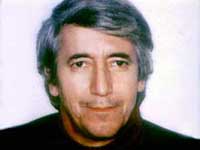
Georgi Ivanov Markov (c)PBS

As Markov approached the huddle of people at the bus stop, a bolt of pain seared through the back of his right thigh stopping him in his tracks. He turned to see a man facing away from him and retrieving an umbrella from the ground. The stranger muttered a brief apology and then hailed a cab and was gone and despite the pain in his leg, Markov continued on with his day. Later at work he saw a red spot on his pants and he showed one fellow employee a bloody, swollen bump on his leg.

That evening Markov came down with a fever. The following day he was having trouble speaking and was admitted to the hospital, but his condition deteriorated. Over the course of the next four days his blood pressure plummeted, he vomited blood and his kidneys stopped working. Then his heart gave out and he died.
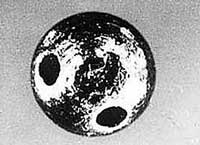
The projectile that held the ricin poison that killed Markov. It is about the size of the head of a pin. (c) PBS

“A totally independent journalist, Markov was Bulgaria’s most revered dissident and Bulgarian communism’s arch enemy,” writes Shayne Gad in Handbook of Pharmaceutical Biotechnology.

As a broadcast journalist for the BBC Markov covered the Communist bloc. He also contributed to Radio Free Europe where he delivered devastating broadsides against totalitarian collectivism.

In 1977, Bulgaria’s Communist dictator, Todor Zhivkov, sought to silence Markov for good and requested help from an all too willing Russian KGB. After two unsuccessful attempts on Markov’s life, KGB agents fabricated an American bought umbrella so that it fired a poison laden bullet. The projectile was a tiny watch bearing. It had two cavities bored out of it using a laser and the holes were then filled with poison. The agent of choice was ricin, an exceptionally lethal phytotoxin made from castor beans.

Common, Valuable and Deadly

Castor bean plants (Ricinus communis) are native to southeast Asia, but grow as a weed all over Santa Barbara County and the warmer regions of the United States in general. As its binomial or scientific name reflects it is a common plant. They are typically found in open spaces and empty lots near roads and along railroad tracks, drainage ditches and creeks and areas where the soil has been disturbed, such as newly cut roads and recent places of construction.
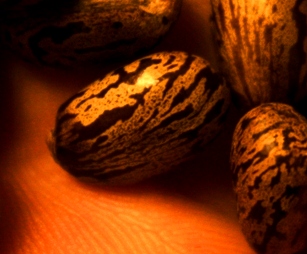
Castor beans.

The seeds of the Ricinus communis plant are the source of castor oil, which is produced by pressing the brown and black mottled beans. Castor oil  is a valuable global commodity with seemingly endless uses from medicine to fuel to food flavoring and much more. It has improved the lives of untold millions in one way or another. About one million tons of castor beans are grown per year as a cash crop.

Ricin is also produced from castor beans and is one of the deadliest natural poisons on earth and has no known antidote. The poison is manufactured using the mash leftover after castor beans are pressed to produce oil. Whether inhaled, injected or consumed the deadly agent works by penetrating the body’s cells and inhibiting their protein production which kills them. The U.S. military experimented with ricin poison during the 1940s as a possible biological weapon and today it continues to be a concern in the age of international terrorism. (BBC News January 8, 2003-Seventh Arrest in Ricin Case )

Trivia

Ancient peoples used castor beans for their rich oil content, and the seeds have been found in six thousand year old Egyptian tombs.

The castor bean plant, Ricinus communis, was named after the Mediterranean sheep tick, Ixodes ricinus, because the plant’s seeds resemble an engorged tick.

Castor oil was the preferred lubricant for rotary engined warplanes of WWI and today is used in jet, diesel and race car engines.

The specialty lubricant company Castrol took its name from the castor bean plant. Castor oil is the primary ingredient in Castrol-R motor oil designed for high performance racing engines.

Mussolini’s Blackshirts used castor oil as a weapon of terror by force feeding it to dissidents and regime opponents, which caused severe explosive diarrhea. A large enough serving and victims could literally shit themselves to death. Castor oil is still used today as a laxative.

The USDA rates ricin poison as being seven times more lethal than cobra venom. Put a different way, two millionths of an ounce, about what a grain of salt weighs, is enough to kill a 160 pound person. Eating as few as four seeds can be deadly.

Castor oil is used to make biodiesel.

Ricinoleic acid, which is derived from castor oil, is used to make synthetic flavors such as apricot, peach, plum, banana, and lemon.

Dehydrated castor oil is commonly used in many paints and varnishes.

Three tons of castor oil can be made into one ton of nylon.

Castor oil is used in cosmetics, emollients and shampoo.

A number of brand name medications are made with castor oil such as Tylenol Extra Strength caplets. And numerous other specialty drugs are produced using castor oil or its derivatives with such applications as anti-fungal treatment, cancer chemotherapy, immunosuppressant medication for organ transplants, and HIV medicine. In lab experiments ricin has been used to kill cancer cells.

.

Bibliography:

R. C. S. Trahair, Encyclopedia of Cold War Espionage, Spies, and Secret Operations (Enigma Books, April 1, 2009), 182-3.

Shayne C. Gad, Handbook of Pharmaceutical Biotechnology (Wiley-Interscience; 1 edition, June 11, 2007), 1582.

PBS Website: Secrets of the Dead, Case File: Umbrella Assassin

BBC News January 8, 2003: http://news.bbc.co.uk/2/hi/uk_news/2637515.stm

Wayne’s World Online Textbook of Natural History

Wikipedia for various uses of castor oil.

USDA, USDA

Posted in History | Tagged , , , , , , , , , , | 4 Comments

Figueroa Mountain Picnic and Wildflower Update

The Swiss Family Griswold ventured up to Figueroa Mountain  for a Sunday picnic. It’s my first time up the mountain this spring wildflower season. I didn’t expect that there would be much color showing this early, but there was a little.

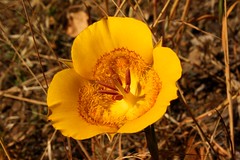
The usual spots had a few flowers, but not much. Grass Mountain had a hint of orange on its steep slope, and the junction of Catway Road and Figueroa Mountain Road had a fair amount. But it was relatively sparse and some of the other bloom areas had next to nothing. The orange wallflowers right now, however, were pretty much in full bloom along the road up the mountain, as seen here last year.

A number of scrub oaks had sprouted three to four inches of fresh new growth in the preceding weeks, but it was crispy and dead from the cold snap back in March. Which no doubt slowed the growth of the wildflowers and set back the bloom cycle a bit too. We need some clear skied warm weather to really get the flowers popping. Somebody was having fun on a glider ride soaring back and forth overhead.

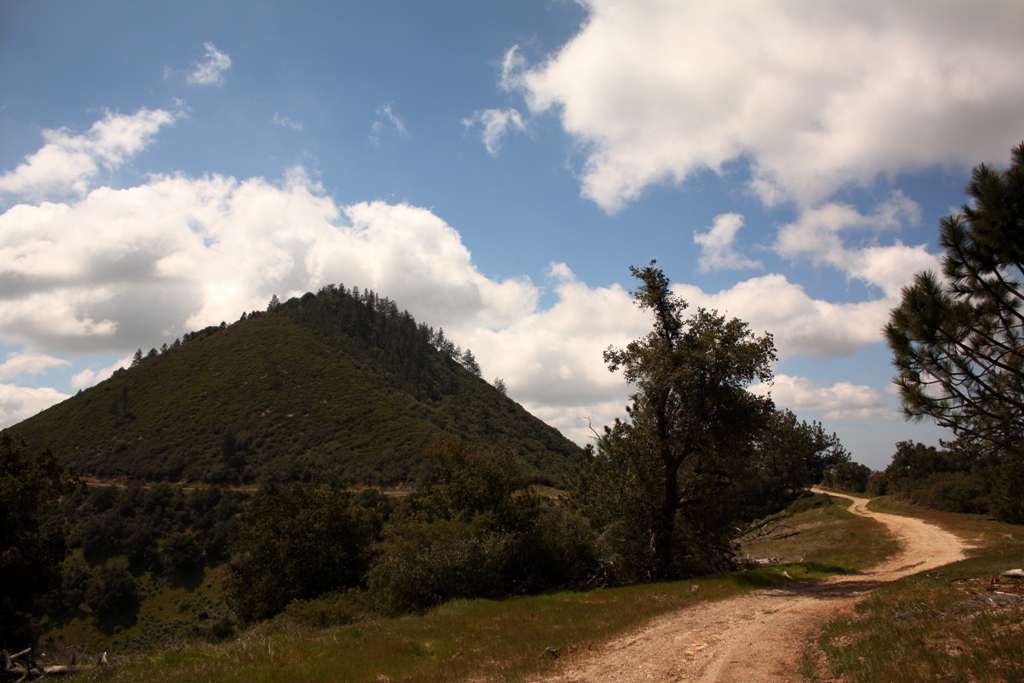
A faint tinge of orange on Grass Mountain.

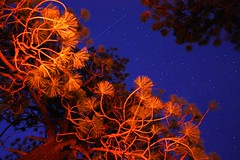
Were a bit camera shy, but this is where we set up shop, on a ridgeline beneath a pine tree.

Related Posts:

Figueroa Mountain Wildflowers March 2010

Figueroa Mountain Wildflowers April 2009

Posted in Santa Barbara | Tagged | Leave a comment

Mountaintop Vernal Pool

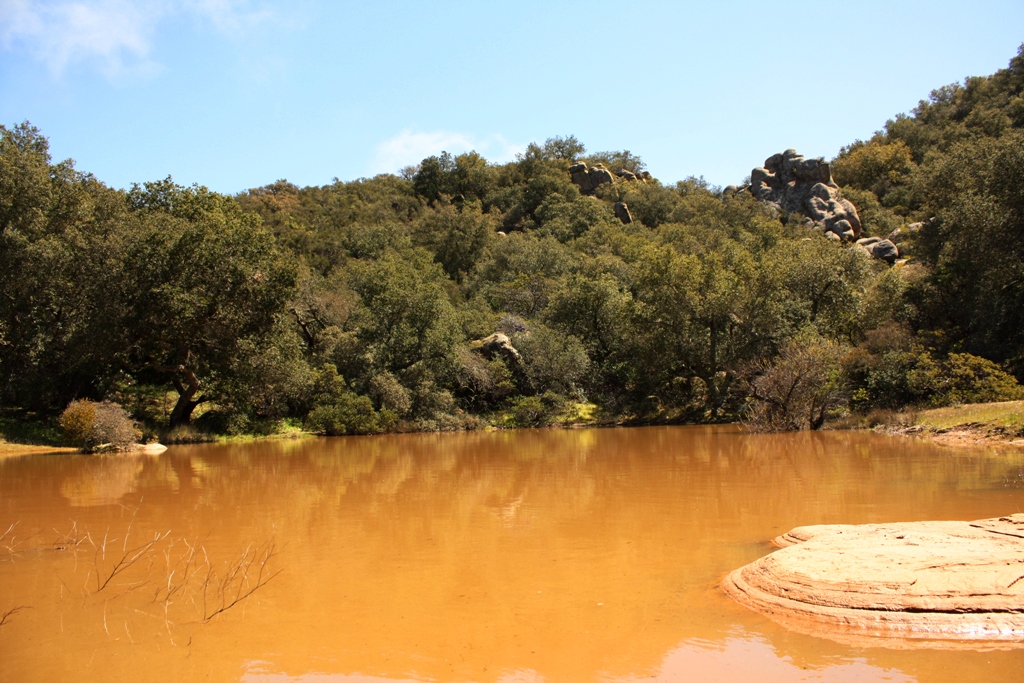
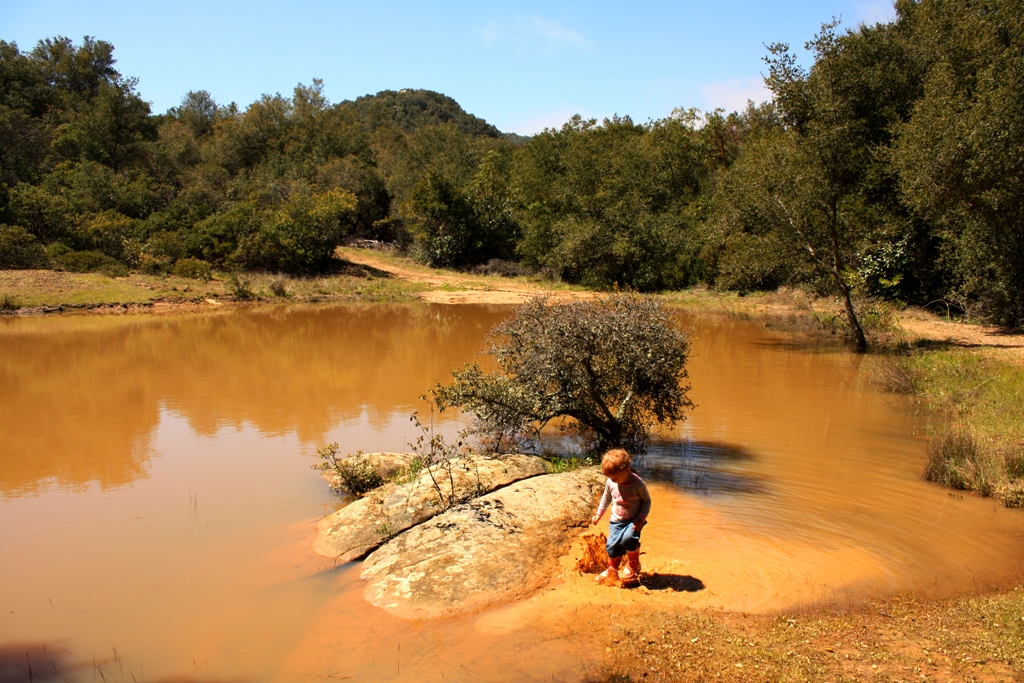
Little Ms. E. and I went for a walk up to a vernal pool atop the Santa Ynez Mountains. I wanted to see how it looked after the area received over 45 inches of rain this season. Not surprisingly, it was still a giant mud puddle so soon after the last rainfall.

A snow capped peak barely visible rising above the foggy clouds in the background on the right.

What better than a pair of boots and the county's largest mud puddle to stomp in?

Posted in Santa Barbara | Tagged , , | 3 Comments

Largest West Coast Tsunamis Generated in Santa Barbara Channel

“The two largest tsunamis known to have been generated on the western coast of the United States formed in the Santa Barbara Channel region. The earthquake of 1812 near Santa Barbara caused waves that reportedly flooded the lower part of town, and the 1927 shock off Point Arguello caused waves at least six feet high.”

U.S. Geological Survey professional paper (1969)

Although relatively minimal in their height and inland reach, and wholly incomparable to the Japanese tsunami, the California earthquakes of 1812 and 1927 near Santa Barbara generated record-sized tidal waves in the region. Both temblors are estimated to have been 7.1 in magnitude.

According to one publication, the oceanic surge resulting from the 1812 earthquake may have reached “15 feet at Gaviota, 30-35 feet at Santa Barbara, and 15 feet or more at Ventura.” Yet, while contemporary accounts make it clear that earthquakes did occur and that there was purportedly some change in the ocean, conflicting statements and a lack of corroborating evidence make it impossible to confirm whether or not a tsunami occurred, and if it did what its actual size or height may have been.

“The sea was observed to recede from the shore during the continuance of the shocks, and left the harbor dry for a considerable distance, when it returned in five or six heavy rollers, which overflowed the plain on which Santa Barbara is built. The inhabitants saw the recession of the sea, and being aware of the danger on its return, fled to the adjoining hills near the town to escape the probable deluge.  . . .The sea, on its return flowed inland little more than half a mile, and reached the lower part of town, doing but a trifling damage, destroying three small adobe buildings.”

Dr. John Boardman Trask, appointed president of the California Academy of Sciences in 1864, recounting the tsunami of 1812 based on the testimony of local residents.

“In 1812 the great earthquake occurred on the California coast and at that time every [Indian] soul left the island of Santa Rosa. The waters receded from the island several hundred yards. This so alarmed the Indians that, fearful that the island was about to be engulfed, they departed and were settled in bands of three or four hundred at the several missions. The above is the story told by the Indian.”

Ethnographer H. W. Henshaw in 1884 relating the story told to him by Anisetto Pajilacheet, one of the last remaining Chumash.

The tsunami generated by the temblor of November 4, 1927 was apparently of little consequence if it was noticed at all by coastal residents, because the reportage in the local papers had nothing to say about it at the time:

“‘QUAKE IS FELT ON STEAMSHIP

SAN PEDRO, Nov. 4.— The steamer Floridan, of the American-Hawaiian line, today reported to the federal radio here that it experienced four distinct earth shocks shortly after 11 a. m. off Point Arguello. The message said the sea appeared to ‘shimmy.'”

Ventura County Star November 4, 1927

“Long-Dry Artesian Wells in Lompoc Canyon Flow Anew

Shimmying earth in the Lompoc region yesterday brought joy to ranchers in and near Lompoc canyon where artesian wells, dry for many years, broke forth from the ground and started a flow that increased throughout the day.

The water will be used for the irrigation of a number of acres in and about the mouth of the canyon.

So copious was the flow from several of the wells that the grounds of the Lompoc canyon school were flooded and school was suspended for the day while workmen built canals to divert the water.

The Santa Ynez river also rose in its banks, probably being supplied from freshly gushing springs in the vicinity.”

Santa Barbara Morning Press, Saturday, November 5, 1927

The official wave heights, as recorded in a U.S. Geological Survey Professional Paper (1993) (PDF):

A tsunami was recorded on tide gages at San Francisco, La Jolla, San Diego, and Fort Point, and waves were observed at Pismo, Port San Luis (1.5 m), and Surf (1.8 m). Many aftershocks occurred.


Bibliography:

Geology, Petroleum Development, and Seismicity of the Santa Barbara Channel Region, California  [U.S. Geological Survey professional paper 1969], 64.

Many more accounts of the earthquake and tsunami of December 1812 have been compiled by Dr. George Pararas-Carayannis, as part of a 1967 study conducted at the behest of government regulators in connection with the San Onofre nuclear power plant. An excerpt of the study can be found at the following link: The Santa Barbara, California, Earthquakes and Tsunami(s) of December 1812.

UCSB Santa Barbara Earthquake History Page:

http://projects.crustal.ucsb.edu/sb_eqs/1812/chumash.html

http://projects.crustal.ucsb.edu/sb_eqs/1812/tsunami.html

Posted in History | Tagged , , | 4 Comments

Backyard Sunset Silhouette

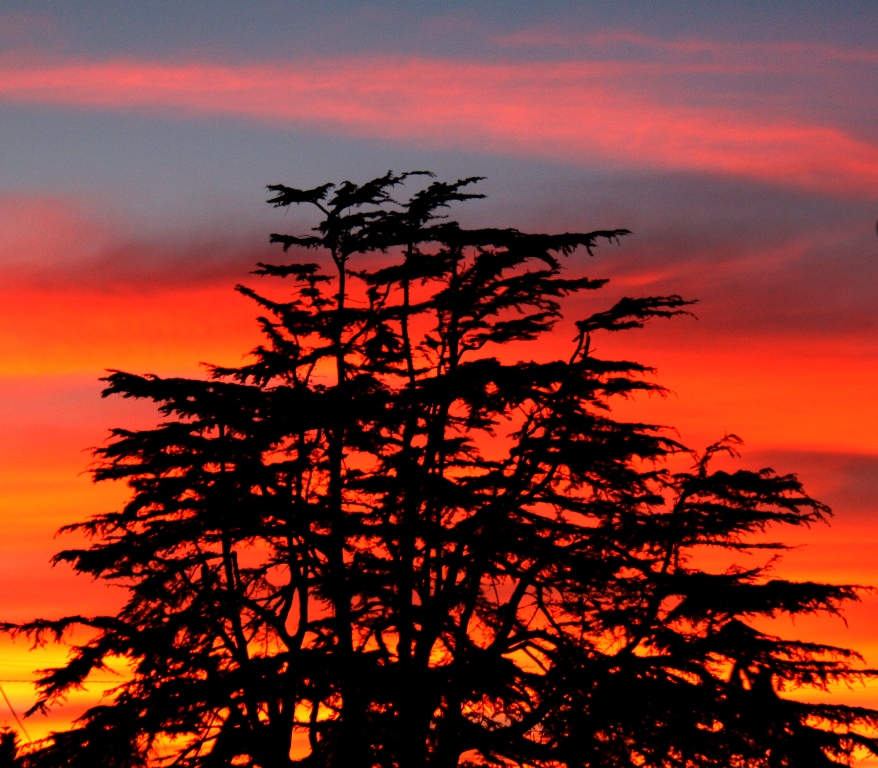
I once lived a few years in a landlocked town where there were no sunsets. The sun would set and the light fade to black, but no color would ever show. Growing up in Santa Barbara where technicolor sunsets seemed nearly as common as the sun itself, I remember how strikingly noticeable their absence was to me at the time. It was one of the many natural splendors found in this corner of California that I had always taken for granted.

March 30

Related Posts:

Palm Trees at Dusk

Matilija Creek Headwaters Foggy Sunset

Refugio Beach Sunset and Moonrise

Rincon Point Sunset

Posted in Santa Barbara | Tagged , , | Leave a comment