
A view of the East Walker River this morning on the edge of the Eastern Sierra in California.

A view of the East Walker River this morning on the edge of the Eastern Sierra in California.
 Holly-leaved cherries (Prunus ilicifolia), seen here in the process of ripening, are a wild grown food that can be foraged in the local mountains.
“Prunus ilicifolia is the most common wild cherry in coastal California south of San Francisco Bay, and it was used as food by every group in whose territory it occurs.”
—Jan Timbrook Chumash Ethnobotany: Plant Knowledge Among the Chumash People of Southern California
Holly-leaved cherries, called ‘akhtayukhash in Barbareno Chumash, are fruiting right now. The fruit, which grows as a thin layer of flesh covering a hard marbled-sized seed pod, is edible right off the plant. The pulp is not much thicker than the skin and offers little more than a taste, but it is juicy and sweet tasting.
Though the pulp is edible, the kernel within the fruit pit was the most valued part of the plant for the Chumash Indians. The seed pods were cracked and the kernels collected, which could then when dried be stored for as long as necessary until they were needed.
The kernels, however, contain hydrocyanic acid and are poisonous. Before eating them they must be properly prepared to remove the poison, as well as their bitter taste. The preparation process involves leaching the poison from the kernels using fresh water.
After the kernels were leached of poison, they were cooked for several hours by boiling until they became soft, then mashed, rolled into balls and coated in pinole flour made from juniper or grass seeds. “The Chumash consultants,” Timbrook notes, “all agreed that it was a good-tasting and prized food.” The small cakes were eaten with roasted meat and were also a featured food in ceremonial events.
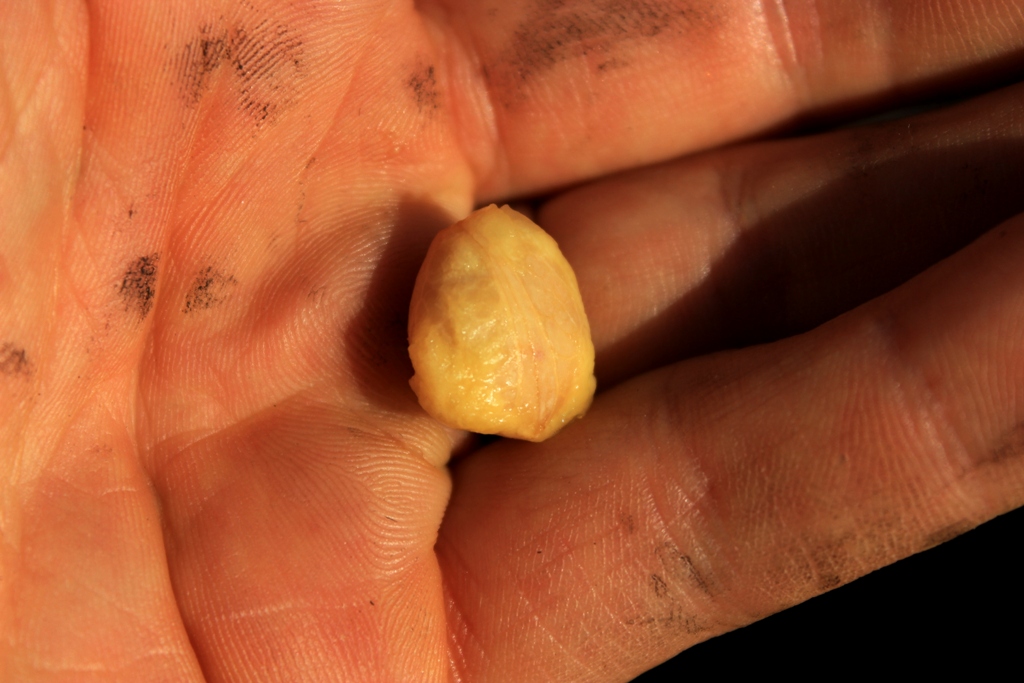 A cherry pit without the skin showing some of the yellow fruit pulp still clinging to the seed pod.
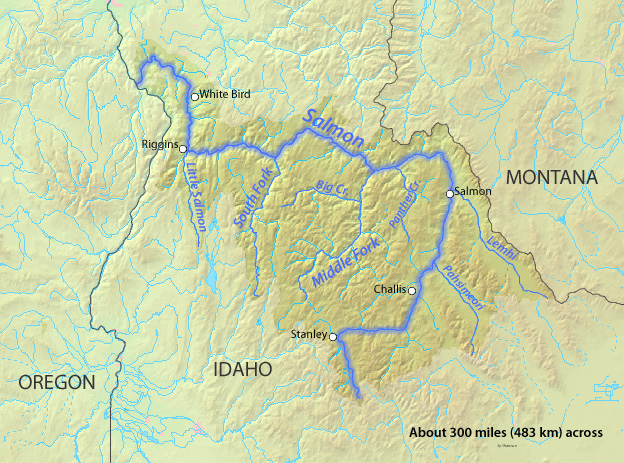
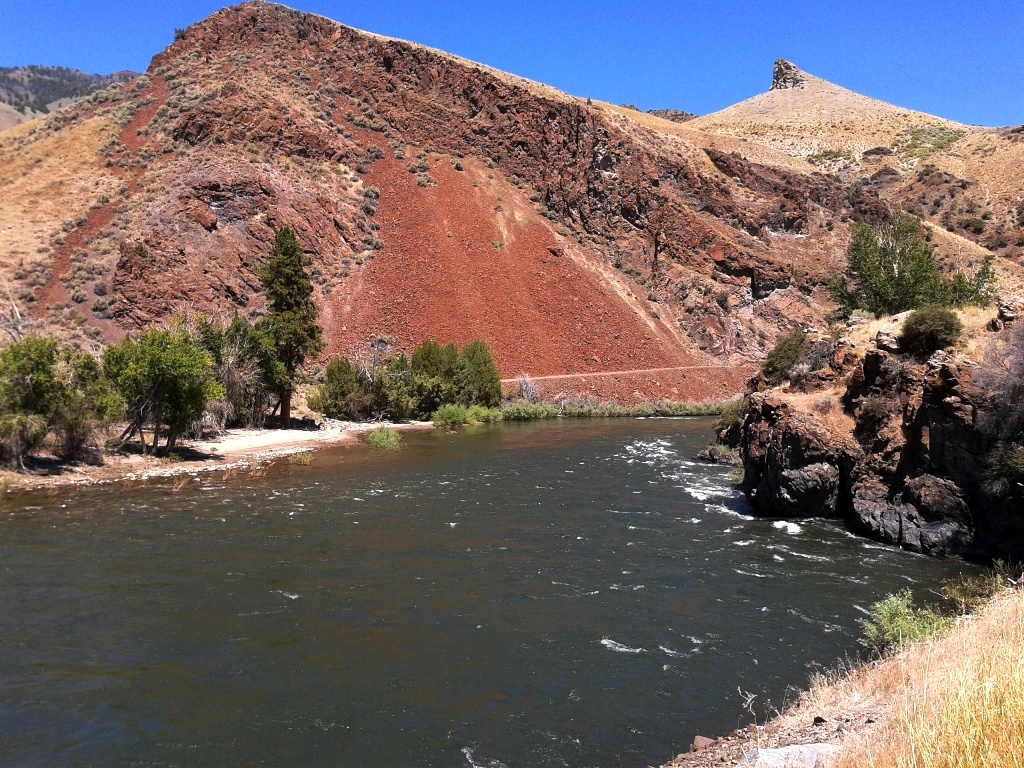 The Salmon River, which is the second largest tributary of the Snake River, is also known as The River of No Return. ©Clint Elliott
Map
“The Salmon River Canyon is one of the deepest gorges in North America, deeper even than the famous Grand Canyon of the Colorado in Arizona. But in contrast to the Grand Canyon, the Salmon River Canyon is not noted for sheer walls and towering heights, but instead for the variety of landscapes visible from the river; wooded ridges rising to the sky, huge eroded monuments and bluffs and slides, picturesque castles and towers, and solitary crags. The United States Congress designated the Frank Church-River of No Return Wilderness in 1980 and it now encompasses a total of 2,366,757 acres.
The name of this Wilderness has two roots. The Main Salmon River was called “The River of No Return” back in the early days when boats could navigate down the river, but could not get back up through the fast water and numerous rapids. The romantic name lives on today even though jet boats can navigate upstream. Second, the name Frank Church that was attached to this Wilderness in 1984, after it’s designation, is a memorial to honor a man who did so much to help preserve this wild central core of Idaho.”
—United States Forest Service
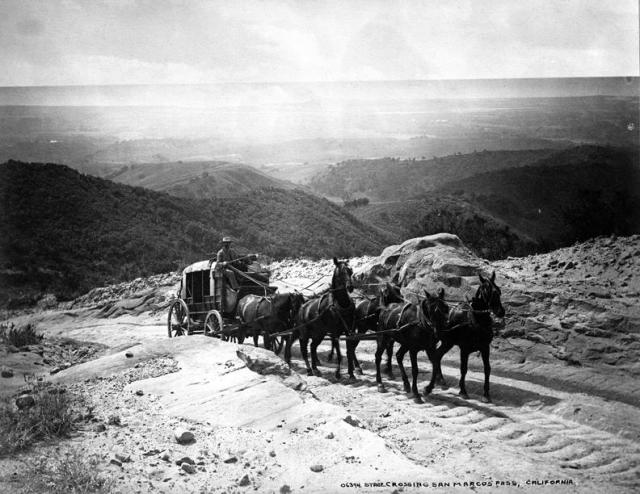 Crossing Slippery Rock in the mountains above the Goleta Valley, along the original San Marcos Pass route over the Santa Ynez Mountains. The Pacific Ocean defines the horizon in the background. © Denver Public Library, Western History Collection
“Santa Barbara lies on the seashore, and until lately it was isolated from the rest of the world by high mountains. No wagon road or stage route ran into it from without, only mere trails or paths for horses over the mountains. For a few years they had had a mail once in two weeks by steamer from San Francisco—two mails per month was the only news of the world outside.”
—William Brewer (1861)
“A ride on a frontier stage-coach was something to be remembered as a back-breaking, bone-twisting experience. ‘I felt like a mess of eggs being scrambled,’ one traveler described the trip. ‘I was bounced and tossed all over and despite our discomfort the driver never paid us any heed.’”
—James D. Horan & Paul Sann, Pictorial History of the Wild West (1954)

From 1861 to 1901 Santa Barbara was linked to the rest of California and the world by stagecoach. Evidence of the historic route leading upstate over the Santa Ynez Mountains can still be seen in a few locations. Along a thin, sandstone capped ridgeline in the mountains above Goleta, a section of the old road crosses an expanse of exposed bedrock. Tracks left behind by stagecoaches and horse drawn wagons and carriages remain worn into the sandstone some ten- to twelve-inches deep or more. The parallel grooves are remnants of the original San Marcos Pass route that was built by Chinese work crews using picks, shovels and wheelbarrows.
The ruts had originally been carved to a depth of about three inches in order to help guide horse drawn conveyances up the technical section of primitive roadway. Over the years the iron-capped wheels of stagecoaches ground the ruts ever deeper into the soft deposit of stone. Running between the ruts, horizontal grooves were chiseled to help horses maintain traction on the slippery surface as they hauled the heavy stages up the mountain. The exposed bedrock was notoriously slick beneath metal horseshoes and stagecoach wheels and was dubbed “Slippery Rock” or “Slippery Sal.”
The Slippery Rock route was closed sometime around 1892 after the owner of the property the road ran through, Tom Lillard, got tired of drivers leaving his gate open and cows straying. A new route was graded up a ridge to the east of Slippery Rock or what is today known as Old San Marcos Pass.
 Looking up Slippery Rock showing the two wheel tracks and the traction ruts carved horizontally across the wheel grooves.
 Looking down Slippery Rock. Two different sets of wheel ruts are visible here, along with the horizontal traction grooves for horses. Once the first set of wheel ruts became worn too deeply a new set was carved.
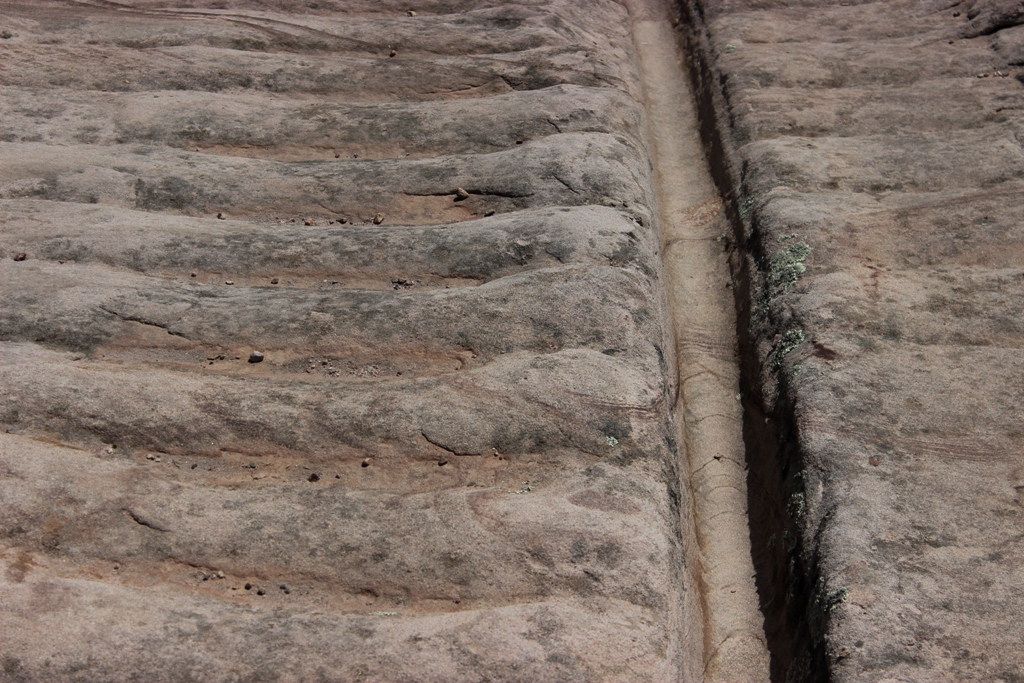 A closeup view of the ruts and grooves.

 The narrow section of Slippery Rock, which is shown below in a photo from 2012 with live oak trees having grown in the middle of the old road. © Denver Public Library, Western History Collection

 Looking up the old road above Slippery Rock.
 A narrow section of the road barely wide enough for a stagecoach to slip by pinched between a cliff on the left and and wall of stone on the right.


 State of the art suspension: rawhide straps.
 Both of these historic stagecoaches can be seen at the Santa Barbara Carriage and Western Art Museum. The yellow carriage was actually one of the last mudwagon stages in use over San Marcos Pass.
Reference:
-Charles Outland, Stagecoaching on El Camino Real: Los Angeles to San Francisco 1861-1901 (1973)
-Walker A. Tompkins, Stagecoach Days in Santa Barbara (1982)
Related Posts:
Through From Santa Barbara to San Francisco in 48 Hours (1873)
The Klutzy Career of Highwayman Dick Fellows (Stagecoach Robbery circa 1870s)
 Last week I spent twelve hours hiking around an area of the woods that I was not familiar with and stumbled across a Chumash pictograph site that I did not know existed, and which I had never seen photos of.
I had been hiking over rugged terrain when I walked up on a sandstone outcrop that stood like a wall against a steep hillside. I stopped in my tracks staring at the rock overhang. Well, well, well, looky what we have here, I thought. It was an X marks the spot moment. Due to its form, prominence and location it was a feature of the landscape well worth taking a closer look at. There is something about rocky outcrops that never cease to attract my attention and lure me in. And this one at first glance felt like a site long visited by humans.
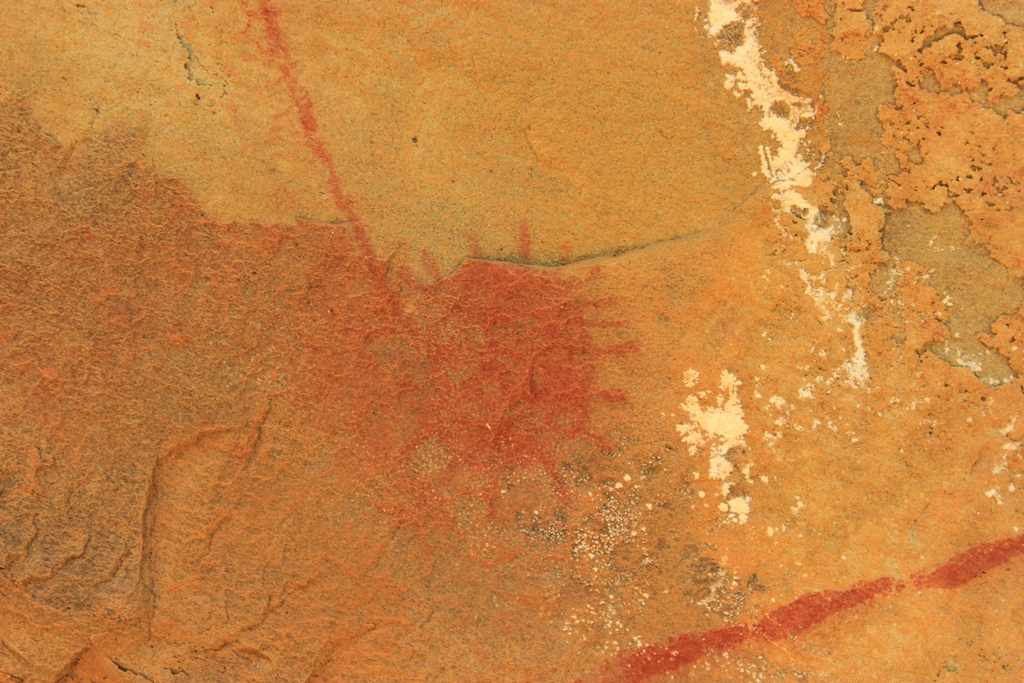
I pulled apart stringy, elongated branches of poison oak and carefully approached the outcrop, scanning its entirety and taking in the whole scene. As I stepped closer my frame of focus tightened and an inch wide ruddle-hued stain on the surface of the sandstone seized my eye; the quintessential telltale trace of prehistoric rock art. Aha! I glanced leftward and saw a panel of highly eroded pictographs about one square foot in size. Inspecting further, a few minutes later, I found several other faded paintings.
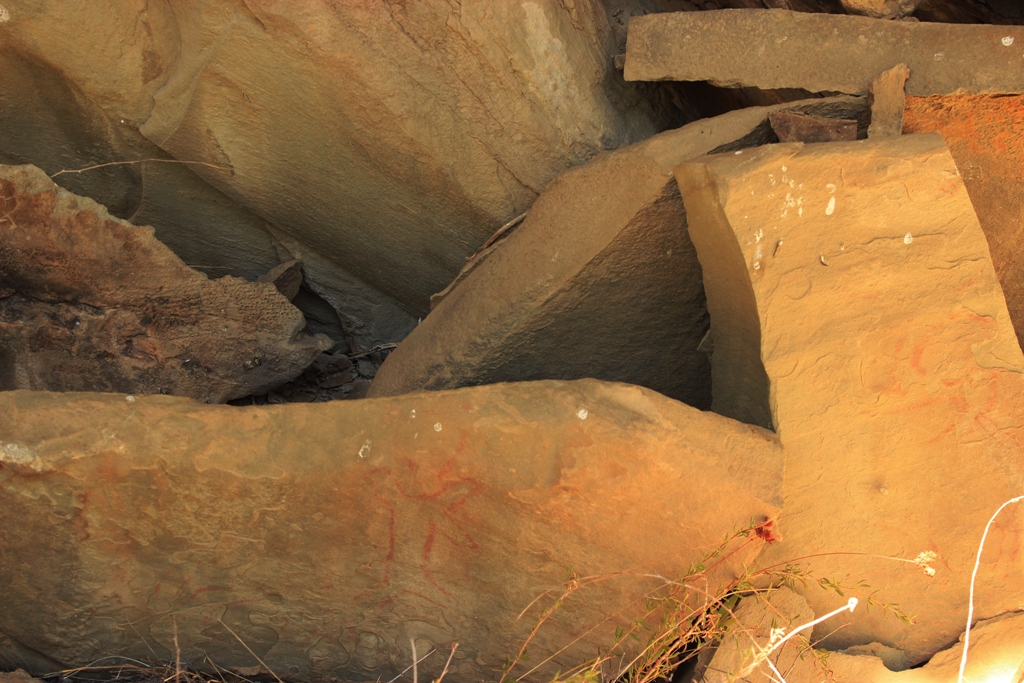
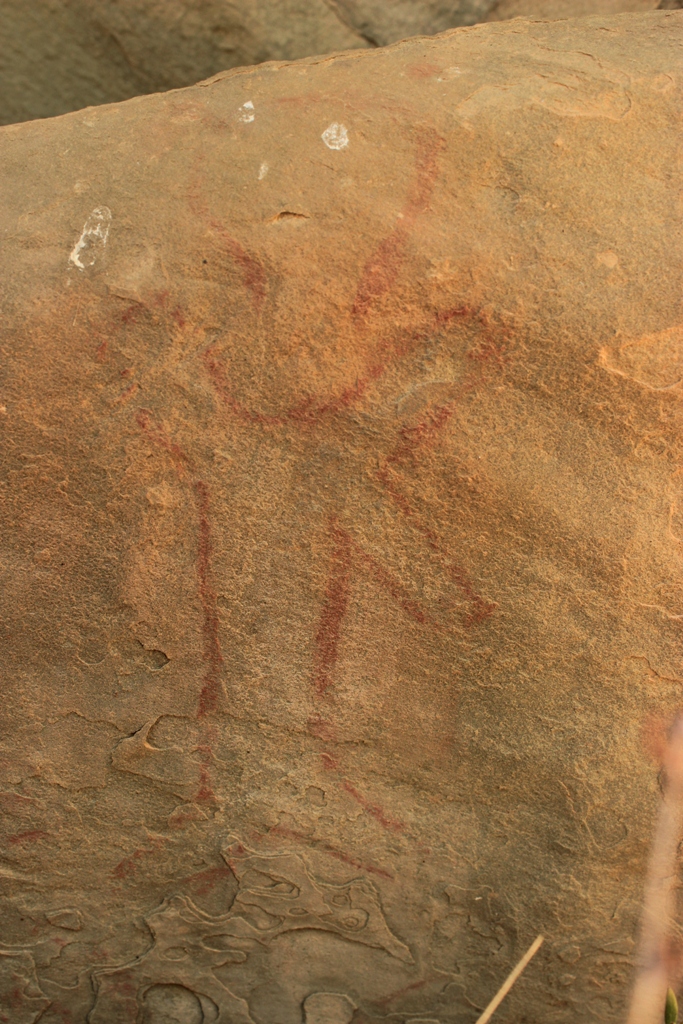
The sandstone is extremely flaky and constantly sloughing off, the lithic equivalent to a human face enduring the deep exfoliation of a chemical peel. Slabs of rock have fallen to the ground through the years and piled up and are in the process of being buried under sand and soil and grown over by annual grasses. Along the foot of the outcrop a massive chunk of stone that slid off the cliff face at some point is stuck into the ground on its edge. The semi-buried slab has several paintings on it and the soil level reaches right up to the bottom of the art. Perhaps other pictographs are buried. Beside it another slab of painted stone has fallen free and sits amidst a jumble of rock shards. It’s impossible to tell, however, whether the slabs were painted prior to having slid off of the outcrop or after.



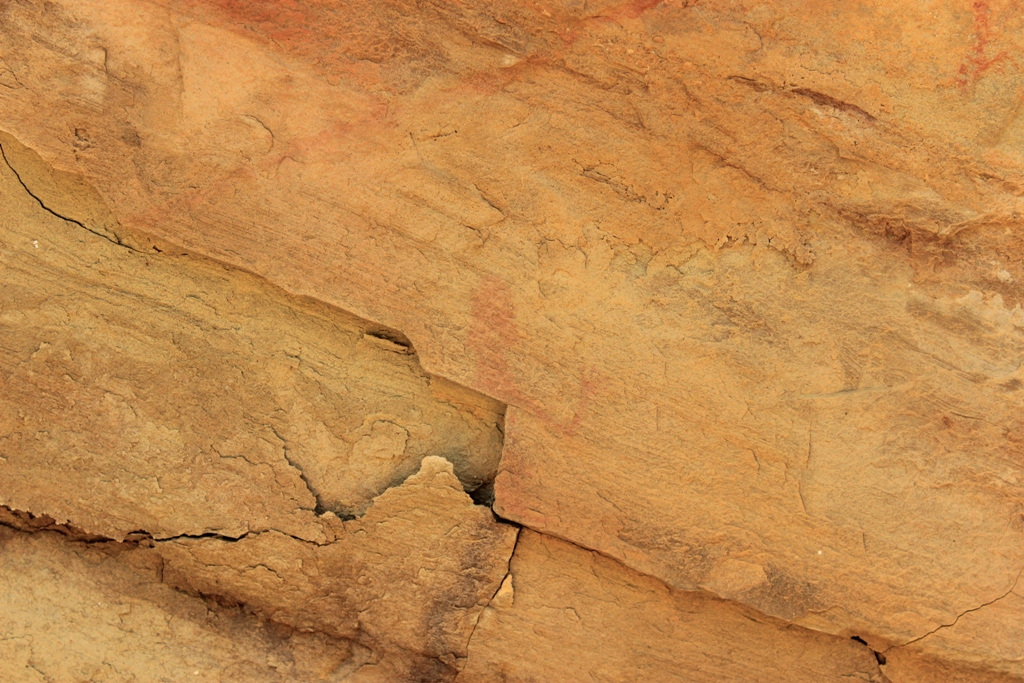 Look closely at the crack line in the center of the frame. The faded remnant half of what looks something like a lizard or newt can barely be seen; a head arm and foot.
 Related Post:











 Jack Elliott's Santa Barbara Adventure