Upper Santa Ynez Camp Vandalism

I spent this last Tuesday in the upper Santa Ynez drainage after hiking in late Monday afternoon and staying the night. I woke at 5:15, broke camp, brewed a tall cup of coffee and chomped down some homemade cake with banana frosting. A slim sliver of moon hung in the twilight of the eastern sky, as the sun began to rise and I sipped my coffee pondering what the day might bring. Few moments in time hold out as much promise as the dawn of a new day.

Later that day I stopped for an hour at Upper Santa Ynez Camp to cook some eggs and refill water bottles. The camp gets little if any use, but there were a few signs that somebody had been there since my last visit in December 2010.

The grill was up and there were a few old coals, but no sign of a campfire in the pit. There was an empty cup of Ranch dressing in the fire pit. Apparently its owner found it easier to hike or bike in the one ounce bit of dressing, but once eaten found it just too damn heavy to pack out the plastic container despite weighing next to nothing.

The most detestable evidence of recent activity at the camp came in the form a freshly carved “Amber and Dad” in the small oak tree closest to the fire pit. Somebody within the last six months blessed us with this tacky, trashy-looking arborglyph so that now when in camp it is constantly glaring at you. I thought about carving it off, but I only had a small Swiss Army knife. I’m not sure if that would be the better thing to do, as it would have left a larger wound, but at least once it oxidized and darkened it would look semi-normal again.

Perhaps I just didn’t notice it before, but the star thistle seems to be really taking over the grassy patches of the woods. What was once grass around the camp is now bristling with thistle.

The picnic table at the camp shows signs of a bear that has torn a large splinter of wood from one of the seats. The claw marks are clearly visible for about a two foot section and were there last December. As I approached the camp this time I came across a rather large wet and shiny bear poop that looked like it was still warm.

The camp is located aside a small alder tree shrouded year round creek and there is a bedrock mortar grinding stone just a few feet from the fire pit.

Upper Santa Ynez Camp

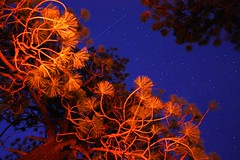
Looking west toward the camp, which is located near the orange-colored sycamore tree. The photos of the camp were taken in December.

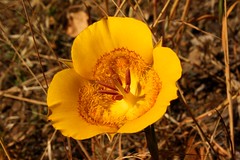
Still a few Humboldt lilies blooming out there.

And even some banana slugs still slithering around in the moister niches of the hills.

Posted in Santa Barbara | Tagged | 1 Comment

Bedrock Mortar On Munson Creek, Pine Mountain

I intended to hike up the canyon to Munson Spring, but a rather dense bramble of wild rose eventually forced me to turn around. My thin nylon hiking pants were no match for all the tiny thorns and my legs were getting shredded. Which wouldn’t have stopped me short normally, but I wasn’t in the mood that day for serving as a pin cushion or bushwhacking and lacerations. So on the way back down creek I wandered over to this rock formation that caught my eye on the hike up. It was filled with holes like Swiss cheese and I had noticed a cave that had looked large enough to crawl inside. Upon entering the small sandstone hollow I found a bedrock mortar.

Looking up Munson Creek from the formation with the mortar.

The formation showing the cave mouth just barely visible on the lower right.

Cave mouth.

Inside the cave.

Cave's eye view looking toward the summit of Pine Mountain.

The mortar.

Posted in Ventura County | Tagged , , , , , | 4 Comments

Old Cold Spring Tunnel (1897)

“With continuous boring, this tunnel developed sufficient water by 1897 to warrant a supply main from the tunnel to the city. Civic leaders found the pulse of industry quickening in ratio to the increased water supply.”

Santa Barbara: A Guide to the Channel City and Its Environs (1941)

On the west fork of Cold Springs Creek in the mountains behind Montecito, near where the trail leading down from Gibraltar Road crosses the creek there, the old Cold Spring Tunnel can be seen. It was Santa Barbara’s first municipal or city-owned water supply and its successful completion led to the construction of Mission Tunnel, which delivers water through the Santa Ynez Mountains from Gibraltar Reservoir. The tunnel marks a crucial point of progress in Santa Barbara’s history.

The warmth and dryness of Santa Barbara’s semi-arid climate had long been an attractive feature of the region, but it also posed a great obstacle to the city’s growth. The sun reflects off the Pacific baking a south facing littoral plain that receives on average about 18 inches of rain annually. The inevitable dry spell meant rainfall could be less than half that.

A catastrophic drought in 1863-64 altered the course of history, as sprawling cattle ranches failed and animal bones piled up near dried up water holes. The ranchos were cut up into smaller parcels, which eventually helped attract and provide land for new settlers, but a steady and reliable supply of water continued to be a problem.

The old Mission aqueduct system built in 1806 provided sufficient water late into the nineteenth century. By 1887, however, the aqueduct, along with the historic De La Guerra Wells no longer supplied enough water to quench the demand of a growing population. That same year, the first train rolled into Santa Barbara and connected the small seaside town with the outside world in a revolutionary new way promising even greater growth and need of water. To solve the problem, the city tapped the Santa Ynez Mountains and effectively turned the sandstone studded, chaparral shrouded eminence into a natural reservoir.

In 1896, Eugene S. Sheffield, for which Sheffield Reservoir was named, suggested to city officials that a tunnel be bored into the mountains, which would provide plenty of water through natural seepage and without need of pumping. “Engineers agreed,” Walker A. Tompkins writes, “that the mountain wall was a huge, untapped lithic sponge of porous sandstone collecting and storing winter rains.” Poke a hole in the mountain, the reasoning went, and the water would naturally flow out.

Charles E. Harding of Carpinteria put in the winning bid to construct the tunnel and in 1897, bored to a depth of 5000 feet, it began supplying water to the city. A plug, to put it simply, was secured in the tunnel, which brought control of the water flow and turned the mountain into a giant hydrogeological town water cooler.

At some point several years later, contractors F. S. Smith and E. J. Hunt fashioned a concrete facade for the old Cold Spring Tunnel, as seen in the photo below. Smith and Hunt were the contractors that bored the southern portion of Mission Tunnel starting in 1904, which eventually tapped the reservoir created with the completion of Gibraltar Dam in 1920.

Bibliography:

The Yankee Barbarenos: The American Colonization of Santa Barbara County, California 1796-1925, Walker A Tompkins (Movini Press 2004)

Santa Barbara: A Guide to the Channel City and Its Environs, Southern California Writer’s Project of the Works Projects Administration (Hastings House 1941)

Related Posts:

Tangerine Falls, Cold Springs Canyon

Posted in History | Tagged , , , | 7 Comments

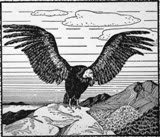
Golden Eagle

Posted in San Luis Obispo | Tagged , | 2 Comments

The Sarsaparilla Drifter

The bat-winged double doors flew open smacking the saloon’s walls with an emphatic clap. He stood there, a bulky figure, face obscured in shadow, the dim sooty flutter of tallow candles warping his features into a caricature. His flat brimmed hat traced a line through the glowing window across the darkened, wagon rutted road behind him.

The drifter entered behind a mustache resembling a hedge of baleen protruding from his upper lip. He strode measuredly across the creaky pine plank floor, the double tap of each heel to toe footstep cracking the silence like gunshots. His stain spattered overcoat shifted to and fro with his movement revealing a glimpse of two tied down six-guns hanging low. A ragged old man in a shadowy corner muttered to himself, as he snatched a shot glass of rotgut whiskey with a shaky hand.

The drifter sidled up to the bar surveying his surroundings in a dead-eyed deliberate stare, the light catching a thin scar running through the grizzled stubble on his cheek. The bartender eased backward, the small of his back butting up against the counter beneath the bottles. His withered face drooped from his skull and two deep furrows at the corners of his mouth accentuated a pair of fuzzy pink cheeks that hung like dog jowls. His bottom lip quavered ever so slightly. “What’ll it be?” he asked.

The drifter leaned sideways against the end of the grimy bar cocked on an elbow, a turned shoulder toward the corner of the room, his back to the wall. He felt the glare of all eyes reading him like the tea stained wanted posters tacked up throughout town. “Sarsaparilla,” he answered.

Posted in Fiction | Tagged , , , , , , , , | Leave a comment