
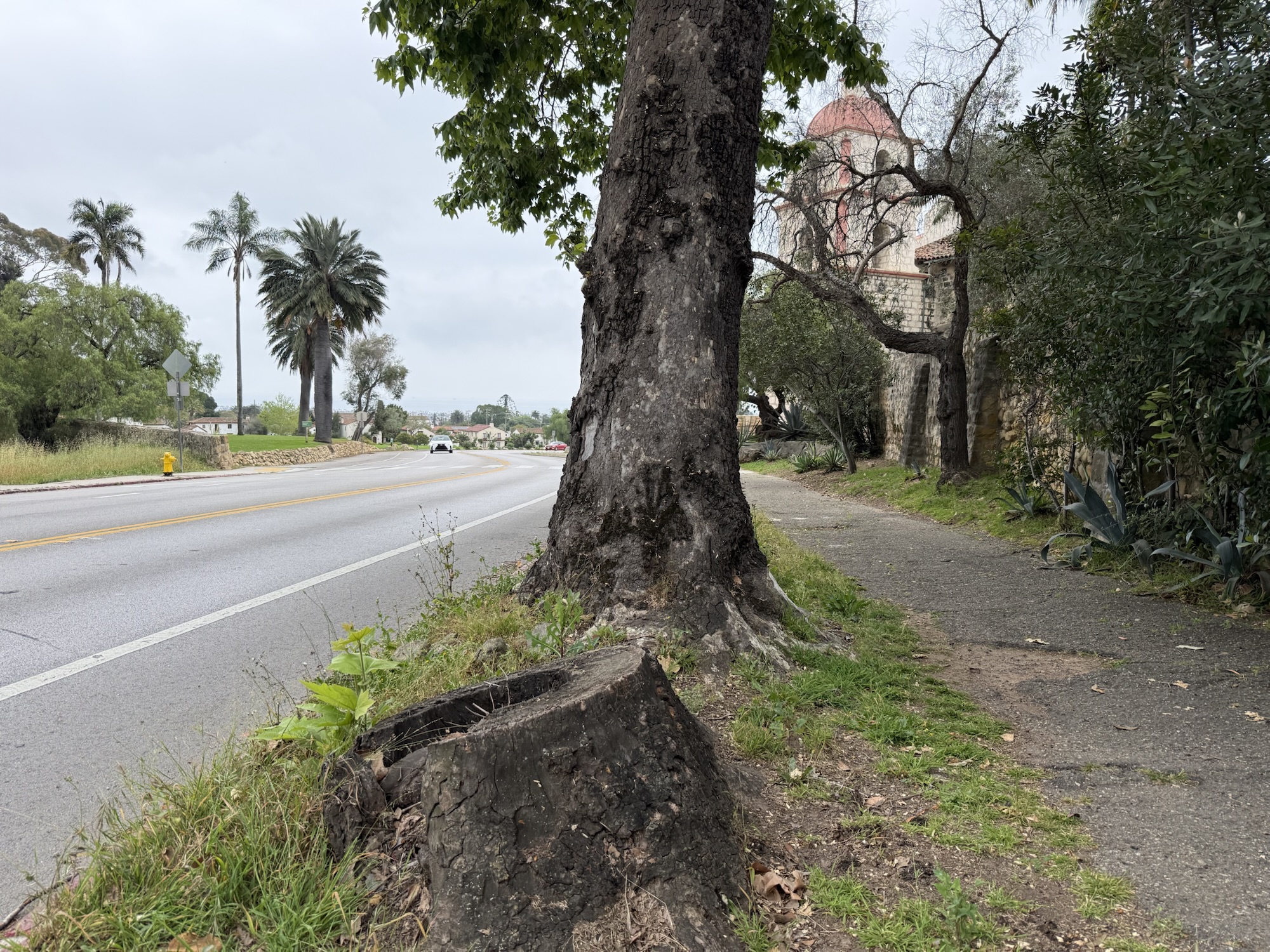
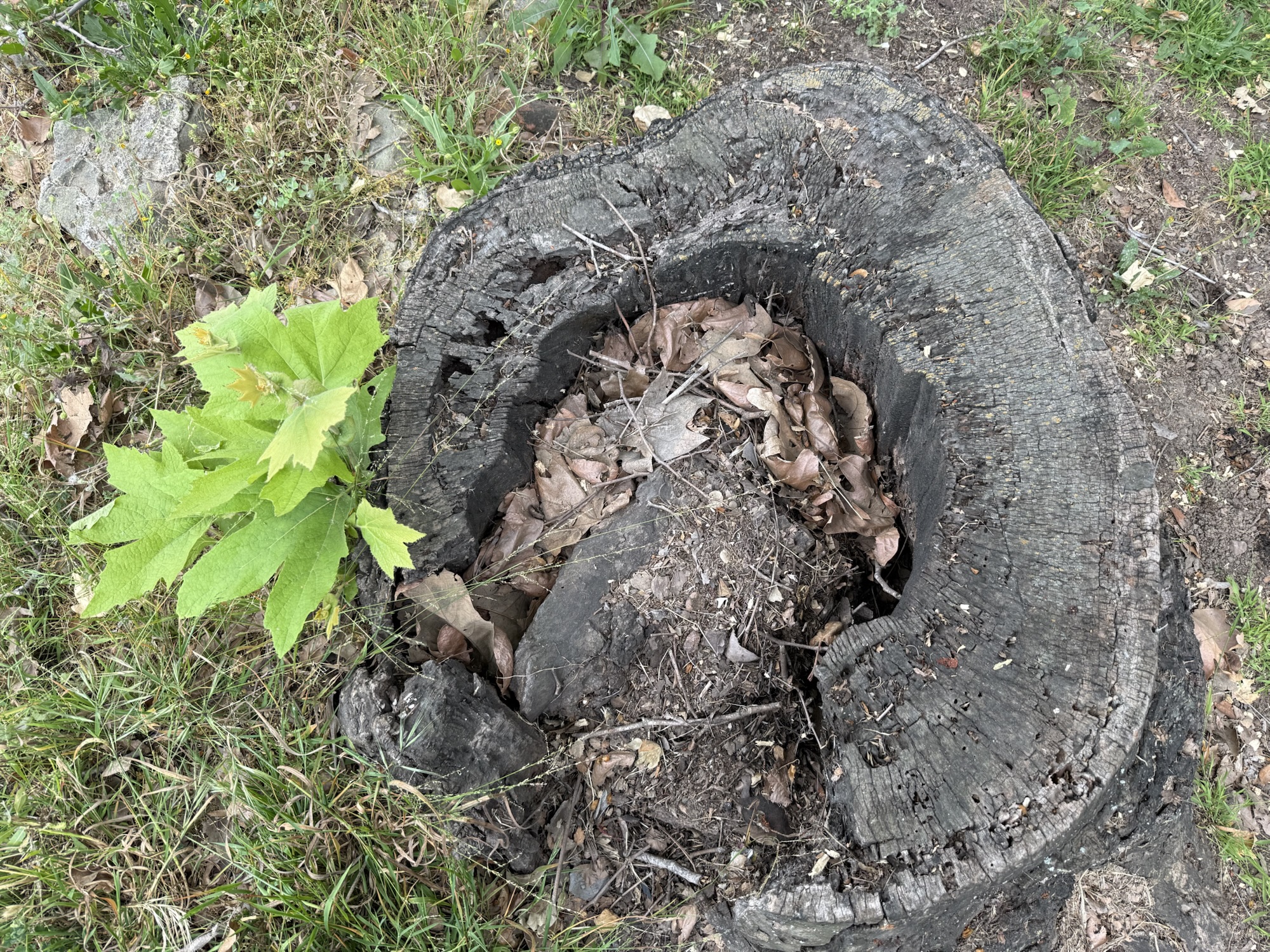
 The sycamore sprout on the tree that refuses to give up.
For years I’ve watched from the window of my passing vehicle the historic sycamore stump adjacent Santa Barbara’s Old Mission resprout, and get whacked.
Every time the tree pops its head up somebody takes it off. This may have been going on for decades or maybe even 100 years, as will be explained below.
Last year or thereabouts the sprout stood waist high with a two inch-thick trunk forming.
Then WHACK! Off with its head.
The sprout had been surrounded in day-glow orange plastic mesh fencing at one point, which was then removed, along with the tree.
Apparently, the makeshift barrier was the work of interested town folk rather than a decided policy to protect and allow the tree to regrow.
I do not know, but it seemed that the sprout had been taken by groundskeepers for no reason other than to maintain a manicured look, when they came through removing annual weeds and grasses along the sidewalk.
Now ’tis the season for such weeding and the tree faces decapitation once more.
Oddly, just behind the sycamore, a volunteer ficus tree has sprouted in the cracks of the Old Mission’s sandstone wall, its roots wrapping and burrowing around and into the stone blocks.
At some point the ficus, a tree of beastly proportions when mature with gnarly, invasive roots that wrap like pythons around anything in the tree’s way, will fracture the wall and send it crumbling apart, thus destroying a historic feature.
Yet, the volunteer ficus has been left in place, while the historic sycamore tree keeps getting whacked for no apparent good reason.
Why?
Probably its mere simple unknowing negligence.
Shouldn’t the sycamore be allowed to grow once more?
If not, why not?
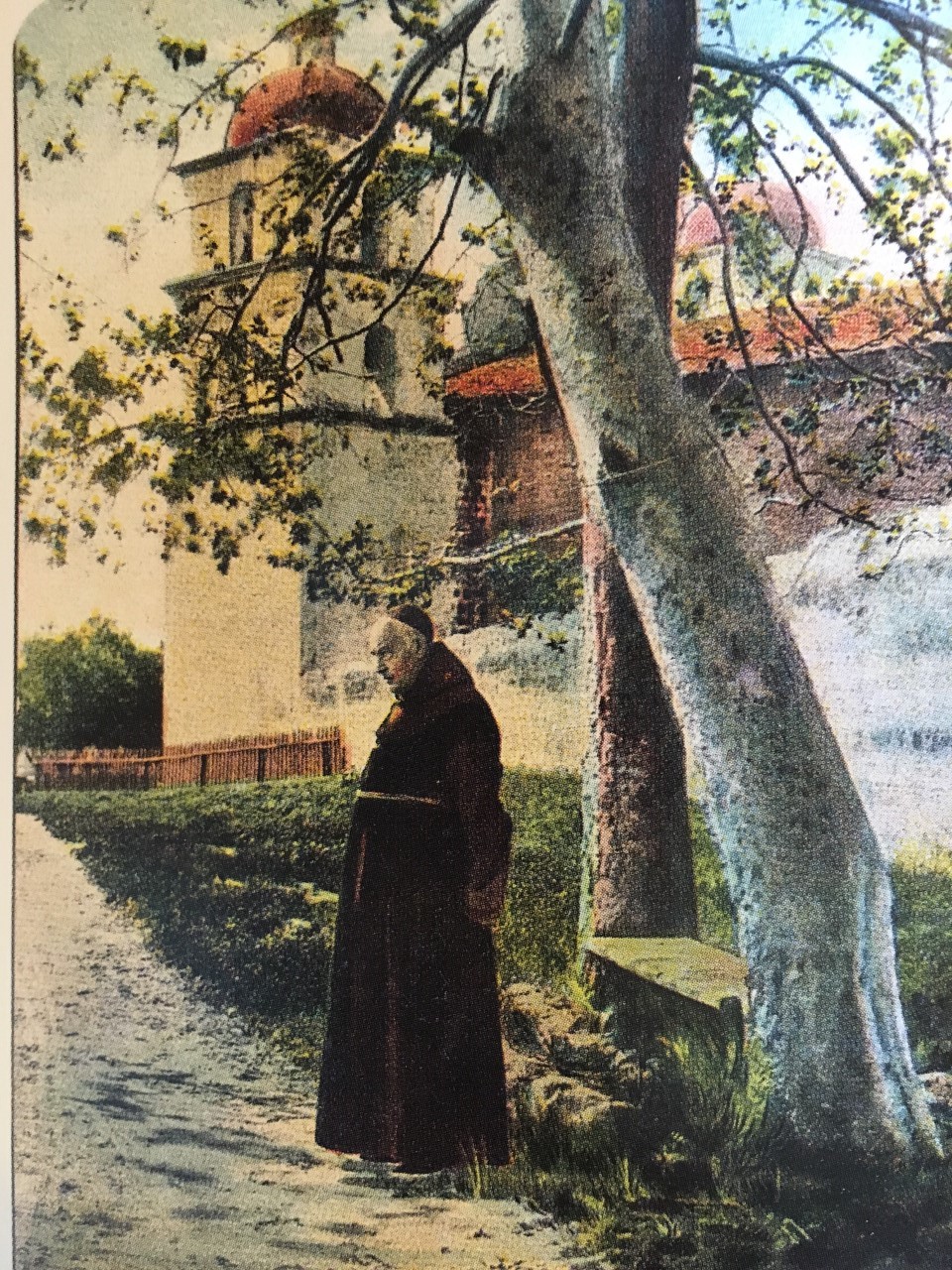 Postcard showing the Old Mission Sycamores (1893).
The tree sprout at issue is one of two sycamores, twins that once stood together, as seen in a postcard image from 1893, as iconic in stature naturally as the Old Mission is in architecture.
I do not know when the one tree was felled whose stump remains, but the tree is very much alive.
A brief one line entry in the book, Trees of Santa Barbara, by Katherine K. Muller, Richard E. Broder, and Will Beittel published in 1974 notably mentions only a single tree:
“A fine specimen on the northeast side of Old Mission Santa Barbara.”
Thus it stands to reason that the tree was chopped sometime long ago.
And although the sycamore may have lost its towering column of a body many decades ago, the tree remains alive.
A tree stump in general may remain alive for hundreds of years after being cut down, by being provided nutrients through an interconnection of roots with other surrounding trees and also through a symbiotic fungal network.
German silviculturist, Peter Wohlleben, in a stunning passage, opened our eyes to this fact in his book, The Hidden Life of Trees (2016).
Wohlleben was previously mentioned on this weblog in other posts:
The Intelligence of Coyote Tobacco (Nicotiana attenuata)
The Mighty Chanterelle and the Gnarly Oak
In The Hidden Life of Trees, Wohlleben tells an incredible story about discovering a stump in a forest he had for years thought was just a rock.
One day he leans in out of curiously, peels back the moss covering from the rock and finds that it is actually a beech stump.
Using a pocket knife he carefully scrapes away some bark and is shocked to find green cambium.
The stump was still alive. What’s more, he surmised that the tree had been felled some four to five hundred years ago!
Wohlleben from The Hidden Life of Trees:
“Living cells must have food in the form of sugar, they must breathe, and they must grow, at least a little. But without leaves—and therefore without photosynthesis—that’s impossible.
No being on our planet can maintain a centuries-long fast, not even the remains of a tree, and certainly not a stump that has had to survive on its own.
It was clear that something else was happening with this stump.
It must be getting assistance from neighboring trees, specifically from their roots.
Scientists investigating similar situations have discovered that assistance may either be delivered remotely by fungal networks around the root tips—which facilitate nutrient exchange between trees—or the roots themselves may be interconnected.
In the case of the stump I had stumbled upon, I couldn’t find out what was going on, because I didn’t want to injure the old stump by digging around it, but one thing was clear; the surrounding beeches were pumping sugar to the stump to keep it alive.”
Put that in your pipe and smoke it. That’s some heady stuff.
And so it appears that something of similar kind is going on with the Twin Sycamores of Old Mission Santa Barbara.
Don’t the sycamores deserve to be allowed to flourish together once more as is their want?
Shouldn’t they be protected?
Would the two together not enrich the scene?
Save our sycamore.
SOS












 Jack Elliott's Santa Barbara Adventure
Hi Jack, A while ago, I asked your permission to use a photo of Montecito Peak in my book RICH PEOPLE in SANTA BARBARA. As it turned out, the publisher didn’t use it. It’s posted on my website. An illustration for the summary of the “Montecito Peak” novella. Thank you. elizabethgilchrist.com
All best with, Elizabeth
Thanks, Elizabeth.