Sierra Snow Melt Well Above Normal

“Good luck and good work for the happy mountain raindrops, each one of them a high waterfall in itself, descending from the cliffs and hollows of the clouds to the cliffs and hollows of the rocks, out of the sky-thunder into the thunder of the falling rivers. Some, falling on meadows and bogs, creep silently out of sight to the grass roots, hiding softly as in a nest, slipping, oozing hither, thither, seeking and finding their appointed work.”

-John Muir, My First Summer in the Sierra (1911)

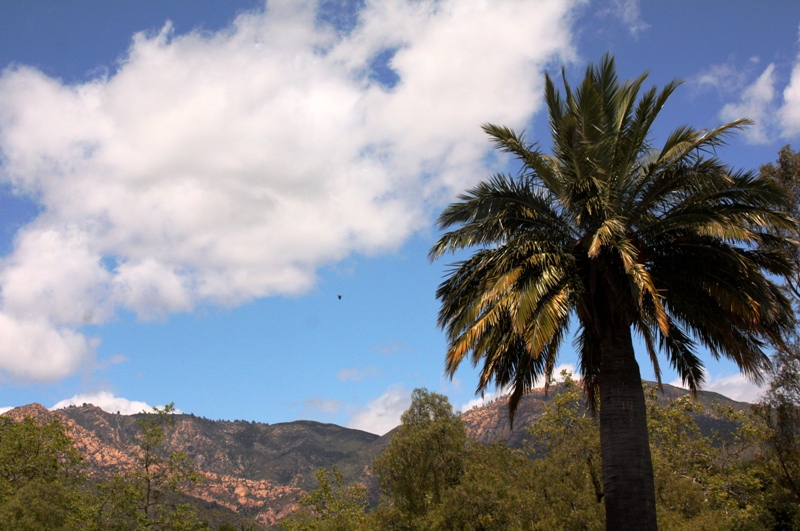
What a year for water! I was back on Figueroa Mountain this last Monday and hiked down to the Sisquoc River via the Sulphur Creek Trail. There was still snow on the backsides of the peaks along the San Rafael Mountains around McKinley Mountain. Not bad for late May in our neck of the woods.

I had noted back in late March, Santa Barbara County 163% of Normal For Rainfall, and now CalTrout is reporting snow melt in the northern, central and southern Sierra to be 253%, 195% and 178% of normal, respectively.

California snowpack map

Posted in News | Tagged | 1 Comment

Sisquoc Sands

Following my tracks back down the Sisquoc River bed near Manzana Creek confluence on Monday afternoon.

Posted in Snapshots | Tagged , , | Leave a comment

Waterfalls, Trout and Indian Mortars

We loaded our rig and hit the super slab up to the Sierra for three nights of car camping April 30-May 3. There were few people and the weather was perfect.

This was home for four days. Well, this and the surrounding mountainside and river that served as our backyard and playground.

I forgot at camp on Sunday my go-to adventure pants. They’re made from extremely durable, thin and lightweight supplex nylon. They rapidly dry when soaked, but are comfortable and easy to hike in even when wet. I normally wouldn’t mention such minutiae, but they’re pretty damn cool pants and I wear them everywhere.

Anyway, I was wearing denim and rather than hiking up and down the canyon in heavy, wet blue jeans that chafe and bind up, I fished in my underwear, hence the photo above showing me from the waist up.

I fished for about an hour with not much luck. I hooked a pan sized trout on my third cast, but it jumped into the air and spat the hook, which suited me just fine for it wasn’t big enough to keep let alone make a meal of.

Seventeen inch brown trout.

I fished on. Numerous times fish bit only to dart away. Further casts would go untouched and I would move on to the next spot. Typical trout fishing in heavily plied waters. They were finicky and bit lightly.

I crept up to another smooth running section of water that looked good and threw my line downstream. Almost as soon as it hit the water a small trout darted out from under some structure and struck, then bolted. Subsequent casts proved he was gone or at least uninterested so I turned my attention upstream.

Standing in the same spot, I tossed my line a short distance in the opposite direction, quickly flipped the bail and cranked the line in to keep up with the swiftly flowing current. I guided my line around a snag and into a small pool and, BAM! I felt a solid strike and snapped my rod back, tip up. A beautifully colored spotted brown trout surfaced just in front of me. A few seconds later and I had it ashore and securely in hand.

Later that evening at camp, I stoked up a fire with the oak wood I brought for just such a purpose. I infused some grape seed oil with a medley of fresh ground herbs and spices and coated the fish inside and out and slow roasted it over smoldering oak coals. It made an exceptional main course for dinner that night.

On Monday we loaded supplies for a day away from camp and drove up the mountain. Heading up the highway, a narrow unmarked and infrequently used dirt road leading from the asphalt into a cedar grove caught my eye.

I rolled to a stop, reversed back down the highway and eased my way forward onto the dirt road. It led a short distance through the trees to a small clearing near a fast flowing brook and I pulled to a stop near a large fire ring of granite stones.

It was an informal camp with no bench or grill. There was a big pile of charcoal in the fire ring and some inconsiderate, disrespectful slobs had left a couple of canned food tins.

It wasn’t more than a minute after I got out of the truck that I caught sight of evidence proving the location had been used as a camp for, I would guess, at least hundreds of years. There beside the fire pit was a granite slab pitted with Indian mortars.

The largest mortar measured over nine inches deep. Some others were just being formed and were less than half an inch deep. How long does it take to bore with a stone pestle a nine inch hole in solid granite?

The area was barely a clearing between the trees and it very well may have been previously shrouded in forest in times past. It wasn’t a natural potrero or flat of any sort, but a gentle slope of open soil with a few patches of grass in the midst of cedars and pines. There was a meadow relatively nearby on the mountainside, but not too close.

The tiny stream of runoff water ran down a gully twenty to thirty yards from the grinding stone beyond the small clearing. Being above 6000 feet it was, no doubt, a seasonal camp. Presumably those that frequented the place historically used it as a base of operations of sorts in gathering pine nuts and other seeds to grind during the spring and summer.

This being the case it makes a nine inch deep mortar all the more remarkable in that it was only used seasonally for several months a year at most. In other words, it would have been bored a lot quicker if used year round. The camp appeared to be, not ancient, but pretty old.

Chips and tiny flakes of obsidian were scattered around the entire area here and there showing that a lot of knapping had gone on at one time. There are probably a few pieces of spear points or arrowheads around or other tools.

I unloaded a cooler full of ice and edibles and we had us a nice little picnic at a place where people have been stopping to eat during the warmer months of the year for quite some time.

The slab of granite dotted with bedrock mortars.

The Indian grinding stone shown here in the shade of a cedar tree.

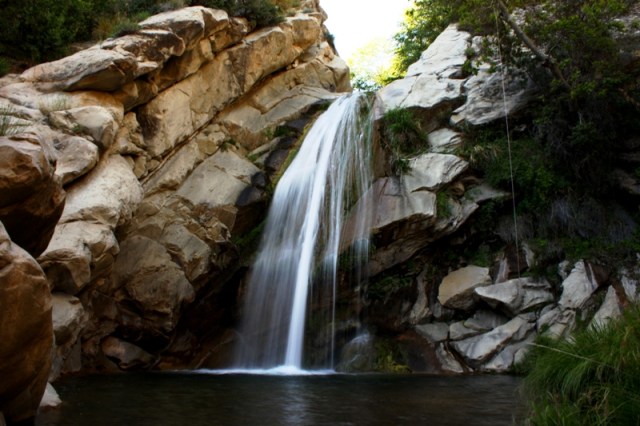
Late Monday afternoon, I hiked up to a waterfall gushing through a slot canyon. A massive chockstone is jammed between the walls of the canyon splitting the fall down the middle and forcing it to flow around the boulder in two torrents. It then flushes through a lengthy  and narrow trough cut in the bedrock and down on into what might be called a normal looking creek. It was flowing scary fast.

In one of the photos several people are visible. They were up on the rocks beside the creek throwing logs in and watching them get battered. The way the creek was flowing it offered zero room for error and it seemed pretty foolish to be screwing around as they were with beers in hand. Guess I’m getting old.

I had originally set out to hike much farther up the creek to a Yosemite-type fire hose of a fall that blasts over a granite precipice and looks to be at the very least a hundred feet in height. I was unable to locate much of a trail and spent too much time route finding and pushing through brush on my way up the canyon. There was a faint trail here and there, but it obviously got very little use.

I was unaware of this lower waterfall in the photos here and was pleasantly surprised to round the shoulder of a grassy hill and see it come into view. It was already late in the afternoon with only about four hours of light remaining. With no clear trail leading up canyon that I could find, I decided to call off trying to reach the larger waterfall.

Related Posts:

Native Steelhead of Yore

48 Pound White Seabass

Halibut

Posted in Sierra | Tagged , , , , | 5 Comments

Dick Smith Calling a Condor, Piru 1970

Via Flickr:
With Lake Piru visible below, a California Condor barely visible above, Dick waves and shouts to draw the bird’s attention. The condor ultimately came directly overhead. December 1970.

I went to school in Santa Barbara with the grandsons of Dick Smith, the backcountry denizen who roamed the local wildlands on horseback accompanied by his dog, and for whom Dick Smith Wilderness was named. I also worked for several years with the wife of his son and they lived a block away from me.

I’m not sure to what extent Smith’s son shared his father’s appreciation of the wilderness, but he did love the ocean. Whenever I saw him around town he usually always had his surfboard in the back of his truck. He was also a craftsman. One day, his eldest son invited me into his house and showed me the miniature wooden surfboards his dad crafted in his spare time. I was impressed.

But I have to confess to not always getting along with Smith’s grandsons and that I was a total jerk at times. It’s something I’m embarrassed about nowadays.

I’m not sure if their mom ever knew, but she was always very kind to me. Her youngest son grew up to be a giant broad shouldered man and could probably beat the hell out of me nowadays. Lord knows I once deserved it!

In later years, I would learn about the legacy of their grandfather and what he did to preserve so much of what I have grown to cherish. Would that we were all a Dick Smith.

Related Posts:

Desperate Fight with Condors: Narrow Escape of Santa Barbara Man (1899)

Condor in a Cage

Condor Point

Posted in History, Ventura | Tagged , , | 5 Comments

A World Away

Sprawled across a gritty sandstone boulder lodged several miles up the canyon, I lie overlooking the south-facing littoral plain far below, the day’s heat seeping into my bones, a cold beer can sweating close at hand.

The stream gurgles through the sticks, stones, and logs and washes over a mossy face of bedrock into an emerald pool.

I raise my head just high enough to slosh a foamy gulp of beer into my mouth, catching a glimpse of the sprawling city and shimmering Pacific beyond my well tanned toes.

I rest my head back onto the boulder in a slothful state to doze, as a swallowtail butterfly dances in puffs of wind rustling the leaves of a bay tree overhanging the creek.

Meanwhile, in a foreign land a world away, a Navy SEAL storms a fortified compound on a mission to find and kill face to face the world’s most wanted militant Islamist.

Posted in Fiction | Tagged , | Leave a comment