Chumash Camp

I headed into the forest in late afternoon with three hours of light left. It was dead calm in the lower reaches of the canyon and I could see that it rained the day before. Upside down oak leaves still held water in their concave undersides.

Two miles along my way, I rounded a bend and spotted two backpackers a quarter of mile off. They stood ambling around apparently taking a breather. I caught up to them on a short, but steep incline, and followed a guy hiking in Wrangler jeans, cowboy boots and a big white cowboy hat to the top, where his buddy stood decked out in full fatigues and eight inch combat boots laced up tight. Each man, in their late twenties or early thirties, cradled a stubby, military-type rifle in their arms.

Neither one of them had spotted me approaching. And the guy in jeans I followed had no clue I walked up right behind him struggling up the gravely slope. His buddy commented in surprise, as did he, when we reached the top of the hill and they both finally saw me.

They were oblivious to their surroundings, which was a bit amusing considering their outfits and what they were packing. Guess it was all show. I blew by them with a clipped, “howdy,” and stomped on down the trail pondering what the hell they were doing. Or thought they were doing.

Less than a mile later, I was walking a flat section along the canyon floor at the foot of a mountain, just beyond the confluence of two creeks, when a shiny black pointed shape caught my eye. 

An arrowhead as found lying in the weeds.

Right on the trail, in the weeds that have been clipped short by constant foot travel, just inches from the bare dirt path itself, laid an inch long obsidian arrowhead. It had been cleaned of dirt from the rain and was lying there as if somebody had set it down.

It was a fairly well crafted point and in near perfect condition with only a slight chip missing from one edge, which was hardly even noticeable if the arrowhead was flipped over. Still miles from the old Indian camp that was my destination and I stumble across an incredible artifact during a trip I postponed and almost didn’t even take.

I pushed on and ended the day hiking the last thirty minutes by twilight and walked into camp just as darkness really set in. An ornery wind was blowing over the mountain, but the camp is well protected and only had a slight breeze by comparison.

The camp sentinel.

I made some quick grub and a cup of coffee by headlamp and then hit the light. I laid back and stargazed for an hour or so in total darkness, peering through a huge almond shaped window to the sky created by the surrounding sandstone formations.

The wind owned the night. A mighty river of air, it flowed over the mountain in a roar whittling away the monolith I was hunkered beneath grain by grain, which rained down and tinkled against my tent all night long. I lay in bed listening nervously. At the height of the gusts, it would reach an eerie howl and I waited to hear the sharp crack of a falling tree or section of sandstone giving way.

I woke at six o’clock to birds singing and more wind. A fine grit coated my face and covered everything else inside my tent. Ominous looking dark clouds were being sucked over the mountains and speedily flying through the sky. Geez, what happened to clear skies for Tuesday? I thought. Am I gonna have to hike outta here in the rain? But it soon cleared to blue skies and I spent a leisurely day wandering around the area near camp.

Late that afternoon while heading back on my way home, I passed the same guys I saw on the way in. They sat in camp aside the creek in full cammies playing cards. My curiosity continued. I walked the remaining two hours in the deepening shade of late afternoon, and timed it so I arrived at my truck at dark, squeezing every minute I could out of the day.

Water flows through the u-shaped hole in the rock on the upper right hand corner and falls onto the rocks below.

View from camp.

Another view of camp showing my tent. The water flows over a double fall.

A drip drop divot under the falls. How long does it take for single drops of water to wear such a depression in the sandstone?

A view from a trip last June.

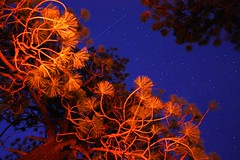
A night shot from that previous trip.

Another camp nearby with its own waterfall flowing through it.

A line of three bedrock mortars.

Posted in Santa Barbara | Tagged , , , , , , , , , | 11 Comments

Scent of the Sea On A Ventura County Creek

The center piece.

With a blustery forecast set for Sunday and Monday, I begrudgingly decided to postpone a backpacking trip. The slight chance of rain that was also expected was of little concern, but the thought of being exposed to the elements for several days in cool windy conditions did not sound too appetizing. After awhile, wind can be like a fly ceaselessly buzzing around your eyes and ears, at a certain point it becomes maddening and you just want to be left alone from its constant unavoidable presence.

So instead, I headed down into the red and purple stone studded void of a Ventura County creek for the day. Several times while in the canyon thoughts of the ocean entered my mind and, specifically, surfing. I didn’t think any of it. A man has a lot of time to think when hiking alone and his mind will wander through the corridors of memory just as his person wanders a trail.

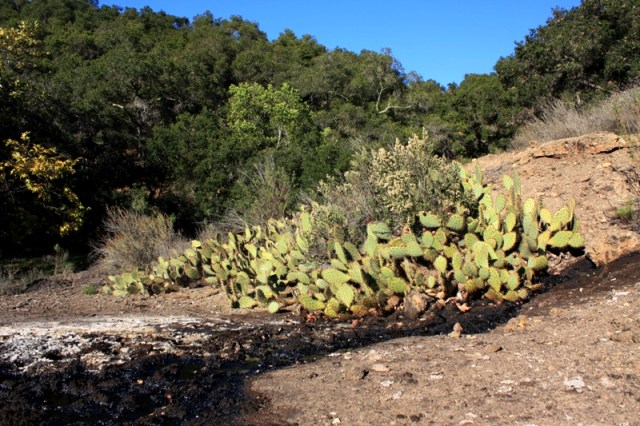
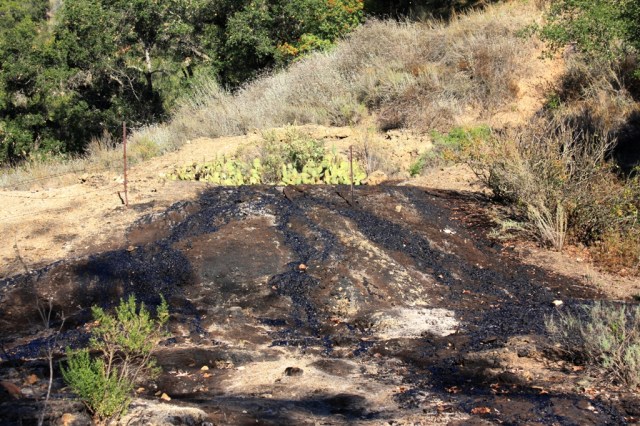
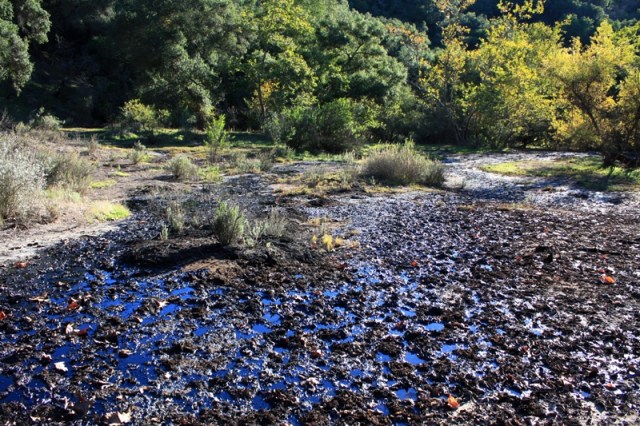
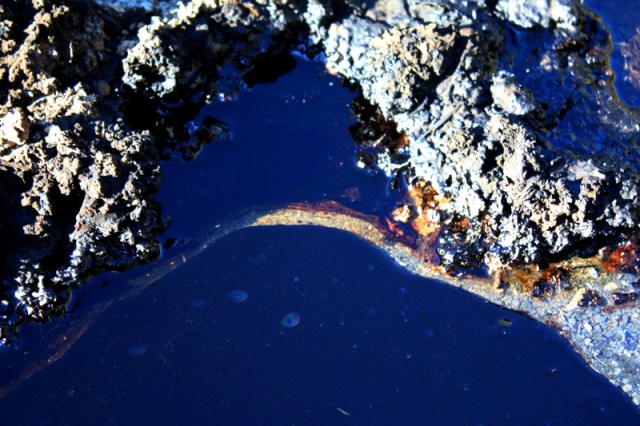
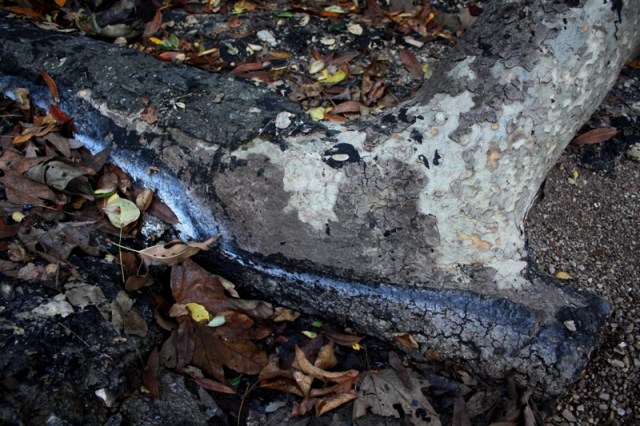
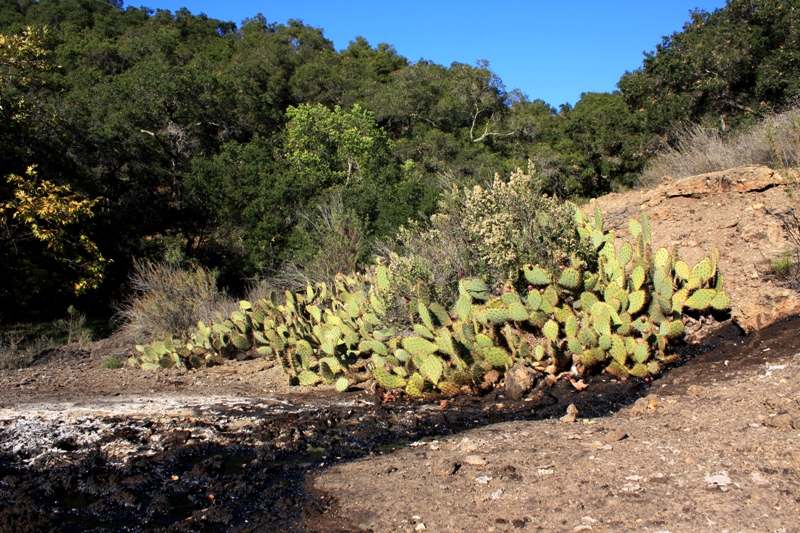
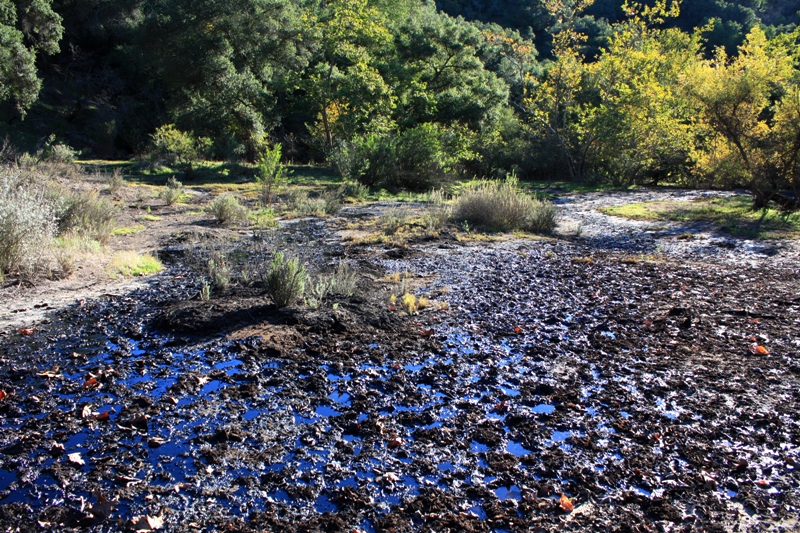
Natural tar deposit on the bank of the creek.

It was not until late afternoon when the cause of these thoughts finally struck me. I was at the foot of the upper fall that pours over the stone lip and into the pool below with the power of a gigantic fire hose. I had a particularly vivid sense of being immersed in the roiling whitewater of the ocean after a big wave breaks.

I thought of the smell of the sea in the impact zone, where the power of ocean swells explode onto the shoreline, vaporizing the seawater and filling the air with a heavy scent. That’s when it struck me. The smell of the creek air was triggering these thoughts. The reason such a thought entered my mind while on the creek, and had been lingering on the fringes of my consciousness all day long, was because the watercourse has the same oily smell as areas of the local ocean I frequent.

The Santa Barbara Channel is home to the second largest natural oil seeps in the world. The result is a near constant smell of oil not only while at the beach, but often in town, too. The powerful waterfalls of the creek work in a similar manner as the swells of the Pacific. They both churn up naturally occurring petroleum deposits and inject its scent into the air.  At the creek the smell of oil is definitely more subtle, but it’s there wafting through the canyon.

It was an overcast day with small patches of blue sky opening up on occasion. There was almost no wind. As the afternoon wore on heavy clouds gathered over the peaks. In the hour before sunset a thick, misty marine layer rolled in and muffled the landscape beneath a cool gray blanket.

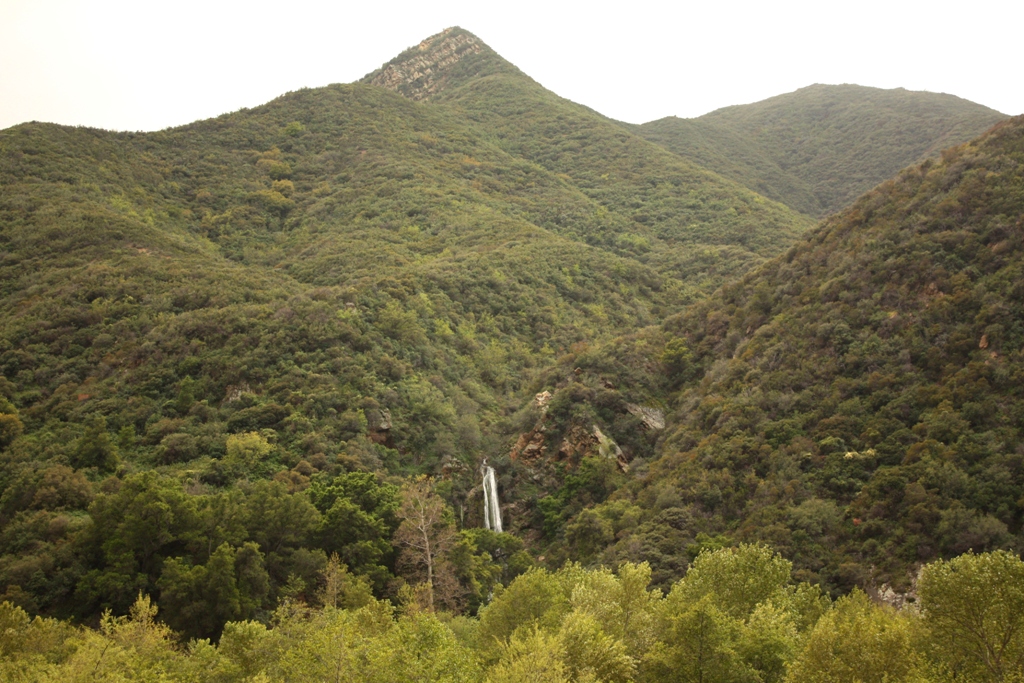
The cloud cover, like a lampshade over a bulb, dispersed the sunlight evenly across the mountains. It actually illuminated the eastern facing Bear Heaven escarpment wonderfully, as seen from the top of the waterfall at the mouth of the creek.

A heavy flow of runoff was plummeting over the precipice of Bear Heaven scarp. It actually became easier to see the falls than it was earlier in the day when there was more sunshine, which had plunged the cliffs into deep shadows throughout midafternoon.

On my hike up out of the creek, I ventured off trail and through the chaparral for one last gaze at the distant Bear Heaven cliffs from far across the deep cut Sespe Creek canyon. Listening carefully, I could hear the powerful slap of water as it smacked against the rocks at the bottom of the falls.

A light, shifty wind blew the noise to and fro through the canyon air and it would come in bursts of crisp, distinct sound and then suddenly vanish with the shifting breeze. I could see sheets of whitewater free falling through the air and exploding off the cliff face and massive boulders below.

Related Post:

Waterfalls of Ventura County

Posted in Uncategorized | Tagged , | Leave a comment

Eating Poison Oak

The Blistery Beginning

I remember sitting in seventh grade math class at La Colina Jr. High one afternoon and itching the hell out of some poison oak on my upper thigh.

I managed to scratch it into a puffy, red blistery mess, and then used my mechanical pencil to pop the tiny serous filled vesicles that had erupted by the hundreds. It was a great distraction.

I walked out of class with a mean looking wet rash that felt hot and hung stiff and heavy on my leg, as if it had been welded to my skin like a vulcanized patch on a bike tire tube.

Such were the wages of the early years. The maddening unbearable-to-resist itch and constant fidgeting, the blisters, the hideous looking dermatitis, and the rashes scratched raw which made showering torturous and sleeping difficult.

Even though I habitually used mugwort as a preventive, inevitably I’d miss a spot, and it would erupt into a rash that I couldn’t resist itching which would then spread. On the flip side, for all the inconvenience and discomfort, itching a good case of poison oak was about the best feeling I knew back then, and almost made it all worth it.

Eating For Immunity

There was a time when I avoided poison oak like an airborne contagion. Nowadays I eat it. And without concern, if need be, I tromp right through the bushiest groves with the biggest, oiliest looking leaves. Rarely do I break out with any sort of dermatitis. At most, if I do have a reaction, it’s short lived and not more than a slight red tinge to my skin in a few select places.

Every season in winter or early spring when poison oak sprouts new leaves I eat them. I pinch off the smallest ones, place them on my tongue and mince them into a sappy pulp with my front teeth and swallow the mush. I repeat this several different times early in the calendar year.

After constant exposure through the years, and especially ever after I began eating it, my reaction became increasingly milder until it was essentially non-existent. I never once broke out in a rash from eating poison oak or suffered any adverse consequences.

Traditional Knowledge

Historically, California Indians valued poison oak for numerous purposes. Costanoan Indians used poison oak leaves to wrap food in and wove the plant’s tender and flexible stems into baskets. Indians in Mendocino County used poison oak leaves to wrap up acorn mush in preparation for baking and the Karok used the plant’s twigs as skewers for smoking salmon.

The Chumash used poison oak medicinally in an effort to cure a host of ailments. Early California mission documents mention the use of poison oak poultices that were “very effective in healing wounds,” writes Jan Timbrook in Chumash Ethnobotany. The juice or sap that flows from young stems was also used to stop bleeding.

The Franciscan priest at mission San Luis Obispo in the early nineteenth century, to note a rather dramatic example, witnessed powdered poison oak used to heal the severe wounds a man suffered during a bear attack. In his own words:

“The Indians have no physicians but they have healers who administer their remedies to the sick. … The remedies they employ are plants, bark, roots and the leaves of various kinds of trees which I do not know except the ivy from which I have seen them make plasters, for instance in the case of a man who had been frightfully lacerated by a bear in the arms, legs, sides and shoulders. He was cured by simply being covered with the powder of the ivy.”

According to Timbrook, the historic populations of Chumash were largely immune to poison oak’s rash causing poison, while visiting Indians from other regions were often highly allergic. Immunity apparently waned in later generations among whom, presumably, traditional medicinal practices were no longer used and there was less exposure to the plant in the wild.

The Mahuna Indians of California steeped dried poison oak roots in water and drank the resulting decoction as a preventive against future allergic reaction to the plant. To obtain immunity the Tolowa ate the youngest leaves in early spring just as they began to form and sprout.

Eating poison oak to avoid getting it may sound totally nuts, but considering the plant’s traditional Native American uses it shouldn’t sound so crazy after all. Just don’t blame me if you chomp down a leaf and end up in the hospital.

Poison oak or "yasis" in Barbareno Chumash.

United States Department of Agriculture Database: Profile page for Pacific Poison Oak.

Bibliography

Jan Timbrook, Chumash Ethnobotanty: Plant Knowledge Among the Chumash People of Southern California (Santa Barbara Museum of Natural History 2007), 214-17.

Maynard Geiger and Clement W. Meighan, Eds., As the padres saw them : California Indian life and customs as reported by the Franciscan missionaries, 1813-1815 (Santa Barbara Mission Archive Library 1976), 75.

John Bruno Romero, The Botanical Lore of the California Indians (Vantage Press 1954), 11.

Marc A. Baker, The Ethnobotany of the Yurok, Tolowa and Karok Indians of Northwest California (Humboldt State University, M.A. Thesis 1981), 58.

Barbara R. Bocek, Ethnobotany of Costanoan Indians, California, Based on Collections by John P. Harrington (New York Botanical Garden Press 1984), 251.

V. K. Chestnut, Plants Used by the Indians of Mendocino County, California, Reprint of U.S. National Herbarium Contributions Vol. VII, pp295-422 (Mendocino County Historical Society Inc.; Reprint edition 1974), 364.

Sara M. Schenck and E. W. Gifford, Karok Ethnobotany (University Of California Press Berkeley 1952), 385.

Related Post:

Mugwort: A Natural Poison Oak Preventive

Posted in Flora | Tagged , , , , , , , , , | 60 Comments

Mugwort: A Natural Poison Oak Preventive

050 YB

A clump of young mugwort or “molush” in the Barbareno Chumash dialect.

Plant Profile

Mugwort (Artemisia douglasiana) is a perennial herb commonly found in areas of riparian habitat.

It likes sunny, moist locations around creeks and rivers, but can also be found in areas of bright shade and the dappled light of oak and sycamore glens.

Mugwort is a member of the sunflower family and it grows in tall, straight single stems topping out at various heights up to three feet or more.

It bears multipronged lanceolate leaves that radiate outward from the main stalk in spiral formation. The leaves are green on top with a whitish colored underside, and they have a distinct herbal fragrance when crushed or rubbed that is similar to sage.

Mugwort typically grows in bushy clumps and can look like a shrub, but it is also found in stands of widely spaced individual plants.

Traditional Knowledge

Historically, Native Americans used mugwort medicinally in many ways and for a wide variety of ailments. To treat itchy skin the Pomo, Kashaya bathed the skin in mugwort tea. Locally, the Chumash used mugwort to soothe the rash caused by poison oak. In Chumash Ethnobotany, Jan Timbrook notes that the sources of ethnographer John P. Harrington (b.1884 d.1961) told of two ways mugwort was used for this purpose.

The simplest method was to grind some fresh mugwort leaves between the hands and then rub the resulting crushed wad of plant matter on the rash. Another way was to boil fresh leaves and make a tea, which was then applied to the affected area.

I was taught how to use mugwort as a kid, but to actually prevent getting poison oak rather than to treat an existing rash. I would pick the fresh leaves and crush them together and then rub them on my skin soon after exposure to poison oak. It’s a natural treatment that is free and easy to use and, I believe, always worked to somehow neutralize the active ingredient in poison oak, urushiol. And mugwort is readily available in the woods often times actually growing near or right beside poison oak.

Poison oak and mugwort growing side by side.

The underside of a mugwort leaf is white and covered in a very fine felt like fuzz.

United States Department of Agriculture Database: Profile page for Mugwort.

Bibliography

Jan Timbrook, Chumash Ethnobotanty: Plant Knowledge Among the Chumash People of Southern California (Santa Barbara Museum of Natural History 2007), 38.

Jennie Goodrich and Claudia Lawson, Kashaya Pomo Plants (American Indian Studies Center, University of California, Los Angeles 1980 ), 119.

Related Post:

Eating Poison Oak

Posted in Flora | Tagged , , , , , , , , , | 15 Comments

Pine Mountain Sunburst

A view from the north slope of Pine Mountain on Sunday.

Posted in Ventura | Tagged , | Leave a comment