The Teetering Boulder of San Ysidro Canyon

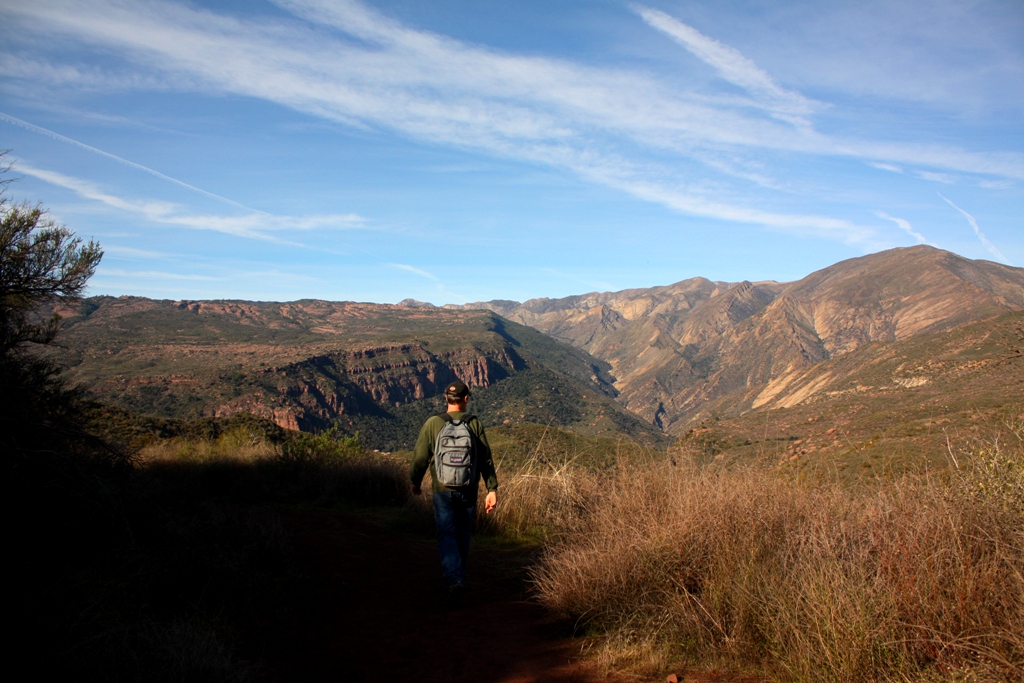
Pushed from the right side, the boulder rocks back and forth. The backpack is to note scale.


About fifteen years ago, I was scrambling through the chaparral and up the sandstone studded ridge on the west side of the mouth of San Ysidro Canyon in Montecito, and came across a boulder. I don’t recall why I stopped at this particular rock, as it is little different than all the others, but something about it caught my eye.

It was perched precariously on a stone ledge overlooking the creek far below. Perhaps it was the mischievous little boy’s mind in my otherwise adult body that drew my attention to what looked like the king of all boulder rolling opportunities. For it is the quintessential boulder of a Wile E. Coyote and Road Runner cartoon. Whatever it was it lead me to lean against the massive gritty concretion and give it a heave. And it moved.

It rocked forward and then gently settled back into its prior position. Holy crap! I thought. This thing is ready to roll. The boulder rocks back and forth with little effort, and although I really wanted to see if I could heave it over the ledge, and watch it crash its way down the brush covered slope and slam into the eucalyptus trees in the creek below, I was concerned that, yeah, this thing really is ready to roll and I could actually push it down the canyon, but it could flatten somebody like a pancake if it hit them.

I have since found that, although the boulder is teetering, it is impossible to set it rolling in its current state. There is just enough of a sandstone lip underneath it to hold it in place despite its rocking, but it wouldn’t take much to make it so it could be rolled.

How did it come to rest in its present unsettled state? How long has it sat there? A thousand years? Five thousand? How long will it continue to sit there? Who knows?

The faint red circle to the top left of the boulder notes the trail (dirt road) far below.

The boulder, noted by the faint red circle, seen from the trail below.

Just up the ridge from the boulder there is an unusual rock with a window-like hole overlooking Montecito. You can actually sit in the little pocket and look out the window.

At the foot of this rock formation there is a vernal pool, which due to the recent heavy rains is filled.

San Ysidro vernal pool high on a ridge.

The reflection off the vernal pool. This photo has been turned upside down. The lower portion of the rock on the left, slightly out of focus, is not a reflection.

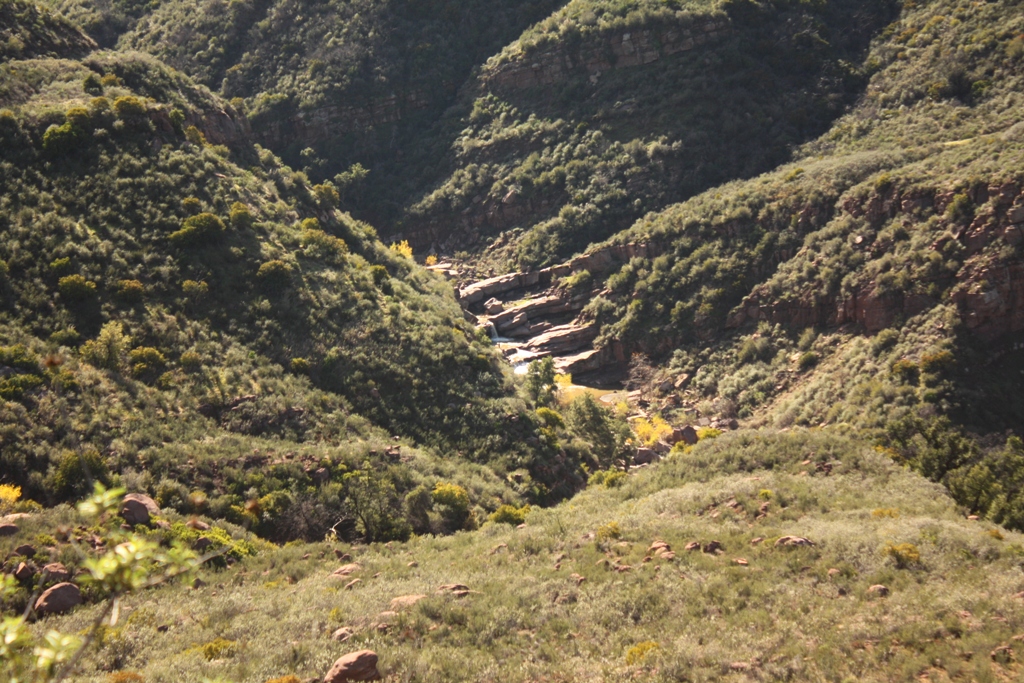
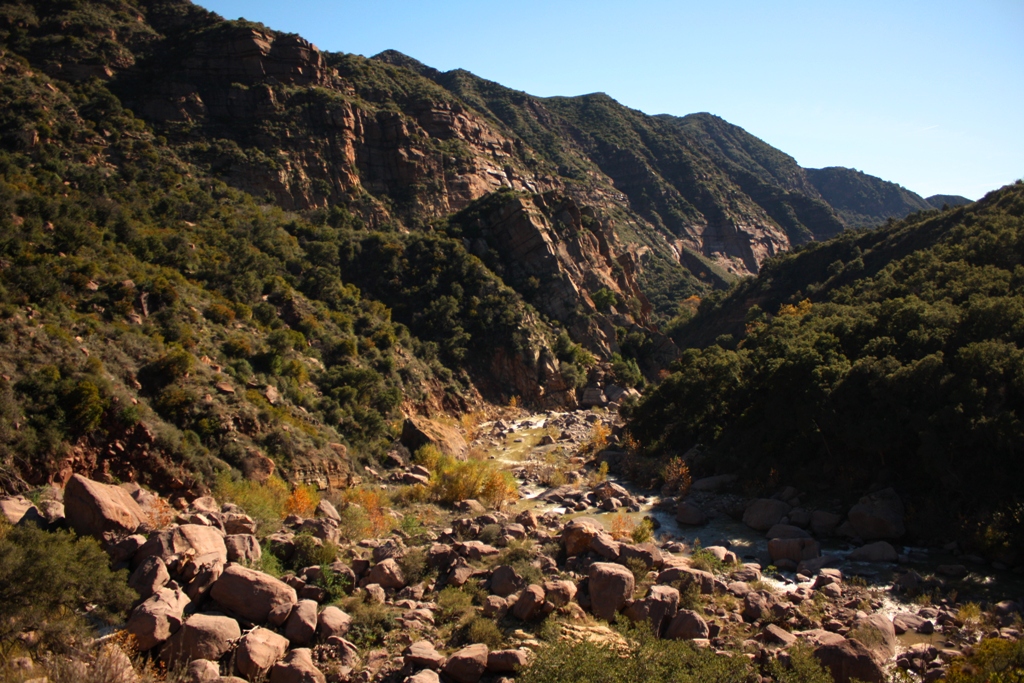
View from rocky ridge looking up San Ysidro Canyon. The road cut on the right is an Edison access road.

Some sort of old stoneworks cemented against the sandstone outcrop at the base of the rocky ridge and just beside the creek.

Posted in Montecito, Santa Barbara County | Tagged , , , , , , , | 3 Comments

Chanterelle Mushrooms

A freshly picked Chanterelle in the dappled afternoon light beneath a thick creek side oak canopy.

“It is possible to live without gold and silver, and one can resist the temptations of seductive women, but to abstain from eating mushrooms is difficult.”

-A quote from an ancient Roman named Martial (43-104 AD)

When it comes to foraging for wild foods Chanterelle mushrooms are the gold standard of Santa Barbara County forests. They thrive during the rainy season in the oak shrouded riparian habitat found in canyons and along the rivers, creeks and seasonal runnels throughout the region.

Chanterelles make an exceptional seasonal addition to the kitchen table in fall and early winter when they are first popping up. Especially for Thanksgiving and Christmas meals, where you can regale your guests with the delectable flavor of a world renowned delicacy, and enchant them with tales of having foraged in the woods yourself to harvest them for their enjoyment.

They are also an incredible treat if found when backpacking. You would be hard pressed to prepare an easier yet more tasty meal when deep in the backcountry than fresh Chanterelles sauteed in butter or olive oil. Yet, while they make for a delicious fresh meal, they are very lean and low in calories. Their value to backpackers, in addition to scoring a meal you don’t have to haul in on your back, is their rich vitamin and mineral content, which can help replenish the nutrients lost during a hard day of hiking.

They have an alluring, sweet and fruity fragrance that is often compared to apricots. Whatever the comparison, a bag full of freshly harvested Santa Barbara County Chanterelles smells incredibly good. With a meaty consistency and a mild, delectable flavor they are one of the few wild foods still worth harvesting in the age of supermarket convenience.

Chanterelles can only be harvested in the wild, because they do not lend themselves to domestication or farming. Anytime you see Chanterelles whether at a classy restaurant or at the grocery store fresh, dried in a bag or frozen in a heat and eat meal, they were picked by somebody out foraging in the woods somewhere.

The Audubon Society’s Field Guide to North American Mushrooms lists the edibility of Chanterelles like those found in Santa Barbara County and the surrounding region as “Choice, with caution.” The warning, however, has nothing to do with Chanterelles. It’s to note that there is a poisonous mushroom called a Jack O’Lantern that may be mistaken for a Chanterelle by some inexperienced mushroom hunters.

A Jack O'Lantern sprouting out from beneath a Coast Live Oak burl. Note the mushroom's gills. Chanterelles do not have gills. They have raised ridges, which might be described best as something similar to the ridges on our hands which make finger prints.

Plucked from the depths of a thick mulch layer, this mushroom is as clean and pristine as they come.

Biology

Chanterelle mushrooms are mycorrhizal fungi, which means they are a type of fungus (myco) that lives underground on tree roots (rhiza) in a mutually beneficial or symbiotic relationship with the trees. The fungus and tree feed each other and together they are able to tap into a greater supply of nutrients than they could otherwise get on their own. In Santa Barbara County, as well as the surrounding regions in Ventura County and San Luis Obispo County, and a fair amount of California in general, Chanterelles grow almost exclusively underneath or in near proximity to Coast Live Oak trees. Although they can be found under conifers in certain areas of the state and in mixed forests where oaks are present.

What grows out of the soil as a Chanterelle mushroom is actually the fruit produced by the fungus. The subterranean vegetative part or what might be thought of as the plant portion of the fungus is called mycelium. The mycelium grow in the soil on the tree roots and sprout mushrooms after absorbing seasonal rainfall or in some instances drizzle from a heavy marine layer or fog.

Chanterelles and oak trees thrive together in a symbiotic relationship. Mycelium receives a constant supply of food directly from the oak tree. In exchange it provides the oak with the benefits of its greater nutrient absorption capabilities. The oak tree gains access to an additional supply of sustenance through the mycelium that it could not get from the soil itself due to its less efficient root structure.

What might be thought of as the roots of Chanterelles, mycelium, are far more efficient at absorbing water and nutrients from the soil than are the roots of oak trees. Mycelium are far smaller and finer than the smallest of tree roots and are able to cover a much greater amount of the soil’s surface area. The fungus forms a micro web-like growth network that penetrates and spreads throughout the soil and is able to draw and absorb nutrients that larger tree roots simply cannot reach or draw in.

The symbiotic relationship with mycorrhizal fungi strengthens the oak trees by increasing their access to water and nutrients, which in turn helps elevate their resistance to drought and lessen their susceptibility to disease and insect infestation.

When and Where To Look

In fall and early winter is best, although they can be found throughout wintertime and into springtime, and with the right weather in summer too. Look two to four weeks after the first decent rainstorm of the approaching winter season. Chanterelles grow from the soil under, near and around Coast Live Oak trees in Santa Barbara County and the surrounding region, although I have also found them growing under Valley Oak (Quercus lobata). They can be found around the trunk of an oak tree or ten feet away or thirty feet away, because they grow from a fungus in the soil on the tree’s roots which spread far from its trunk.

Chanterelles grow underneath the thick layers of leaf mulch that blanket the soil around stands of large oak trees. Depending on the depth of leaf mulch, which can easily be six to eight inches, and the age of the mushroom, it may or may not be visible to somebody walking by. Until they are large enough to push the mulch up and cause a bump in the otherwise flat mat of mulch the mushrooms remain invisible. In these instances it’s easiest to hunt for the mushrooms a month to a month and half or even two months after the initial rains of the season. The benefit is that the mushrooms harvested from deep mulch tend to be the cleanest and most pristine specimens found and have little if any dirt on them.

Mushrooms may also be found sprouting in among weeds, as long as an oak tree is near, and from bare soil around scattered oaks where little mulch has accumulated or under plants such as poison oak and lemonadeberry (Rhus integrifolia), which are commonly found growing around oaks and beneath the canopy. In this type of setting with little mulch the mushrooms are visible the soonest, but tend to be muddy. The photo shows an unusually clean one inch button sprouting out of the mud.

Chanterelles typically seem to prefer locations with more moisture and shade than sun, although in years of heavy rainfall patches of them can explode in sunnier and drier areas. And sometimes what seems like perfect Chanterelle habitat never produces a mushroom, while a seemingly less suitable zone sprouts them by the sack full every single year.

Sponges for Pollutants

Speaking of unsuspected mushroom zones, I once found a patch of Chanterelles growing between a freeway on- and off-ramp in Northern California. It must of been about a ten to twelve yard width of earth with a few oak trees that separated the two opposing lanes of roadway. I didn’t harvest the mushrooms because of their proximity to the roadway and the likelihood of pollutants being routinely washed by rain from the asphalt and into the dirt where they were growing.

The remarkable efficiency of Chanterelle mycelia to absorb moisture from the soil also means the fungi is good at drawing in pollutants. In fact, certain types of mushrooms are used to help clean up and restore polluted landscapes and ecosystems in a process called mycoremediation. Fortunately most Chanterelles grow in pristine natural settings, but it’s something to keep in mind.

Harvesting Fruit

Chanterelles are like oranges. Not because they are both the color orange and smell good, but because you can pick them and more will return next season. Chanterelles are something like a fruit, which is produced by a fungus that grows on tree roots. So long as the fungi or mycelia are not damaged they will continue to produce mushrooms seasonally, although some zones tend to be less frequent or lighter producers compared to other locations. Some sites may not even sprout Chanterelles every year. But it’s not because somebody picked too many mushrooms the year before. The mycelia remain living in the soil aided by the oak trees and when the particular conditions are right again more mushrooms will pop up.

You don’t have to leave a few mushrooms behind when harvesting a patch to ensure its regrowth the following year. Harvesting all the mushrooms, from buttons to big caps, in one spot is similar to picking all the oranges from an orange tree. More will grow next season. I am not, however, advocating a rake the slopes, clear cut approach to mushroom picking.

According to a study cited in “Chanterelle Dreams, Amanita Nightmares: The Love, Lore, and Mystique of Mushrooms” by Greg Marley, it’s best to pick Chanterelles by hand rather than slice them free with a blade. Although there has long been a lot of debate on this point and others say use a knife.

Cleaning

Give mushrooms a cursory cleaning in the field before putting them into a plastic bag. Any dirt and mud on them will get smeared and spread around inside the bag so it’s best to remove as much as possible by blowing or lightly rubbing it off. The mushrooms can be left lightly cleaned (see photo under storage heading) in a plastic bag in the refrigerator for up to several weeks and used as needed.

At home in the kitchen the mushrooms can be swept clean of dirt and grit with a nail brush just before being cooked. It is common for mushrooms to be darkly stained on their caps from dirt even after it has been brush off. Sometimes the stems are stained, too. These areas can be carefully sliced away or simply eaten. You can also usually remove the shallow stains by applying pressure when using the brush. The mushroom is soft and is easy to grind away.

You want those sizzling bubbles to be the result of the mushroom's natural moisture content and not tap water.

Avoid washing the mushrooms with water if possible. Washing them won’t ruin them, but it’s best to avoid it. Mushrooms soak up water like sponges and dousing them in hard mineral laden chlorinated tap water may alter their flavor, and besides that possibility it just doesn’t make sense when it’s usually unnecessary.

The mushrooms will release the absorbed liquid when cooked and then you’ll be sauteing your wild delicacy in a pan full of boiling tap water, which will evaporate leaving its minerals and salts behind.

However, Chanterelles harvested from muddy locations usually have to be washed to avoid grinding your teeth away on grit. In those cases brush the loose dirt off and then wash them as rapidly as possible. Gently squeeze dry with a paper towel.

Storage

A sack full in storage in the refrigerator vegetable bin. Pulled from the bag as needed they are easily brushed clean, trimmed and sliced up for use.

It is best to use a plastic bag to carry them in when foraging. I use plastic grocery bags from the supermarket. They wad up easily in a pocket so I can carry as many as I need and they can hold just about as many mushrooms as you would want to cram into one bag. Plastic bags are durable, will not rip and are non-absorbent unlike paper bags, which fall apart.

Chanterelles are a sturdy mushroom not susceptible to mushiness. Kept in the coldest part of a refrigerator freshly picked Chanterelles will last several weeks in a plastic bag. The plastic bag traps moisture which helps keep the Chanterelles from drying out. Some edges of the mushrooms may, after awhile, get a little brown or soggy where they rest against the plastic bag, but these areas in most cases can be sliced off and the rest of the mushroom still used. Fresh is of course always best and mushrooms can get tainted with a funky tinge to the flavor if too old. If it looks too funky to eat don’t.

The Law

Picking mushrooms on private property is stealing. Depending on the amount of mushrooms the charge can be grand theft. A local story about mushroom poachers chronicled in the Lompoc Record illustrates the point:

Arrests in Mushroom Poaching

“The arrest of five suspected mushroom poachers in Lompoc. . .arrested on suspicion of grand theft. . .a trespassing charge. . . suspicion of conspiracy.

http://www.lompocrecord.com/news/local/article_35dc487d-748b-5569-a0ce-9c91b01552df.html

Mushroom Poachers Agree to Plea Bargain

Three chanterelle mushroom poachers have agreed to a plea bargain in which the charges were reduced to misdemeanor trespassing and they were given 200-day jail sentences.

http://www.lompocrecord.com/news/local/article_f844e335-0271-5384-931b-e6c51ade2960.html

.

Recipes

Sauteed Chanterelles

Fresh Chanterelles, sliced

Butter

Fresh parsley, chopped

Fresh minced garlic

Salt

For its simplicity and exhibition of the mushroom’s flavor this basic recipe is the best way to prepare Chanterelles.

It is best to use the cleanest and most pristine mushrooms possible for this recipe. Ones that had little to no soil on them and were brushed clean rather than washed. Slice the cleaned mushrooms about 1/8 to 1/4 of an inch thick depending on personal preference for thin or thick pieces. Spread sliced mushrooms evenly over bottom of pan on medium-high heat and dry saute to release their moisture. Dry saute means sauteing the sliced mushrooms by themselves with nothing else. The water in the mushrooms will cook out and they will simmer in their own juices. Mushrooms harvested during or soon after a rain storm are laden with water, which will cook out and release into the pan filling it with a roiling boil of Chanterelle “juice.”

If the mushrooms are fairly dry and release little water then add butter sooner. The trick is to really fry ’em up golden brown giving them a nice searing in the pan in order to draw out all water and intensify the flavor. Otherwise, after the water has cooked out of the mushrooms and evaporated add a generous, don’t skimp, amount of butter, a light amount of freshly crushed garlic, a dash of salt and mix. Cook for another minute or two and then add several pinches of freshly chopped Italian parsley. Mix together and continue cooking for another minute. Remove from heat and serve while hot. 

Tempura Chanterelles

Butter

Fresh minced garlic

Fresh Italian parsley

Salt

1 Package of tempura mix

Although it’s a bit of work to make this recipe it is by far, hands down, no holds barred the best way ever to prepare Chanterelles. At least no other way of cooking this mushroom that I’ve had comes even remotely close.

Follow the previous recipe for sauteed Chanterelles, but be sure to slice the mushrooms in larger, extra thick pieces. Cook as before. Pull cooked mushrooms from heat and remove from pan onto a paper towel to drain and cool. While the sauteed mushroom slices cool prepare the tempura batter according to its directions.

Add enough grape seed oil in a frying pan so that it’s about an 1/8 to 1/4 inch deep. Dip the cooked slices of mushrooms in tempura batter and place in pan. Lightly fry sloshing the hot oil over the tops of the slices so you don’t have to flip them. Don’t leave in oil too long, you only need to crisp the tempura because the mushrooms are already cooked. Remove from oil and place on paper towel covered plate and dab off excess oil. Salt to taste.

Chanterelle steak.

Beef Burgundy with Fresh Chanterelles

4 Bacon slices, thick cut

1 1/2 Pounds boneless beef stew meat cut into 1-inch chunks

12 Ounces Chanterelle mushrooms, sliced thickly

1 Medium onion, chopped

1/8 Teaspoon freshly ground black pepper

3 Tablespoons all-purpose flour

2 cups high quality red wine

3 Cups beef broth

3 Tablespoons tomato paste

Fresh rosemary sprig about four inches long

1 Bay leaf

1 Tablespoon firmly packed dark brown sugar

20 packaged peeled baby carrots

1 Cup fresh pearl onions, peeled

Preheat oven to 350 degrees F.

Chop and fry bacon in heavy duty ovenproof 6-quart pot over medium heat until lightly browned and slightly crispy. Remove pot from heat and use a slotted spoon to remove cooked bacon and place it on a paper towel to drain and save for later.

Return pot to a burner on high heat. Add the meat and cook in bacon grease until browned on all sides. Reduce heat to medium-high and add the mushrooms, onion and black pepper. Saute the ingredients for several minutes stirring constantly with a wooden spoon until onion is cooked and turns translucent and the moisture in the mushrooms releases and evaporates. Sprinkle the flour over the ingredients in the pot and cook for several more minutes.

Add the wine, broth, tomato paste, rosemary, bay leaf, brown sugar and bacon. Stir ingredients together until they come to a simmer and being sure the scrape any browned crusty bits off the bottom of the pot. Cover the pot and place in preheated oven and bake for 1 1/2 hours.

Remove from the oven and add the carrots and pearl onions and continue baking uncovered about 30 minutes more. Remove from oven, stir gently to mix, let set covered for ten minutes and then serve with mashed potatoes.

* * * * *

Other excellent recipes to consider include Chicken Marsala with Fresh Chanterelles and Cream of Chanterelle and Leek Soup.


Related Posts:

Jack O’Lanterns and Chanterelles

Baby’s First Chanterelle


Posted in Flora | Tagged , , , , , , , , , , , | 23 Comments

Time Magazine Story: Chumash Oak Arborglyph in San Luis Obispo County

Here is a story in Time Magazine by Santa Barbara Independent senior editor Matt Kettmann. It’s  about a Chumash Indian carving or arborglyph in an old oak tree in the mountains of San Luis Obispo County.

The story features a time lapse photo of a pictograph at night at the Painted Rock site on the Carrizo Plain in San Luis Obispo County rather than a shot of the arborglyph. I recognized the particular pictograph shown in the photo. I included several of my own photos below showing what the area looks like during the day.
.

A Tree Carving in California: Ancient Astronomers?

By Matt Kettmann Tuesday, Feb. 09, 2010
.
Though local lore held that the so-called “scorpion tree” had been the work of cowboys, paleontologist Rex Saint Onge immediately knew that the tree was carved by Indians when he stumbled upon it in the fall of 2006. Located in a shady grove atop the Santa Lucia Mountains in San Luis Obispo County, the centuries-old gnarled oak had the image of a six-legged, lizard-like being meticulously scrawled into its trunk, the nearly three-foot-tall beast topped with a rectangular crown and two large spheres. . . .
.
.
* * * * *
.
 

The multi-colored lichen covered rock face with the pictograph to the lower right of the darkened hole in the center of the frame. The banner image was cropped from this photo.

The red arrow points down to where the pictograph is located on the Painted Rock monolith on the Carrizo Plain.

The trail to the top of the rock and where the pictograph is located. It is well worn from centuries of use.

This shot is taken from just above where the pictograph is painted and shows the Carrizo Plain and the Caliente Range in the background.

Looking the opposite direction from the previous photos. The salty white crust of Soda Lake is in the background on the right. The well worn trail climbs the section of rock shown in this shot.

(Related story mentioned by Nico in the comments to this post: Santa Maria Sun: Native truth: Discovery of an ancient Chumash artifact sheds light on the tribe’s complex history)

Related Posts:

Chumash Pictographs at Condor Cave

Chumash Pictographs and Petroglyphs at Pool Rock

Chumash Shamans, Rock Art and Datura

Chumash Pictographs of the Santa Ynez Mountains

S’ap’aksi: House of the Sun Chumash Indian Cave

Posted in History | Tagged , , , , , | 4 Comments

Cottam Camp

Cottam Camp, junction of Forbush Trail and Blue Canyon Trail, Los Padres National Forest

Posted in Santa Barbara County | Tagged , , , , , , , , , | Leave a comment

Lost Valley Camp

Lost Valley Camp, Upper Manzana Creek Trail, San Rafael Wilderness

Posted in Santa Barbara County | Tagged , , , , , , , , , | Leave a comment