Lost Valley and Castle Rock

Early morning fog line. Socked in on one side and cloudless blue skies on the other.

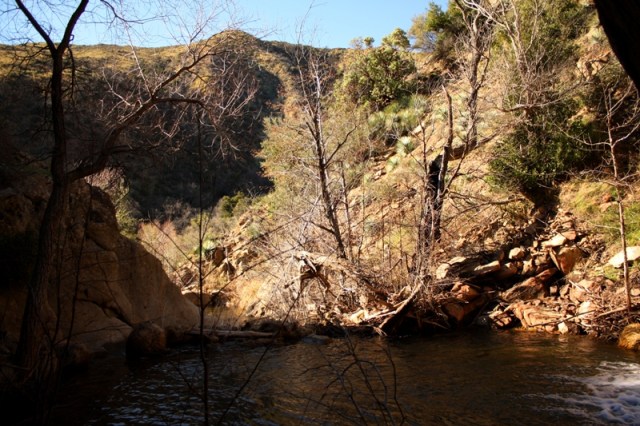
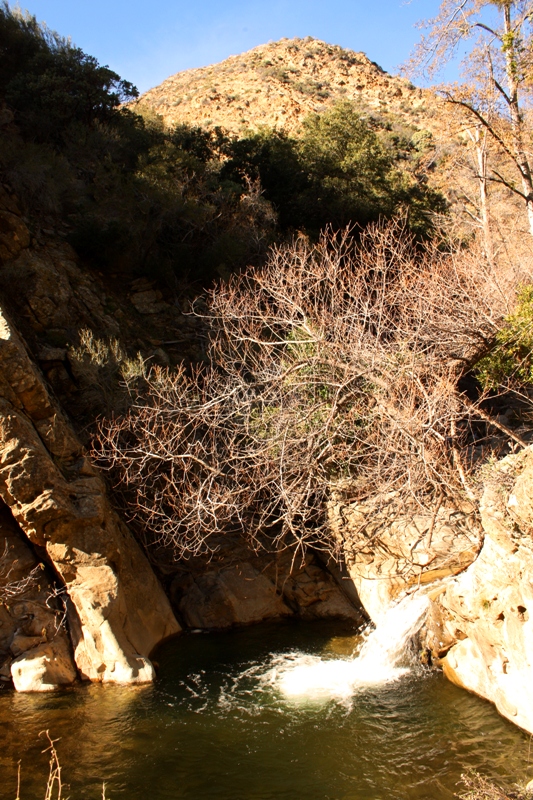
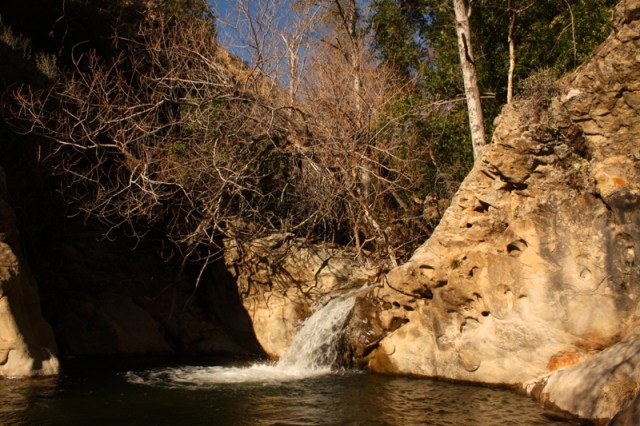
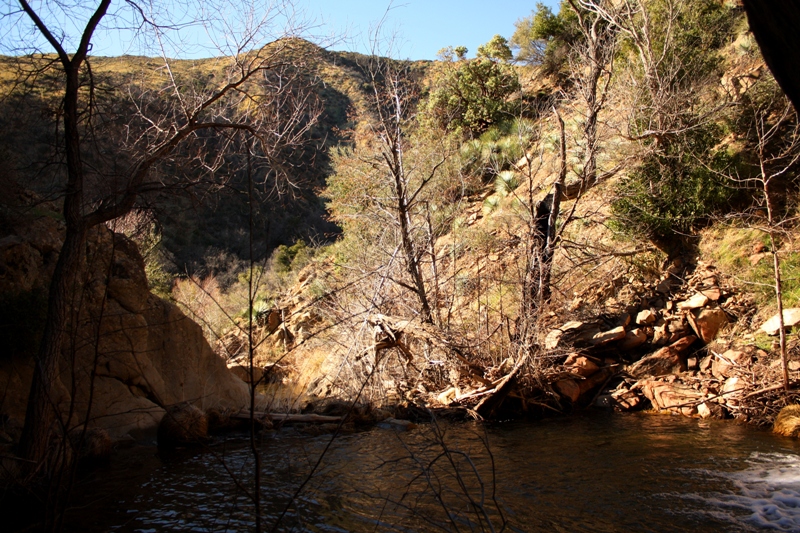
I spent ten hours wandering around up Lost Valley way and covered nearly 12 miles altogether winding and weaving around on and off trail here and there.

I rolled into Nira Campground early Tuesday morning and nobody was around. I smiled. I didn’t see a single person all day.

It was a chilly, blustery day without a cloud in the sky. I walked up Lost Valley Trail eventually making my way past twin oaks camp, and on up the switch back section of the old road cut and through the small potrero.

A stiff wind was howling across the land, as it often does, and in it I could feel the same timeless force jabbing at me that has been carving the area’s sandstone formations for eons.

The throaty cackle of ravens and the howl of wind across desolate stretches of chaparral and sandstone, that’s the sound I always appreciate when I’m up in that area. The problem with a day hike is that I get up the trail a good distance and just want to keep going.

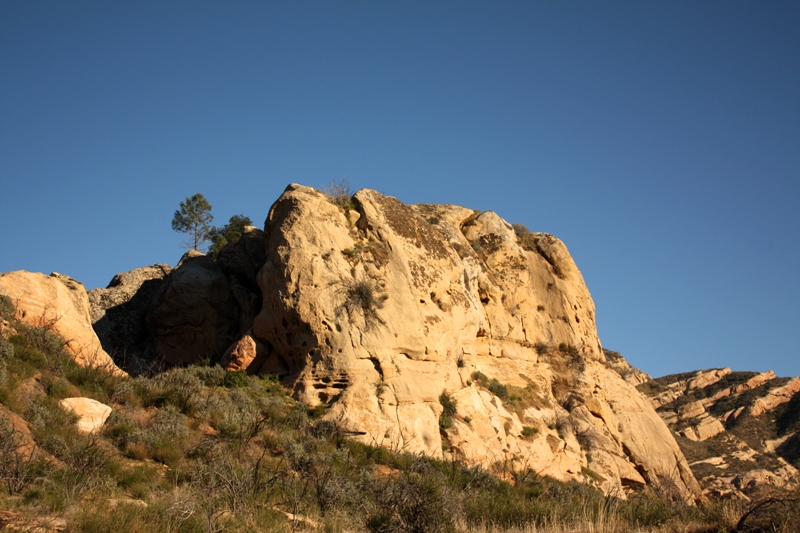
The approach to so-called Castle Rock. There is another formation named on maps, Castle Rock, which is on lower Manzana Creek.

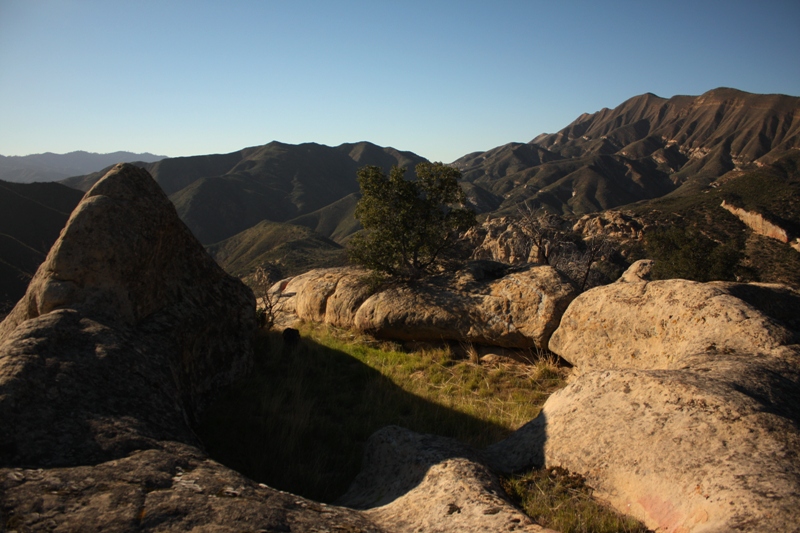
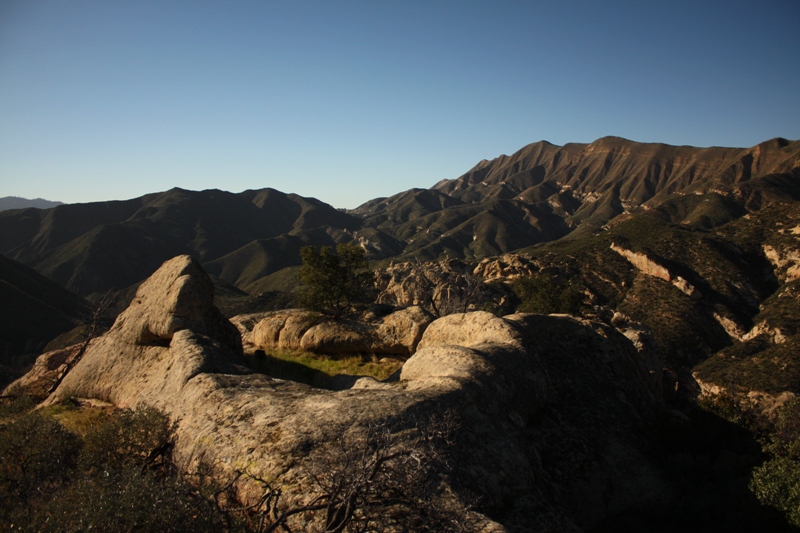
The grassy nook on top of Castle Rock with Hurricane Deck defining the skyline on the right.

A view of Hurricane Deck from Lost Valley Trail. Castle Rock is noted center frame with the small red dot.

Looking over the potrero toward Hurricane Deck in the distance.

Looking east from Lost Valley Trail.

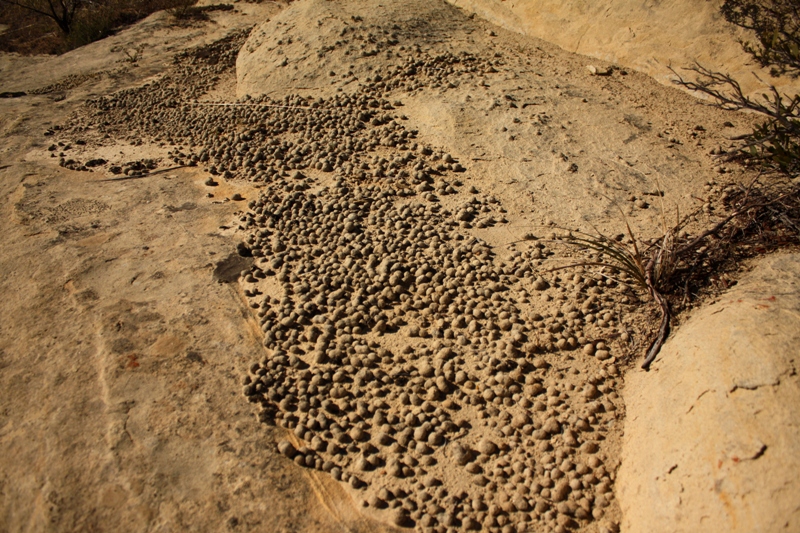
The wind is scouring out these roundish little balls of stone from the larger sandstone bedrock formations. These naturally carved marble-like pellets have been eroded free from their lithic encasement and blown together by the hundreds in some places. Elsewhere they are still connected to the bedrock, some nearly freed and others just a bump starting to emerge.

These ones are still in the process of being carved free from the larger piece of stone.

Loose sandstone marbles blown together into the low spots of the formation.

Castle Rock noted by the red dot inside a circle, twin oaks camp noted by the red dot and the line of dashes is Lost Valley Trail.

Posted in Santa Barbara County | Tagged , , , , , , , , , | 3 Comments

Hericium Mushrooms of Santa Barbara County

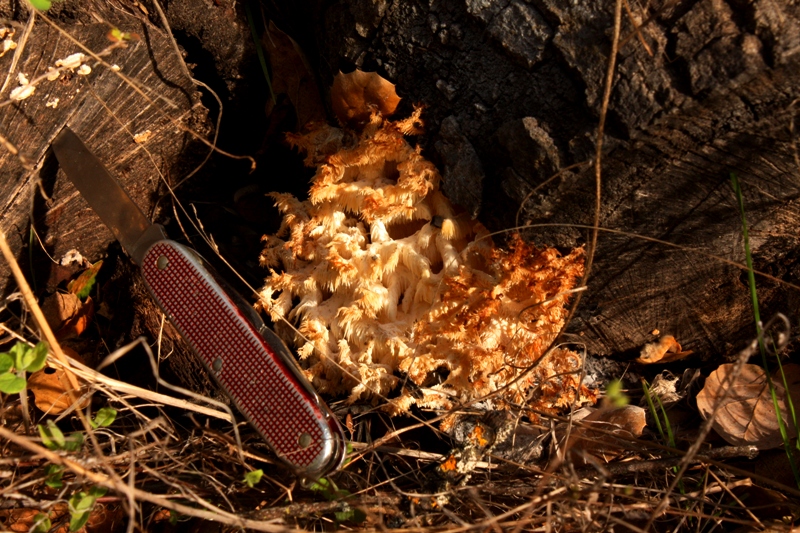
I spotted a Hericium today growing on an oak log alongside a well used trail. Because there are so many different common names for Hericiums (Comb Tooth, Bear’s Head Tooth, Bearded Tooth, Lion’s Mane, Pom Pom, Hedgehog, Bearded Hedgehog . . .), I tend to use the scientific genus name alone when talking about all of them. This particular one, to be precise, was Hericium coralloides or Comb Tooth.

An oak tree had fallen across the path sometime in the last few years and had been cut up and cleared to the side. On the opposite end of the log there was another mushroom of the same type and size, but unfortunately both specimens were far past their prime.

H. coralloides shown in the morning sun turning brown, past its prime and drying out.

The genus Hericium includes several species of fungus all rated as choice edibles by the Audubon Society Field Guide to North America Mushrooms. “Like other Hericium species,” the guide notes of H. coralloides, “it is a very good edible when young.” Once it begins to turn brown the window of opportunity has passed and it’s not worth harvesting. And certainly not when it looks like the one in the photo above.

The Comb Tooth, previously called  H. ramosum, was recently renamed H. coralloides. The new name fittingly reflects the mushroom’s coral-like branching growth structure, which distinguishes it from other species. Two types of Hericium grow on Coast Live Oak trees in Santa Barbara County and the surrounding region. Apart from H. Coralloides, there is also H. erinaceus.

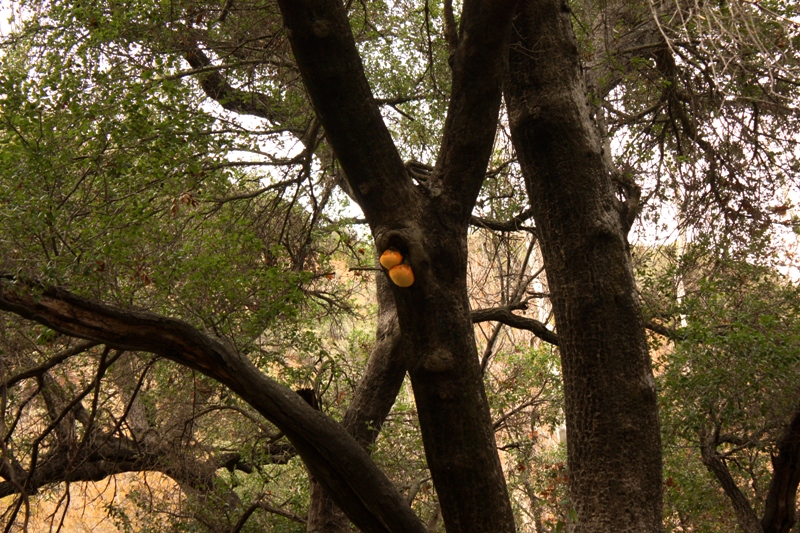
Right after I found the two H. coralloides, for some reason, I had a good feeling that I was going to find more. And not more than a minute after I stood and began slowly walking away from my first find I looked up to see a nice sized H. erinaceus growing, characteristically, in an old wound on a tall oak tree.

H. erinaceus has a compact growth habit and does not branch like H. coralloides.

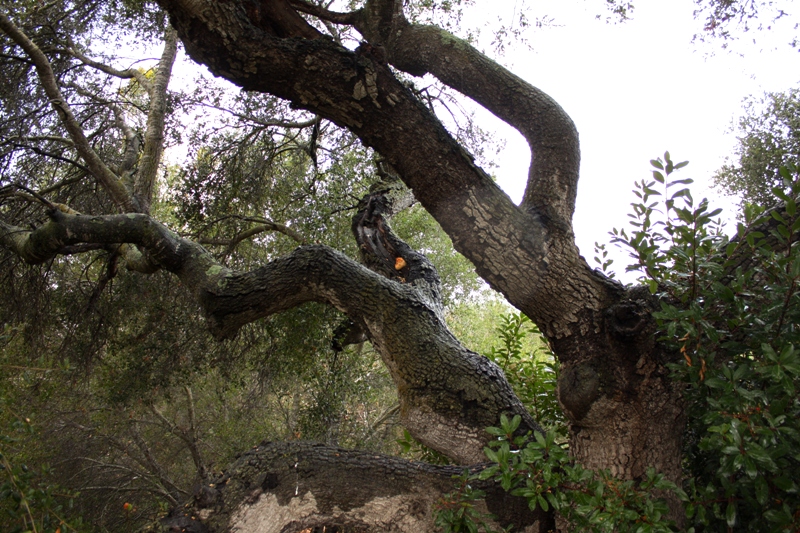
While H. coralloides grows on dead and decaying Coast Live Oak wood, H. erinaceus grows on living oak trees and is found in old wounds or where the bark has separated to reveal the wood underneath.

As with most other mushrooms, look for Hericiums after the rainy season dumps the first good drenching on the land. Typically H. erinaceus needs a decent amount of rainfall to trigger its growth, because it tends to grow in the wounds of trees which are often on the undersides of large branches and in areas otherwise shadowed from the rain.

This season I have been late to the scene of every Hericium I’ve found. Unlike chanterelles, they do not grow together in large numbers, which makes harvesting them more challenging. Finding a chanterelle grow site typically ensures an abundant harvest of many mushrooms often times measured by the score, whereas coming across a Hericium site means finding a single mushroom.

I have known about several sites for a number of years, but I never made it a priority this season to drive or hike miles just to check on one Hericium. However, because they do indeed grow in the same spot year after year, I’ll have the opportunity next season to return in time to harvest them. Below are some photos of H. erinaceus that I’ve taken during the last couple of months.


An old withered H. erinaceus as seen in mid-December. I'm not sure if this one had already completed its growth cycle for the season and had sprouted from November rains, or if it had yet to sprout.


A close up of the dried mushroom shown in previous photo.

H. erinaceus growing high on a limb.

A close up of previous mushroom.

I spotted this H. erinaceus from the road while driving.

A closer shot of the previous mushroom.

Related Posts:

Chanterelle Mushrooms: Hunting Santa Barbara County

Jack O’Lanterns and Chanterelles

Baby’s First Chanterelle

Posted in Ventura | Tagged , , , , , , , , , | 3 Comments

Sespe Creek Reflections

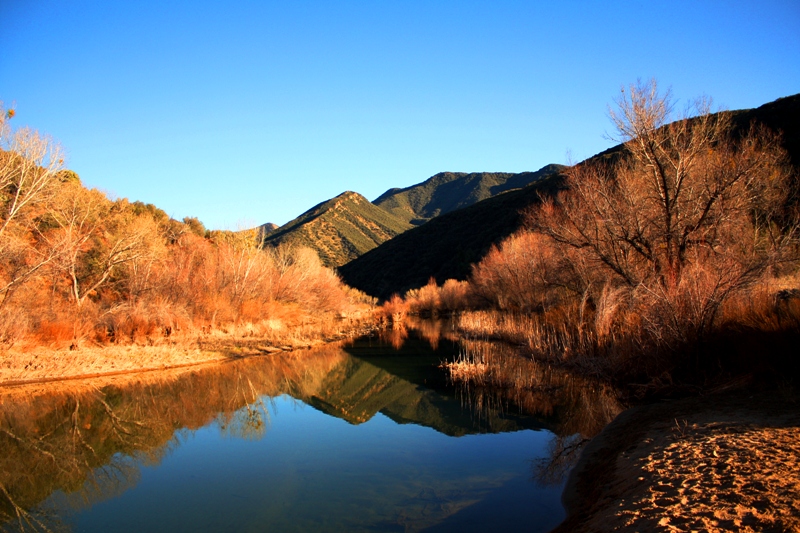
Sespe Creek at Piedra Blanca Trailhead late yesterday afternoon.

Posted in Ventura | Tagged , , , | 4 Comments

Don Victor Valley and Pine Canyon

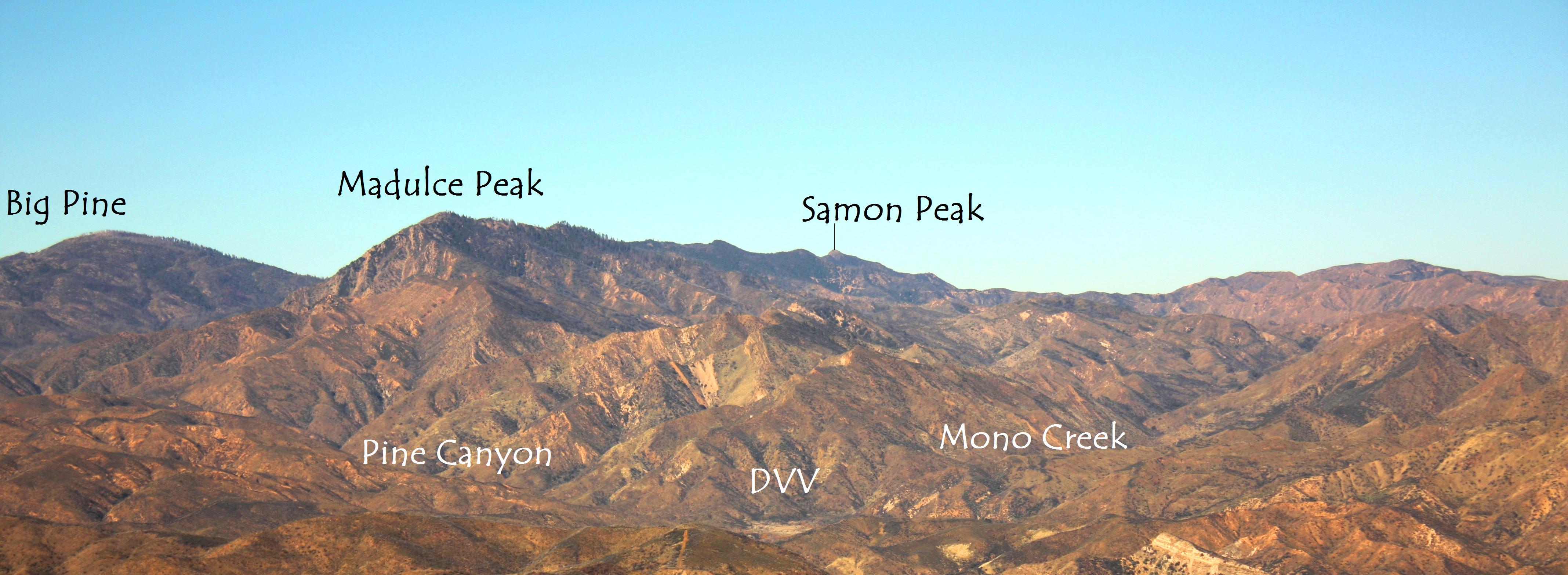
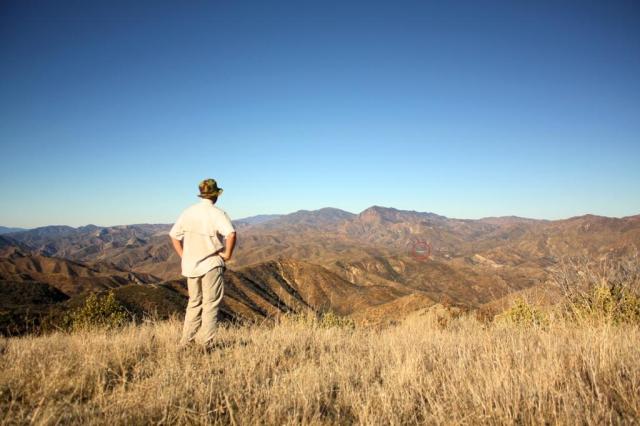
Looking at Don Victor Valley, circled in red, from the junction of Potrero Seco Road and Loma Pelona-Victor Road.
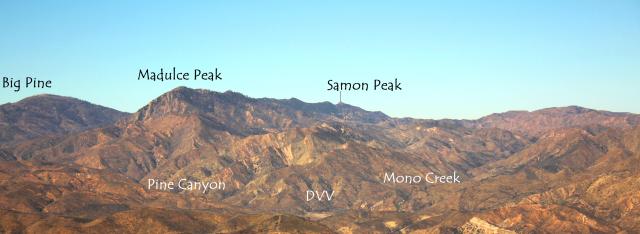
(Click to enlarge.)

“. . .here, where there are still the silences and the loneliness of the earth before man, . . .” -Dick Smith

With a high pressure system ensuring near perfect clear winter conditions—cloudless blue skies, mild temps with warmth in the sun and coolness in the shade—I set off for Pine Canyon in the Dick Smith Wilderness for a two night stay.

Just after dawn I left Highway 33 at Pine Mountain Summit and marched down Potrero Seco Road. I rounded a few bends before the sun cast its first golden-orange beams upon the land, the earthy aroma of which was invigorating in the cool, early morning air. Fresh afoot the day was ripe with promise.

Walking fire road is usually not as enjoyable as hiking canyon trail, but at least Potrero Seco Road and Loma Pelona-Victor Road provide remarkable views of the backcountry. All the way down the ridge running LPVR to Don Victor Valley Madulce Peak looms before you. Unfortunately, the entire region resembles a wasteland in many ways rather than a forest, as it continues its long recovery from the Zaca Fire.

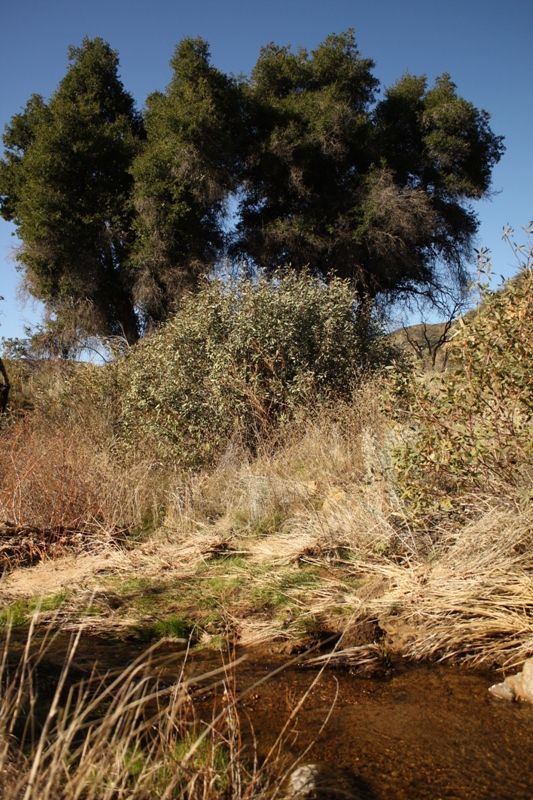
A seasonal creek running by the oaks in Don Victor Valley.

I reached the valley floor and crossed Mono Creek, which although narrow and small was flowing at a good clip through the tunnel of yellow-tinged willows that marks its course through the valley. Animals tracks, mostly coyote and deer, seemed to cover every patch of open sand or dirt.

On my way upstream along the overgrown fire road, I stopped to take a look at some rocks embedded in the cliff above Mono Creek. Just then I heard a squeak and turned to see a hawk soaring toward me. I missed seeing the hawk snatch up its mid-afternoon meal by mere seconds, but it circled directly overhead twice, obviously curious about my presence, and the way I must have stuck out in the desolate valley. And rather than some type of rodent damned if it didn’t have a bird clenched in its talons.

I plodded up the valley along the creek passing where I supposed Don Victor Camp to be, which apparently doesn’t exist other than in an historical or cartographical sense. [EDIT 12-17-2011: “There is a campsite at Don Victor. It’s nothing to write home about but there is a site with a shovel and fire grate on the N side of the creek and some old ice can stoves hiding under the grass on the S side.” Bryan Conant] Somebody had been down in the valley in a Jeep recently and I came across some old foot impressions up Pine Canyon, but other than that, it looked like very few people ever venture into the area. The trails and road were overgrown and I saw no sign of any type of formal USFS camps anywhere.

Pine Canyon trail is matted over with the thatch of several seasons worth of dead grass and the fresh green sprouts of the current crop. It’s overgrown with some brush and trees and buried beneath dead fall in other areas. Despite the overgrowth, however, the trail is still plainly visible in many sections.

I attempted to find its beginning at the mouth of the canyon, but couldn’t locate it and so just barged into the regrowth. I was able to pick my way through the thinned out brush fairly easily, and eventually found myself on and off the trail all the way to Pine Canyon Flats or what used to be Pine Canyon Camp.
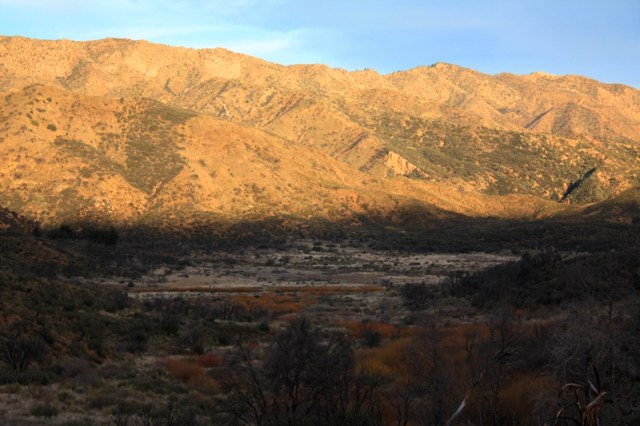
A late afternoon view of Don Victor Valley seen from Pine Canyon. The oak trees in the previous photo can be seen here on the left in the shadow just beneath where the sun is striking the mountain.

A morning view looking at the mouth of Pine Canyon from Don Victor Valley.
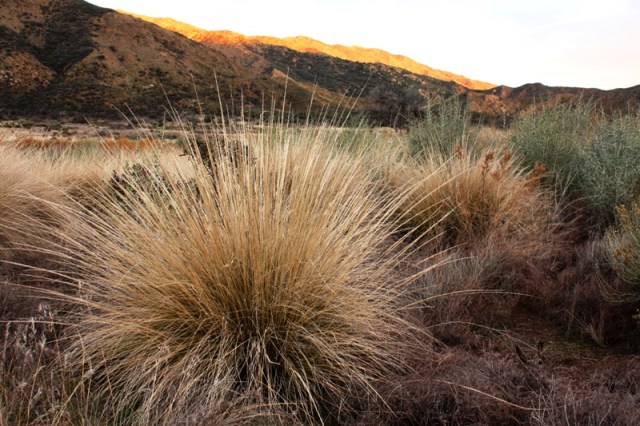
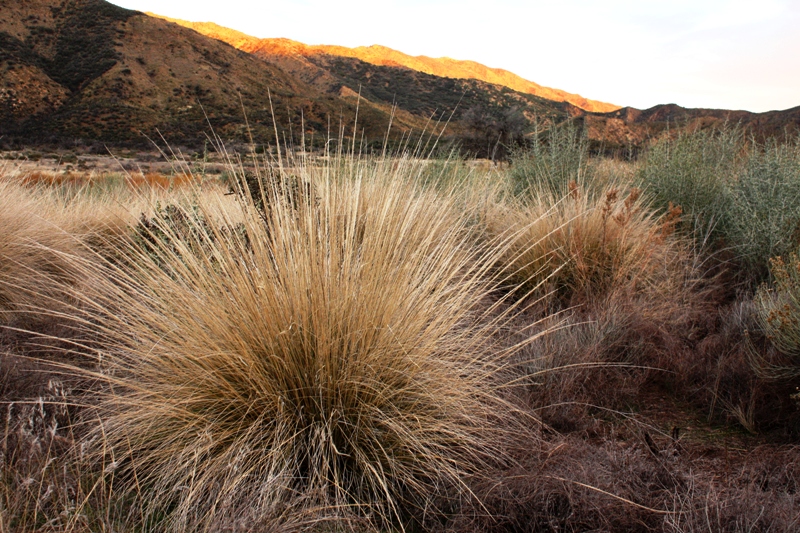
At the mouth of Pine Canyon, there is a patch of huge tufted grass with some clumps growing three feet tall or more. They are an interesting feature of the landscape, as far as grass goes.

Lower Pine Canyon still looking less than glamorous from the fire.

Pine Canyon Flats or the area once known as Pine Canyon Camp.

Pine Canyon Camp at the flats is also nonexistent. Maybe there are some old stoves or rusty iron remnants around somewhere buried or covered by grass, but it looked like it had never been used, except for the faint grass covered depression of a seldom traveled trail heading for the swimming holes of the Jackson Five upstream.

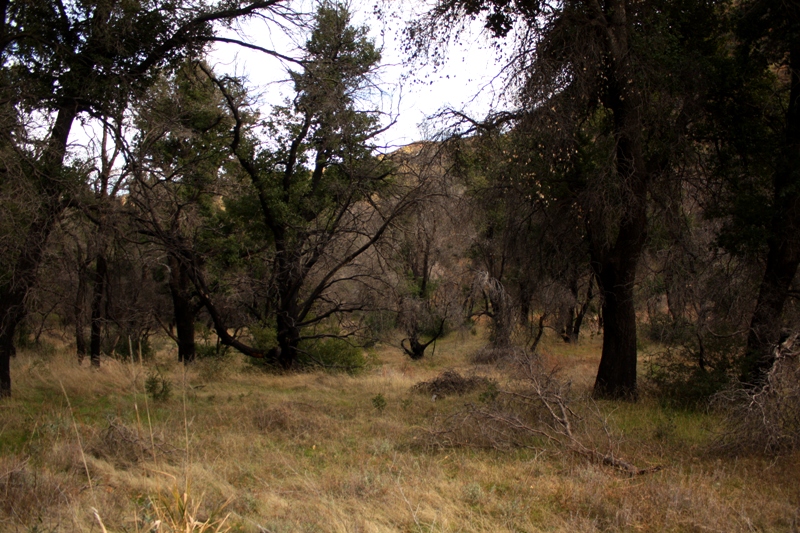
Pine Canyon Flats is set amidst a small oak grove growing on a bar along the creek and provides plenty of places to camp for those who appreciate such informal arrangements, as I do. There are numerous nooks and crannies under the oaks where a fella can set up a sweet little campsite.

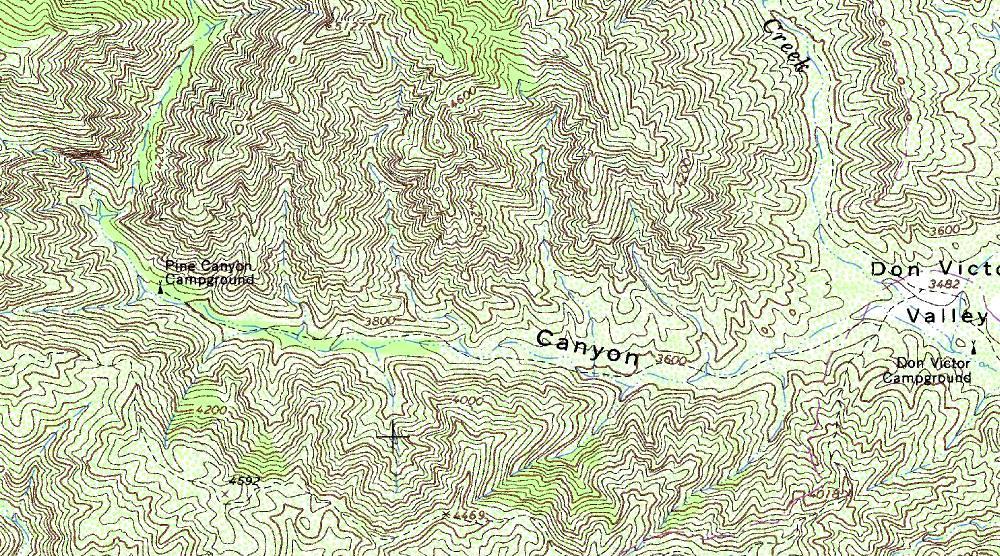
Map from 1988 showing the location of Pine Canyon Camp. (Click to enlarge.)

The first evening a warm wind kicked up after midnight and I didn’t sleep well with the constant rush of it through the oaks. I slept late next morning to make up for it and laid around reading Louis L’Amour and sippin’ coffee well into the forenoon. The wind had died and the creek once more filled the canyon with the sound of flowing water. And nobody else was around for miles. Pura vida!

I hiked up to the first couple of pools of the Jackson Five in early afternoon and kicked around for awhile. The swimming holes had far less gravel and silt in them than I was expecting, and were plenty deep enough to get wet in and swim around a bit. I came across a well gnawed on piece of antler and then got distracted climbing up and exploring a rocky slope above the creek. I didn’t make it up the creek very far.

On the way back I jumped into one of the pools to cool off and freshen up. Well, it nearly gave me a heart attack. It was painfully cold and forced me into a fit of yelling as I scrambled to get out. I don’t have much tolerance for cold water. At least not without waves. The water was refreshing for a split second before its bone penetrating steely cold set in, and it felt as if I was being eaten alive from the inside out. I moseyed back down to camp at dusk later that second day and hunkered down for the night. I was up at first light next morning, broke camp and started home on a leisurely pace making it back to Highway 33 at sunset.

It’s still pretty ugly back there in this area of the Dick Smith and Pine Canyon because of the fire, but at least the trees now have enough regrowth to provide some shelter, shade and ambiance. The oak groves, the year round flow of water off Madulce Peak above the flats, the pools of the Jackson Five and the area’s desolate untraveled nature puts the canyon on my short list of prime backcountry destinations. It looks pretty bleak on the hike in even up through Don Victor Valley, but it has its own appeal and once you get up in Pine Canyon it’s a different realm altogether.
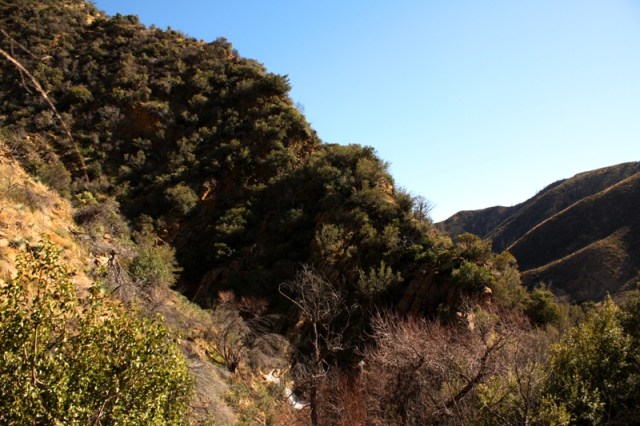
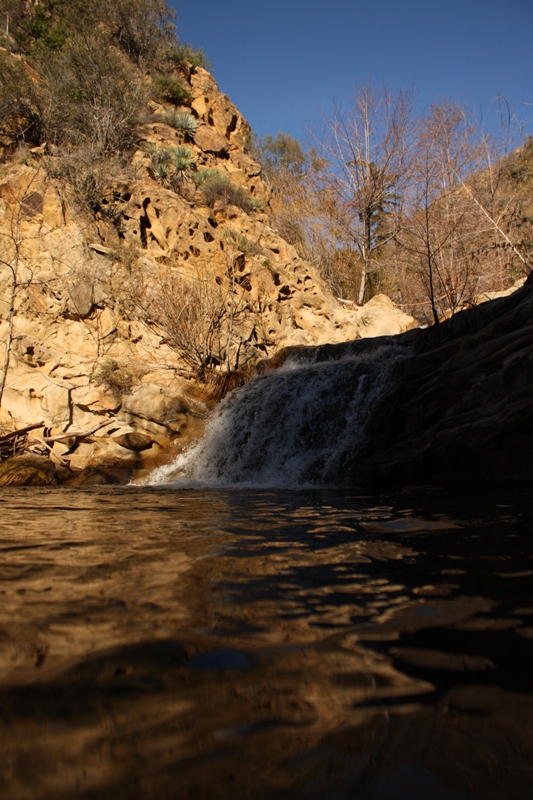
The dog leg in the creek is where the first pool is located.

Posted in Santa Barbara | Tagged , , , , , , , | 6 Comments

Jack O’Lanterns and Chanterelles

I was out wanderin’ around the other day in the Santa Barbara backcountry and happened to be near a place where I know chanterelles grow. I had not planned on picking any mushrooms, but since I was so close I decided to take a looksee at how they were growing this season.

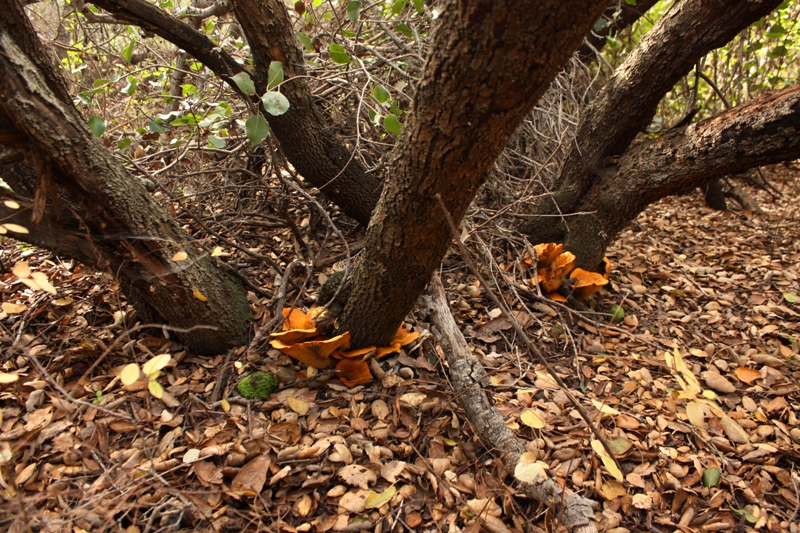
Not more than fifteen feet apart there were both Jack O’Lanterns and chanterelles growing from the base of small trees. And the chanterelles were not growing on the base of a Coast Live Oak either or any kind of oak for that matter, although oaks were nearby.

Jack O'Lanterns sprouting up around the bases of small trees.

Chanterelles growing at the base of a small tree within fifteen feet of the Jacks shown in the previous photo.

Then the incident occurred.
I had just finished packing some mushrooms in my backpack and cranked the zipper shut ziiiiiiiiiiiiip! when I heard footsteps crunching in the leaf mulch a split second before a voiced bellowed, “It’s all poison oak over here.” By the sound of it, the person must have been only a few yards away behind the dense undergrowth.

Crouched in a kneeling position in a black hat, olive drab t-shirt and khaki colored pants, I was well concealed, but totally blew my cover screwing around with the zipper, which I was not at all happy about. And I couldn’t believe I hadn’t heard anybody coming sooner.

The steps marched off in the opposite direction. I knew there were at least two people, though I hadn’t seen anybody, just heard them close by. Real close. For the next ten minutes I sat listening as the crunchy-sounding footsteps came and went. They would get louder then fade away and then suddenly sound again. Twice I caught a glimpse of a guy with a bag stomping around in the woods foraging and I heard voices several times.

At one point, as I was crouching surrounded by a patch of chanterelles, I clearly saw a guy walking toward me in the forest about 30 yards away or so and thought the game was up. I couldn’t move to hide behind anything without making noise in the crispy leaf mulch. The guy was moving toward me, moved behind a small thicket and then I lost him and it went quiet for a little while. A minute or two later the steps sounded again and eventually faded away for good.
I’ve been picking at this spot for many years and have never seen sign of anybody else around. I’m not sure, but I have a hard time believing they didn’t see me or at the very least hear me zipping my bag closed. Hopefully they found and saw nothing and won’t return next season to plunder the spot.

The underside of a Jack O'Lantern showing the paper-thin gill structure, which differentiates them from chanterelles.

Chanterelles lack gills and have, what I would describe as, ridges.

Related Post:

Chanterelle Mushrooms: Hunting Santa Barbara County

Baby’s First Chanterelle

Posted in Santa Barbara | Tagged , , , , | 6 Comments