The Crackling Oak Forest of Aliso Canyon

White Fire Aliso CanyonA stand of charred oak trees on an elevated flat overlooking the Santa Ynez River. The White wildfire was touched off by careless recreationists barbequing at White Rock Day Use Area in May 2013.

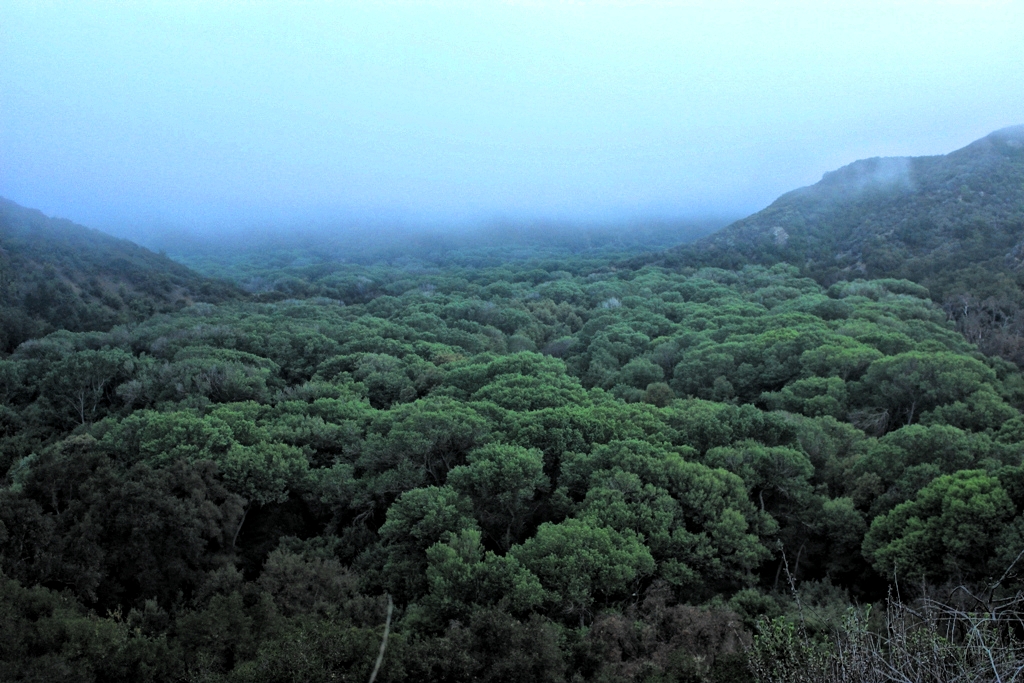
A thick and lumpy Pacific marine layer was flowing up the Santa Ynez River valley and a cool wind buffeted the crests of ridges. The late afternoon low cloud cover added a degree of dark character and attitude to the spring day giving the land a muffled, closed in feel.

I wandered aimlessly around the odoriferous burnt forest. It’s a canyon I’ve hiked through many times, but now I could see the lay of the land like never before, stripped naked and devoid of vegetative cover. Every fold and crease was visible.

I wondered what I might find. I was sure I’d see vintage beer cans long ago tossed aside by littering lushes and buried beneath the now nonexistent leaf mulch. The steel and aluminum variety that required a churchkey to open by punching holes into the can.

Apart from whatever other trinkets I might see, I thought I might perhaps, by the sheer luck of slim chance, stumble across some treasure, something historical from the Spanish colonial or American postcolonial period or perhaps even prehistoric artifacts, like a Chumash arrowhead, a spear point or a bowl. It wouldn’t be the first time, though it’s not a habit of mine to plunder or intentionally partake in such searches. All I found was a rusty horseshoe that now adorns the mid-point of the exterior wall above our garage door.

Aliso Canyon White Fire Santa YnezI climbed a shaley ridgeline to reach an elevated flat forested by a stand of coast live oaks overlooking the Santa Ynez River. I wandered a curvilinear course through the blackened trees inspecting the regrowth, which consisted in part of numerous wildflowers that are particularly adept at taking advantage of the slower reseeding of other wild weeds, which eventually smother or depress the delicate more attractive floral species.

I came to one particular oak that had had its core entirely burned out and stood twisted up into the air from the barren earth like some wicked piece of sculpted black art, as if it had been frozen still in the midst of a death throe as it was burned alive at the stake in some terrible form of sacrifice. It caught my attention enough that I walked over for a closer look.

Weirdo that I am, because, really, how many other people do this sort of thing. I felt compelled to smell its skeleton. I leaned slowly forward into its woody cavity and, with my nostrils inches away, took a sniff.

It was then, with my head inside the charcoal-colored wooden cavity traced with bits of ashy grey, that I noticed it was snapping, and crackling and popping, something like Rice Krispies cereal in a bowl of milk. It sounded like the smoldering coals of a campfire after the flames have died out. I had to touch it just to make sure it wasn’t still burning, though I knew that was silly. That’s how odd, and how similar to smoldering coals, it sounded.
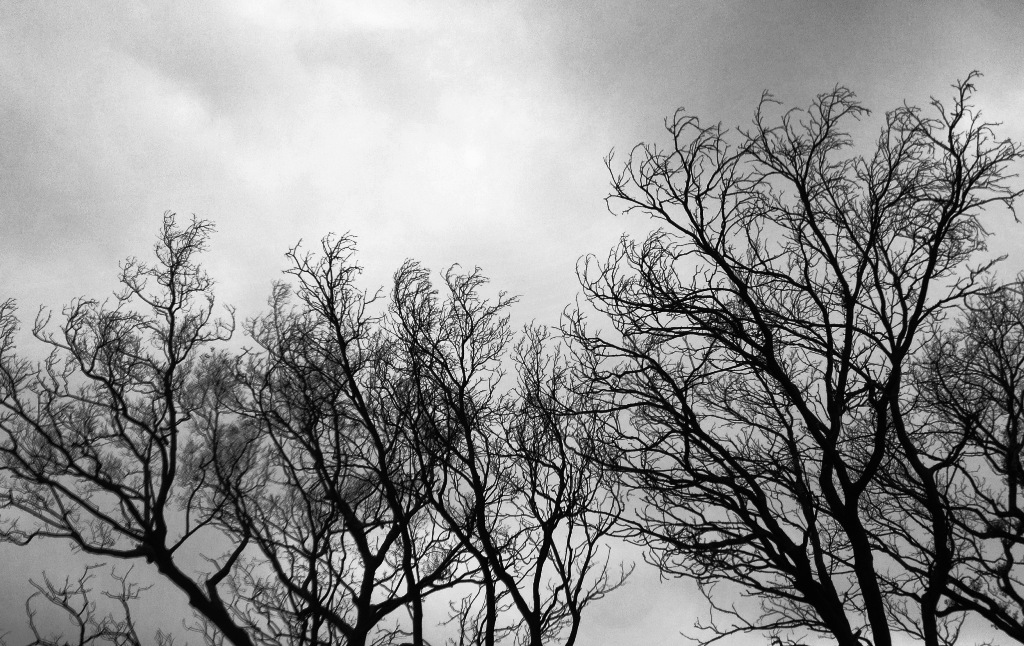
Aliso Canyon White Wildfire
As I walked on, so silent was the place beneath the muffling blanket of maritime fog, I could hear the myriad crackling of an entire blackened forest of oaks cracking in the moist breeze. I stopped and stood looking into the back-lit, black tree skeletons reaching into the grey sky like the gnarled and crooked arthritic fingers of an old man.

The noise did not seem to be the result of scorched, fire-stiffened branches being forcibly bent by the current of air flowing up the valley, as much as it was the moisture in the breath of air blowing against the charcoal in some way playing upon the desiccated carbonaceous wood.

Whatever the phenomenon at work, the faintly lit gloomy and grey late afternoon sky, and the crackling black and bare trees and largely achromatic environment I stood alone within in no way connoted springtime. It felt otherworldly. Like the setting in a mystical realm of some fantastic tale that was about to unfold before me. So far removed did it feel from the bright and cheery, and otherwise ordinary ambiance that that particular patch of land holds on a sunny blue skied day prior to the burn.

Posted in Santa Barbara County | Tagged , , , , , , , , , , | 8 Comments

California Stream Orchid (Epipactis gigantea)

California Stream Orchid Epipactis gigantea Santa Ynez RiverA California stream orchid growing beneath a large boulder beside a seep in an otherwise dry creek feeding into a seasonal tributary of the Santa Ynez River.

I think that all but the keenest, most experienced observers would never suspect there is flowing water up this dry wash when looking at it from the flats below. The arroyo, however, turns into a small, bouldery creek bed that cuts a deep gash into the mountainside, but it’s hidden from plain sight until one gets right up to it. And through a short section of the miniature canyon, even in this year of record drought, water flows.

The creek bed is shaded through midday in the dappled light of a sparse cover of oak and sycamore trees, a mountainside casting a shadow over it through early morning and a massive outcrop shading the area by late afternoon.

Here in this unlikely moist nook, filled with a melange of scents comprised of the sweetness of trickling clear water, the earthy fragrance of wet sediment, and spiked with effluvial hints of decomposing organic matter, a place surrounded by parched south and west facing chaparral-covered hills that are blistering hot in summer months, California stream orchids thrive in abundance.

California Stream Orchid Epipactis gigantea Santa BarbaraA rather large orchid yet to bloom.

I recall the first time I saw this type of orchid in the wild, which is notable, for no other first experience with a native wildflower sticks out so prominently in my mind. I was about 10 or 11 years old exploring the forest with a friend and we found a small clump growing along Mono Creek, just below the campground and debris dam.

Mono Jungle

Mono Jungle

I was surprised to find orchids growing in this semi-arid region of south-central California, though this portion of Mono Creek tends to be exceptionally lush relative its upper reaches and other creeks in general. Nonetheless, the orchids seemed out of place even in the “Mono Jungle.”

I didn’t actually know for sure that they were orchids, but I knew enough to recognize that they certainly resembled orchids, and so that’s what we called them. Always curious, I touched one of the blooms and it moved, under its own power, which made the plant all the more fascinating.

California stream orchids are thigmonastic, meaning that they respond when touched. They move the lower portion of their blooms, presumably as a means to better spread pollen to pollinators that come in contact with their flowers. For this reason they are sometimes referred to as “chatterbox orchids,” for their nastic motions call to mind the jaw movement of a talking person.

Santa Ynez River tributary creekLooking down the dry creek below the seep where the orchids grow.

Posted in Santa Barbara County | Tagged , , , , , , , , , , | 11 Comments

Teardrop, Santa Ynez Mountains

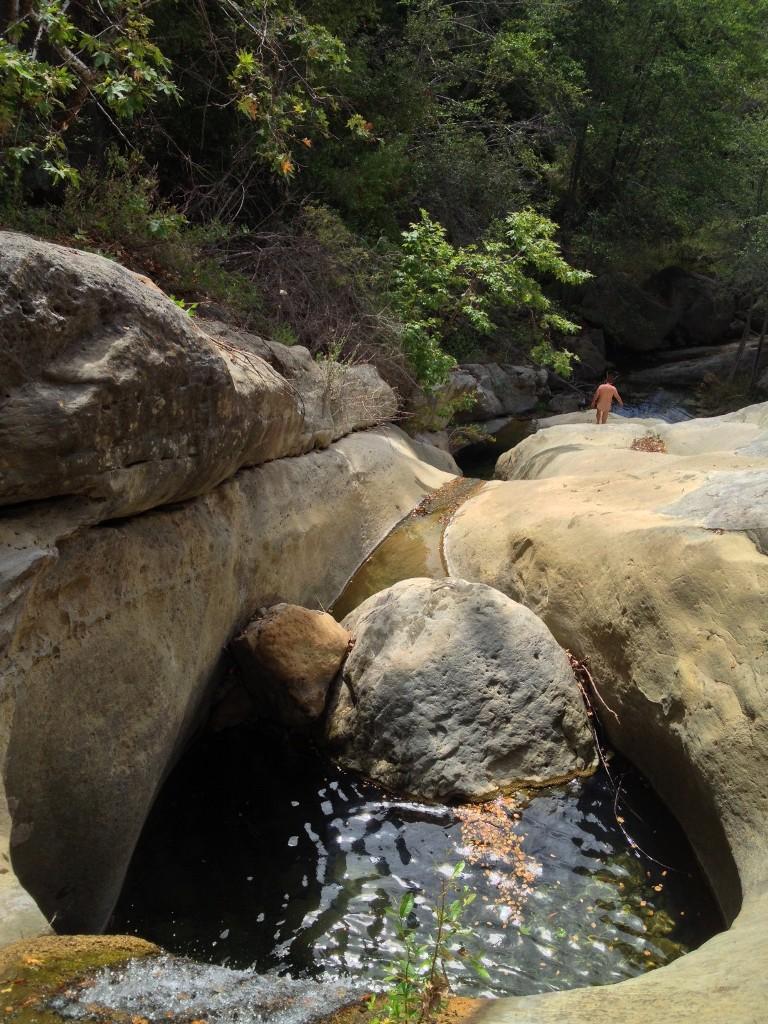
Tear Drop swimming hole Santa BarbaraBare bunned at Teardrop.

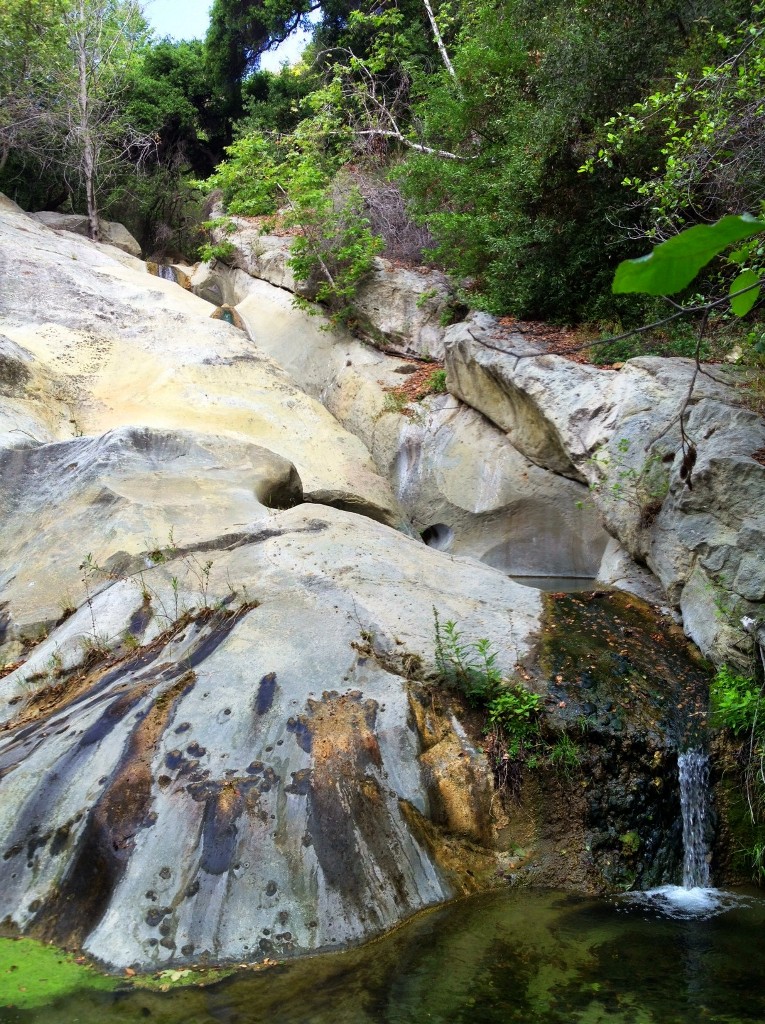
Teardrop was named for its shape. It’s a small swimming hole, a large bathtub, bored out of sandstone bedrock visually and audibly accented by a waterfall dropping into its emerald water. Like many swimming holes, its depth fluctuates through the years depending on how heavily it rains and if winter storms are strong enough to flush the pool of rocks or too weak and so it fills with sediment. Located on a steep slope of exposed bedrock, which provides plenty of room to lay around basking in the afternoon sun, it’s unshaded by forest canopy throughout the hottest part of the day. (Teardrop is located on private property that is off-limits to the general public without permission from Mr. A.)

Tear Drop swimming hole

The waterfall into Tear Drop.

Santa Barbara swimming hole Tear Drop
I lived for a time as a kid not much more than a stone’s throw up the canyon from Teardrop on the old Whitaker property in a Six Pac camper shell with my mom. As one might imagine, it was a humble, nothing fancy time of scant funds and some hardship. I woke more than once in the night to the sound of my mom weeping in the darkness, probably concerned about how to make ends meet and how little she was able to provide for her young son. Yet, as a kid who had few expectations or assumptions about how things should be I didn’t seem to lack much.

There was only one other kid around of my age, an often barefooted boy named Eric who lived with his hippie mom, “Rainbow,” and little sister, Aurora, in a trailer on the other side of a small sloping potrero. He once came to our house wearing nothing but a large bath towel because he apparently had no other clothes.

I didn’t much get along with him, however, and so I spent many hours alone exploring the Los Padres National Forest right outside our aluminum shelled camper door. There was little space inside our “home” for anything other than eating a meal or sleeping so I lived outdoors for the most part during daylight hours.

The point is not to recount some sob story or to say I had it particularly rough, many others had it way worse, but that in such lean times I learned to appreciate the subtle beauty and value of my surroundings, the natural wealth which too often seems to be overlooked by most people.

In combining my imagination with nature the possibilities for fun seemed limitless. I spent a lot of time outside in the mountains discovering in the forest ways to keep me occupied. It was a formative time that helped foster an interest in and appreciation for the Santa Ynez Mountains.

Tear Drop swimming hole Santa Barbara Los Padres National ForestLooking down the spillway from Teardrop pool.

Tear Drop swimming Santa BarbaraLooking up the spillway toward Teardrop.

Santa Barbara swimming holes Tear DropLooking up from the next pool down, the top of Teardrop waterfall barely visible.

Related Post:

Finding Frontier in the Forest Conquered

Posted in Santa Barbara County | Tagged , , , , , , , , , | 11 Comments

Native American Rock Art (Kern County)

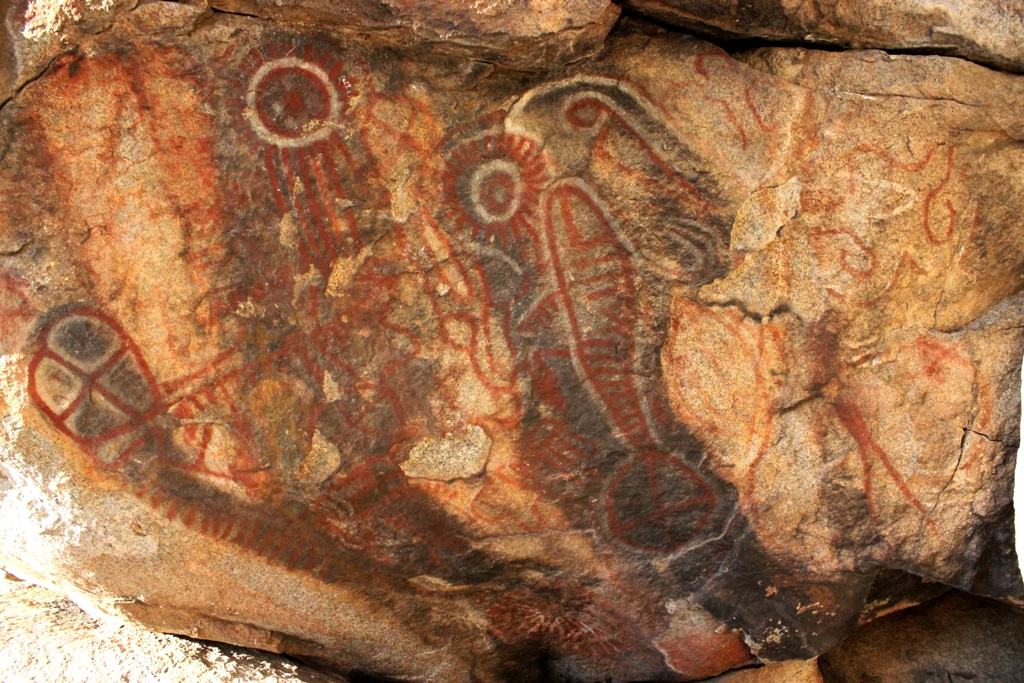
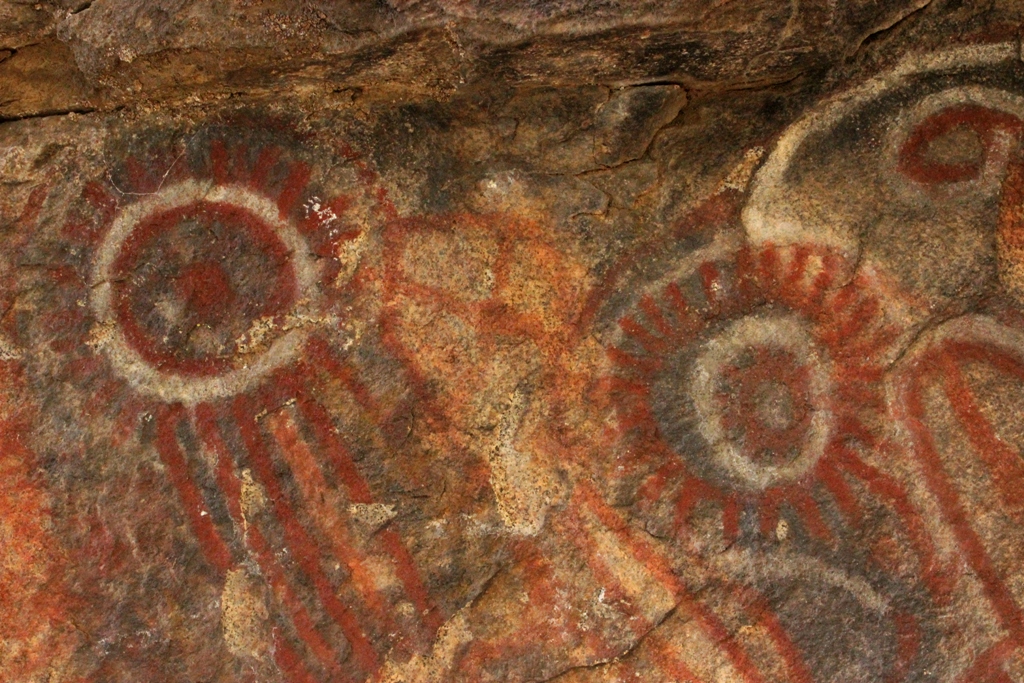
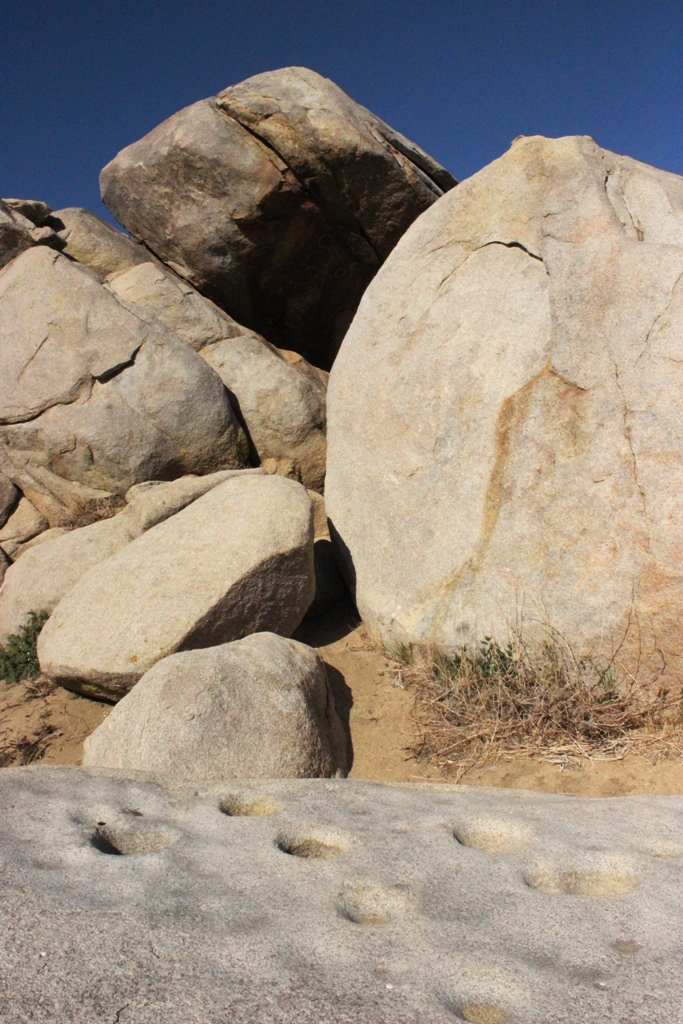
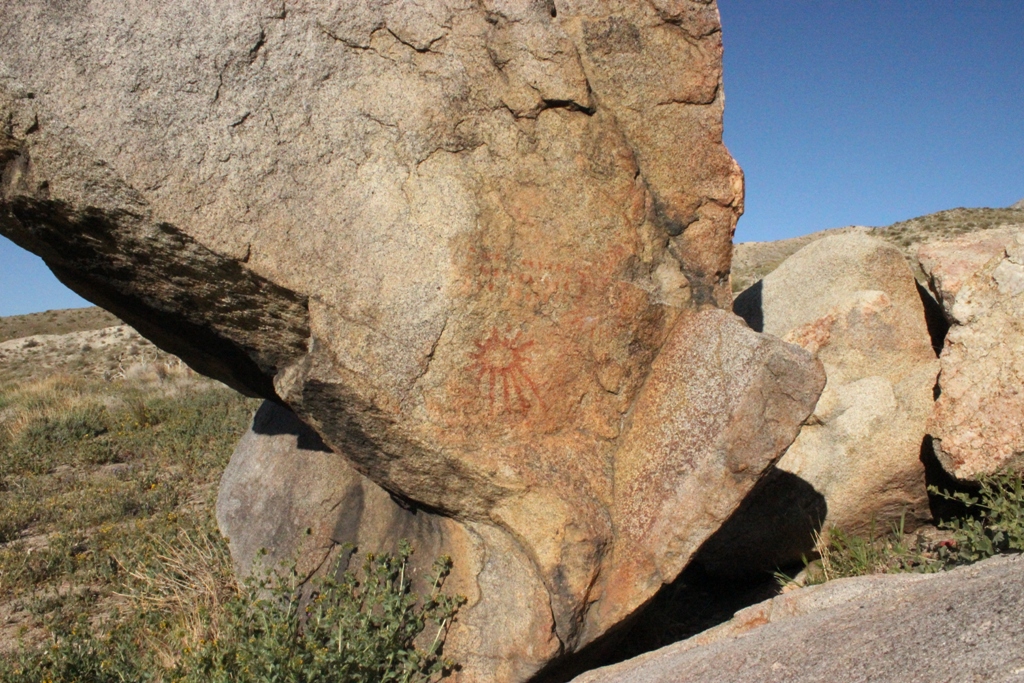
Indian rock art pictographsThis rock art panel painted on granite sits in a shallow canyon along the foothills of a mountain range on the edge of California’s Mojave Desert. More art adorns the underside of a natural shelter formed by the boulders, but has been nearly entirely erased by the elements. A large millstone with numerous mortars lays at the foot of the painted rock and an adjacent boulder is also painted.

Native American pictographs Kern CountyIndian mortars millstoneThe pictographs are found on the shaded face of the boulder.

Indian mortarsI always marvel at deep mortars bored into granite, an exceedingly hard stone. It reflects many long hours of use. Note the patina surrounding the work surface of the stone compared to the rougher edges of the boulder, which also reflects long use of the site. How long might it take to polish granite like that from mere contact with the hands, feet and rumps of humans using the  mortars?

Indian rock art Kern County

Posted in Kern County | Tagged , , , , , , , , , | 1 Comment

Indian Wells Canyon, Southern Sierra

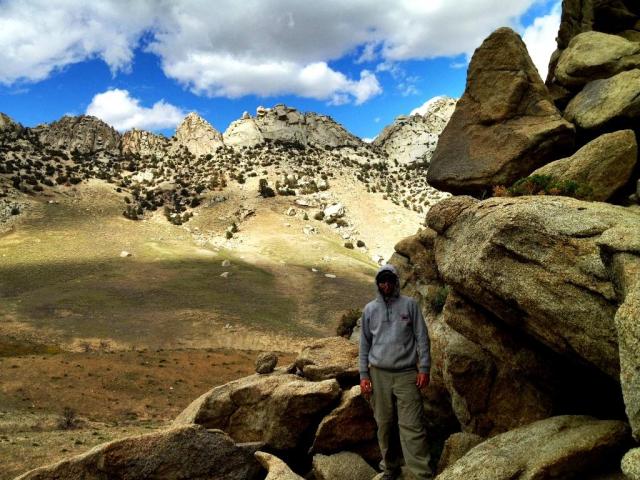
Indian Wells Canyon Kern CountyA view of the ridgeline running down from Owens Peak, which was named by Major General John C. Fremont after Richard Owens, a captain who served in his California Battalion during the Mexican-American War.

During the war Fremont captured the city of Santa Barbara in 1846 after a treacherous night-time crossing over the Santa Ynez Mountains in a rainstorm. Today there is a public campground adjacent the Santa Ynez River named in Fremont’s honor and hikers can follow Fremont Ridge Trail which follows the battalion commander’s historic route over the mountains.

—Walker A. Tompkins, Santa Barbara, Past and Present. [1975]

Named for by John C. Fremont for Richard Owens (1812-1902), an Ohio born explorer (aka “Owings”), who accompanied him on his third expedition to California (1845–46). Fremont also named a valley, river and lake for Owens, whom he considered “cool, brave and of good judgment”. Owens served as Captain in Fremont’s California Battalion during the Mexican-American War, and was California’s Secretary of State during Fremont’s brief tenure as Governor (1847).

—Sierra Club

We put in a cursory effort to try and locate Native American rock art in Indian Wells Canyon, but came up empty, which isn’t a hard achievement to attain when looking for small stains of faded paint hidden along a monstrous mountainside stubbled with a million rocks and looming ridges and peaks.

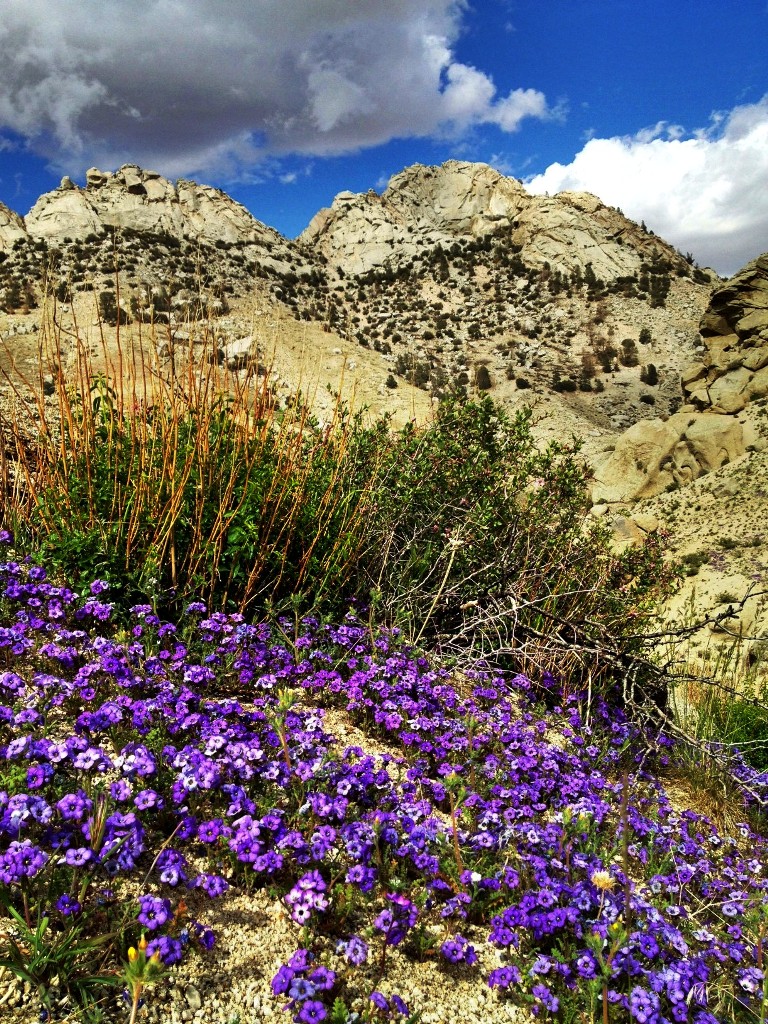
We were rewarded, however, with awesome views of the Sierran landscape. Leaving the stark flatness of Mojave Desert, we climbed by four wheels up the long canyon ’til we reached high slopes covered in knobby granite and conifers and accented with the color of spring wildflowers.

Perhaps a few images may inspire readers to get out and explore places they’ve never seen, because you just never know what you may find even if you don’t find what you were looking for.

Indian Wells Canyon wildflowers and peaksIndian Wells Canyon hikes

Posted in Kern County | Tagged , , , , , , , , , , | 4 Comments