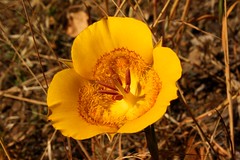
Pine Mountain Lodge Camp

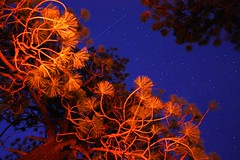
Campfire night under the pine at Pine Mountain Lodge Camp.

Last November I set off in late afternoon on the punishing climb up the Gene Marshall Trail from the Piedra Blanca trailhead to the top of Pine Mountain and the camp near the old Pine Mountain Lodge site .

Don’t ask me why I decided on that route. I’d respond that it was the closest trailhead and the shortest distance to the camp, which isn’t a good answer. You’d have to be some kind of masochist to actually enjoy the grueling uphill trudge. Okay, I might be a little dramatic here, but I’m not a mountaineer-type that routinely seeks out high peaks to climb so six miles of uphill and 3000 feet of elevation gain is plenty enough to start me whining.

I had a leg cramp near the crest of the trail just as the sunlight was starting to noticeably wane. I had a fleeting thought of staying the night right there, but knew I was too close to stop and so lumbered the remaining few hundred yards up the slope, through the cedar trees and toward the camp.

As I walked the flats atop the mountain I heard voices, which turned my typically irascible mood in its usual direction. I don’t mean to suggest that I necessarily have a problem with other hikers, but I certainly don’t hike for hours on end, sweating profusely and straining beneath a loaded pack to find myself surrounded by crowds. That is precisely what I seek to escape. It’s like hiking into a remote surf break hoping to score empty waves and seeing a couple of guys already in the water when you get there.

I moseyed on down the trail to confirm the situation and saw two guys chatting in camp and so turned and headed back down the small creek and through the bush. Fortunately the other camp was vacant. I quickly unpacked and set up shop and sparked a fire as darkness enveloped the land in its cold grasp.
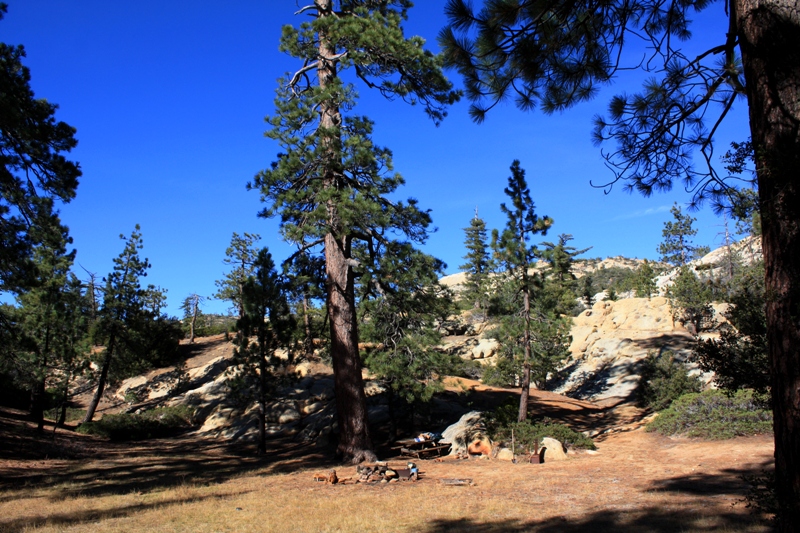
Pine Mountain Lodge Camp. An old ice can stove can be seen to the right of the table. The cave shown in the photos below can be seen here toward the upper right.

It was chillier than I had hoped with remnants of crusty snow scattered about the shadier pockets of the basin from an early storm, but not thinking it’d cause me problems, I foolishly pitched my tent on the hard packed sand in the mini-meadow in which the camp is located.

It’s a sort of depression surrounded by small hills and rock formations. Just the sort of geography that funnels cold air off the hills and down into the low spot where my tent was. It was a cold night trying to rest on what felt like a slab of refrigerated cement. The hour before dawn really sucked.

The next morning I heard the two fellas over yonder getting ready to haul out. Apparently one of them started off before the other, because they were yelling back and forth to each other for several minutes before their voices faded and I had the mountain to myself.

That afternoon I moved my tent to a more sheltered location. I prepared a deep bed of pine needles under the tent and created a shallow, reclined depression to lay in. The needles served as not only padding, but as insulation, too, being that, typically, the cold ground draws the most heat out of a person during the night. Pine needles are excellent for padding and piled up they create a spongy mattress. I also piled up needles on the exterior of my tent for further insulation. I slept like a baby that second night well cushioned and toasty warm.

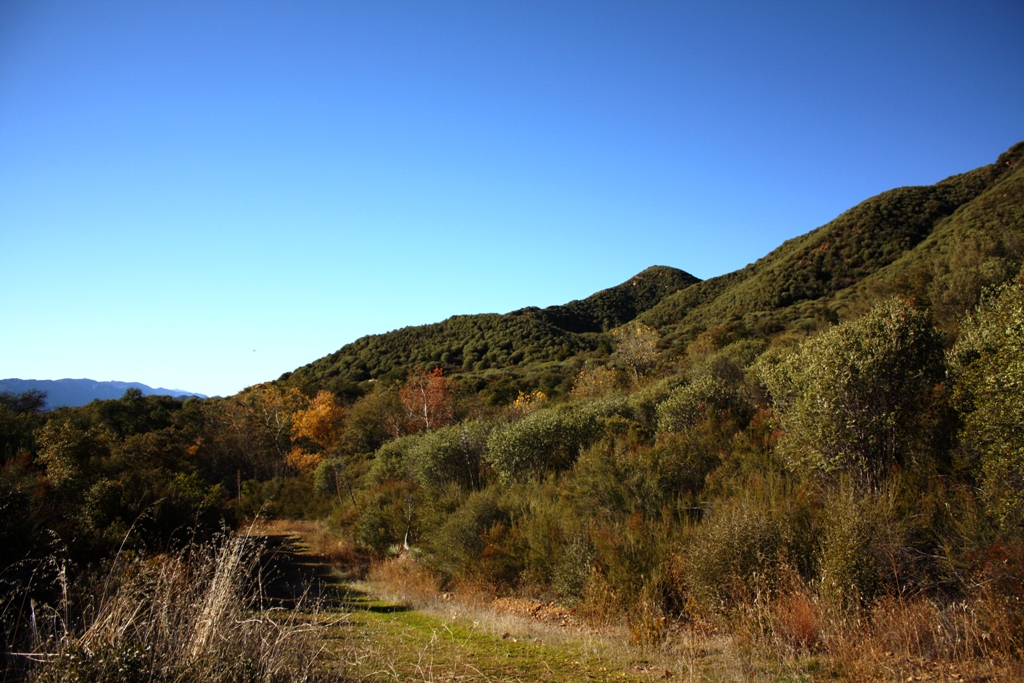
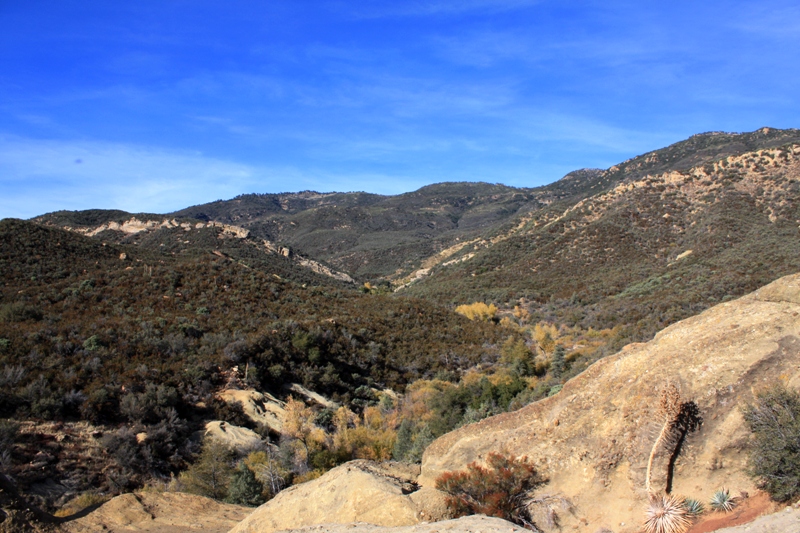
I spent my days lounging around reading at my makeshift Rancho Relaxo and hiking around the basin to see what I might see. I walked up the slope south of the camp and to the crest of the hill, which afforded me a spectacular view overlooking Sespe Creek and the Piedra Blanca trailhead area. I found a hole in the well weathered sandstone up there that looked to me to be an Indian grinding stone.
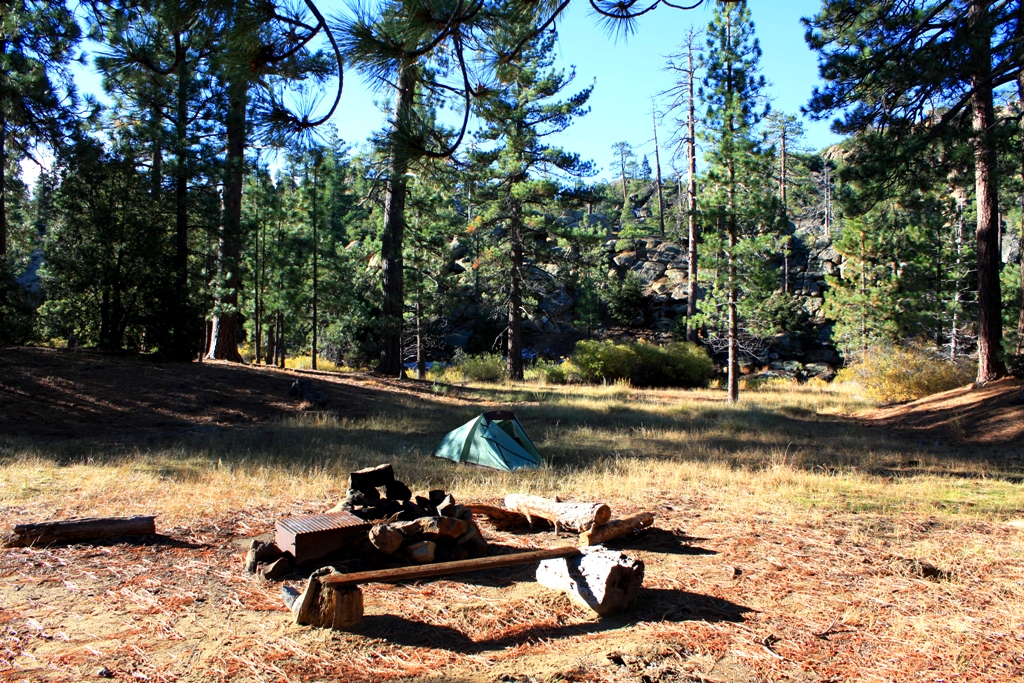
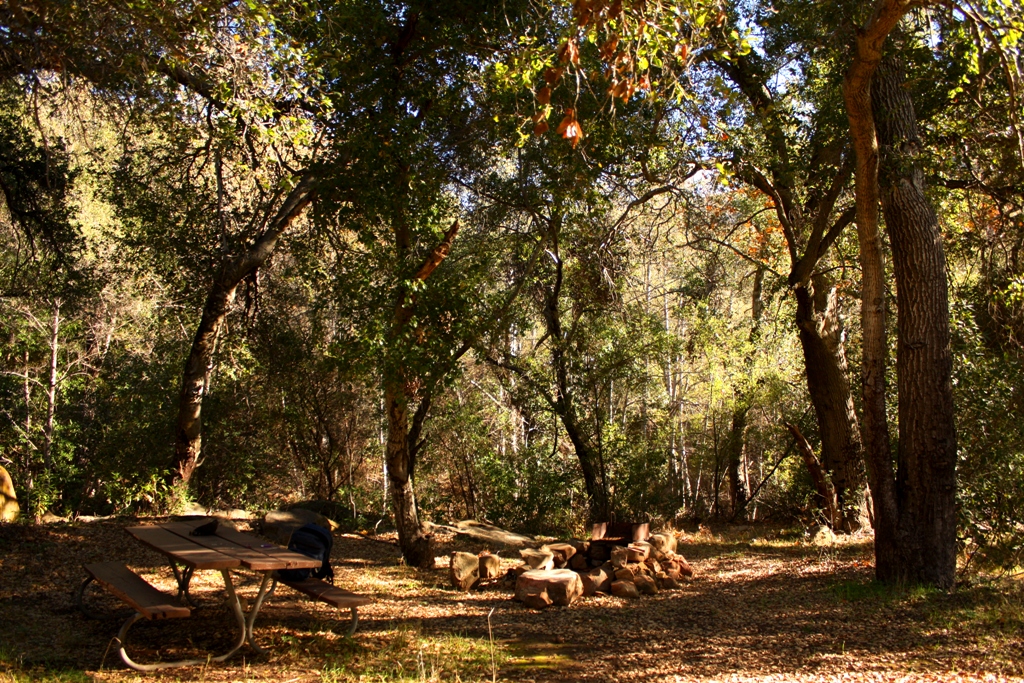
Another view of the camp looking the opposite direction, south, showing where I set up my tent the first night.

After the first night I moved my tent atop a small rise beneath the pines and oaks (seen in the previous photo on the left).

Showing off my pefect posture looking northward over the basin.
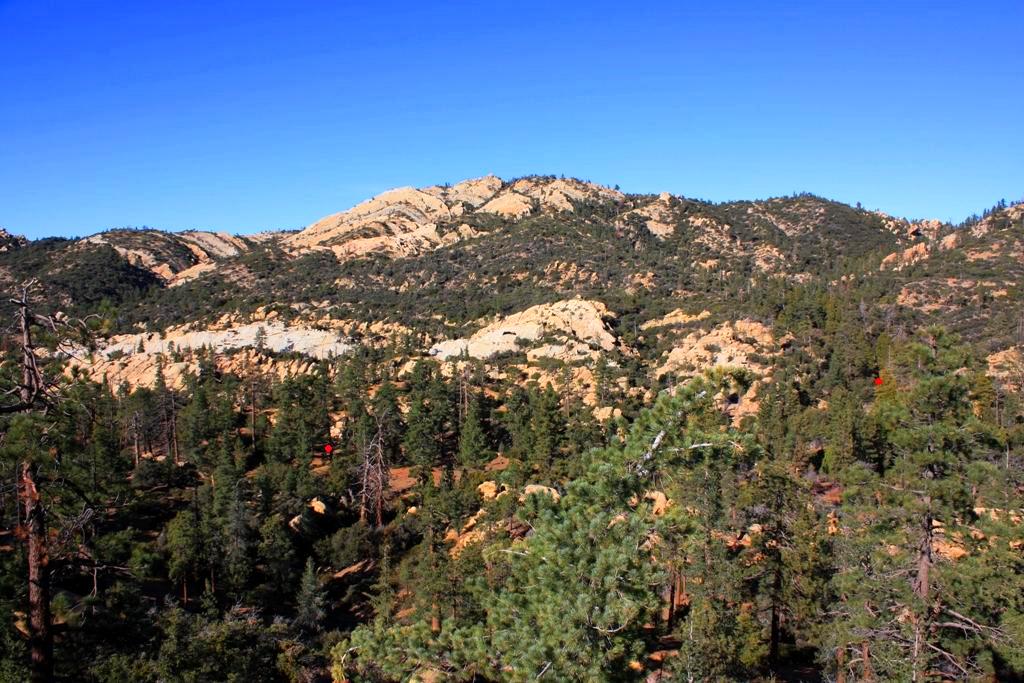
The two dots show the approximate locations of the two campsites. The dot on the left is where the camp shown in the photos here is located.

One of several caves in the area.
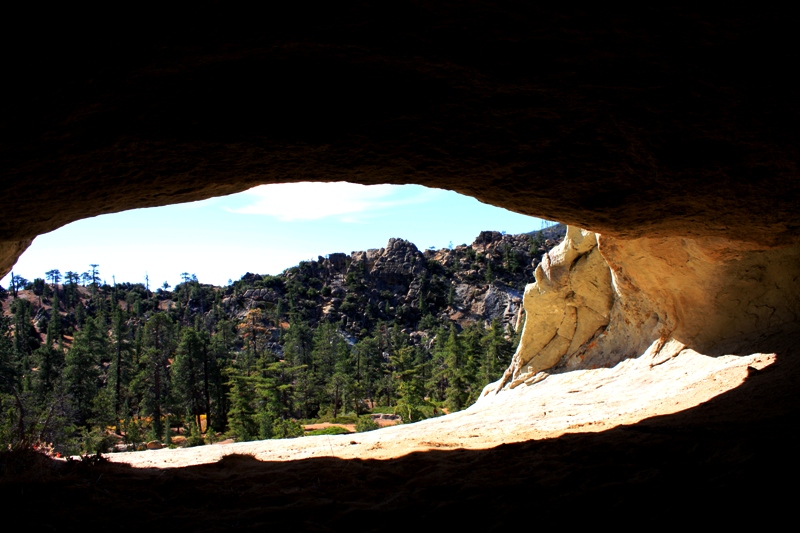
Cave’s eye view.

I assumed this to be a bedrock mortar, but am unsure. Whether it is or not, with a view like that, it sure is an excellent place for working the pestle and grinding up food!
Posted in Ventura | Tagged , , , | 9 Comments

Oaxacan Jungle, Mexico

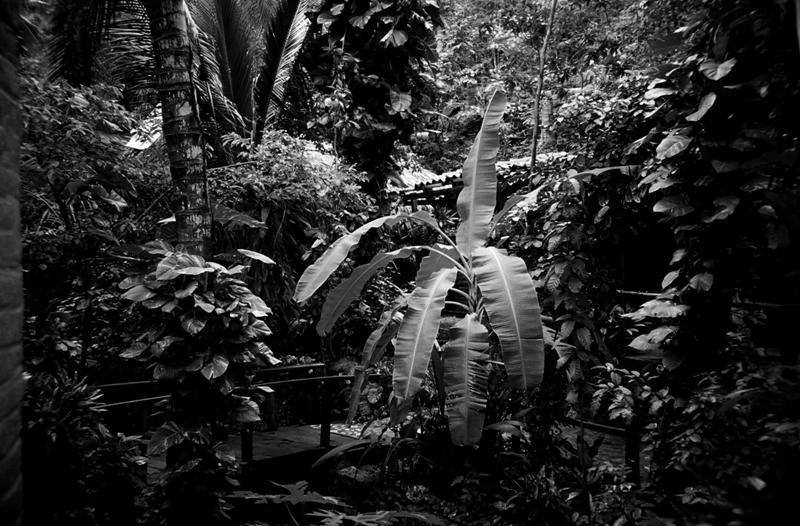
Wooden walkways and tile roofs amidst the verdant tangle of the Oaxacan coast.

Posted in Mexico | Tagged , | Leave a comment

Upper Santa Ynez Camp Vandalism

I spent this last Tuesday in the upper Santa Ynez drainage after hiking in late Monday afternoon and staying the night. I woke at 5:15, broke camp, brewed a tall cup of coffee and chomped down some homemade cake with banana frosting. A slim sliver of moon hung in the twilight of the eastern sky, as the sun began to rise and I sipped my coffee pondering what the day might bring. Few moments in time hold out as much promise as the dawn of a new day.

Later that day I stopped for an hour at Upper Santa Ynez Camp to cook some eggs and refill water bottles. The camp gets little if any use, but there were a few signs that somebody had been there since my last visit in December 2010.

The grill was up and there were a few old coals, but no sign of a campfire in the pit. There was an empty cup of Ranch dressing in the fire pit. Apparently its owner found it easier to hike or bike in the one ounce bit of dressing, but once eaten found it just too damn heavy to pack out the plastic container despite weighing next to nothing.

The most detestable evidence of recent activity at the camp came in the form a freshly carved “Amber and Dad” in the small oak tree closest to the fire pit. Somebody within the last six months blessed us with this tacky, trashy-looking arborglyph so that now when in camp it is constantly glaring at you. I thought about carving it off, but I only had a small Swiss Army knife. I’m not sure if that would be the better thing to do, as it would have left a larger wound, but at least once it oxidized and darkened it would look semi-normal again.

Perhaps I just didn’t notice it before, but the star thistle seems to be really taking over the grassy patches of the woods. What was once grass around the camp is now bristling with thistle.

The picnic table at the camp shows signs of a bear that has torn a large splinter of wood from one of the seats. The claw marks are clearly visible for about a two foot section and were there last December. As I approached the camp this time I came across a rather large wet and shiny bear poop that looked like it was still warm.

The camp is located aside a small alder tree shrouded year round creek and there is a bedrock mortar grinding stone just a few feet from the fire pit.

Upper Santa Ynez Camp

Looking west toward the camp, which is located near the orange-colored sycamore tree. The photos of the camp were taken in December.

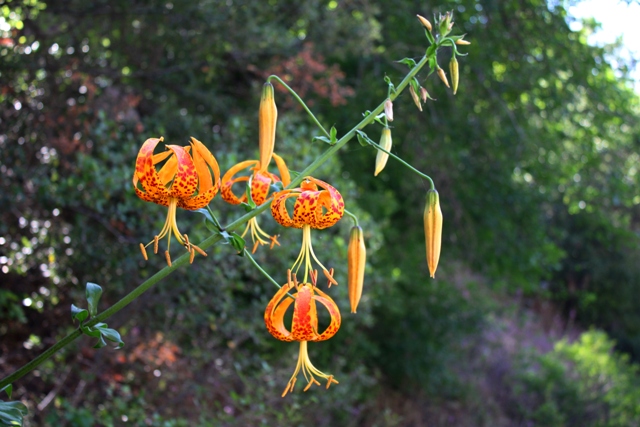
Still a few Humboldt lilies blooming out there.

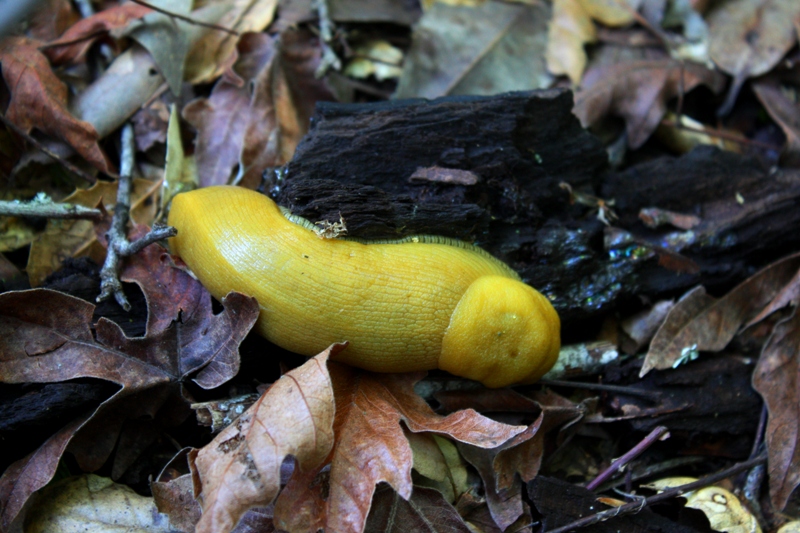
And even some banana slugs still slithering around in the moister niches of the hills.

Posted in Santa Barbara | Tagged | 1 Comment

Bedrock Mortar On Munson Creek, Pine Mountain

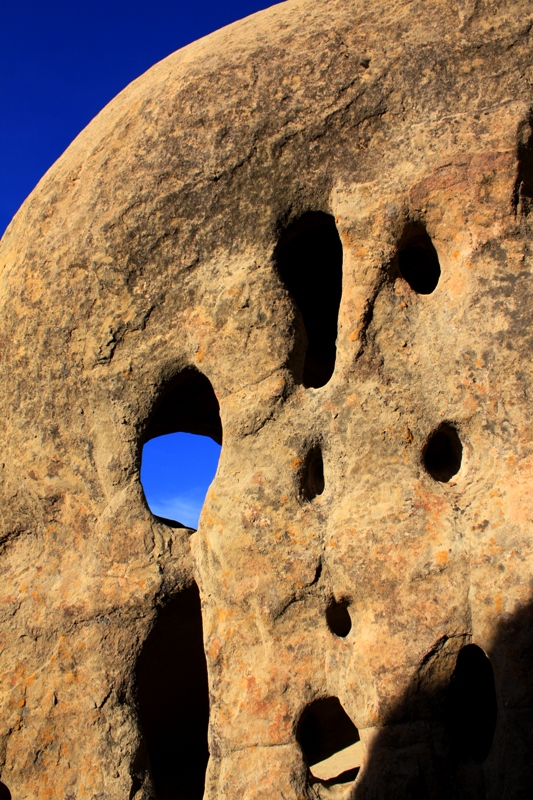
I intended to hike up the canyon to Munson Spring, but a rather dense bramble of wild rose eventually forced me to turn around. My thin nylon hiking pants were no match for all the tiny thorns and my legs were getting shredded. Which wouldn’t have stopped me short normally, but I wasn’t in the mood that day for serving as a pin cushion or bushwhacking and lacerations. So on the way back down creek I wandered over to this rock formation that caught my eye on the hike up. It was filled with holes like Swiss cheese and I had noticed a cave that had looked large enough to crawl inside. Upon entering the small sandstone hollow I found a bedrock mortar.

Looking up Munson Creek from the formation with the mortar.

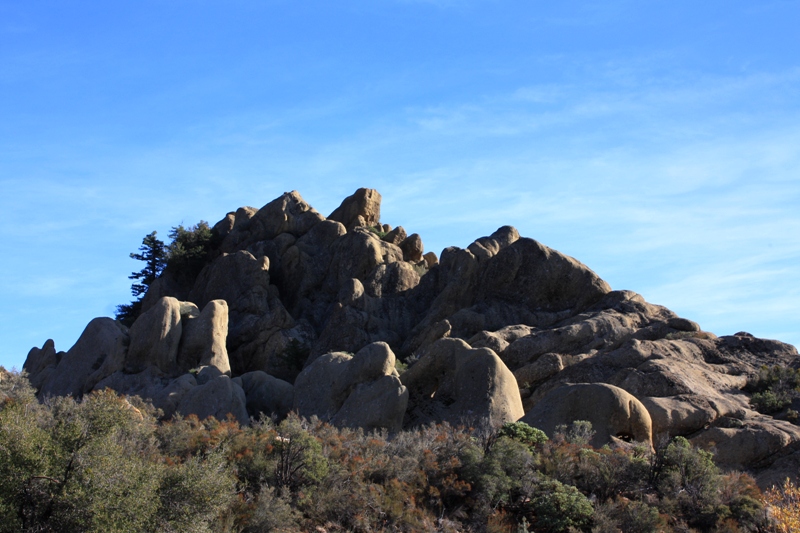
The formation showing the cave mouth just barely visible on the lower right.

Cave mouth.

Inside the cave.

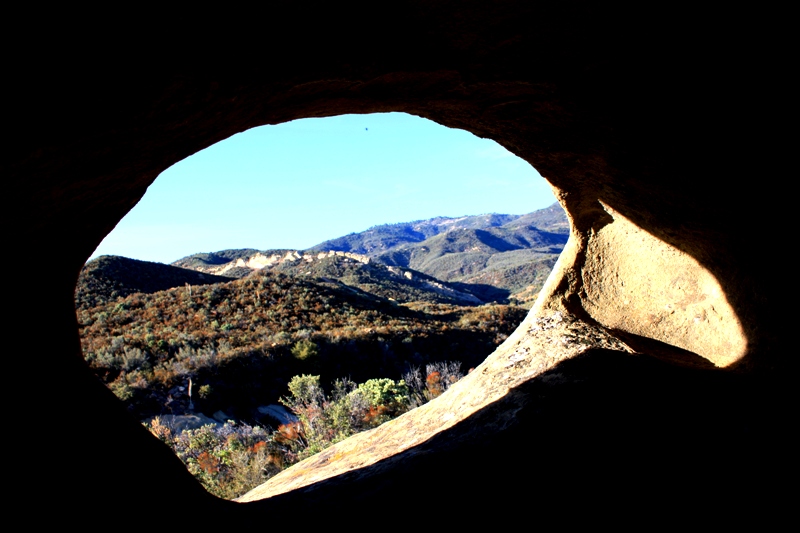
Cave's eye view looking toward the summit of Pine Mountain.

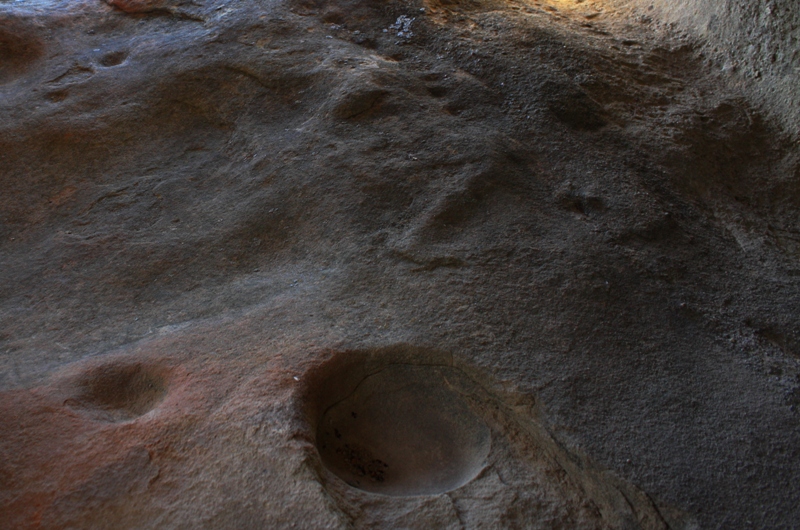
The mortar.

Posted in Ventura County | Tagged , , , , , | 4 Comments

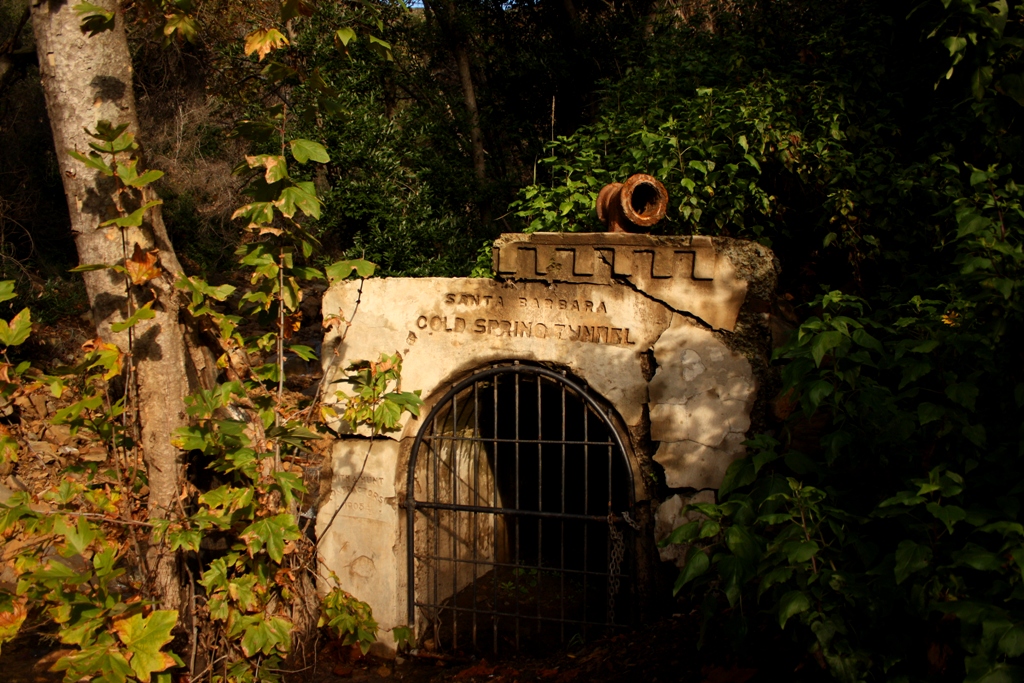
Old Cold Spring Tunnel (1897)

“With continuous boring, this tunnel developed sufficient water by 1897 to warrant a supply main from the tunnel to the city. Civic leaders found the pulse of industry quickening in ratio to the increased water supply.”

Santa Barbara: A Guide to the Channel City and Its Environs (1941)

On the west fork of Cold Springs Creek in the mountains behind Montecito, near where the trail leading down from Gibraltar Road crosses the creek there, the old Cold Spring Tunnel can be seen. It was Santa Barbara’s first municipal or city-owned water supply and its successful completion led to the construction of Mission Tunnel, which delivers water through the Santa Ynez Mountains from Gibraltar Reservoir. The tunnel marks a crucial point of progress in Santa Barbara’s history.

The warmth and dryness of Santa Barbara’s semi-arid climate had long been an attractive feature of the region, but it also posed a great obstacle to the city’s growth. The sun reflects off the Pacific baking a south facing littoral plain that receives on average about 18 inches of rain annually. The inevitable dry spell meant rainfall could be less than half that.

A catastrophic drought in 1863-64 altered the course of history, as sprawling cattle ranches failed and animal bones piled up near dried up water holes. The ranchos were cut up into smaller parcels, which eventually helped attract and provide land for new settlers, but a steady and reliable supply of water continued to be a problem.

The old Mission aqueduct system built in 1806 provided sufficient water late into the nineteenth century. By 1887, however, the aqueduct, along with the historic De La Guerra Wells no longer supplied enough water to quench the demand of a growing population. That same year, the first train rolled into Santa Barbara and connected the small seaside town with the outside world in a revolutionary new way promising even greater growth and need of water. To solve the problem, the city tapped the Santa Ynez Mountains and effectively turned the sandstone studded, chaparral shrouded eminence into a natural reservoir.

In 1896, Eugene S. Sheffield, for which Sheffield Reservoir was named, suggested to city officials that a tunnel be bored into the mountains, which would provide plenty of water through natural seepage and without need of pumping. “Engineers agreed,” Walker A. Tompkins writes, “that the mountain wall was a huge, untapped lithic sponge of porous sandstone collecting and storing winter rains.” Poke a hole in the mountain, the reasoning went, and the water would naturally flow out.

Charles E. Harding of Carpinteria put in the winning bid to construct the tunnel and in 1897, bored to a depth of 5000 feet, it began supplying water to the city. A plug, to put it simply, was secured in the tunnel, which brought control of the water flow and turned the mountain into a giant hydrogeological town water cooler.

At some point several years later, contractors F. S. Smith and E. J. Hunt fashioned a concrete facade for the old Cold Spring Tunnel, as seen in the photo below. Smith and Hunt were the contractors that bored the southern portion of Mission Tunnel starting in 1904, which eventually tapped the reservoir created with the completion of Gibraltar Dam in 1920.

Bibliography:

The Yankee Barbarenos: The American Colonization of Santa Barbara County, California 1796-1925, Walker A Tompkins (Movini Press 2004)

Santa Barbara: A Guide to the Channel City and Its Environs, Southern California Writer’s Project of the Works Projects Administration (Hastings House 1941)

Related Posts:

Tangerine Falls, Cold Springs Canyon

Posted in History | Tagged , , , | 7 Comments