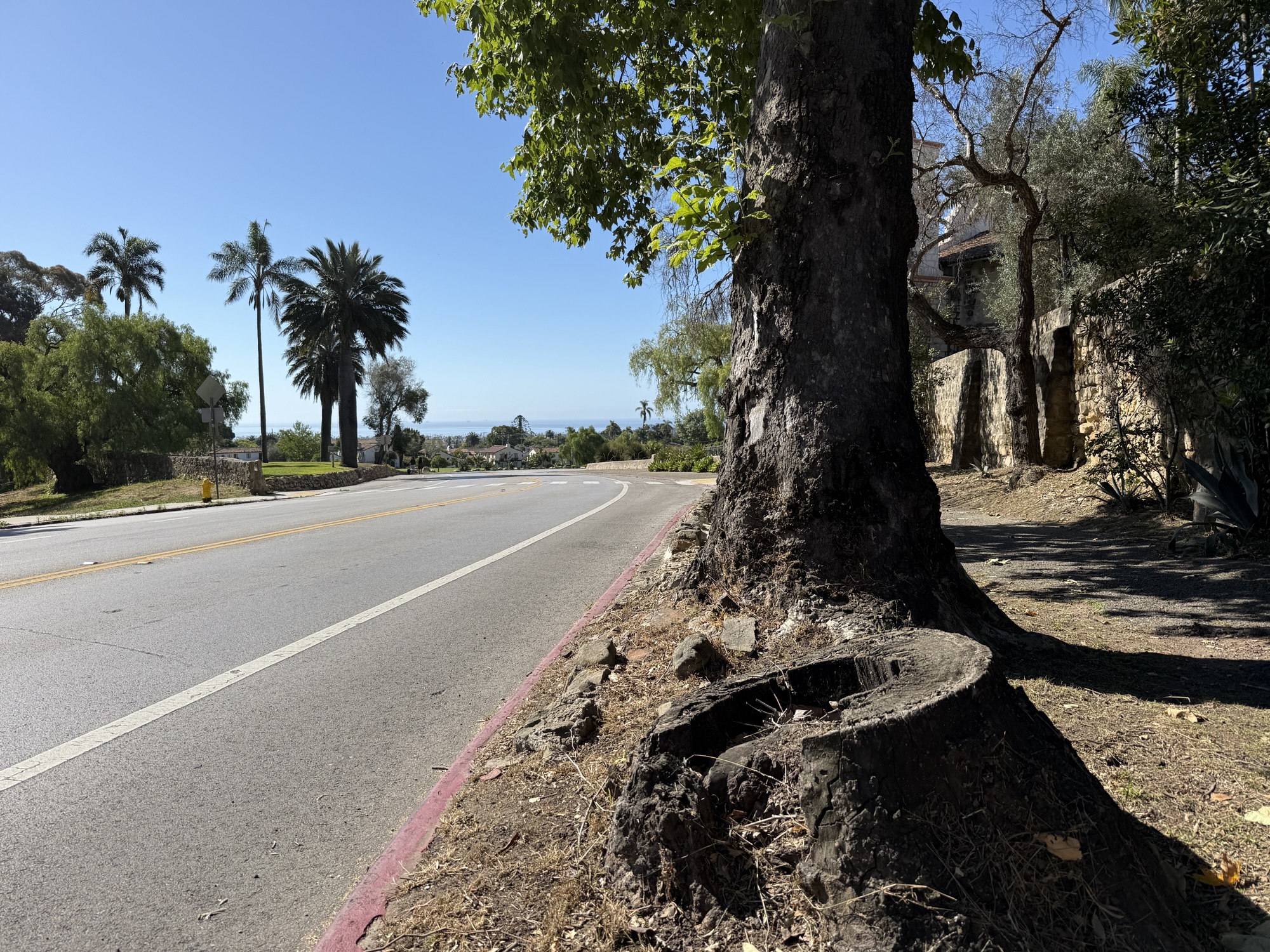
 As dead as it looks, that stump is still very much alive, although the tree may have been cut down decades ago.
The old sycamore stump sprout has been razed yet again.
A maintenance worker apparently snipped it off when clearing seasonal grasses along the verge. The grass and the sprout were cut at the same time.
It’s unclear why the tree keeps getting whacked. There doesn’t appear to be any reason of significance when standing on the scene.
It doesn’t block foot traffic on the adjacent sidewalk and never would.
It doesn’t block the view of cars driving by were it allowed to grow into a tree again.
Although, perhaps, in one hundred years or more it might begin to encroach on the bicycle lane along the road, when its trunk finally became swollen with age.
That distant possibility hardly seems reasonable cause to justify the continued lopping.
The sprout did not last nearly as long this time, as it did in its last effort at a taller life.
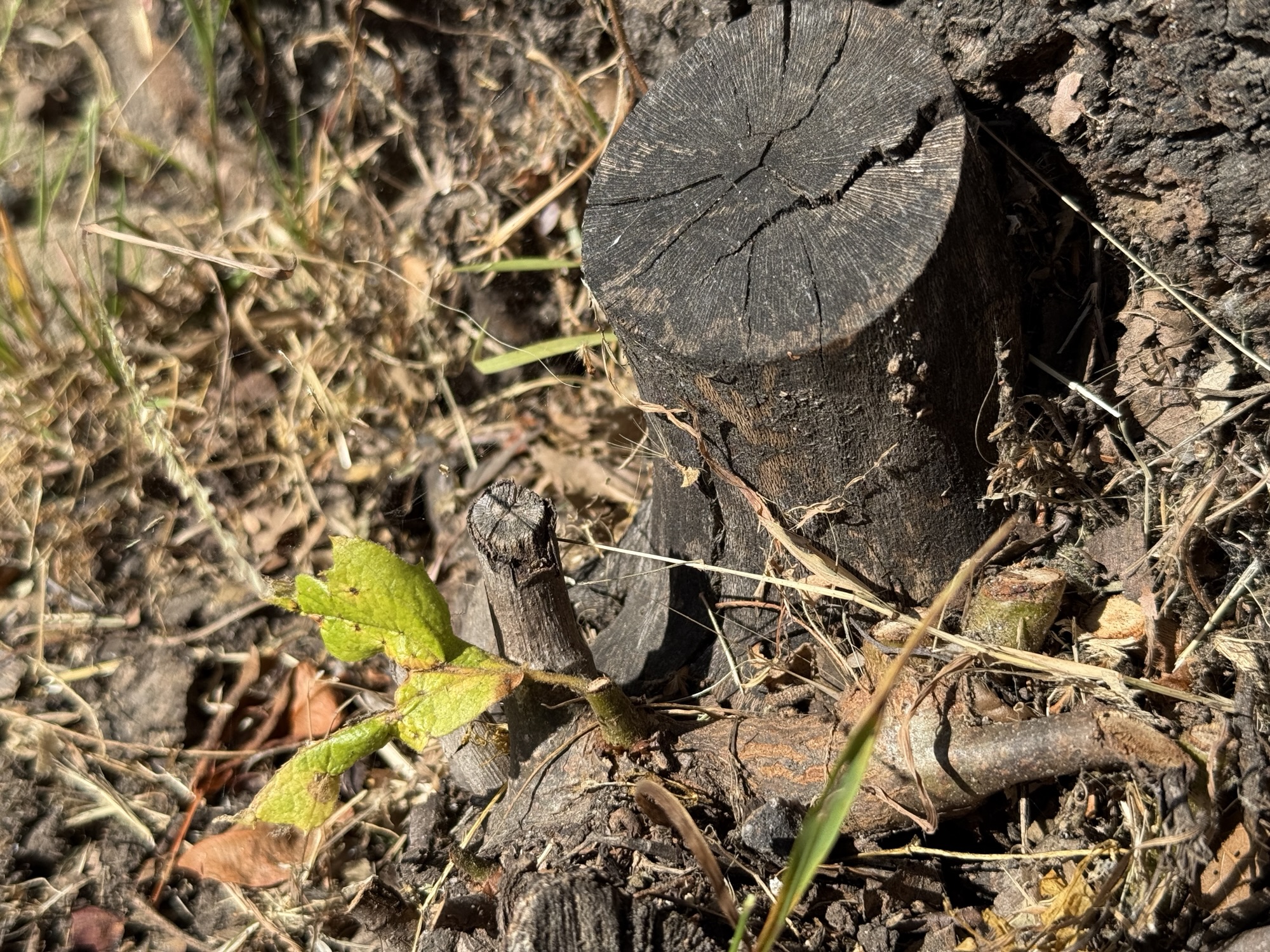 The freshly clipped sprouts with but one small leaf remaining, and a previous sprout of several inches in diameter that had been lopped off the last time.
As seen in the photo above, the last time the tree had reached two or three inches in diameter before being decapitated.
Repeated whacking has only slowed the tree’s visible growth, but not killed it.
A tree may live on long after its central core or heart wood above ground has rotted out naturally and left a cavernous void or has been purposely removed altogether by human hands. That columnar wood is not really its heart.
Common perception may hold that a tree consists mostly of what is seen above soil line, and that may be true in volume, but what exists below ground is really the heart of the matter.
Thus, the girth and height of a tree can be deceptive as a measure of age.
A tree may be far older than what its trunk may suggest. A dead looking stump is not always dead. Counting tree rings does not always provide an accurate measure of age.
And so the latest thin sycamore sprout, looking similar to a young sapling, is in fact merely the freshest growth of a rather old tree.
In a town that first won recognition back in 1980 from the Arbor Day Foundation as being a Tree City, just four years after the program was initiated, its ironic to see this iconic landmark repeatedly chopped down to a nub.
Wouldn’t it be nice if the old sycamore was allowed to grow again to its full potential?
Powered by an existing long established and possibly still extensive root system, and apparently tapped into its twin neighbor sycamore through connected roots and or a symbiotic fungal network, the tree would probably grow rapidly.
Related Post:

















https://photos.app.goo.gl/LhW7h42VEHPs778y5
I captured the linked picture in 2002 with my then awesome newfangled digital camera. So the tree was cut down above ground sometime less than 25 years ago. The second picture, showing its first sprout, or an early one, with an enclosure and sign placed by the city arborist, captured in 2017.
https://photos.app.goo.gl/4Rnf5Fcez9tqRuodA
and here’s a close up of the sign in 2017.
https://photos.app.goo.gl/zvNazEtwGGLgC7mv5
Thanks for the newsletter entry. Enjoy. Tim Pettit
Thanks, Tim! Wonderful photo.