
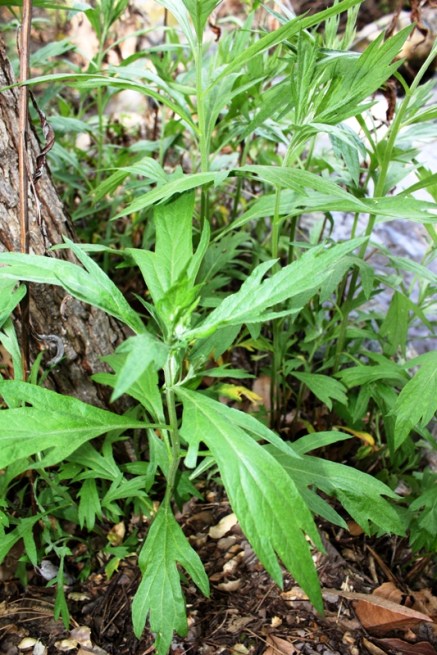
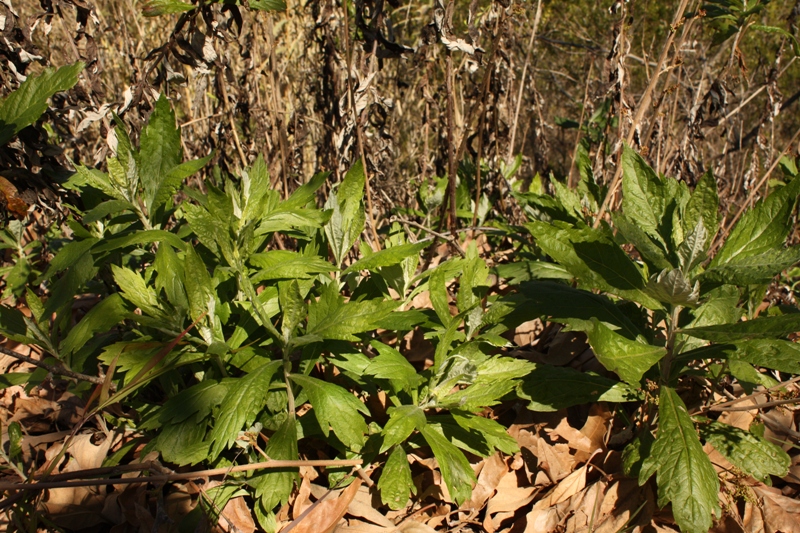
A clump of young mugwort or “molush” in the Barbareno Chumash dialect.
Plant Profile
Mugwort (Artemisia douglasiana) is a perennial herb commonly found in areas of riparian habitat.
It likes sunny, moist locations around creeks and rivers, but can also be found in areas of bright shade and the dappled light of oak and sycamore glens.
Mugwort is a member of the sunflower family and it grows in tall, straight single stems topping out at various heights up to three feet or more.
It bears multipronged lanceolate leaves that radiate outward from the main stalk in spiral formation. The leaves are green on top with a whitish colored underside, and they have a distinct herbal fragrance when crushed or rubbed that is similar to sage.
Mugwort typically grows in bushy clumps and can look like a shrub, but it is also found in stands of widely spaced individual plants.
Traditional Knowledge
Historically, Native Americans used mugwort medicinally in many ways and for a wide variety of ailments. To treat itchy skin the Pomo, Kashaya bathed the skin in mugwort tea. Locally, the Chumash used mugwort to soothe the rash caused by poison oak. In Chumash Ethnobotany, Jan Timbrook notes that the sources of ethnographer John P. Harrington (b.1884 d.1961) told of two ways mugwort was used for this purpose.
The simplest method was to grind some fresh mugwort leaves between the hands and then rub the resulting crushed wad of plant matter on the rash. Another way was to boil fresh leaves and make a tea, which was then applied to the affected area.
I was taught how to use mugwort as a kid, but to actually prevent getting poison oak rather than to treat an existing rash. I would pick the fresh leaves and crush them together and then rub them on my skin soon after exposure to poison oak. It’s a natural treatment that is free and easy to use and, I believe, always worked to somehow neutralize the active ingredient in poison oak, urushiol. And mugwort is readily available in the woods often times actually growing near or right beside poison oak.
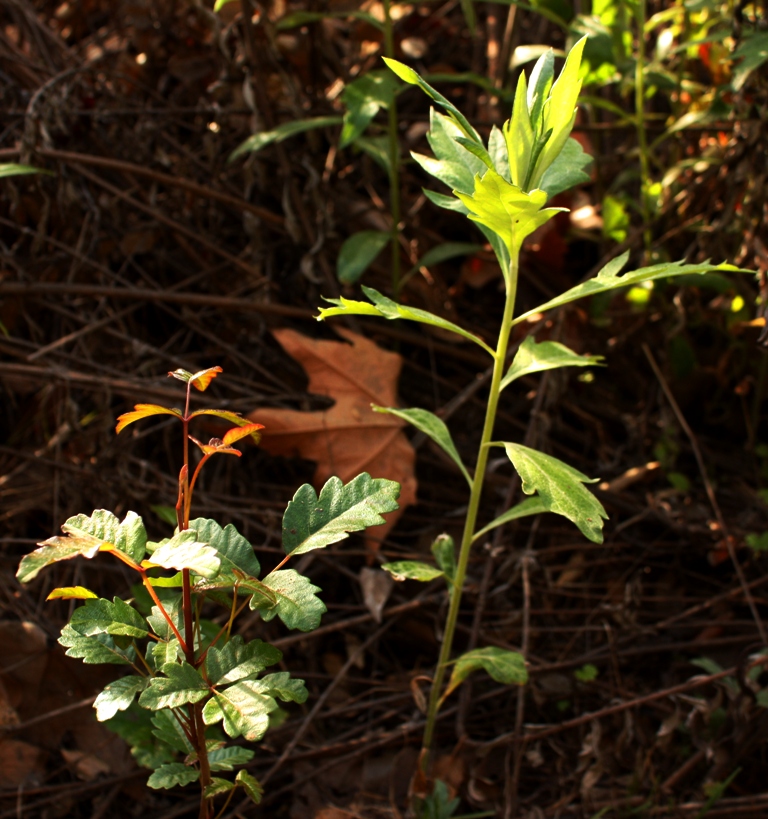
Poison oak and mugwort growing side by side.
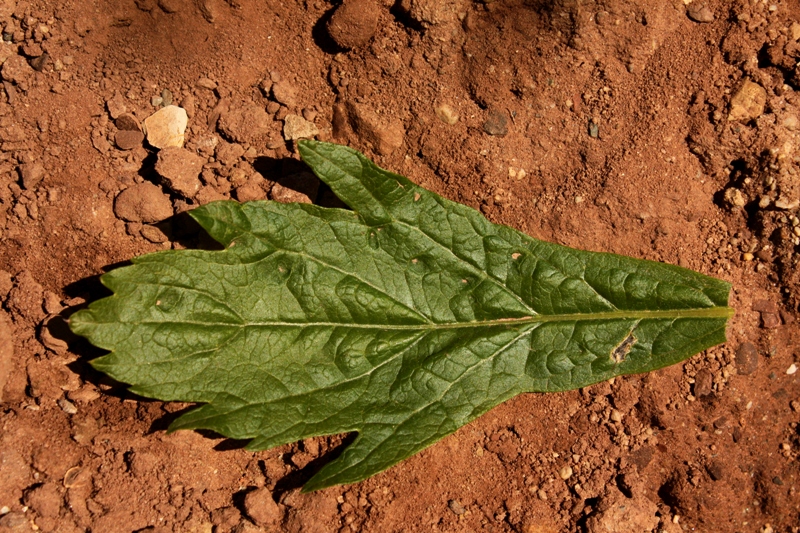
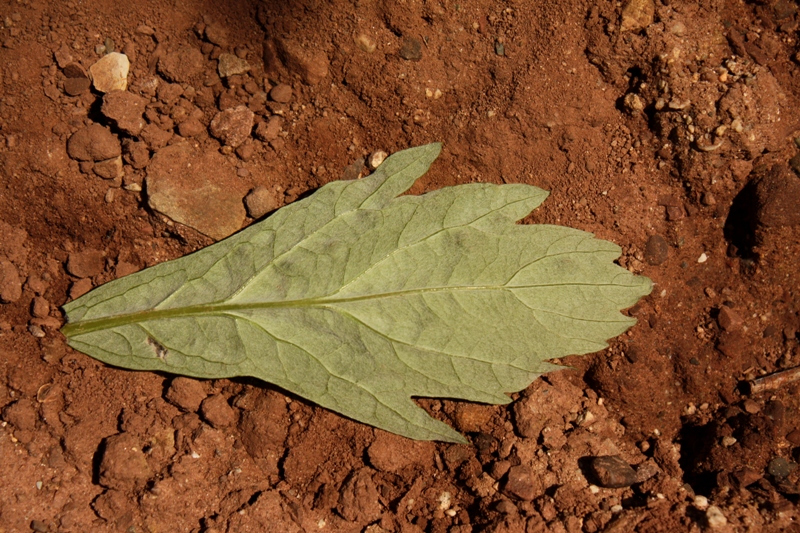
The underside of a mugwort leaf is white and covered in a very fine felt like fuzz.
 United States Department of Agriculture Database: Profile page for Mugwort.
Bibliography
Jan Timbrook, Chumash Ethnobotanty: Plant Knowledge Among the Chumash People of Southern California (Santa Barbara Museum of Natural History 2007), 38.
Jennie Goodrich and Claudia Lawson, Kashaya Pomo Plants (American Indian Studies Center, University of California, Los Angeles 1980 ), 119.
















 Jack Elliott's Santa Barbara Adventure