
 Los Padres National Forest, Santa Barbara County
“The evidence strongly suggests that the prehistoric Indians’ effect on the environment can no longer be ignored by scientists and government agencies charged with stewardship of our natural resources.”
The environmental legacy of Native Americans deserves wider recognition, and greater influence in the management of our forests and wilderness areas. If the dignity of all Americans does not demand this, the health of our wildlands may depend on it.
One national creation myth of these United States holds that North America was a pristine continent prior to European contact and the spread of American settlers.
“A virgin, undisturbed, Edenic land—America was, in the language of a later day, a wilderness,” Stephen Pyne writes regarding common early American thought.
“It mattered not,” he continues, “that such concepts were not only anthropogenic but also ethnocentric.”
Stephen Pyne Fire In America: A Cultural History of Wildland and Rural Fire (1997)
To early Americans an uncleared, untilled, unfenced land without permanent structures and no obvious sign of capital improvement or development was a land that appeared unowned, uninhabited, and untouched.
They did not recognize all the ways in which many generations of Native Americans through thousands of years had altered the land.
“Much of the landscape of California that so impressed early writers, photographers, and landscape painters was in fact a cultural landscape, not the wilderness they imagined,” Anderson writes. “While they extolled the ‘natural’ qualities of the California landscape, they were really responding to its human influence.”
The myth of original virginal purity and a primeval forest endured and was officially enshrined in the American national consciousness in the Wilderness Act of 1964.
The law describes wilderness as “an area of undeveloped Federal land retaining its primeval character and influence, without permanent improvements or human habitation, which is protected and managed so as to preserve its natural conditions.”
The land is seen as primeval, natural and without human habitation. The law failed to recognize anything about the long tenure of native peoples on the land.
When signing the act into law President Johnson spoke as if Native Americans never existed. He romantically described wilderness as “the world as it was in the beginning.”
The president’s words and the language of the law make it seem as if the Native Americans we all know lived around here for millennia did so like mannequins without effect.
History was ignored.
In the twenty-first century, at this late date, rather amusingly, we still tell ourselves this soothing fairy tale of purity whenever we designate new wilderness areas; perhaps a necessary act of preservation in the face of relentless and insatiable rapaciousness, yet one rooted in myth nonetheless.
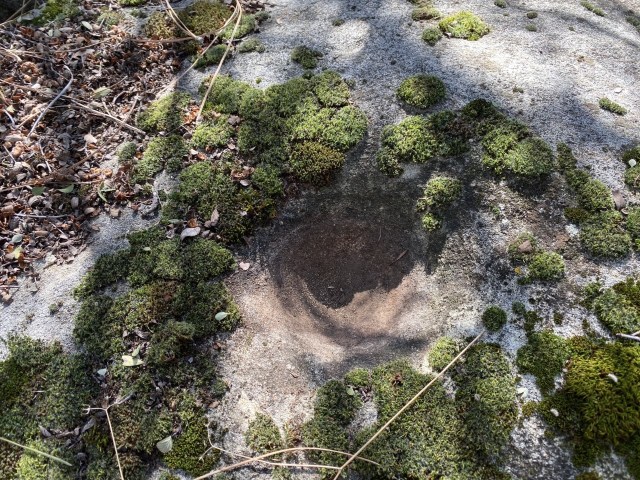 A mortar in the forest, Santa Barbara County.
Roderick Nash, professor emeritus of history and environmental studies at the University of California, Santa Barbara, writes about how Americans overlooked native culture when designating wilderness in Alaska.
“From the natives’ perspective the whole concept of wilderness was a curious, white myth that ignored history,” Nash writes regarding Native American sentiment.
He continues, “As anthropologist William Brown recognized, the whole concept of wilderness in Alaska is ‘ethnocentric to the point of being insulting.’”
Roderick Nash Wilderness and the American Mind (1967)
Wilderness was an imposition of a romantic white cultural conceit.
The concept of wilderness as a dangerous place of wild and uncontrollable lifeforms and the word itself came to America from Europe.
“It is revealing that most Native American languages are unable to translate it,” Dan Flores writes.
“Never mind the ethnocentric dimensions,” Flores writes, “Indians obviously had altered and been gazing on the continent for centuries, and what seemed ‘virgin’ was actually a landscape maintained for hunting.”
Living agents of change with a sophisticated and intimate understanding of the land and its plants and animals, Native Americans changed their environment in subtle and significant ways to suit their needs of survival, to thrive and to flourish.
Indian wild gardens in California took the breath away from Europeans and early Americans when they first arrived.
They mistook the beautiful abundance for the work of nature alone without recognizing it was to some extent the creation of humanity.
The use of broadcast fire was perhaps the most important and far-reaching tool.
“It was in large measure owing to the Indian and his Grandfather Fire that the forest primeval had already been widely cleared, converted and otherwise managed,” Pyne writes regarding “the myths of the virgin forest and the forest primeval.”
In the Wilderness Act Americans sought to preserve something that did not exist.
 Chumash incised grooves, cultural markings, on a boulder beside a seasonal brook in a mountain meadow, Los Padres National Forest, Santa Barbara County.
The widespread and long-term use of fire altered the distribution and arrangement of plants across the land, which in turn influenced the lives and behavior of its organisms and animals.
The land, though still wild and natural in most respects, became in other regards a product of humanity.
Pyne in Fire In America :
“So extensive were the cumulative effects of these modifications that it may be said that the general consequence of Indian occupation of the New World was to replace forested land with grassland or savannah, or, where the forest persisted, to open it up and free it from underbrush. Most of the impenetrable woods encountered by explorers were in bogs or swamps from which forest was excluded; naturally drained landscape was nearly everywhere burned.”
“Taken in its broadest meanings to include plains, prairies, barrens, savannahs, and wetlands, grasslands were probably the dominant cover type in North America at the time of European discovery. . . .nearly all these grasslands were created by man, the product of deliberate, routine firing. . . .Continuous or not, grasslands followed the Indians nearly everywhere they took broadcast fire.”
In the introduction to Omer Call Stewart’s, Forgotten Fires: Native Americans and the Transient Wilderness (2009), Henry T. Lewis and M. Kat Anderson describe a similar scene:
“Indigenous burning practices are a. . . significant part of almost every habitat’s historical ecology. . . .Indigenous burning practices were so successful in altering pathways of vegetation change that most of North America does not fit the definition of a pristine, uninhabited wilderness at the point of European contact. . . .The success of indigenous economies depended on setting fires.”
The United States Forest Service on California:
“Land use in the Native American period was characterized by hunting and gathering. Ethnographic information indicates that Native Americans used fire as a management tool to facilitate both hunting and gathering of certain plant materials (Lewis, 1973). Fires were set annually in lower elevation grasslands and some chaparral areas were periodically burned in the fall (Aschmann, 1959).”-Joe R. McBride and Diana F. Jacobs, “Land Use and Fire History in the Mountains of Southern California (PDF),” United States Forest Service
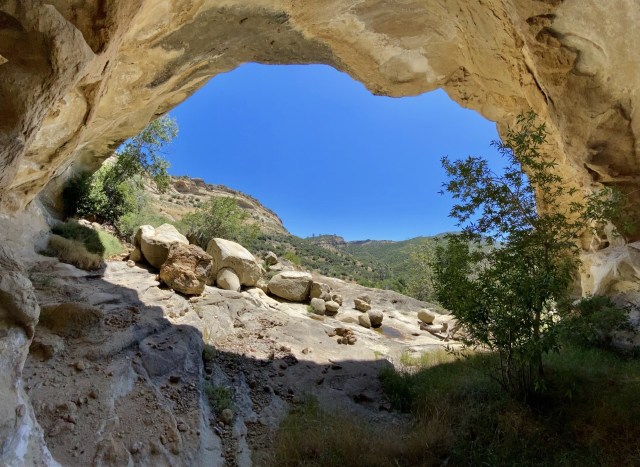 Chumash pictograph cave, National Forest Wilderness, Santa Barbara County
One of the oldest human skeletons found in North America was discovered in 1959 on Santa Rosa Island in Santa Barbara County.
The bones, alternatively having been called the “Arlington Springs Man” or “Arlington Springs Woman,” are believed to be around 13,000 years old.
The Chumash people bridged the gap between the prehistoric and historic periods in this region.
Jan Timbrook, Curator of Ethnography at Santa Barbara Museum of Natural History, cites several primary sources of “ethnohistoric evidence which shows that the Chumash did deliberately use fire in ways which may have had pronounced long-term environmental effects.”
Jan Timbrook in “Vegetation Burning by the Chumash”:
“It seems likely that the Santa Barbara coast in pre-European times was dominated by grassland and oak savanna. … Indian burning may also have been an important factor in maintaining the openness of oak savanna in coastal areas.
 Chumash arrowhead, Los Padres National Forest, Santa Barbara County
Wilderness is an American cultural conception, an abstraction existing in the collective minds of the American people.
One day a stretch of wildlands exists out there. The next day a law, words on paper, is passed and the land is suddenly wilderness. Voila!
Nothing changed but the particular way in which the citizenry seeks to categorize and control the land and its wildlife. And then we fight over it ever after. It’s good fun.
That the land to be protected may be the product of Native American stewardship stretching back millennia through countless generations is overlooked.
That Americans changed the land by removing the Indian and ending native management practices rooted in ancient traditional ecological knowledge is overlooked.
The complicated history of the land goes unrecognized or is largely if not altogether ignored in order to prop up and promote the simple national myth.
 Chumash petroglyph cave, National Forest Wilderness, Santa Barbara County
Ironically some of the wilderness Americans sought to protect and preserve may have grown as a result of their fellow countrymen’s own actions in settling the country.
“Almost wherever the European went, forests followed,” Stephen Pyne writes. “The Great American Forest may be more a product of settlement than a victim.”
Whereas Native Americans regularly fired large portions of the land across the continent, American settlement brought with it a general reduction in fire, which allowed for the growth of forests.
Pyne in Fire In America:
“The effect of European settlers was in general to reverse that [grassland] frontier, first by occupying the land and then by bringing with them the forest, an environment that Indians found largely uninhabitable. Reforestation, primarily through direct or de facto fire control, has succeeded beyond the wildest dreams of the young aboriculture and forestry movements.”
Aldo Leopold in Sand County Almanac (1949):
“In the 1840’s a new animal, the settler, intervened in the prairie battle. He didn’t mean to, he just plowed enough fields to deprive the prairie of its immemorial ally: fire. Seedling oaks forthwith romped over the grasslands in legions, and what had been the prairie region became a region of woodlot farms. If you doubt this story, go count rings on any set of stumps on any ‘ridge’ woodlot in southwest Wisconsin. All trees except the oldest veterans date back to the 1850’s and the 1860’s, and this is when fires ceased on the prairie.”
John Muir in Boyhood and Youth (1913):
“The uniformly rich soil of the Illinois and Wisconsin prairies produced so close and tall a growth of grasses for fires that no tree could live on it. Had there been no fires, these fine prairies, so marked a feature of the country, would have been covered by the heaviest forest. As soon as the oak openings were settled, and the farmers had prevented running grass-fires, the grubs grew up into trees and formed tall thickets so dense that it was difficult to walk through them, and every trace of the sunny ‘openings’ vanished.”
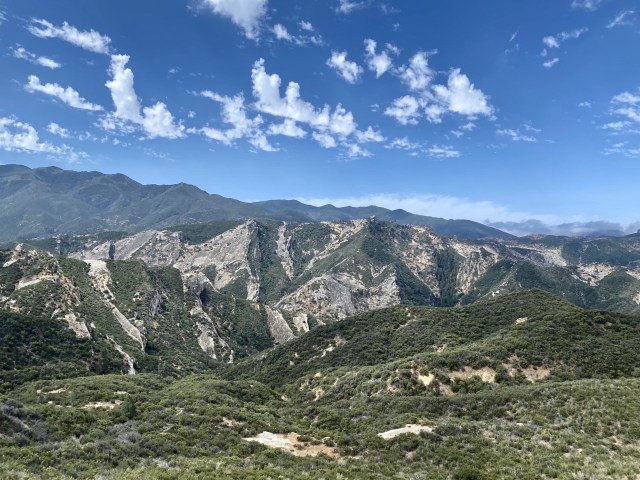 National Forest Wilderness, Santa Barbara County
Folks nowadays have inherited the environmental product of all those people that lived on the land long before.
Wilderness is not primeval and untrammeled.
Wilderness is an artifact.
There is no going back to “the world as it was in the beginning,” as President Johnson declared when he signed the Wilderness Act.
“Once man had played God. . .he could not stop his intervention. The primeval scene was gone forever,” Alston Chase writes regarding wilderness management of Yellowstone.
He makes a simple point.
“Natural conditions, like virginity, once lost, could never be recovered.”
Alston Chase Playing God In Yellowstone: The Destruction of America’s First National Park (1987)
We cannot go back or return to the beginning because we—Homo sapiens, that is, Native Americans generally, the Chumash specifically in Santa Barbara and the people that followed—long ago intervened in nature and forever altered the course of evolution.
Anderson on the legacy of Native American land management:
A reassessment of the record in California reveals that land management systems have been in place here for at least twelve thousand years—ample time to affect the evolutionary course of plant species and plant communities. . .
When the first Europeans visited California, therefore, they did not find in many places a pristine, virtually uninhabited wilderness but rather a carefully tended “garden” that was the result of thousands of years of selective harvesting, tilling, burning, pruning, sowing, weeding, and transplanting.
*
In many cases these landscapes experienced far greater degrees of managerial care and ecologically sophisticated manipulation than are found today. Over time, indigenous peoples’ investment in time and energy in tending many habitats produced real biological changes in those habitats. Important features of major ecosystems may have developed as a result of human intervention.
Yet even if we cannot return to the world as it was in the beginning it may be tempting to think we can return wildness to wilderness if only we step away and let nature alone to take care of itself.
When Ventana Wilderness Alliance in November of 2019 posted a news story regarding road closures in Monterey County, California and the resulting reduction of forest access for recreationists, a man offered an enthusiastic endorsement of the closures believing that keeping humanity out would lead to a wilder wilderness.
“Praise doggod!” he exclaimed amusingly. “Lack of funding making wilderness more wild!”
Would that were it true. But wildness and wilderness are not the same thing.
We may have a huge tract of designated wilderness, but with not much wildness in it.
Some stretches of wilderness around this neck of the woods today were once home to grizzly bears and wolves and bighorn sheep and condors and steelhead trout and many other species that are now drastically reduced, critically endangered or regionally extinct.
The image of the bear on the California flag represents the last known grizzly that lived in the state. The bear did not die of natural causes. The bear was shot to death.
The wilderness was designated and human access greatly restricted and wheeled transportation and motored machines prohibited, no roads of any sort assured, but such measures did not increase wildness.
 Chumash pictograph cave, National Forest Wilderness, Santa Barbara County
A gentleman from a local chapter of the Sierra Club, and whose family has given land that was preserved and protected from development in perpetuity around these parts, offered a similar and common interpretation of wilderness in a newsletter:
“The wildness of the land, wilderness we call it, is a place untouched by the human hand where each of us can go to be in awe of our natural world.”
Paul Shepard drew a sharp and critical distinction between wildness and wilderness.
“Wildness is a genetic state,” he wrote. “Wilderness is a place that we have dedicated to the wildness.”
He goes on to note that, “To his credit Thoreau did not say, ‘In wilderness is the preservation of the world.’ The Great Aphorist did damage enough without confusing wildness and wilderness.”
Instead, Thoreau wrote, “In wildness is the preservation of the world.”
Paul Shepard Coming Home To the Pleistocene (1996)
In the genetic bank of wildness is the preservation of the land; land as understood in the all encompassing sense that Aldo Leopold used the word to describe not only the ground, but the flora and fauna that live in and on it. Everything. The collective biotic systems.
Protecting wildness is much different than protecting wilderness.
Protecting wildness often times requires human intervention, the touch of human hands, and so the setting aside of the myth of an untrammeled wilderness.
A lack of funding to government agencies does not make wilderness more wild. That the road leading to wilderness is closed does nothing for our cause here either.
The condor serves as the greatest icon of both wildness and wilderness in Santa Barbara County.
The bird humanity saved from extinction after nearly causing it in the first place.
Our hands are all over everything. We have left finger prints at the scenes of many misdemeanors and crimes.
Humanity is inextricably bound up in this story of life. Humans play the part of evolutionary engineers picking and choosing intentionally or otherwise. Humans are the ultimate agent of change.
Whether we choose to fire the forest or extinguish fires in the forest, we are selecting one way or the other, and altering the course of life on the land.
Pyne in Fire In America:
“In many environments fire, anthropogenic or natural, is the controlling agent of ecological dynamics, exerting an inordinate influence on the composition of flora and fauna, on their historical arrangements, and on their contemporary energetics.
Fire in natural, as in cultural, systems is as effective an agent by being withheld as by being applied.”
Paul S. Martin in Twilight of the Mammoths (2007):
“We often identify as ‘wild’ conditions those that are in fact heavily influenced by humans. In appraising ecosystems, both ecologists and the general public may overlook, or leave to the anthropologists, or simply take for granted the one mammal of overriding importance — Homo sapiens.”
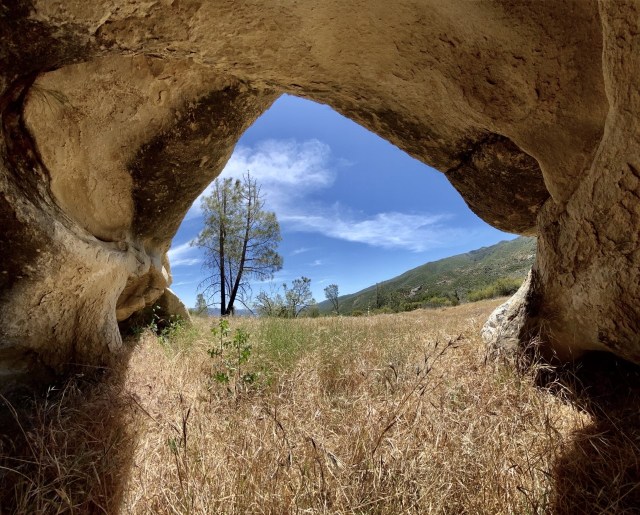 A cave beside a mountain meadow in National Forest Wilderness, Santa Barbara County
We may be losing wildness within our wilderness because of our hands-off management approach.
The genetic bank of wildness is not what it once was not despite the Wilderness Act, but perhaps because of it.
Wilderness today may becoming less wild without humanity rather than more wild.
Native Americans not only manipulated the ecological succession of the land and its floral composition using fire, but actively tended the wild in numerous other ways as Anderson details.
These practices together carried out through millennia did not just temporarily change the appearance of the land, but reoriented biological systems thus setting the natural world on a new evolutionary course.
In the face of such history the idea of an untouched primeval American wilderness unravels and falls apart. The myth is shattered.
But another crucial point arises.
Native American tending of the wild resulted in an abundant and prolific diversity of plants and animals otherwise not possible without the touch of human hands.
Today, with our national neglect of Native American history and traditional ecological knowledge, this natural richness has diminished and these wild communities of plants and animals may further decline or disappear.
Anderson in Tending the Wild:
“The disturbance caused by California Indians’ use of fire in a variety of ecosystems, occurring at intermediate intensities and frequencies, promoted a maximally heterogeneous mosaic of vegetation types and increased species diversity.”
Rather than becoming wilder without humans it might be said that these places have become less wild as the floral composition of the land becomes more homogeneous, less diverse, without the careful hand in Indian tending.
If we are to think of plants and animals as the denizens of wilderness, then the fewer of these wild characters that reside in the neighborhood the less wild the place is.
We should not conflate the absence of humanity and wildness.
And not only does it appear that we have lost some diverse communities of plants in some places, but the animals and organisms once found there as well.
The land as tended by Native Americans “supported a rich and varied fauna of butterflies, birds, and small mammals that is now largely absent,” Anderson suggests.
The many species previously attracted to these once robust and prolific places have declined or disappeared as the habitat changed with the absence of Indian stewardship.
Anderson in Tending the Wild:
“Removing California Indians from traditional economic and land management roles in California has not led to a prehuman state of nature in our wildland areas. Instead, the hands-off approach to management of wilderness preserves is jeopardizing the long-term stability of many plant communities.”
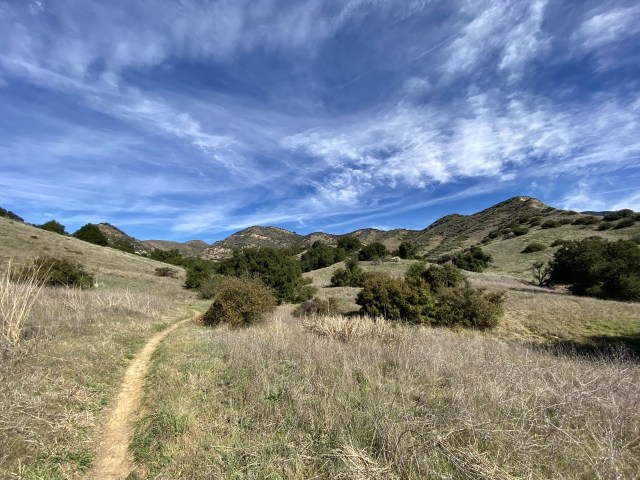
So what’s a wilderness?
Whatever it is, a wilderness is not primeval and untrammeled at this late stage of the continent’s human occupation.
So why bind ourselves to this romantic national myth any longer in managing our wildlands when doing so may threaten and degrade the very treasures we seek to preserve and protect?

 Morning at a spring in the Chumash Wilderness.
 Swallowtail on an iris beside the spring in the Chumash Wilderness, June, 2020.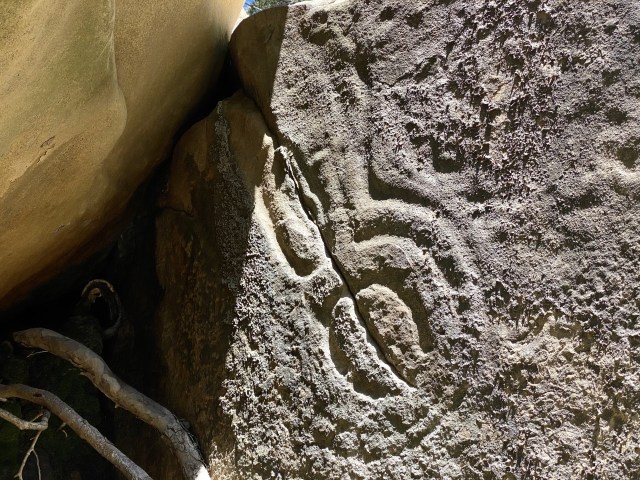
 Honeysuckle in the woods of Scotland.
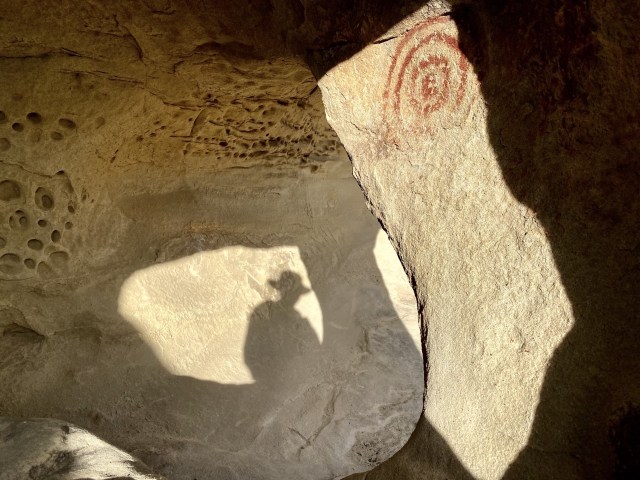 Chumash pictograph, Santa Barbara County
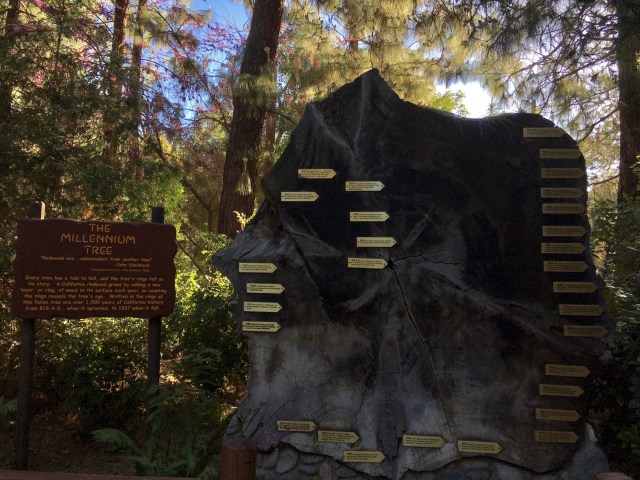 Ancient redwood log at Disney’s California Adventure.
 The second oldest year labeled on the log after the tree’s sproutdate notes a sacred Chumash Native American place in the Los Padres National Forest in Santa Barbara County.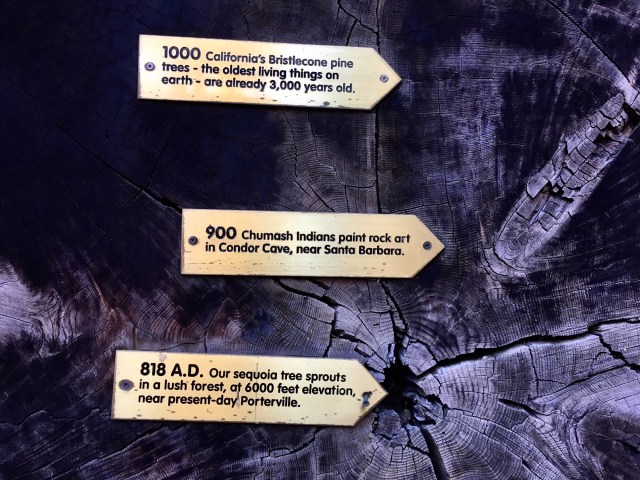










 Jack Elliott's Santa Barbara Adventure