 A cold drizzle falls steadily from a heavy marine layer blanketing the coast, as six men heave a ragged plank rowboat across dampened sand to the water’s edge.
With rough, cracked and calloused hands sucked dry of moisture by constant exposure to seawater and ungloved labor, they collect their crude tools and few provisions and drag the skiff into the chilly waters of Goleta Bay.
The uncertainty of the prospects ahead weighs on them, unsure if their full day’s work will earn them any pay. If it does it is guaranteed to be scant.
Yet, they may not even return to shore at all. A long and potentially deadly day at sea awaits them pitching to and fro in the chop in pursuit of the planet’s largest animals.
Shore Whaling
The shores of Santa Barbara County once served as a base of operations for whaling. Small groups of men launched skiffs from the beach and chased whales in nearshore waters using primitive harpoon guns. They operated out of makeshift seaside camps on the lee side of Goleta and Government Points, where they watched for passing whales from shore and processed those they caught. The main catch was gray whales, but humpbacks were also occasionally taken in north county waters.
Santa Barbara County Whaling Companies 1870-1893
Santa Barbara Whale Company Goleta Sandspit 1870-78
Cojo Whaling Company #1 Cojo Bay 1879-85
Cojo Whaling Company #2 Cojo Bay 1885-88
Cojo Whaling Company #3 Cojo Bay 1889-93
Goleta Bay
 A mountaintop view of the Santa Barbara Channel and the hunting grounds of the Goleta shore whalers. The red arrow notes the approximate location of the old whaling camp. The runways of Santa Barbara Airport can be seen, as well as Goleta Beach pier on the left and Santa Cruz Island in the distance.
“This station was established about 1870 and suspended about 1880. During this time there were three different companies here, the first being composed of Jamaica negroes.”
—Edwin C. Starks, A History of California Shore Whaling (1923)
Santa Barbara Whale Company operated out of a rustic beach camp at the foot of the cliffs on the west end of the Goleta Sandspit or what is today Goleta Beach County Park. The men lived out of several shanties on the sliver of sand mounded up between the sea and Goleta Slough and it was here that they cut up whales and made oil. Jamaicans made up the crew and were commanded by the founder of the company who was originally from Connecticut. A Chinese man worked as cook.
The company hunted gray whales from December to April using three rowboats, which were not designed for whaling. According to witnesses of the time the equipment used by the Santa Barbara Whale Company was in poor condition. They did benefit, however, from the use of bomb lance guns that had replaced earlier hand thrown harpoons. In 1874, a wharf was constructed at More’s Landing, which stood about a quarter mile east of the mouth of Goleta Slough at that time. Here the barrels of oil were carted from shore to ship and brought to market.
 An aerial view of Goleta Beach in 1927 before it was turned into a park. The red circle notes the approximate location of the old whaling camp. © Santa Barbara County Parks Department
Cojo Bay
 Cojo Bay
“Captain Anderson and company started this station April 25, 1879, coming here from Pigeon Point. The men owned the property and employed Captain Anderson for cash and commission.”
—Edwin C. Starks, A History of California Shore Whaling (1923)
The Cojo Whaling Company set up shop at Cojo Bay on the lee side of Government Point. The management and captain of the company were Portuguese and two Chinese men worked as cooks. The crew lived in several buildings set on the coastal bluffs overlooking the beach. They had genuine whaleboats crafted in New Bedford, Massachusetts and in addition to bomb lance guns, they also used the more powerful bow-mounted Greener harpoon guns.
Cojo Whaling Company Tally, 1879-80
June-September – 0 January 9 – 1 gray
October 18 – 2 humpbacks January 10 – 1 gray
October 24 – 2 humpbacks January 12 – 2 grays
December 14 – 1 gray January 14 – 1 gray
December 21 – 1 gray January 17 – 1 gray
December 24 – 1 gray January 21 – 1 gray
December 28 – 1 gray January 22 – 1 gray
December 29 – 1 gray January 25 – 1 gray
January 5 – 1 gray February 1 – 1 gray
Total – 4 humpbacks; 16 grays
 Captain Jose Pedro holding a Greener harpoon gun with his second in command, Antonio Silveira, on Monterey Bay in 1900. © Berwick, The Cosmopolitan, 1900
Cash Cows of the Sea
“He’s a hundred barreler—don’t lose him now. . .There goes three thousand dollars, men!—a bank!—a whole bank! The bank of England!”
– Herman Melville Moby Dick (1851)
This quote from Melville’s literary masterpiece reflects the financial fervor surrounding whales during the heydays of the whaling industry. The marine mammals served as floating warehouses full of raw materials used to produce a long list of goods including, namely, whale oil for lamp fuel and lubricant for the machines powering the Industrial Revolution. As the commercial use of whales continued through the decades the list of products made from them increased. They eventually provided raw materials in various forms that went in producing steel, soap, margarine, corsets, hoop skirts, umbrellas, automatic transmission fluid, and even explosives.
Mortal Combat
A deadly affair, California shore whaling was a mortal fight between 200 pound men in a puny wood plank skiff and 30 ton leviathans. A six-man crew in a 14 foot rowboat used harpoons and a coil of hempen rope to lash themselves to 45-foot long whales. Shore whalers of Santa Barbara County benefited from the advent of harpoon guns that replaced hand thrown spears, but the process of capturing whales stayed largely the same. Secure a skiff to a whale with a length of rope and then ride it out until the massive beast expired.
In an historical account a veteran relates what he describes as “uncontrollable terror” when the boat approached a whale just prior to the strike. The crew rowed or sailed within range and the harpoon was shot into the whale, whereupon an intense battle ensued in which the whale or men may be killed. One old man reminiscing about his experiences during the 1860s described gray whales as “almost sure death to hunt.” He told of “a good many graves in those days alongshore of men who had been killed by those whales.” Gray whales became known as “devil fish” due to their fierce nature when hunted.
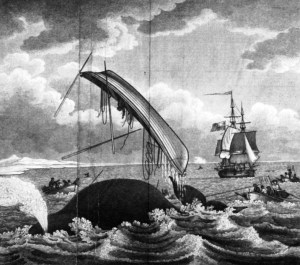
An illustration of a whale tossing a whaling boat into the air. (circa 1820)
The second the iron harpoon struck whales thrashed wildly sometimes smashing the boat to pieces. Local newspapers often reported on the battles between men and whales. In 1870, the Monterey Democrat published an account of an incident with a gray whale. Upon harpooning the whale the boat “got unawares within the sweep of the leviathan’s tail,” which slammed down and “crushed like an eggshell the timbers of its bow.” The captain was “struck in the side by a fragment of the broken timbers and was almost paralyzed” before regaining his senses.
At other times whales bolted pulling the harpoon rope out of the boat at such furious speed that blue smoke peeled into the air, as it slid through the metal guide on the bow with a wicked sounding whine. Occasionally the rope wrapped around a man’s leg or arm thrashing him across the inside of the boat and into the sea to his demise. Once the rope reached its end, the boat leaped forward with a tremendous jerk “at a rate that would put a locomotive to blush,” wrote a reporter for the Monterey Weekly Herald in 1874.
Speeds topped 20 miles an hour as the bow slammed through the chop sending spray flying and rattling the little vessels to their core. The crew frantically bailed water and a man astern steered with an oar. One guy always sat ready to cut the rope if the whale sounded threatening to drag the small boat under. Typically crews stayed within ten miles of shore, but whales fought for hours at times pulling boats far out to sea. One report tells of a crew from L.A. County having to hunker down on the Channel Islands for the night before setting out for the mainland the next morning. Crossing the Santa Barbara Channel while dragging a carcass was brutally slow with the average speed recorded at a measly one mile per hour. At that rate it could take an entire day to get back to the mainland.
Self-inflicted Wounds
The invention of harpoon guns made whaling easier by increasing the distance from which a crew could strike and adding a new element of lethality to the hunt. The new technology lessened the chance of being caught too close and smashed by a thrashing whale when striking with the harpoon and made it easier to kill quicker. But guns also brought entirely new risks to the hunt for humans.
Some men badly injured themselves or died from self-inflicted wounds suffered while loading and handling the guns during the fray. Newspaper reports relate graphic stories of men shooting themselves through the head while attempting to load the weapons at sea or dying from internal hemorrhaging as a result of the powerful recoil of the guns.
Rendering Oil From Blubber
 Slicing chunks of blubber from a whale or what is called flensing. Monterey, California 1896. © Berwick, The Cosmopolitan, 1900
“The whalers would take chisels and machetes and start peeling off the blubber, which lay in a six-inch-thick layer between the hide and the flesh. The blubber was put into small carts and delivered to a battery of 60-gallon iron tubs, or ‘try-pots’, which were lined up on the beach at the foot of the west cliffs at Cojo Landing. There the blubber was rendered down into liquid. I can still see those whalers wading knee-deep in blood and blubber—ugh!”
-An eyewitness account of a whaling operation in Santa Barbara County
After successfully taking a whale, and managing to return to shore with it in tow, the dangerous work was done. The gruesome chore of carving up the behemoth came next and cooking the blubber down in massive iron cauldrons called “trypots” to produce oil. Bones and putrid flesh littered the seashore where the butchering took place. Only the whale’s blubber was harvested leaving its flensed carcass to rot on the beach, be eaten by scavengers and wash away with the tide.
The malodorous stench of death attracted thick swarms of flies, birds constantly circled overhead and tore at the piles of slaughtered whales lying about, while crabs, sharks and other marine life finished off whatever was carried to sea by the sweep of high tide. In 1872, the Monterey Democrat described “a most offensive stench” emanating from a nearby whaling camp. A witness to one of the camps reported that the men “were dripping and fairly saturated with the oil, and everything around was in the same condition. The stinking fluid had run down the face of the bluff to the water’s edge, and the whole place was redolent of the perfume.”
The men sometimes used dried whale parts for fuel to avoid having to haul in cut firewood from local oak forests. The resulting try-pot fires billowed thick clouds of sooty black smoke into the air, as the men stirred and tended the steaming iron cauldrons of hot oil like warlocks. The coastal bluffs near UCSB, at the west end of Goleta Beach, were still stained in 1963 with the soot of the whaling camp fires. In the construction of Ward Memorial Boulevard leading into the university the area was buried with fill dirt and paved over.
 The tryworks at Pigeon Point, California in 1869 showing blubber being carved from a freshly caught whale and boiled down into oil in a large iron trypot. © Evans, A La California, 1873
Shore Whaling Ends
“The American fishery did not last long for continual slaughter on their breeding grounds soon so depleted the numbers of the gray whales that the hunt was no longer profitable, and the shore stations which had been established at various points along the coast finally ceased operations altogether. For over twenty years the species had been lost to science and naturalists believed it to be extinct.”
—Roy Andrews Chapman, Whale Hunting with Gun and Camera (1916)
In 1859, the first petroleum oil well in the United States was drilled in Pennsylvania and two years later the first well in California was tapped. In 1866, oil was collected from tunnels dug at seeps at Sulfur Mountain in Ventura County and that same year a well was drilled nearby. Petroleum oil was emerging as a valuable new resource and reshaping society.
Kerosene had been distilled from crude oil and lamps invented to burn it, and as the nascent American petroleum business grew, crude oil began to replace whale oil for lighting and lubrication purposes. In 1878, Edison invented the electric light bulb which would further decrease demand for whale oil lamp fuel.
As petroleum use was increasing, the whale population was in precipitous decline due to the free-for-all mass slaughter. The pursuit of whales up and down the California coast, including the discovery of breeding grounds in Baja California, devastated the gray whale population. In addition, the constant harassment of the remaining population began to alter their behavior. They became skittish and much harder to hunt and increasingly remained further offshore out of reach of beach-based hunters.
The depleted fishery and shifting societal needs together forced shore whalers out of business, as demand for whale oil lessened around the same time it became harder and more costly to produce. Eventually it became too difficult and ceased being a profitable enterprise. The shore whalers of Santa Barbara County had seen their heyday come and go and the seaside ventures at Goleta and Cojo were abandoned.
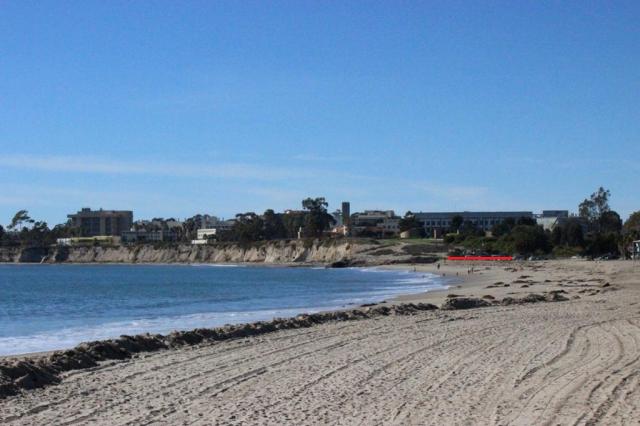 A view of Goleta Beach in 2011. The bold red line shows the approximate location of the historic whaling camp, as noted in the previous photos. The buildings on the bluffs are part of the University of California, Santa Barbara.
Aerial imagery of the locations of both whaling stations mentioned above can be seen at the following links: Cojo Bay and Goleta Bay.
Bibliography:
Banner header photo of breaching whale provided courtesy of NOAA.
Whaling scene illustration by Isaac Walton Taber in an early copy of Herman Melville’s Moby Dick.
Albert S. Evans, A la California: Sketch of Life in the Golden State (1873).
Edward Berwick, “Offshore Whaling in The Bay of Monterey,” The Cosmopolitan, Volume XXIX (May, 1900).
Walker A. Tompkins, “Santa Barbara Yesterdays: Eyewitness Account of Whaling Station Operation.” Santa Barbara News-Press ( May 8, 1960).
Walker A. Tompkins, Goleta: The Good Land (1966).
David E. Bertao, The Portugese Shore Whalers of California 1854-1904 (2006).
Roy Andrews Chapman, Whale Hunting with Gun and Camera; A Naturalist’s Account of the Modern Shore-Whaling Industry, of Whales and Their Habits, and of Hunting Experiences (1916).
Edwin C. Starks, A History of California Shore Whaling (1923).




 Chicken and chanterelles in a Madeira wine butter-cream sauce. I came up short in extra sauce; a ladle full over the top of everything would have been good.
















 Jack Elliott's Santa Barbara Adventure