Wellhouse Falls and the Waterfalls of Lewis Canyon

Lewis Canyon local.

A few months ago I walked up Snyder Trail from Paradise Road in search of a path to the waterfall in Lewis Canyon, but to no avail. Upon reaching the transmission tower, where the power lines cross over the trail, and having found no sign of a pathway, I turned around.

On the way back down Snyder Trail, I came to one of the many bends in the singletrack and noticed that there was actually an old roadcut leading east down into Lewis Canyon, which I had missed on the way up. Having never hiked the trail, I hadn’t noticed the road before, as I had always been flying by on my mountain bike at top speed in front of or behind several other friends racing downhill.

The route looked promising and I eagerly started following it. There was evidence of its use by others, but it was quickly consumed in old growth chaparral and apparent that it was obviously not routinely traveled. I pressed on nonetheless thinking it was, indeed, an old route to the falls, though all evidence of use quickly disappeared altogether. I believe it is the old road cut made by George Owen Knapp, which led to the bathhouse he purportedly built in the canyon somewhere near the waterfall.

I figured the road had to have led to the falls at some point and that it would just require some bushwhacking. I continued on wrangling my way under, over and through the brush but it soon became apparent that reaching the creek bed would require far more effort than I cared to exert. At that point I called it off entirely and that was that for the day.

One of the smaller cascades in the lower part of Lewis Canyon.

Same cascade as shown above.

This last Tuesday I made another effort and ventured up Lewis Canyon creek from the bottom, where it crosses Paradise Road. The lower reaches of the creek were bone dry, but I soon heard a faint trickle of water. I figured that in August, even with this season’s record rainfall, any waterfall wouldn’t be flowing with much force.

The small crick is relatively easy to follow and open enough to pass through without too much effort, but the usual sort required when rock hopping and pushing aside branches here and there in a tight drainage.

I passed over several modest waterfalls before coming to the main attraction. Twice I had to crawl up the steep banks and out of the creek bed in order to get around the falls. There are two large falls, one right after the other, and the worse detour was in getting around the lower fall to reach the foot of the main fall. It took more effort than I cared for and I ended up on my hands and knees in several places, as I pushed my way through the dense brush.

The next fall on the way up the canyon.

After taking a looksee at the main fall for a bit, I crawled up through the slough of the creek bank and around the top of it, and then followed the drainage up the canyon for about a hundred yards.

The water disappeared underground just after the main fall and the riparian canopy that shrouds the lower canyon in dense shade soon thinned and the temperature rose dramatically. Though the hiking was easier, in that the creek turned into bare boulders and sheets of sandstone without all the vines and trees found lower down, I turned around thinking there likely wasn’t much more worth seeing up yonder.

On my hike back, traversing along the steep slope of the bank, about twenty to thirty yards above the creek, I stumbled across an old trail. The level cut of it was clearly visible against the slope of the hillside and there were a number of faded plastic ribbon-tape strips tied to branches here and there marking its course.

It quickly disappeared into the thick underbrush, though, and I decided not to push my way through trying to follow its course. I had no idea where it led and it was much hotter and more work once I was out of the canyon bottom. So I slid my way through the organic litter back into the creek and on down to my truck at Paradise Road.

The first of the two big falls showing just a thin stream of white water flowing over its face.
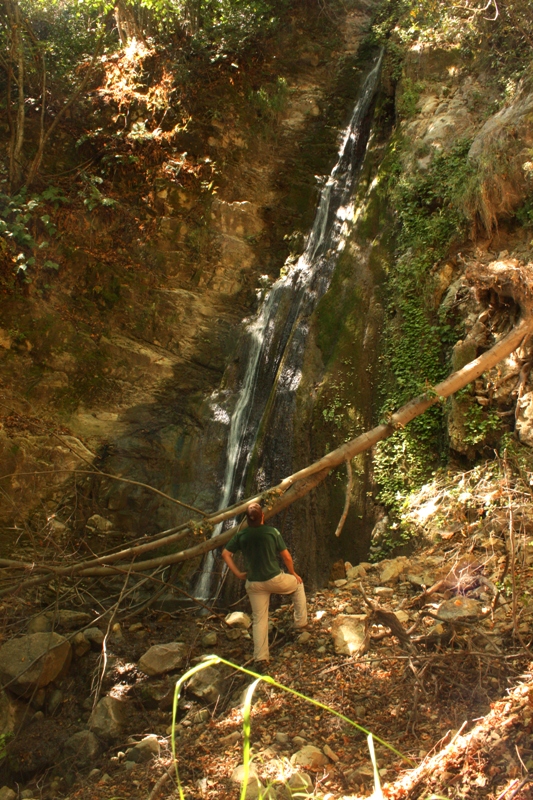
Wellhouse Falls

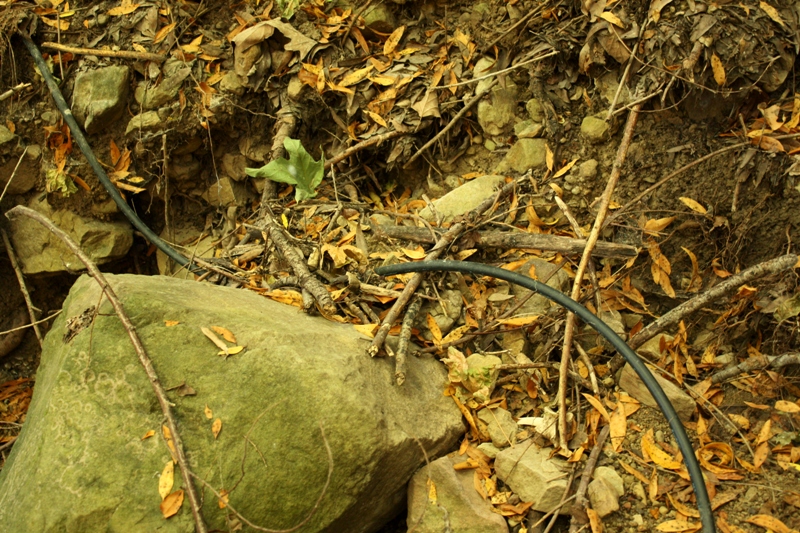
The tell tale trace of guerrilla growers.

I saw this sort of plastic irrigation tubing in several places. Marijuana growers will set one end in the creek concealed by rocks and with a screen of some sort to filter out debris. The line is then run slowly up out of the creek down canyon, buried beneath dirt and leaves, and to the grow site, where it waters the plants through the natural force of gravity or fills reservoirs.

I came across two cement walls that ran across the creek in two different locations, which were apparently designed long ago to make use of the water flow in some manner. One of the cement barriers appeared to have some sort electrical infrastructure attached to it, as if it was made to harness the force of flowing water to generate power. Or, perhaps more likely, the degraded infrastructure was used to power a pump of some sort that drew water from the creek for use elsewhere.

This seems to be confirmed by the presence of the machine shown in the photo above, which I found in the creek and consists of a flywheel on one end and a small gear on the opposite side. Behind the rusty hunk of iron I saw a telephone pole-like timber that still had some braces attached to it for holding something. I was unable to locate any trace of the bathhouse built by George Owen Knapp near the big waterfall.

Related Posts:

Knapp’s Castle Then and Now

Waterfalls of Ventura County

Scent of the Sea On a Ventura County Creek

Waterfalls, Trout and Indian Mortars

Santa Barbara County 163% of Normal For Rainfall
Tangerine Falls, Cold Springs Canyon

Indian Creek Waterfalls (Dick Smith Wilderness)

Posted in Santa Barbara | Tagged , | 11 Comments

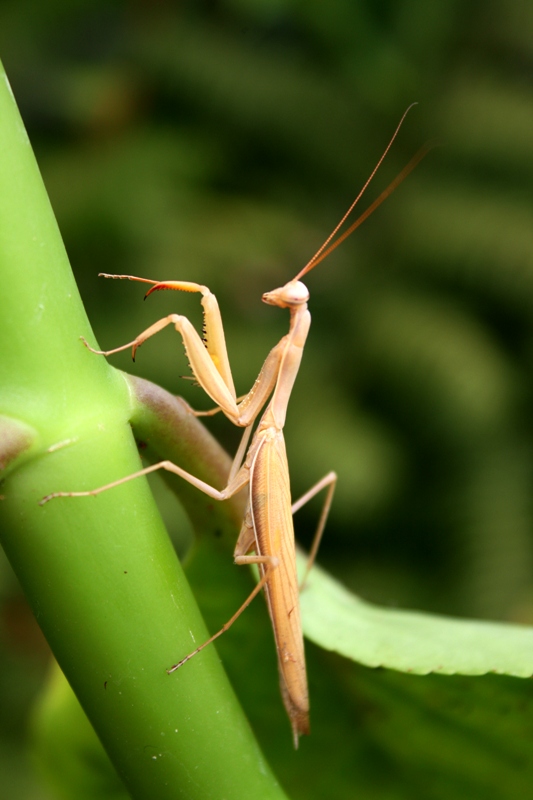
Praying Mantis

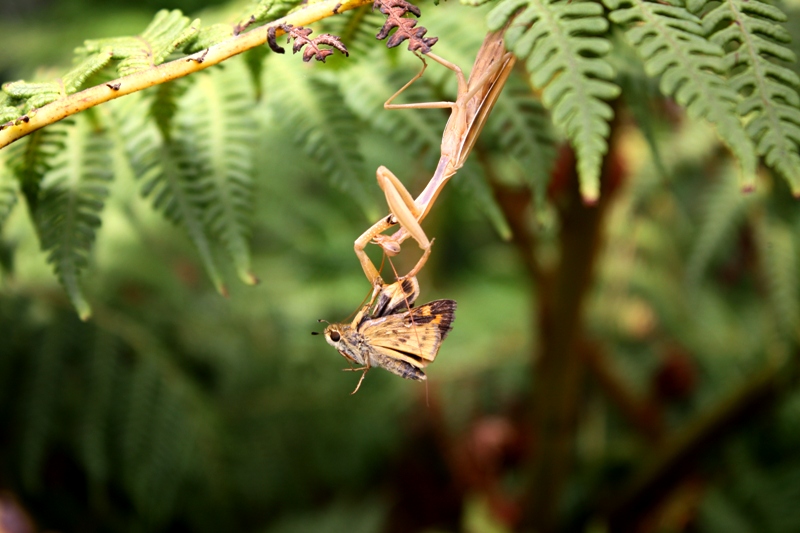
I discovered this praying mantis in my garden as I was poking around in the yard. When I first saw it he was empty clawed, perched and waiting for prey, but when I went back some minutes later to take a look he had managed to snag a small butterfly.

This is only the second one I recall ever seeing around these parts. The other one I found on top of a tent of a classmate way back in sixth grade when we were camping up at Sage Hill during a class outing. Aside from a tarantula it was the prize find, as we were up there specifically for an insect gathering experience.

Posted in Santa Barbara | Tagged , | Leave a comment

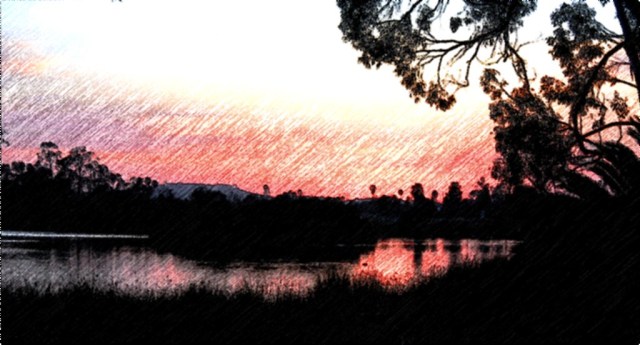
Bird Refuge Sunset Silhouette Sketch

A view of Santa Barbara’s Andree Clark bird refuge. Description from County of Santa Barbara’s webpage:
“One of Santa Barbara City’s most beautiful natural refuge features a 29-acre freshwater/brackish lake and its surrounding vegetation. The Andree Clark Bird Refuge’s 42 acres are bordered by the Santa Barbara Zoological Gardens, Highway 101 and East Cabrillo Boulevard. The lake drains into the ocean at East Beach.

Historically, this area was a salt marsh, receiving fresh water from Sycamore Creek.

However, the construction of the railroad in the 1880’s resulted in rerouting Sycamore Creek, thereby isolating the salt marsh. In the late 1920’s, the City restored the area with the sole purpose of providing a refuge for wild birds.

Today, the refuge is a balance of urban and wildlife interface. The refuge’s duel purpose is to cater to wild birds that migrate through or reside permanently at the refuge and to provide a enjoyable setting for people to gain greater insight into our responsibility to preserve our natural world.”

Posted in Santa Barbara | Tagged , , | 1 Comment

Palm Reflections In an Indo Rice Field

“I like rice. Rice is great if you’re hungry and want two thousand of something.”

-Mitch Hedberg

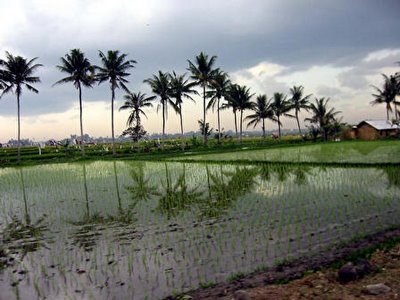
On the way to the beach one morning in Indonesia I caught a fleeting view of this recently planted rice field. In a country that lacks the convenience provided by high-tech agricultural machinery, I’m not sure what is more monotonous, planting each little sprig of rice or harvesting each miniscule grain. Fortunately I’ll never know.

Posted in Indonesia | Tagged , , | Leave a comment

Knapp’s Castle Then and Now

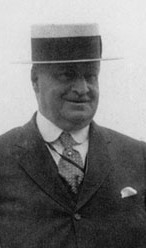
Mr. Knapp (c) Benjamin R. Taylor

Perched on a promontory along a ridge on the north slope of the Santa Ynez Mountains, overlooking the Santa Ynez River Valley, the sandstone ruins known as Knapp’s Castle are the remnants of a remote mountain retreat built by George Owen Knapp.

He purchased the property in 1916 and named it Laurel Springs Ranch. Four years later, construction of the mountain lodge at San Marcos was finally completed, but in 1940, the home burned to the ground in a wildfire. Knapp had sold it for $10,000 just five weeks before the conflagration.

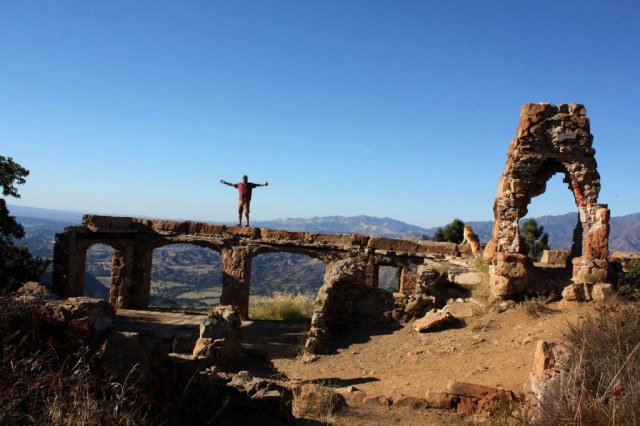
The hilltop residence included five bedrooms, a kitchen and dining room, a pipe organ room and an observatory for stargazing. An illuminated waterfall cascaded outside providing a touch of ambiance to a spectacular setting needing no adornment. Large stone arches today still frame the views enjoyed long ago in the main room of the home through huge picture windows.

Aside the main lodge, and attached by an interior staircase, sat a studio. Below this there was a cottage for workers, a guesthouse, sleeping quarters for servants and a caretaker’s flat.

Tucked away down in the brush-choked crease of nearby Lewis Canyon, somewhere purportedly near the waterfall there, Knapp built a bathhouse. It was accessed by a winding dirt road. The remnants of the road can still be walked today for some distance, before it fades into the dense canyonside chaparral, and is finally lost to the mountain buried in nearly a hundred years of erosion and slough.

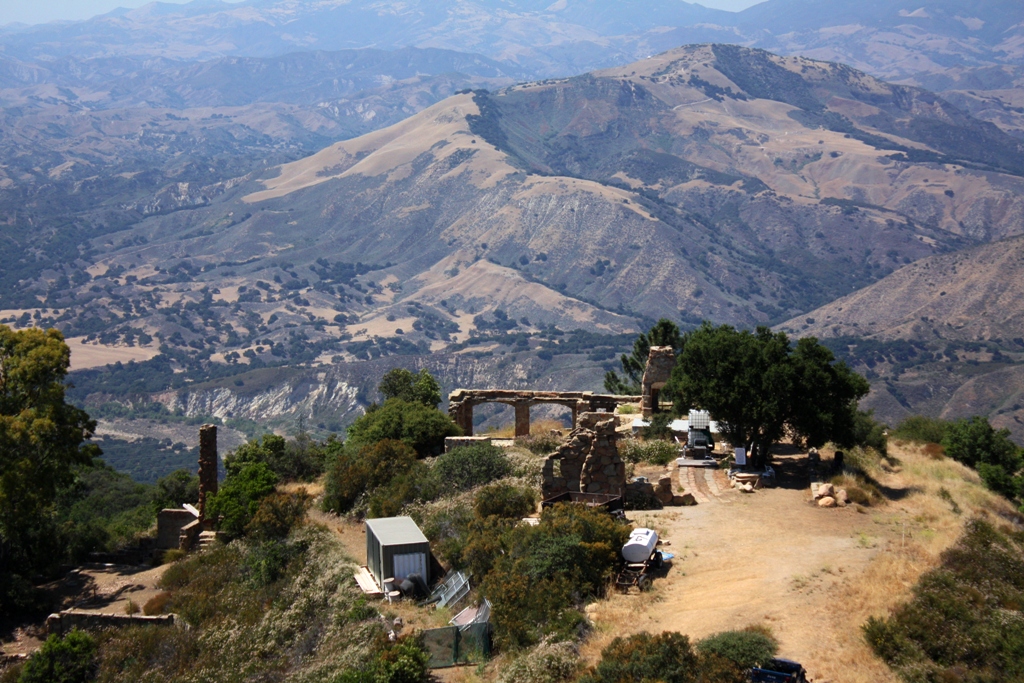
A view of Knapp's Castle ruins in the summer of 2011. The site sat empty for decades, but recently the current owner has moved a bunch of junk to it, seen in this photo, and begun a half-assed construction project of some sort.

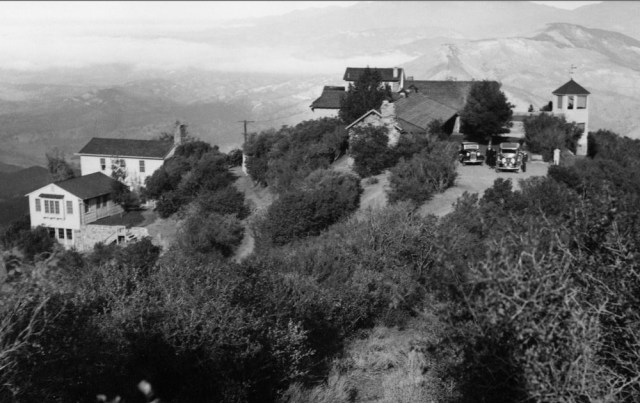
A view of Knapp's so-called castle as it was. (c) Benjamin R. Taylor

The property was accessed by a primitive dirt road perhaps not much better than a stagecoach trail in places, and done so in some of the first models of automobiles ever created. Historically, as today, San Marcos Pass and East Camino Cielo provided the roadways to the mountaintop home.

San Marcos Pass was first graded in 1868 and finished two years later, before being rerouted and improved in the 1880s. East Camino Cielo, off of which Knapp built his long driveway, was first cleared around the time of WWI, but not paved until the 1930s.

The property was not easy to get to and before any construction could begin Knapp had to build his own road to reach the parcel. An entry in History of Santa Barbara County, State of California (1939) notes the following:

“Speaking of hobbies, next to organ-building and hospitals, Mr. Knapp’s abiding passion is for road-building. Though past eighty-three years of age, he personally supervises the construction of mountain roads to and from his beautiful Santa Ynez Mountain Lodge with all the interest and enthusiasm of a man of half his years.”

A view of the ruins in 2009 showing the arches that once framed huge picture windows.

The view of the Santa Ynez River Valley from the ruins. Cachuma Lake can be seen in the distance today, but was not around at the time of Knapp's mountain lodge.

Born in 1855 in Massachusetts, Knapp was a businessman and civil engineer by trade. He helped found Union Carbide Corporation and served as company president for 22 years (or 25 years depending on the source consulted).

His entrepreneurial success was reflected in numerous real estate holdings, which included no less than nine different homes in Santa Barbara County alone. These ranged from oceanfront parcels at Montecito and Carpinteria to mountaintop retreats atop the Santa Ynez Mountains above Santa Barbara.

Aside from providing aplenty for himself, Knapp’s wealth enabled him to donate generously to numerous causes. He arrived in Santa Barbara in 1912 and “became identified with and interested in everything that pertained to the general welfare.”

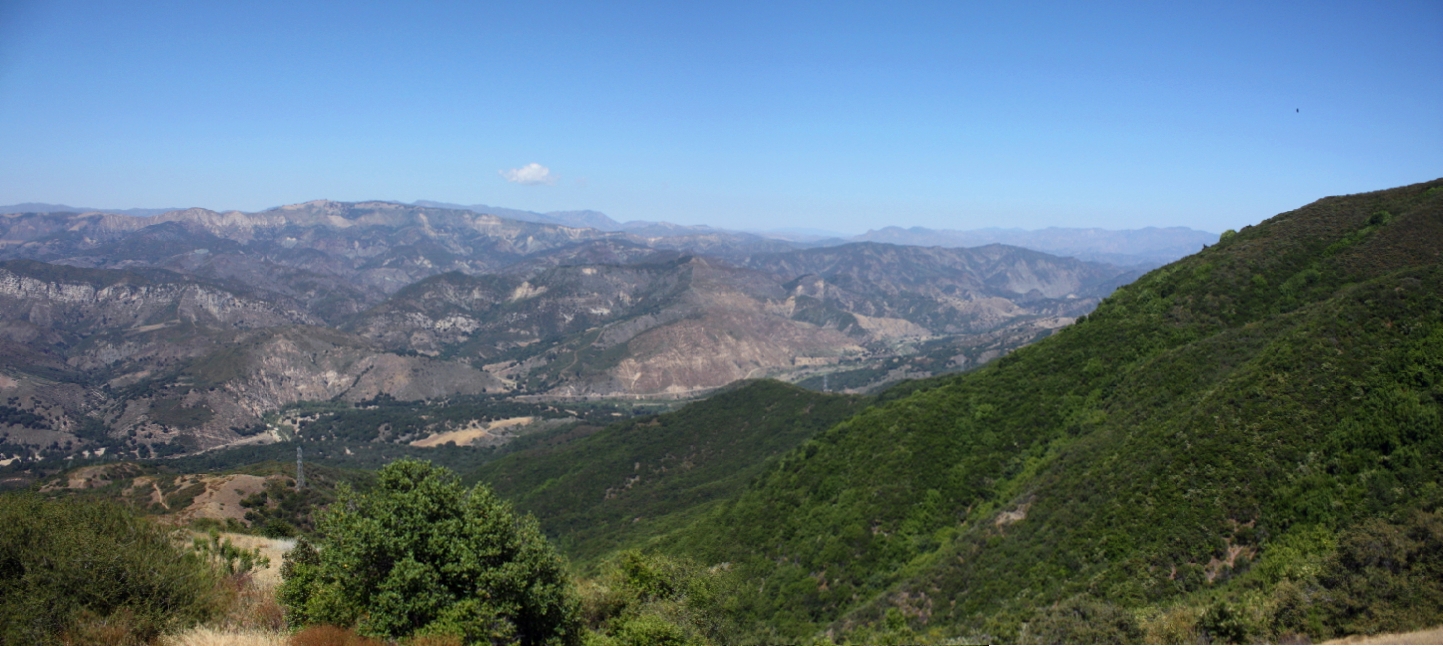
A panorama view overlooking Lewis Canyon to the east of the ruins and the Santa Ynez River Valley far below.

Knapp served as president of Santa Barbara Cottage Hospital and donated $200,000 to create the Louise Savage School of Nursing. In addition, he gave $200,000 to fund the construction of the hospital’s four-story south wing. And he played a role in attracting Dr. William D. Sansum, of the Sansum Clinic, to Santa Barbara.

He also contributed a total of at least $32,000 to several local churches for various purposes. One of his other pursuits in Santa Barbara was the building of roads and trails into the inaccessible backcountry, as referenced in a Los Angeles Times piece from 1988.

“While Knapp was developing his private retreat, he was also helping to boost public access to the Santa Barbara Forest Reserve, as it was known in those days. Knapp and a couple of his wealthy friends were tireless promoters of roads and trails, in order to make the back country accessible to all. Knapp’s enthusiasm and money helped extend trails west to the top of Refugio Canyon (now Ronald Reagan’s spread) and east to Ojai.

The trail-building efforts of Knapp and his buddies were much appreciated by the local populace. As a 1917 editorial in the Santa Barbara Daily News put it:

‘They are strong advocates of the great out-of-doors, and under their leadership, places in the wild heretofore denied humans because of utter inaccessibility are being opened up to the hiker and horseback rider.'”

George Owen Knapp was a man of action and accomplishment whose presence benefited the community. He left his mark on Santa Barbara in more ways than one, the least of which are the gritty sandstone ruins known as Knapp’s Castle, which have long been a popular hiking destination for outdoor enthusiasts.

Bibliography:

George Owen Knapp: A Splendid Secret, Benjamin R. Taylor (2004)

History of Santa Barbara County, State of California: its people and its resources, Owen H. O’Neill, Editor (1939)

“Trekking to George Knapp’s Dreamy Castle in the Sky,” John McKinney, Los Angeles Times, November 26, 1988 (Retrieved July 2011: http://articles.latimes.com/1988-11-26/news/vw-235_1_santa-barbara)

Historical Overview of the Los Padres National Forest, E.R. “Jim” Blakley and Karen Barnette, (1985), p. 62.

Related Post:

Waterfalls of Lewis Canyon

Posted in Santa Barbara | Tagged | 13 Comments