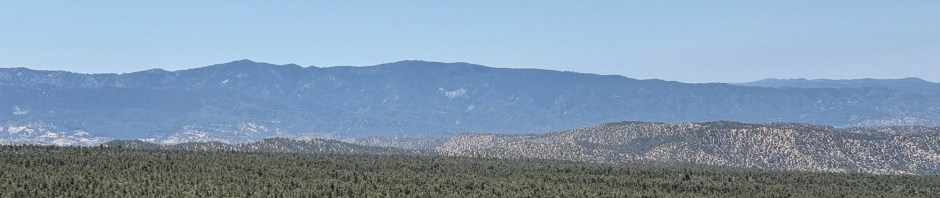
 Yellow lupine on Pine Mountain, Los Padres National Forest, Ventura County (May 2025)
I came across the first quote below back in 2019 when reading M. Kat Anderson’s extraordinary book, Tending the Wild: Native American Knowledge and the Management of California’s Natural Resources (2005).
I suspect most people have not seen this passage from Anderson before and that this may be the first time it’s ever been openly published online.
Surely, the quote from Trump is known by far more people, Kuyper’s known by far fewer, Anderson’s probably nearly unknown.
Certainly, tending forests by hand in yesteryears with simple tools and broadcast fire is far different than industrialized silviculture these days using mechanized means. I do not mean to conflate the two.
All three speak to the same issue using the same particular word.
Los Padres National Forest and wildlands in general are our preoccupation here.
Thus, the comments and the issue in general fall within the rubric of this weblog.
Take the comments for what ever they may be worth; edification or entertainment or agitation. Choose your own adventure.
“What’s that mean?”
“Read it anyway you like,” I said. . .
—Louis L’Amour, The Man From the Broken Hills (1975)
 A view of pinyon pine forest in Chumash Wilderness, Pine Mountain in the distance defining the skyline. (June 2025)
“Aware that pinyon pines are not fire-resistant, Indians pruned back dead wood in the canopies and cut back low-lying limbs under the trees that could catch fire.
Tribes also raked litter and duff from under pine nut trees and removed by hand any live growing shrubs that might act as fuel ladders.
These practices protected the trees from the devastating effects of wildfires and, even more important, worked in conjunction with fires set intentionally.”
—M. Kat Anderson (2005), Ph.D. in Wildland Resource Science
Tending the Wild: Native American Knowledge and the Management of California’s Natural Resources
Anderson shares a personal communication related in 1989 by Virginia Jeff (Central Sierra Miwok), directly quoting Jeff: “They burned so they would not have big fires.”
Anderson paraphrases Jeff speaking of how her father in the 1920s “raked the debris from around the oaks” in preparation for “setting fires in the fall.”
“You gotta take care of the floors. You know the floors of the forest, very important.
You look at other countries where they do it differently and it’s a whole different story.
I was with the president of Finland and he called it a forest nation, and they spend a lot of time on raking and cleaning and doing things and they don’t have any problem.
And when they do, it’s a very small problem.”
—President Donald J. Trump (2018)
Trump Says California Can Learn From Finland On Fires. Is He Right?
www.nytimes.com/2018/11/18/world/europe/finland-california-wildfires-trump-raking.html
“This project exemplifies the misguided ‘rake-the-forest’ policy that began under the last Trump administration, and will only worsen over the next four years.”
—Jeff Kuyper (2024), Executive Director of Los Padres Forest Watch
Appeals Court Clears Path for Controversial Pine Mountain Logging Project
Related Post:
The Myth of Wilderness and Ethnocentrism: Race and Recognition in the Woods











 Jack Elliott's Santa Barbara Adventure
Kuyper gets my vote. I really REALLY hate it that the thing now is prescribed burns. As someone who knows how bad PM2.5 is for our health, those burns are a menace. And logging to prevent conflagrations is the most backasswards lame s–t EVER.
Thanks for your comment.
Yes, fine particulate matter is terrible for our health, indeed. One of the worst things, no doubt.
The counterpoint would be, that smoke from controlled prescribed burns would tend to be much less than that from huge out of control unintentional conflagrations.
Several years ago we actually fled Santa Barbara for a time, driving north, to escape the terrible smoke plume from wildfire. It was so bad we could see the blue haze in our living room in town day after day, and it blotted out the town like heavy marine layer.
It seems as best we can tell that we live with forests these days that have been severely altered by the zero tolerance policy for wildfires of some 100 years of suppression.
And so the question now is how to manage the unintended consequence of decades worth of what is, by historical standards, vis-a-vis California Indian management informed by Traditional Ecological Knowledge, overgrowth and a build up of detritus.