 Cold War Biological Warfare
Georgi Ivanov Markov climbed the stairs on the south side of the Waterloo Bridge in London for the last time on September 7, 1978. He worked across the River Thames at the BBC and routinely parked his car to catch the bus over the bridge.

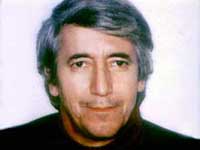
Georgi Ivanov Markov (c)PBS
As Markov approached the huddle of people at the bus stop, a bolt of pain seared through the back of his right thigh stopping him in his tracks. He turned to see a man facing away from him and retrieving an umbrella from the ground. The stranger muttered a brief apology and then hailed a cab and was gone and despite the pain in his leg, Markov continued on with his day. Later at work he saw a red spot on his pants and he showed one fellow employee a bloody, swollen bump on his leg.
That evening Markov came down with a fever. The following day he was having trouble speaking and was admitted to the hospital, but his condition deteriorated. Over the course of the next four days his blood pressure plummeted, he vomited blood and his kidneys stopped working. Then his heart gave out and he died.
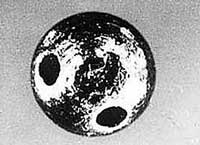
The projectile that held the ricin poison that killed Markov. It is about the size of the head of a pin. (c) PBS
“A totally independent journalist, Markov was Bulgaria’s most revered dissident and Bulgarian communism’s arch enemy,” writes Shayne Gad in Handbook of Pharmaceutical Biotechnology.
As a broadcast journalist for the BBC Markov covered the Communist bloc. He also contributed to Radio Free Europe where he delivered devastating broadsides against totalitarian collectivism.
In 1977, Bulgaria’s Communist dictator, Todor Zhivkov, sought to silence Markov for good and requested help from an all too willing Russian KGB. After two unsuccessful attempts on Markov’s life, KGB agents fabricated an American bought umbrella so that it fired a poison laden bullet. The projectile was a tiny watch bearing. It had two cavities bored out of it using a laser and the holes were then filled with poison. The agent of choice was ricin, an exceptionally lethal phytotoxin made from castor beans.
Common, Valuable and Deadly
Castor bean plants (Ricinus communis) are native to southeast Asia, but grow as a weed all over Santa Barbara County and the warmer regions of the United States in general. As its binomial or scientific name reflects it is a common plant. They are typically found in open spaces and empty lots near roads and along railroad tracks, drainage ditches and creeks and areas where the soil has been disturbed, such as newly cut roads and recent places of construction.

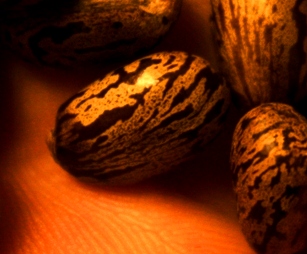
Castor beans.
The seeds of the Ricinus communis plant are the source of castor oil, which is produced by pressing the brown and black mottled beans. Castor oil is a valuable global commodity with seemingly endless uses from medicine to fuel to food flavoring and much more. It has improved the lives of untold millions in one way or another. About one million tons of castor beans are grown per year as a cash crop.
Ricin is also produced from castor beans and is one of the deadliest natural poisons on earth and has no known antidote. The poison is manufactured using the mash leftover after castor beans are pressed to produce oil. Whether inhaled, injected or consumed the deadly agent works by penetrating the body’s cells and inhibiting their protein production which kills them. The U.S. military experimented with ricin poison during the 1940s as a possible biological weapon and today it continues to be a concern in the age of international terrorism. (BBC News January 8, 2003-Seventh Arrest in Ricin Case )
Trivia
Ancient peoples used castor beans for their rich oil content, and the seeds have been found in six thousand year old Egyptian tombs.
The castor bean plant, Ricinus communis, was named after the Mediterranean sheep tick, Ixodes ricinus, because the plant’s seeds resemble an engorged tick.
Castor oil was the preferred lubricant for rotary engined warplanes of WWI and today is used in jet, diesel and race car engines.
The specialty lubricant company Castrol took its name from the castor bean plant. Castor oil is the primary ingredient in Castrol-R motor oil designed for high performance racing engines.
Mussolini’s Blackshirts used castor oil as a weapon of terror by force feeding it to dissidents and regime opponents, which caused severe explosive diarrhea. A large enough serving and victims could literally shit themselves to death. Castor oil is still used today as a laxative.
The USDA rates ricin poison as being seven times more lethal than cobra venom. Put a different way, two millionths of an ounce, about what a grain of salt weighs, is enough to kill a 160 pound person. Eating as few as four seeds can be deadly.
Castor oil is used to make biodiesel.
Ricinoleic acid, which is derived from castor oil, is used to make synthetic flavors such as apricot, peach, plum, banana, and lemon.
Dehydrated castor oil is commonly used in many paints and varnishes.
Three tons of castor oil can be made into one ton of nylon.
Castor oil is used in cosmetics, emollients and shampoo.
A number of brand name medications are made with castor oil such as Tylenol Extra Strength caplets. And numerous other specialty drugs are produced using castor oil or its derivatives with such applications as anti-fungal treatment, cancer chemotherapy, immunosuppressant medication for organ transplants, and HIV medicine. In lab experiments ricin has been used to kill cancer cells.
.
Bibliography:
R. C. S. Trahair, Encyclopedia of Cold War Espionage, Spies, and Secret Operations (Enigma Books, April 1, 2009), 182-3.
Shayne C. Gad, Handbook of Pharmaceutical Biotechnology (Wiley-Interscience; 1 edition, June 11, 2007), 1582.
PBS Website: Secrets of the Dead, Case File: Umbrella Assassin
BBC News January 8, 2003: http://news.bbc.co.uk/2/hi/uk_news/2637515.stm
Wayne’s World Online Textbook of Natural History
Wikipedia for various uses of castor oil.
USDA, USDA

 We passed these guys on the way to the beach on Java. I’m not sure what type of bikes they were riding or when they were made, but somebody made a wise crack about it looking as though they’d been salvaged out of the ocean after a century and everybody chuckled.

















 Jack Elliott's Santa Barbara Adventure