The Day Hell Hit Santa Barbara; Third Hottest Temperature Ever Recorded on Earth

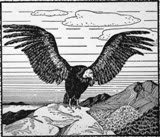
A crumbling Santa Barbara adobe in 1898.

“. . .and there lies Santa Barbara on its plain, with its amphitheatre of high hills and distant mountains. There is the old white Mission with its belfries, and there the town, with its one-story adobe houses, with here and there a two-story wooden house of later build. . . in the golden sunlight and glorious climate, sheltered by its hills. . .and there roars and tumbles upon the beach the same grand surf of the great Pacific. . .”

-An excerpt from Richard Henry Dana’s maritime travel narrative titled, Twenty-Four Years After (1869).

As the sun slipped above the hills east of town on the morning of June 17, 1859, it revealed another near perfect California day in Santa Barbara. From a cloudless, brilliant blue sky, the brassy ball of fire overhead beating down on the tile-roofed adobes and dusty roads quickly raised the temperature.

As mid-morning passed, so did the 80-degree mark. It was nothing out of the ordinary, but that would soon change. By day’s end, the small town of several thousand people would suffer through what was at the time the hottest temperature ever recorded on Earth.

As morning passed into early afternoon, the heat continued. Then out of nowhere, a blast of superheated air blew over the Santa Ynez Mountains like a blowtorch. The sky was soon darkened by a massive dust cloud kicked up by the blistering wind. Not long after, the heat “began taking a terrible toll of the beasts in the field,” the late Santa Barbara historian Walker Tompkins wrote, “leaving the buzzards a feast of calves, rabbits, field mice and even full-grown cattle who perished under the oak trees where they had sought respite from the punishing heat.”

By 2 p.m., the temperature had rocketed to an unbelievable 133 degrees!

People fled to the Old Mission and Our Lady of Sorrows Church in sheer terror, thinking the end of the world was at hand. Others took to their adobes desperately seeking refuge behind the earthen insulation of mud walls.

A decade later, the phenomenon was included in an official government report by the United States Coast Survey titled “Coast Pilot of California, Oregon, and Washington Territory.” The survey crew happened to be on a vessel at sea in the Channel at the time of the heat wave, and were it not for them, an official record would not exist.

“All the residents betook themselves to their dwellings and carefully closed every door and window,” wrote George Davidson in the report. “No human being could withstand such heat out of doors.” A fishermen, having suffered through an afternoon at sea in an open boat, returned literally scorched, his arms covered in blisters.

Home gardens and commercial crops along the typically cool littoral plain withered before the sweltering bluster of biblical proportions. “The fruit fell to the ground, burned on the windward side,” the survey report recorded. An entire grape crop baked on the vine in the Goleta Valley. Birds fell out of the sky in mid-flight, their carcasses scattered over the land along with numerous other animals that had expired. Others were found drowned in the bottoms of wells where they had tried to escape the heat. “We had a good deal of trouble cleaning out the wells,” one lady later recounted.

Then just as mysteriously as the wind emerged, it died. The temperature fell slightly to 122 degrees by around 5 p.m. and finally down to 77 degrees as the sun set.

Santa Barbara’s world record remained for 75 years, until it was beat by a single degree by weather in the Mojave Desert recorded at Death Valley. Nine years after that, in 1922, a heat wave of 136 degrees was recorded in the Saharan Desert of Libya, which remains the hottest temperature yet documented.

To this day, the simoom that seared Santa Barbara in 1859 with 133-degree heat remains the third-hottest temperature ever recorded on Earth. There exists no comparable event in meteorological history or known Native American folklore.

Source: The Yankee Barbarenos and It Happened in Old Santa Barbara by Walker A. Tompkins.

Photo credit: USC Digital Archive and the California Historical Society.

Posted in Santa Barbara | Tagged , , , , | 34 Comments

Backcountry View from Figueroa Mountain Peak

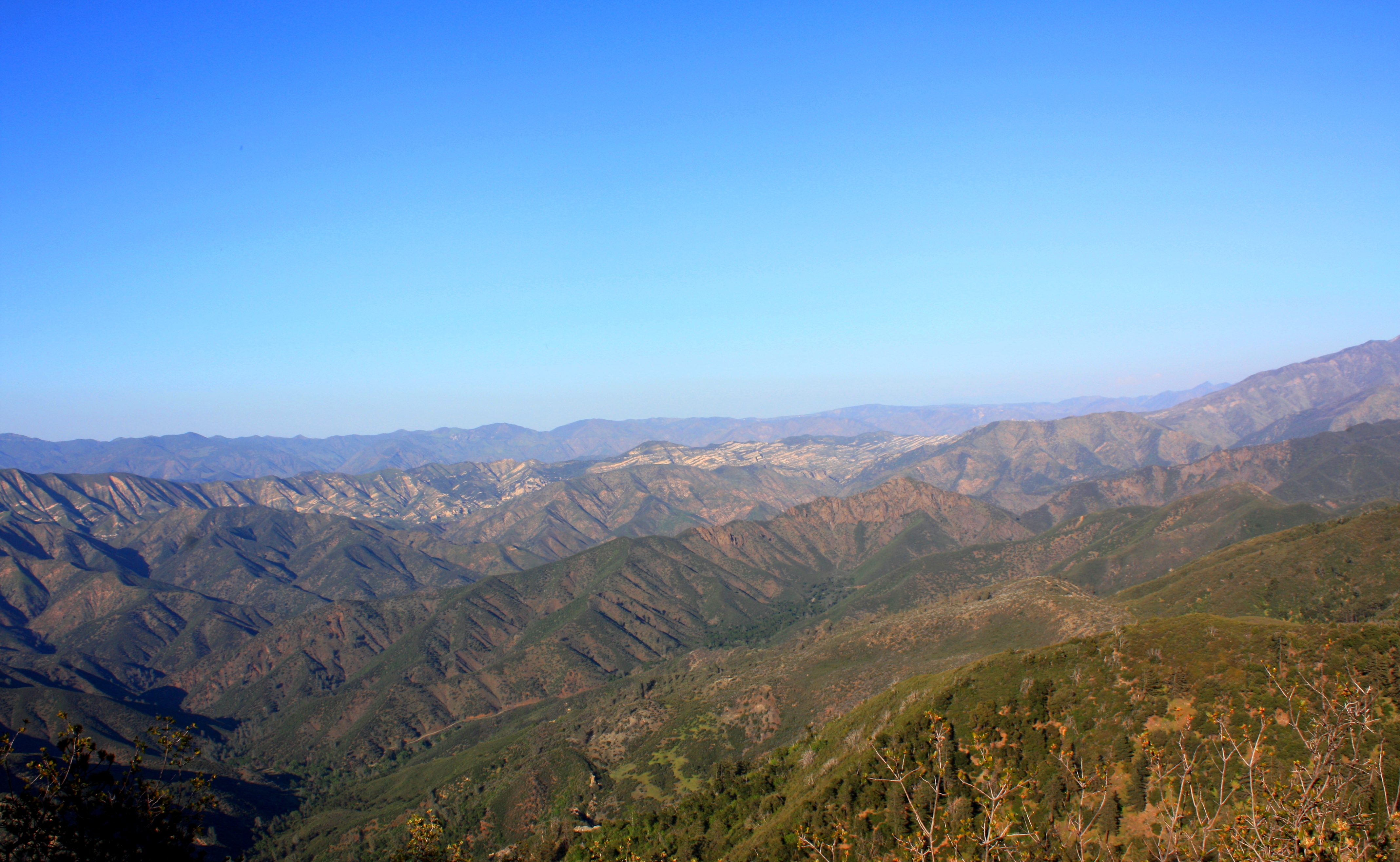
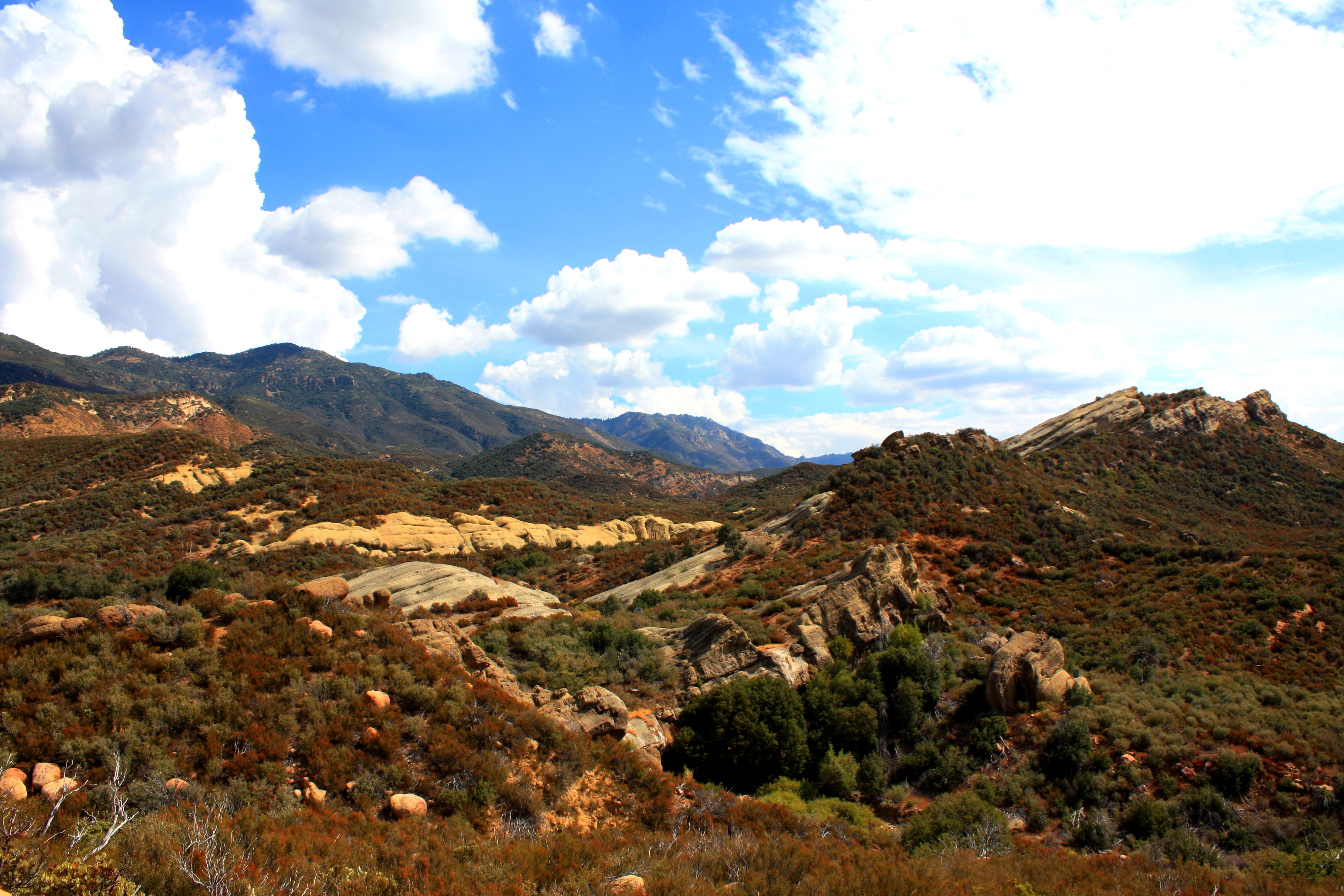
View from Figueroa Peak looking toward San Rafael Wilderness.

(click to images to enlarge)

Posted in Santa Barbara | Tagged , , , , , , , , , , , , , , | Leave a comment

Indian Creek Waterfalls (Dick Smith Wilderness)

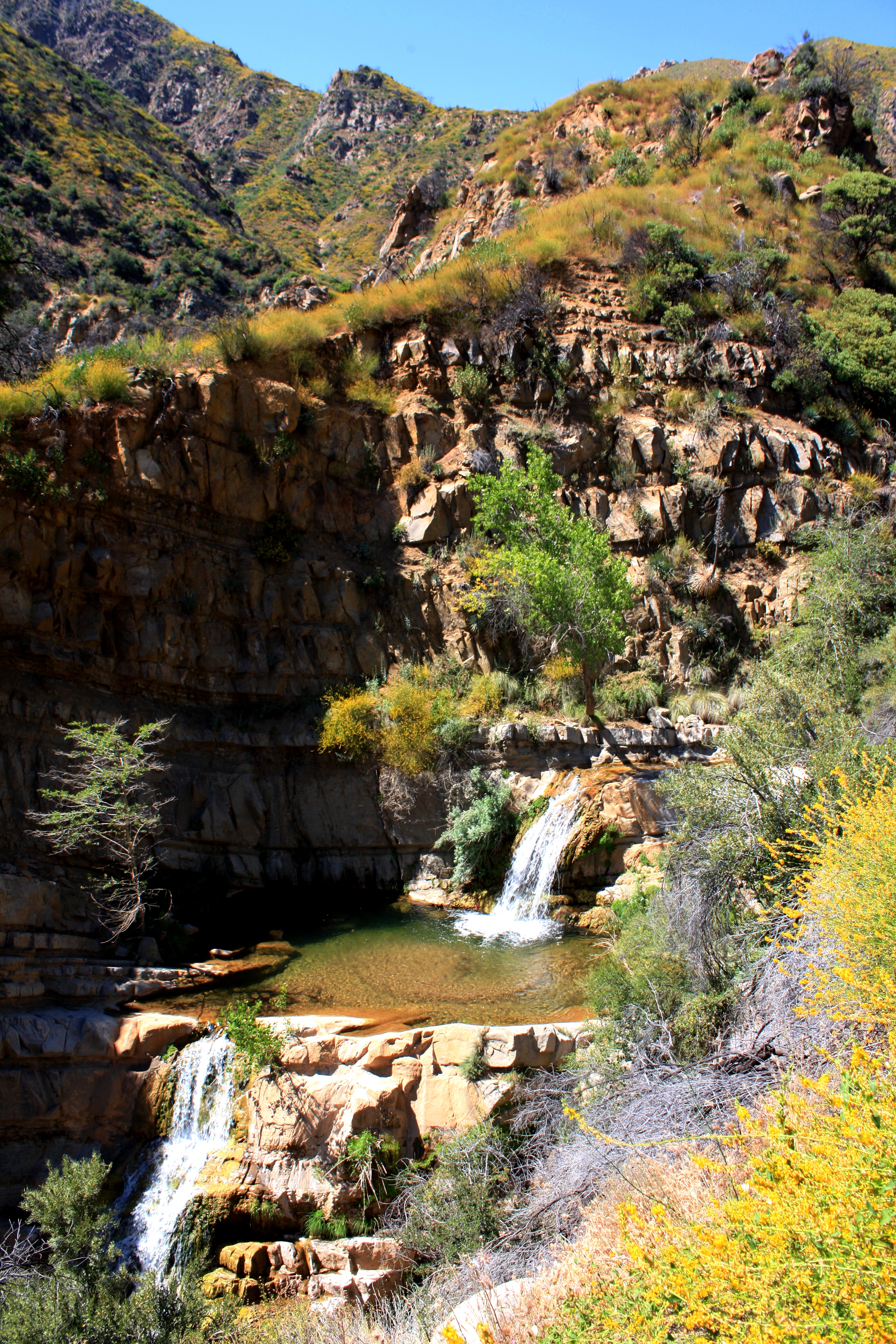
Indian Creek Falls in June 2010 showing regrowth of surrounding slopes after Zaca Fire of 2007.

I started out midday in the iron horse. At Escondido Creek on the north side of the Santa Ynez Mountains on Romero Camuesa Road, I came across a swarm of thousands of ladybugs. I made it to the Indian Creek Trailhead at about 3:30. Nobody was around and I set off through the gate and down the dirt road to the trail junction. A few people had signed the log on different days.

It was a good time to be hiking up the canyon in the late afternoon shade. Plenty of water was still flowing all the way down the canyon at a decent clip. I took my time and made it to Meadow Camp about an hour before sundown. Some jackass had left a plastic bag of trash that had then been shredded by some critter.

I was on the trail early the next morning and zigzagged my way up the narrowing canyon the remaining couple of miles. After crossing the creek the last time just before reaching Indian Creek Camp, the trail led through a swarm of some type of bee-like fly that had scores of burrows in the ground. Not sure if they stung or not, I ran through the swarming insects and within a few yards I came around a slight bend in the path only to nearly stumble onto a rattlesnake.

I swung my walking stick toward the snake on my left and yelled at my dog as it started to rattle. I coxed it off the trail and into the creek and then nearly had to drag my dog across the trail where it had crossed.

After setting up camp I hiked up to the waterfalls for the day. It was hot in the sun, but walking through the creek kept me nice and cool making for a relatively easy hike. Erosion from the Zaca Fire in 2007 has filled in the creek with gravel covering the cobblestone in many places and making some sections of the creek easy walking. The surrounding mountains are still pretty barren, but the creek is shrouded in a lush, verdant tangle of vegetation.

I set out early the next day to hike up the creek and spend some time at the Perfect 10 waterfall. But, alas! My dog had, at some point the prior year, officially hit and was over the peak of that proverbial hill that portends the inevitable decline into decrepitude.

Somewhere a mile or two above the falls I was forced to turn around lest I have to carry my dog back or leave her for mountain lion food. She was beat. Reaching camp by early afternoon I brewed some coffee and read Louis L’Amour the rest of the day.

I was plodding my way up the incline coming out of the potrero at Meadow Camp in late morning, on my way back, when I turned to see my dog slump down under a few branches casting a scant tinge of shade onto the sun-baked trail cut.

It ended up being a long, slow walk out, but with quivering legs, a dangling tongue and lots of breaks she finally dragged herself back to the truck. I never thought I would out hike my dog, but she could hardly walk by the time we got home. I had to lift her out of the truck and it took several days for her to recover.

Related Post:

Indian Creek Waterfalls and Narrows 2013

Posted in Santa Barbara | Tagged , , , , , , , , , , | 8 Comments

Blistered on the Chorro Grande Trail

In socks on rocks.

I was about two miles up the trail when I got a blister. It was bad enough that I decided, grudgingly, I had no choice but to take off my boots and hike back in my socks. Then it started to rain. Big, fat, summertime thunder storm drops slapping down.

I had set out mid-morning on Saturday for a short hike up Chorro Grande Canyon in the upper reaches of the Sespe Creek watershed. About a mile up the trail my right boot started grating on my heal. I had made the foolish decision to wear a pair of six inch logger-style boots I had not worn since last winter, although they had never given me any trouble before. When I plan on bushwhacking, I prefer their heavy sole and leather protection, as opposed to my usual choice of light-weight trail shoes.

Rather than stop and take off my boot to see if I could fix the problem, I pushed it another mile to Oak Camp. I thought the irritating burn on my heal would only amount to minor scrape, and that I would make an adjustment at the camp and then continue hiking.

A view from the trail of a dry Chorro Grande falls. It normally flows in two places over the rock face just above the group of green bushy oak trees in the foreground.

The dirt portions of the trail were splattered trackless by a light rain shower the afternoon before, and just short of the camp a set of bear tracks appeared for a number of yards. They were the only tracks I saw that day.

When I got to the camp I took off my boot and saw that I had a blister the size of a quarter on the back of my heal. I decided to take off both boots rather than hobble around like Quasimodo from one heavy boot and one barefoot. I had no tape or any supplies to pad the blister and it was unbearable to walk with the boot on.

A decent trickle of water was still flowing in the creek aside the top camp for a few yards before it seeped back underground. In typical fall fashion, it was pleasantly cool in the shade but still hot in the sun.

After a brief respite under the oaks I started back down the trail and shortly after it started raining. It rained lightly for about ten minutes. The big drops wetted down the landscape, my socks and the tops of my shoulders and hat. The fallen moisture made the humidity rise quickly and unpleasantly, but it also brought out the earthen and floral aromas of the mountain, a wilderness equivalent to the smell of the first drops of rain on hot asphalt in the city.

I made it back to my iron horse parked on Highway-33 frustrated the day ended short of my intentions, but with no further travails.

Oak Camp

Highway 33 heading into Sespe Gorge with Pine Mountain rising in the background.

Red sandstone along the Chorro Grande Trail.

Related Posts:

An Arrowhead, Fossils and Bear Tracks on Pine Mountain Or Return to Chorro Grande

Snow Day on Pine Mountain, Chorro Grande Falls

Posted in Ventura | Tagged , , , , , , , , | 1 Comment

Meadow Camp (Dick Smith Wilderness)

4.8 miles from Trailhead to Meadow Camp:

—>4.4 miles from Trailhead to Lower Buckhorn Camp

—> 0.4 miles from Lower Buckhorn Camp to Meadow Camp

—> 2.2 miles from Meadow Camp to Indian Creek Camp

From Santa Barbara: Gibraltar Road—>East Camino Cielo—>Camuesa Romero (dirt) Road 13 miles to the locked gate serving as the Trailhead.

Indian Creek Trail leads through the Los Padres National Forest and into the Dick Smith Wilderness. The footpath begins from Camuesa Romero Road, a little less than 1 mile above the confluence of Indian Creek and Mono Creek, and about 1.5 miles upstream from Mono Camp at Mono Debris Dam.

The Trailhead is located on Camuesa Romero Road where it is closed by a locked gate just east of Mono Creek. Just after the gate Camuesa Romero Road continues west and crosses Mono Creek and then Indian Creek several times. From the locked gate continue up the road for about one mile to find the start of the trail heading north into the mouth of Indian Creek Canyon. A metal sign-in box is located at the beginning of the trail, but is not clearly visible from the road due to being set back from it and behind a slight rise in the land.

Indian Creek Trail begins in a fairly arid and uninviting setting, but as the trail climbs up the canyon it enters a lush riparian habitat. The lower sections of the trail up to Meadow Camp are fairly well worn and easy to follow, although sometimes it’s easy to lose the path for a bit through the creek crossings. Above Meadow Camp the trail becomes a bit overgrown in places and certain creek sections there is little or no trail, although it’s easy to find your way up the relatively narrow canyon.

Indian Creek dries up during summer in the stretch that passes by Meadow Camp. The photos below were taken in mid-June; there was plenty of water for camping, but it was getting low. When this lower section of Indian Creek is dry sometimes water can be found near Lower Buckhorn Camp.

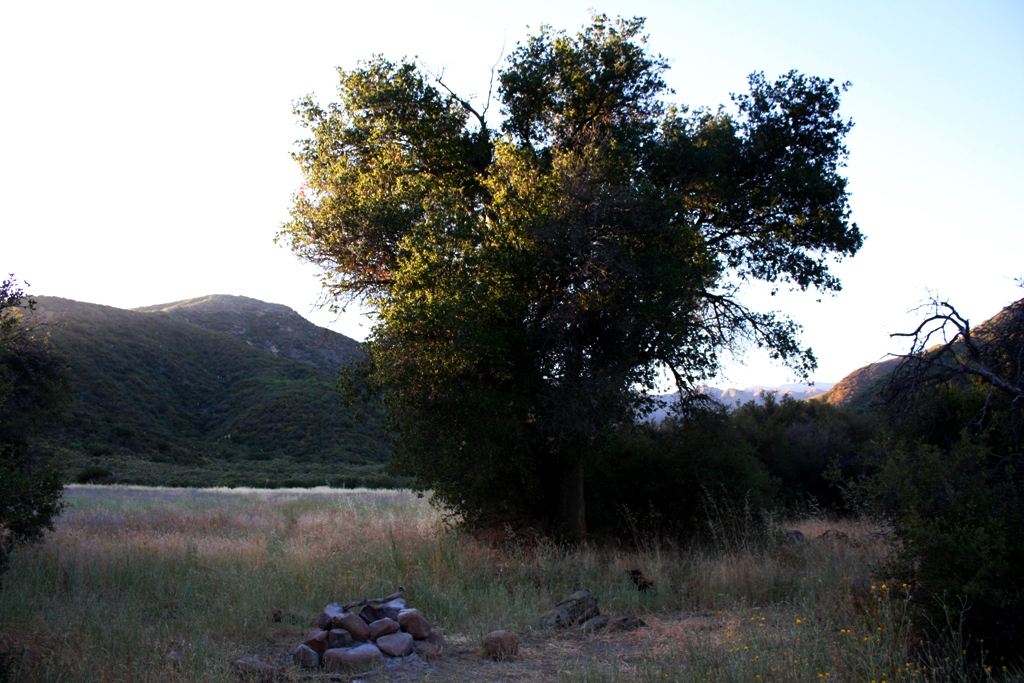
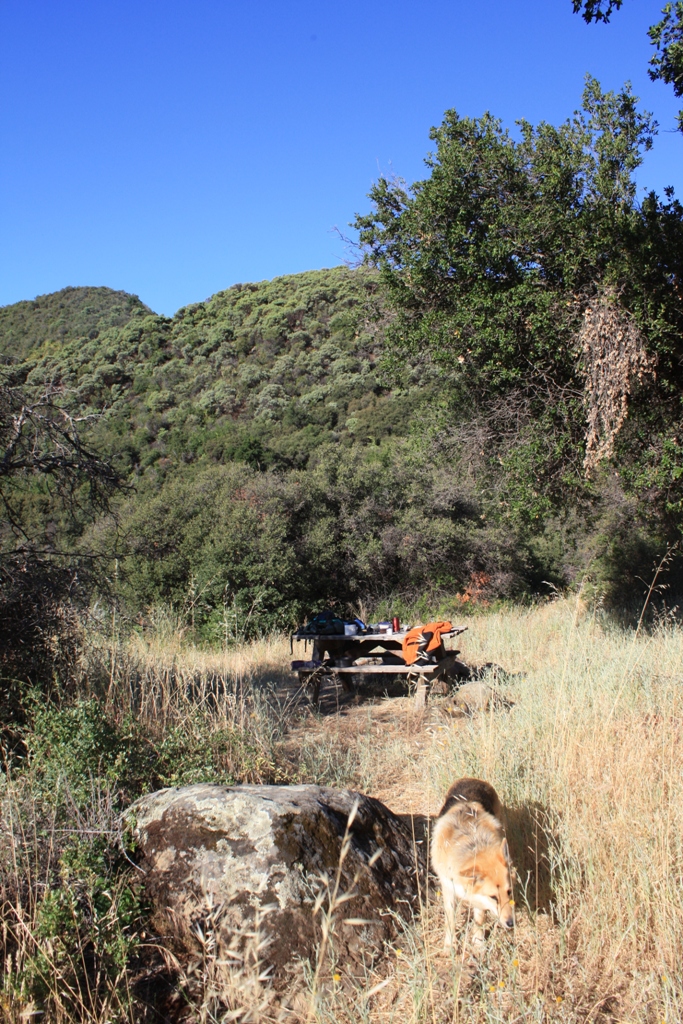
The meadow of Meadow Camp looking up Indian Creek Canyon. The creek runs to the right of where I took the photo.

Meadow Camp

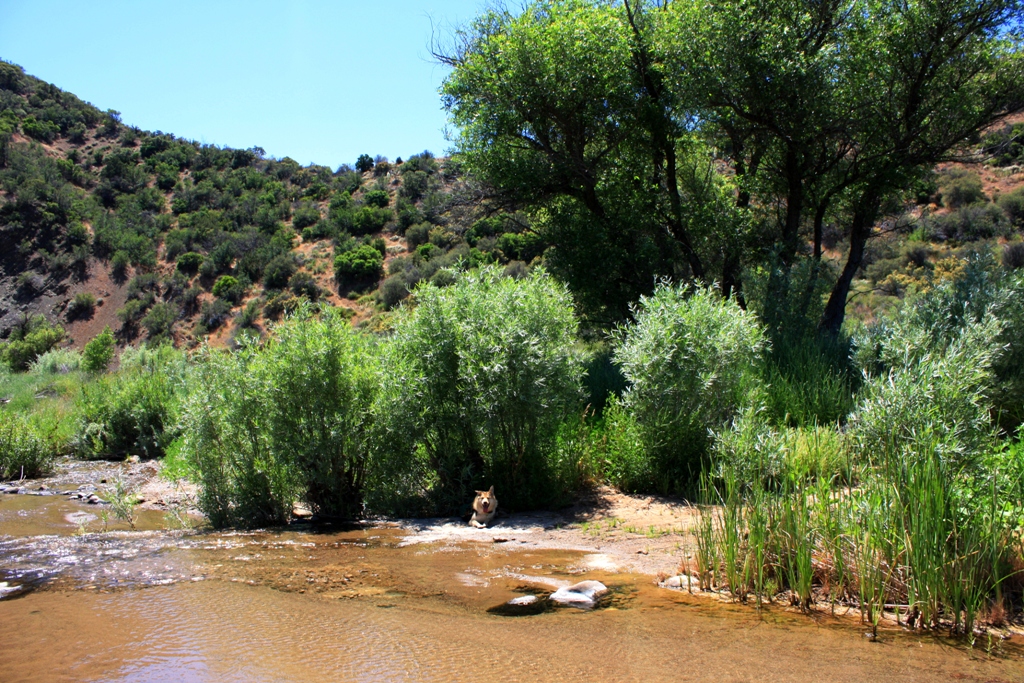
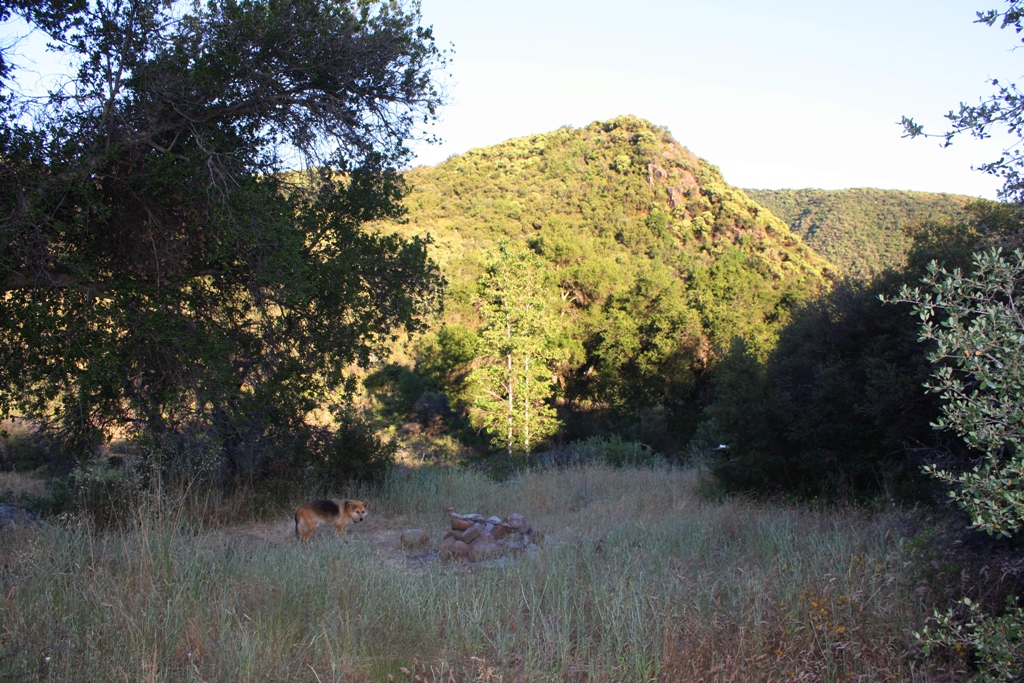
Looking toward the creek. The camp sits well above the creek.

Just behind where I took this shot the land slopes down to the creek about 20 yards below.

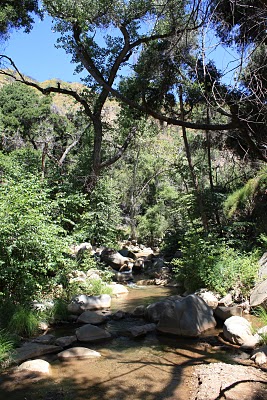
Indian Creek flows beside, but below the camp.

Posted in Santa Barbara | Tagged , , , , | Leave a comment