
 Jack-in-a-crack doing what he does. Wandering. Searching. Hunting. Looking. Seeing. Sometimes discovering.
Looking to get my hike on, and so surveying various trailheads through my car window during the COVID-19 governor’s lockdown order, I saw more cars parked than expected, more cars than often seen without the lockdown. I expected far fewer.
Holy nightmare, Batman!
This despite the low ceiling of clouds sucking over the Santa Ynez Mountains in breezy 48 degree weather with snow capped peaks beyond in the San Rafael Range. In April!
We’ve been bestowed with a desperately needed late season blast of rain.
The state largely shut down in an unprecedented effort to halt the spread of the debilitating and deadly SARS-CoV-2 virus and people took advantage of the downtime from busy schedules for much needed mountain medicine, as I expected they would.
But I hadn’t expected such trail traffic in less than hospitable weather. Foul weather friends abounded. And good for them. Get out of town, Leroy Brown!
The Grouch of the Woods kept driving. Naturally. Onward forth.
Because, apparently, as per the lockdown law, my “neighborhood,” to quote the governor’s order, includes the entire county. Hmmm. As long I “continue to practice social distancing of 6 feet.”
I wonder if the eses on the East Side and West Side know that the güeros on the North Side own all now.
¿Que onda, güey? ¡No mames!
Time to get inked by Mister Cartoon.
This doesn’t make sense, I know. Neither does the law.
But Governor Newsom has an 83% approval rating so what senselessness may be found in his policy doesn’t matter. He’s headed toward the presidency.
 “Not a chill to the winter but a nip to the air”
Days earlier I made the mistake of hiking a trail in the Santa Ynez Mountains I figured sufficed for my needs, since only three cars were parked, and the trail split in two different directions at this trailhead, and so what few people were around could have been divided between the frontcountry slope and the backcountry.
My needs being outdoor exposure in undeveloped unimproved nature and plenty of distance from my fellow humans.
Anybody spending much time out in the forest around Santa Barbara County well knows that on some trails, in many areas, it is not possible to maintain the six feet of separation called for in the social distancing guidelines enforced by police and advocated by health officials and learned professionals on disease and epidemics.
We’re talking about foothpaths a foot-wide.
Have you hiked one of these trails that cut through chaparral, along steep mountain slopes?
In a noteworthy number of places the only way to maintain proper separation between another hiker or biker or equestrian would be to leap off a cliff or slip and slide precariously off the beaten path into the slough on a steep slope or somehow burrow your way into a bristling wall of chaparral.
Or trail users approaching each other would have to yield one to the other and perhaps backtrack to find sufficient room to pass safely. But to exercise this option requires a willing participant on the other end, which does not always happen.
Case in point: I was ambling that aforementioned trail, having made the mistake, and several groups of mountain bikers appeared now and then. I stood on a foot-wide path with a wall of mountain on my right and a cliff on my left at one point, where I had stopped to flower gaze. I could not escape to maintain proper distance.
The bikers slowed, respectfully, we exchanged a quick greeting, but they did not stop and nor did they show any concern for distancing etiquette. I was forced to take one step, all that was possible, up a slippery and rocky slope, turn my back and let them pass.
Huffing and puffing, I imagined their aerosolized breath vapor floating all about, possibly carrying tiny balloons of the virus. I held my breath hoping the breeze would flush it away.
Belgian-Dutch Study: Why in times of COVID-19 you should not walk/run/bike close behind each other.
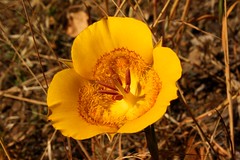
 Rare wildflower Ojai Fritillaria. Previous post: Thoughts on Rare Lily Ojai Fritillaria and Indian Fire
Not long after this encounter I happened upon two riders on horseback. Once more I yielded the right of way this time by stepping into the poison oak under the oak tree canopy.
Fortunately, I long ago stopped being allergic to this wicked little greasy-leafed plant: Eating Poison Oak.
So, in other words, the nature of our local trails renders the state’s guidelines not easy to follow in many places and difficult to impossible to follow in others, and sometimes dangerous.
Again, as per the law, I am allowed to hike in my neighborhood contingent on keeping my distance from others. If I cannot maintain distance, then the option of outside recreation is prohibited.
To the extent that the law is not enforced makes the code no less clear, nor muddled.
That is the problem with such speedily thrown into place, rigid one-size-fits-all blanket laws: They do not account for the nuance of reality across time and space.
If we are to read the law by its letter rather than spirit, as defendants in court are routinely held to—strict and narrow definitions of language because words really do hold certain and particular meanings—then we are to remain within our own individual urban residential areas if outdoors for non-essential activities.
The law is clear on this point.
These distancing guidelines and the lockdown order have been enforced by police:
Police Across CA Issue Citations for Violations of Stay at Home Order
In Santa Cruz, deputies issued about 40 citations to people who were not social distancing around beach areas.
This is not to say I am fearful of arrest, although arrests in California have occurred. In at least one case that gained nation-wide attention, a man was arrested despite being nowhere near anybody at all, arrested in open ocean:
California surfer in handcuffs after enjoying empty, epic waves
Other unreported anecdotes tell of similar encounters.
In addition to the law and my concern for my health and the health of others in my community, regarding the possible danger of distancing on narrow trails, the last thing I need is to get hurt and require some sort of rescue or a trip to the hospital.
Santa Barbara County Search and Rescue team member, Nelson Trichler, has said flat out, in the context of a recent ATV accident, to keep away from trails. Do not play too hard in the forest for sake of the health and well-being of SAR members, he has suggested.
“We understand that people feel the need to get out,” Trichler said. “I love the trails and I can understand why people want to be out there, but now is the time to give them a break.”
Ray Ford: Santa Barbara Search & Rescue Asks Community to Give Trails a Break
Healthcare workers on the front-lines, which include some of my family members and friends, have pleaded to adhere to the distancing guidelines and lockdown order to prevent the hospitals from being overwhelmed.
I wouldn’t want to clog up healthcare facilities should I twist an ankle or break a bone or whatever in trying to maintain distancing on trails.
Fortunately, as also reported in the county’s preeminent news outlet, Noozhawk, as per Brian Goebel, the curve in California has been crushed.
“. . .the statewide curve was flattened days ago and is now completely bent downward.”
Órale vato. ¡Que viva!
Maybe these restrictions will soon be eased.
Okay. Alright. I know. I know. Enough with the parsing, Jack! Good grief. You’ve mentally masticated this thing into a pulpy sludge. Let it alone already.
That’s what I do. Chew the cud. Ponder.
That’s what this back alley blog is all about. Thinking.
I analyze the reality of the world around me as shot through the prism of outdoor pursuits in the natural world. Readers should not mistake exploring all possibilities about certain issues as paranoia. This is an exercise in thought. It is academic.
Now to what I found out yonder. . .
 From a short distance away I spied on the right-hand side of this beautiful boulder what appeared to be foot holds carved into the stone. Before a closer inspection I sat in the shelter of the small pocket at its base to eat a few calories to fuel my machine.
I could quote Robert Frost on the path less taken making all the difference. But that’d be hackneyed. Oops. I did anyway. Because it is true.
Not having found an empty trailhead I parked aside the road in an unpaved unsigned nondescript pullout and headed into the mountains without a trail. I knew where I was headed despite no path leading me there.
In recent weeks I gazed from my house at the hills, as usual, and late one afternoon the oblique sunlight cast a revelatory beam onto the slopes and illuminated a particular area against its surrounding shadowed backdrop.
Whoa! I thought.
Never before had I seen this nook exposed in such light and at that moment I could see with the naked eye what appeared to be a small oak-studded flat high on the mountainside. Leading further up the mountain from the flat, towards an unremarkable peak, was a small and short ravine.
Reading nature’s telltale signs from afar I knew that the oaks grew there because water drained through the ravine and quenched their thirst on this south-facing hot and otherwise dry slope.
I knew immediately I had to venture out to take a looksee. This place called to me as I imagined it might have to other people in times past with similar minds.
When I arrived afoot at this place I found traces of those others.
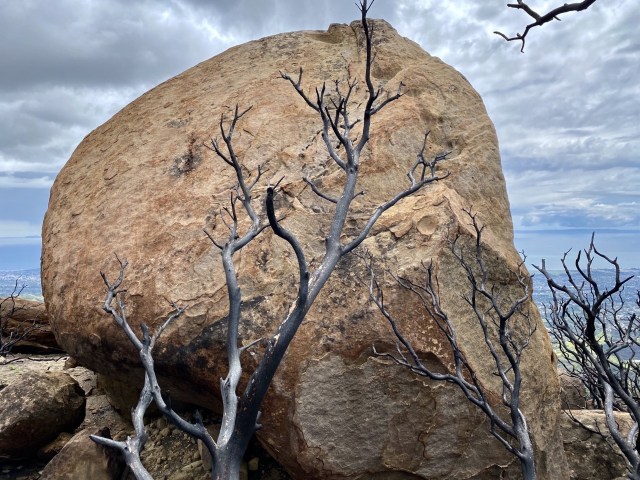 Upon closer inspection the possible footholds appeared no less striking, but in my attempt to find a way up to the first hold I was thwarted. There did not appear to be any way to reach the first step, though I didn’t give it my best try because I didn’t want to fall back into the stiff scorched skeletons of manzanita surrounding it.
I trudged up the mountainside in my approach, after steep rocky descents and steep ascents along my way and the crossing of a gushing clear water creek, nearly scrambling in some sections here and there.
I neared the crest of the ridge I had my sights set on and of a sudden broke onto what I immediately recognized as an old, long unused trail.
“No way. No way,” I muttered to Me, Myself and I. “Wow.”
In my first reaction I wondered how old the trail was, that it could possibly be of Native origins, maybe an old Chumash route from the coast to the Santa Ynez Valley and interior hinterlands. The location made this a real possibility, not wishful thinking.
Moments later, however, looking up and down the old footpath, then following it for a short distance, it became apparent that in its well-labored over construction and character and how it crossed over the lay of the land, that the old trail was of more recent origins and the work of Yankee Barbareños in modern times.
Americans may be persnickety about their trailcraft and meticulous in design and construction and it was readily apparent that Indians would never have built a trail of this nature.
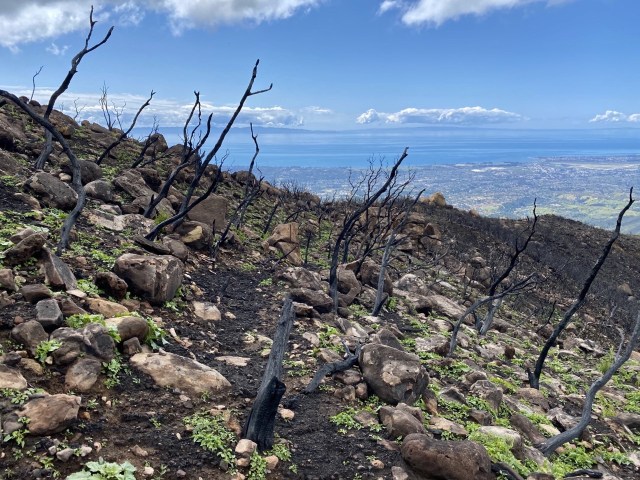 The old trail bed as first discovered, cobbles removed to form a clear pathway.
I followed the trail a bit further and came to a cluster of large boulders through which it weaved and continued on down the mountain turning corners smoothly here and there as it found its way across the steep and rugged terrain.
At the base of one outcrop by which the trail led I found a spent rifle cartridge. Without my eye glasses I could not decipher the caliber but felt it had obviously been left by a deer hunter.
I did not recognize the caliber from the form of the shell casing and so at that moment it seemed remarkably old. Although the casing appeared rather old, this find confirmed my notions of a much more recent trail than I had first thought.
Later in my home study I eyed the cartridge and was amused to find that it seemed likely to have been from sometime between World War I and World War II.
Of course, the round may have been new old stock (NOS) when fired and left on the trail. It may have been manufactured much earlier than when it was left on the mountain.
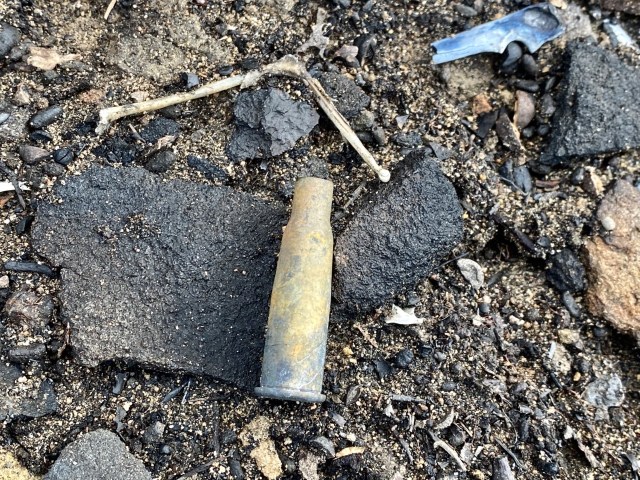
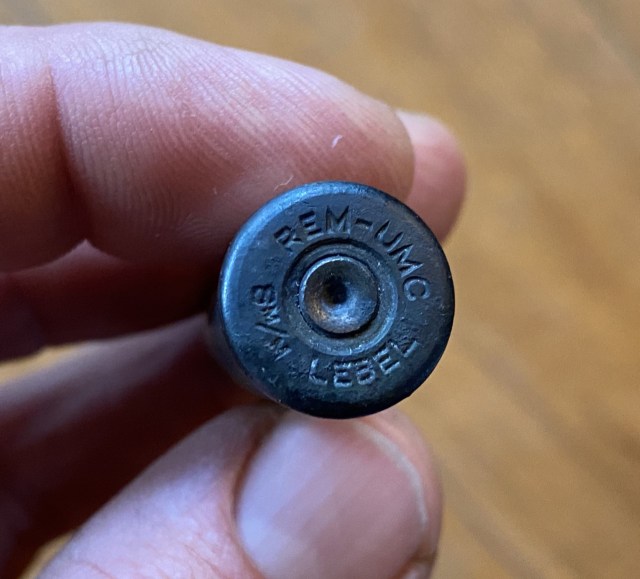 Remington-Union Metallic Cartridge company 8 millimeter French Lebel. I believe this may be circa WWI due to the Lebel marking.
A moment later I found that ubiquitous sign of modern man in the woods, a rusty beer can. “Hayduke sign,” as Edward Abbey wrote in The Monkey Wrench Gang, “beer cans.”
The can was made sometime around the 1930s to 1940s, I’d posit, based on the churchkey design whereby a separate handheld can opener was required to puncture two holes into the tin, one to drink from and one as a carb.
I still wonder as of this writing if the trail was built upon the moldering bones of an old Chumash path. Maybe this path had followed the ancients.
Standing on the mountain and gazing over the land I could make out two or three sections of the trail as it led down the mountain in the direction of, and along a canyon which, leads to an area where, in fact, an old Indian village was once located long ago somewhere in the vicinity of today’s Tucker’s Grove Park.
Among common folk interested in these sorts of things around this neck of the woods it’s common knowledge, and has been mentioned in media outlets in passing here and there through the years, that relatively near the location of the trail I found was once located an old Native footpath used to transit the Santa Ynez Mountains.
I have yet to look into the matter, but whatever the case may be, adding up the two telltale clues I found in the cartridge and can, it appears this trail is a leftover remnant from, perhaps, roughly about 100 years ago.
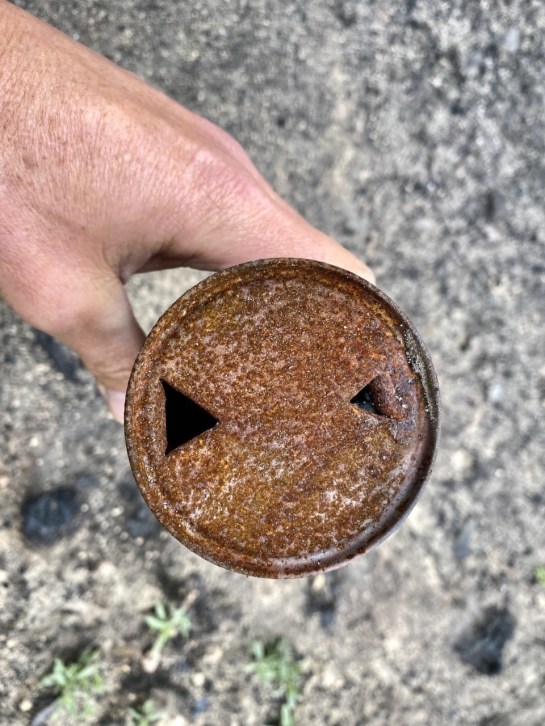 Bullets and bear cans, the ubiquitous sign of humanity throughout the forest.
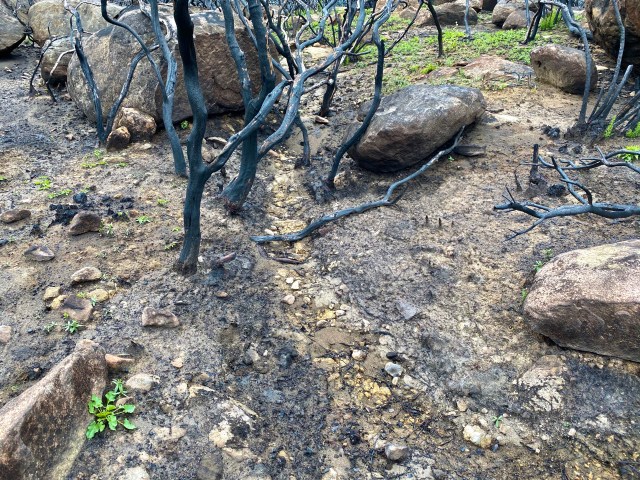 More old trail bed which with rain turned into a runnel. On either side of the photo frame the trail meanders a curvaceous route through a boulder field and remains remarkably clear to the eye and well preserved after all these years.
 A faint section of the trail, center frame, seen from afar leading along the razor edge of a steep-sided ridge. The aforementioned oaky flat seen from my home lies just out of frame on the left. Downtown Santa Barbara is seen in the distance.
 A single baby blue eyes now blooming in the folds of the Santa Ynez Mountains, standing tall and strong though alone, maintaining proper social distancing from family and friends in the background, beneath a blue spot of sky above.
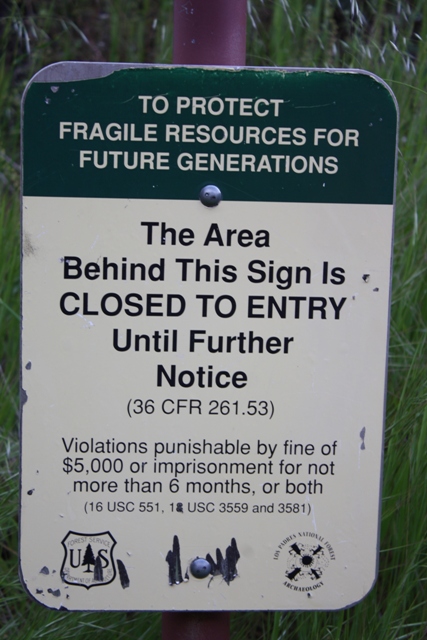 Santa Barbara backcountry
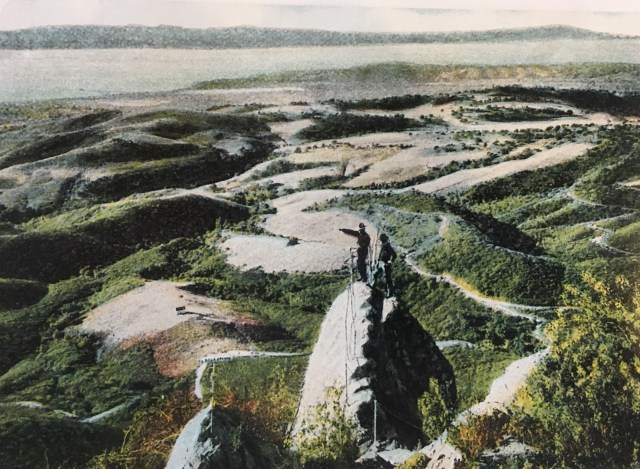 El Roca Grande circa 1909 overlooking the Santa Barbara littoral, Pacific Ocean and Santa Cruz Island in the distance. Note the metal poles and cable handrail.
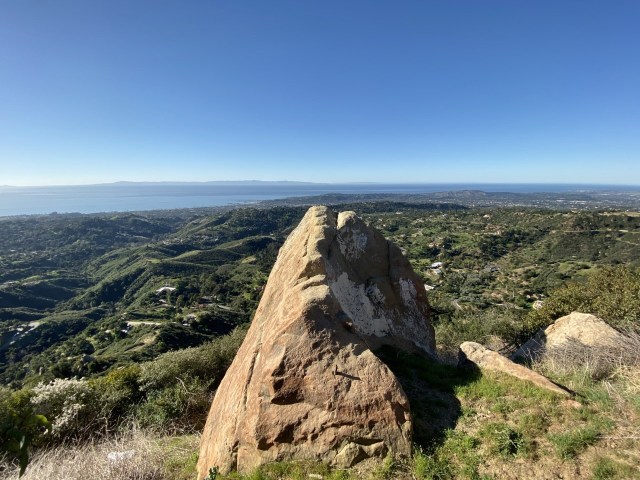 El Roca Grande
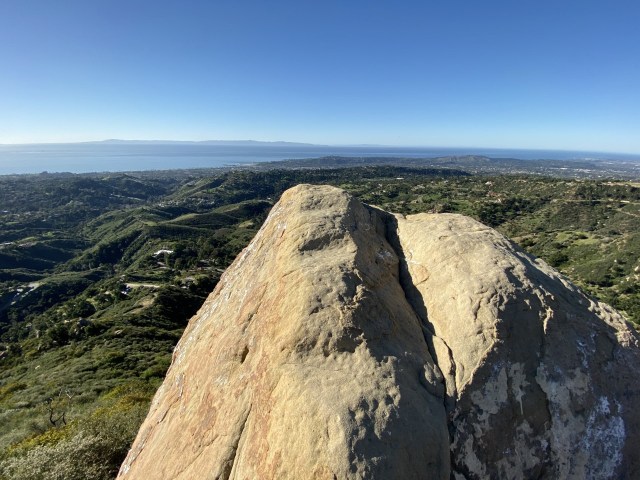 Note the old steps carved into El Roca Grande.
 Remnants of the old handrail on El Roca Grande.
 El Roca Grande noted here, which sits just below Gibraltar Road. The new house still under construction sits stop the larger sandstone outcrop which is just above Gibraltar Road.
 Standing on the old dirt pullout, now barricaded by cement walls, looking back at what we called The Rock.
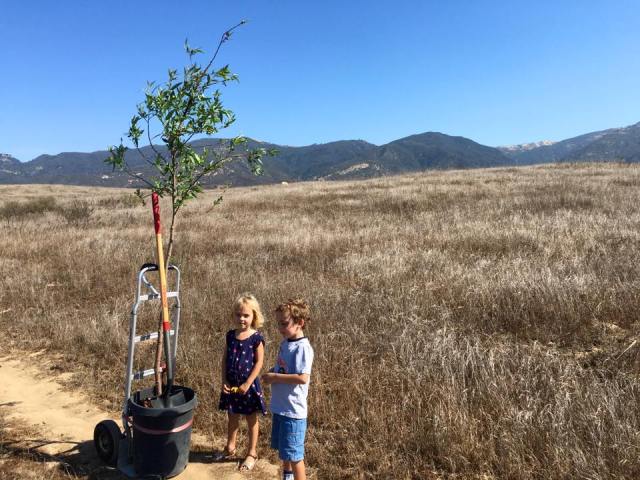 In September of 2016, under cover of broad daylight, assisted by her two trusty partners in crime, whom also served as convenient sweet little innocent distractions to any suspecting walkers in the area, Jackie Willowtree smuggled in and planted the contraband.
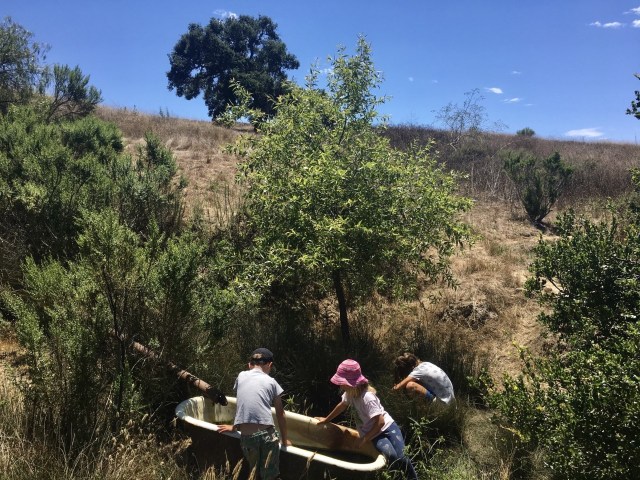 The willow cutting growing strong in July of 2019.











 Jack Elliott's Santa Barbara Adventure