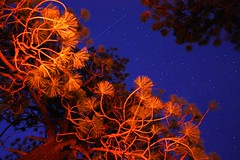
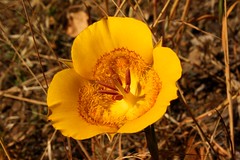
Trona Pinnacles. Enter, if ye dare.
The Trip Out Yonder
Some monstrous industrial ramrod ferociously hammered at long intervals some unseen target of progress, the metallic slamming a devilish metronome, the concussive impact reverberating off a pinch of rolling mountains and across the salt flats.
We stood warmly colored in the slant of early morning sunlight.
The town of Trona lay scattered like flotsam along the foot of those desert mountains, the scattered wrack of abandonment and ruin washed ashore along the ancient high water line of Searles Dry Lake.
Semi-trucks clamored around the bending strip of asphalt behind us, speeding by in a vibratory sucking whoosh of swirling grit like big rigs in Stephen King’s Pet Sematary, barreling toward the tangle of pipes and towers and metalwork spread about the railroad tracks just down the road toward town.

He stood hunched under the hood of his truck fiddling to secure, yet again, the hood latch, the monstrous ramrod keeping the beat from somewhere off in the unseen distance.
On a previous outing the latch had busted loose. Nearly going airborne as we launched off a dirt berm, out of the desert scrub, and back onto the asphalt probably hadn’t helped.
We had driven out of the Mojave Desert after that to find a piece of wire to lash it shut amid the ruinous gutted remains of an auto repair garage beside the famed old Route 66.
This time we were on the road again after adjusting a couple of bolts and tightening them down.
Onward forth yet deeper into the desert, on our way from Trona Pinnacles where we had spent a wild mind-warped night under a harvest moon, and into the Panamint Mountains of Death Valley National Park.
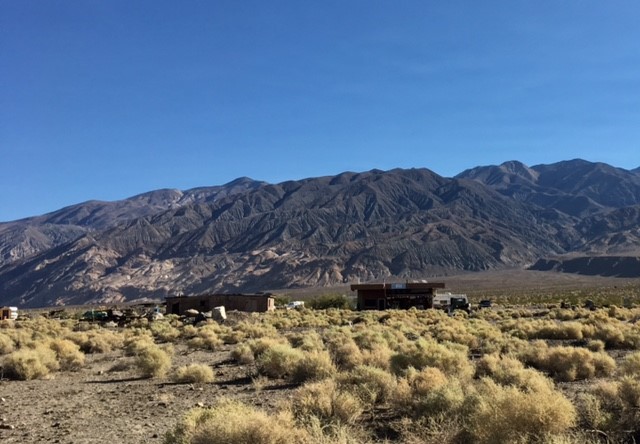
 Looking over the salt flats toward our destination high in the Panamint Mountains.
The brilliant stark white and glowing yellow paint stripes of the Shell gas station beamed obscenely in the morning slash of sunlight, sitting as it did against the drab backdrop of the half-dead town and its ragged and leaning and collapsed artifacts of better times.
The gas station recalled pop art pioneer Ed Ruscha’s iconic “Standard Station, Amarillo, Texas (1966).”
“I go out to the long, lonely stretches of desert,” Ruscha said in a recent interview I read in an in-flight magazine while over the Atlantic, commenting as he was about where he draws inspiration from.
Yes, sir, Mr Ruscha. Indeed. Inspiration.
I caught a peek of a local resident pulling off the byway and into his neighborhood. I strained to see what sort of person could possibly find this place worthy of living in.
The man drove a late model well-kept full-sized pickup truck, appeared clean shaven and dressed well enough, for what little I could glimpse as we sped by. He looked normal, which here looked out of place.
We passed the sprawling, out-sized campus of the local high school, an immaculate, well-built and maintained symbol of pride, but impossible to believe enough children were around to attend even half of it.
The school building stuck out from the town conspicuously like a knobby crystal inclusion cutting through dark stone.
The two best kept articles of property in all the town appeared to be the filling station and the school, so far as was seen at speed from the outside.
 Ballarat (Previous post: The Bandit of Ballarat)
“Turn here.”
We left the two-lane asphalt and followed a dirt road across the salt flats toward Ballarat, once a town now not.
We passed the two buildings known as Ballarat, a lone man standing in the shadows outside gazing at us from afar.
We sped by climbing a long alluvial jumble of fractured rock spat out of the canyon mouth to the desert floor below. We reached the end of the old road and set up shop for the night in an old miner’s camp.
The next morning when I woke, laying on my cot and wrapped in my sleeping bag, I caught sight of a single desert bighorn sheep making its way up the canyon we would soon be hiking up.
The bighorn’s presence foreshadowed the day to come searching out as we would be Native American pictographs depicting the same type of mountain sheep.
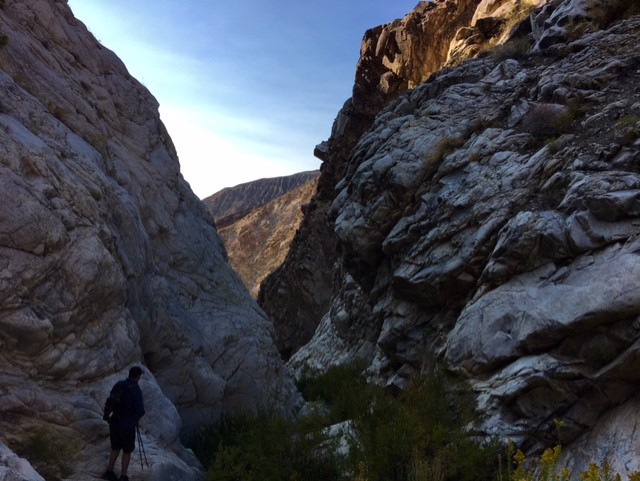 The canyon hike.
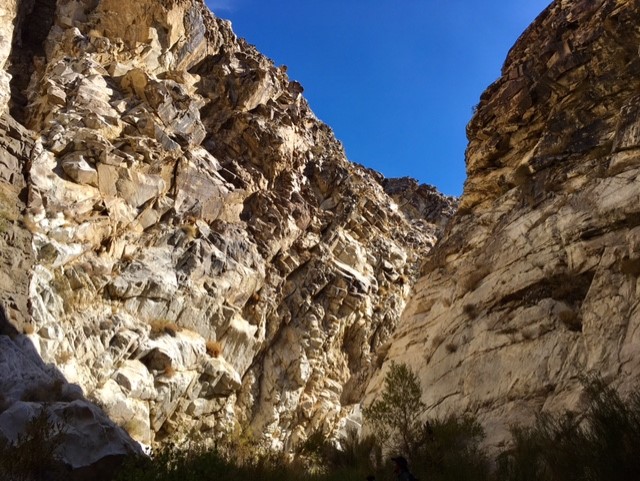 Looking through the canyon on the hike up.
 Canyon walls looming overhead.
The Hike
Once within the canyon walls I was surprised at the new world we had entered, so different from the desert just outside its mouth.
Cool water flowed giving life to a verdant flush of various plants. Orchids grew along the creek, while cacti sat perched high overhead along the stony walls. Riparian and desert habitats met headlong. Higher up the creek the canyon opened and gave way to juniper and piñon pine and sparse scrub.
We trudged up the relentless alluvial acclivity for some six miles, gaining over 4,000 feet, to an elevation of almost 7,000 feet. Long swaths of the trail led over loose shards of scree that shifted beneath your feet with each step and drew yet more energy from our peregrinatory engines.
The slope went on, and on, and on.
Finally we came to the site of an old mining operation and what was left of its town built in a boom during the late nineteenth century.
We saw the boulder, the underside of which we had come a long way to gaze upon and ponder. The boulder rested on a gentle slope overlooking the wash not far below and had a view of the ruined town.
 Stilly in his element. Captain Crash leading the way, as always.
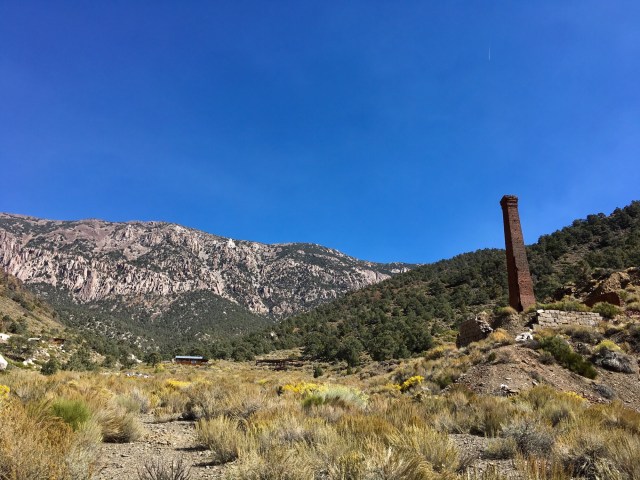 The ruins of the mining town.
First Impressions
Perhaps the oddest and most remarkable and immediately evident point that struck me was that the Indian rock art on this lithic canvas was virtually free of vandalism.
How could this possibly be?
The boulder sat in clear view mere steps from what was once a bustling mining operation, whose inhabitants, like most if not all early mining towns, where drunken rowdy and violent rough-and-tumble types.
The historic town here has been described as the meanest, toughest hellhole around, but then again that is a popular description and the same is said of many such mining towns. It ain’t called the Wild West for nuttin’.
Somehow the Indian rock art survived unscathed. There were no initials nor names etched into the panel. I failed to find even a single bullet mark. Not a one. Imagine that. It was astounding!
I wondered if the paintings had come after the mining boom went bust and the town fell to ruins. The paint was certainly not too old looking being thick and pasty, the colors vibrant.
 The rock shelter. (All photos from October 2017)
Some of the design elements found in the cave:
Quadrapeds (unidentified) 33
Bighorn sheep 26
Horse or mule and rider 9
Anthropomorphs 16
Anthropomorphs with weapons 8
Sun-like symbols 3
Deer 2
Bird 1
Ring 1
Star 1

The Cave Site And Interpretation
This Indian rock art site is associated with hunting magic and the Ghost Dance movement of the latter nineteenth century in California. This site appears to depict hunting scenes as suggested by the bowmen and animals that appear to be pierced with arrows.
The Ghost Dance movement was a reaction to the decline and destruction of Native American cultures resulting from the various consequences of Euro-American settlement and the expansion of the United States.
The movement sought to revitalize native traditional ways of life to empower its people and bring on the return of bountiful lands and a fruitful and fulfilling existence for hunter gatherers.
Native American prophecy held that the world would be destroyed, but following this cataclysm the animals and plants would return along with the Indians and their dead ancestors, and the Europeans would disappear.
The Ghost Dance movement stimulated a renascence in rock art creation. And because rock art reflected important life experiences it is believed that many pictograph sites are adorned with aspects of the Ghost Dance.
The desert bighorn sheep design element at this site is key in linking the paintings to the Ghost Dance. It is thought that these paintings were inspired by participation in this movement.
The particular stylized design of the sheep was an important choice made by the artists in their efforts to restore depleted sheep herds and reinvigorate their cynegetic way of life.
The design of the bighorn sheep at this site are reminiscent of the many bighorn petroglyphs in the nearby Coso Range, which are thought to have been created around 1,000 years ago.
Although it is theorized that the creation of those ancient petroglyphs coincided with a sharp decline in bighorn sheep numbers, looking today at the many Coso petroglyphs, thousands of them depicting sheep, it gives the sense that game was incredibly abundant back then.
It may be that the artists at this site featured below, inspired by the Ghost Dance movement’s call to return to and enliven old ways, had been looking back at that ancient art found in the Cosos and saw a time of fecundity and therefore sought to mimic that style of art in their efforts to bring back abundant game and a vibrant culture.
The various horse or mule and rider designs along with the depiction of people wearing hats are believed to be Indians rather than Euro-Americans as might be commonly thought at first glance.
These riders are believed to be Indian Ghost Dance messengers.
The spread of the movement was facilitated by the adoption of horseback travel by native peoples. The arrival of such messengers on horseback would have been a special occasion worthy of the creation of rock art, whereas the sight of Euro-American riders in the late 1800s, long after the advent or arrival of white folk and domestic horses, would not likely have been worthy of special record.
This is the theory of, and all the preceding information comes from, anthropologists that studied the site in the 1980s. As always, such theories and conclusions, although underpinned by evidence of various sorts, are only “maybes.” And if newer studies have been conducted of which I am unaware, it may be that these conclusions by those scholars are now out dated. Take it as you wish.
 This is an illustration depicting the design elements found in the cave. A close and careful examination of the illustration will help identify the same design elements shown in the photos below, though the snapshots are of poor quality.
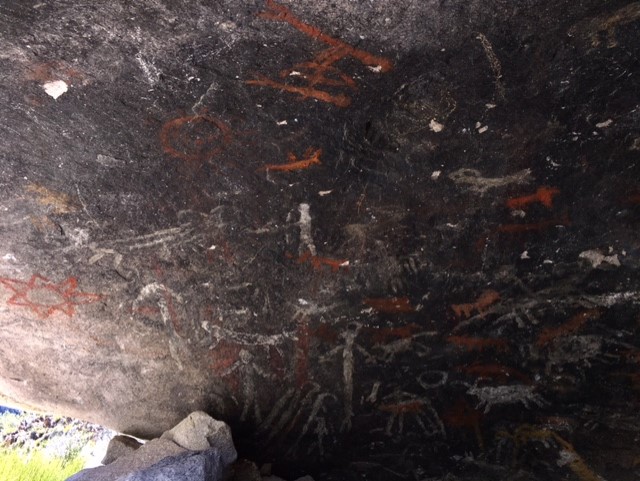 White bowman center frame, as featured below.
 A possible hunting dog seen here at the bowman’s side.
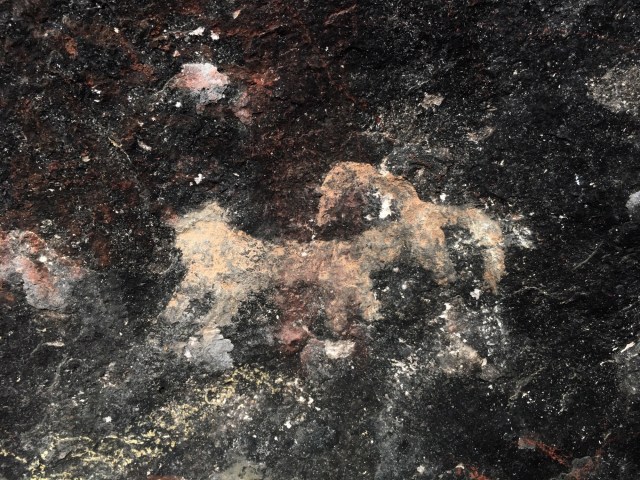
 Here a horse or mule and rider can be (barely) seen on the very lower left just above the rocks. It was a hard canvas to capture clearly by this ‘ere rank amateur cell phone snapshot clicker.
 Note the bowman on the lower left, which appears to be taking aim at a large horned animal of some sort.
 Bighorn sheep and a horse or mule and rider on the left hand side.


 The view from the top of Hageman Falls, which overlooks the Santa Ynez River.
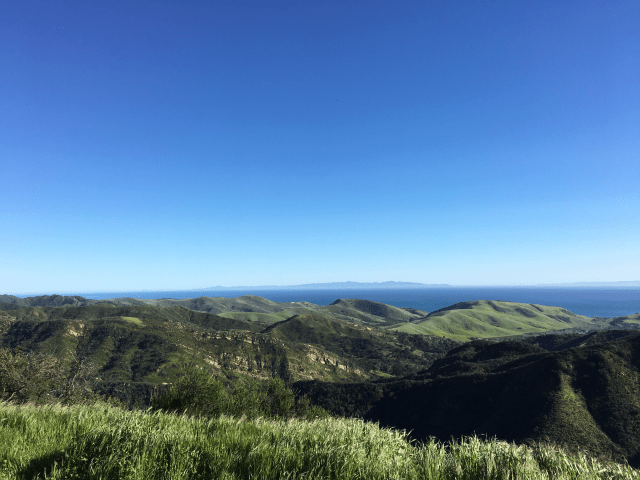
 A view of the Pacific Ocean overlooking the Gaviota Coast from the crest of the Santa Ynez Mountains atop San Lucas Falls canyon.
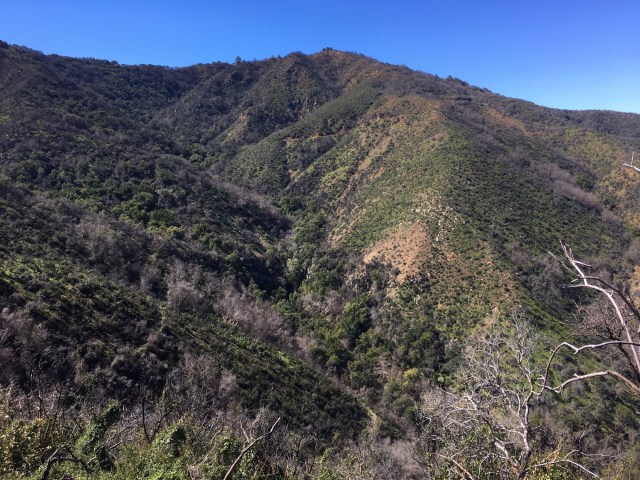 San Lucas Falls is located center frame, the old road cut visible near the lower left.
 Cachuma Lake
 Looking down San Lucas Canyon toward the Santa Ynez Valley.
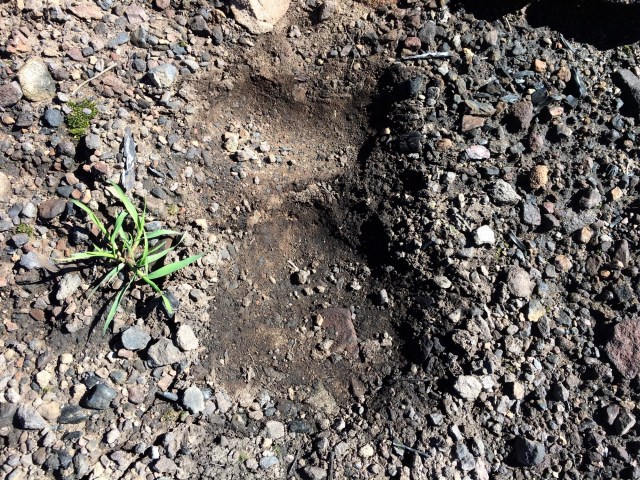 The bears around here, or “bars” as Abe Lincoln purportedly pronounced the word back when, have a funny habit of stepping right in the same foot prints every time they pass along their own trail. This results in rather deep and well-worn footprints like this one here.
 San Lucas Falls
 The water falls with much more force than might be suggested by these photos and it casts off quite a misty breeze.
 The “west fork” of San Lucas Creek at the confluence showing a peek of the miniature “gorge.”
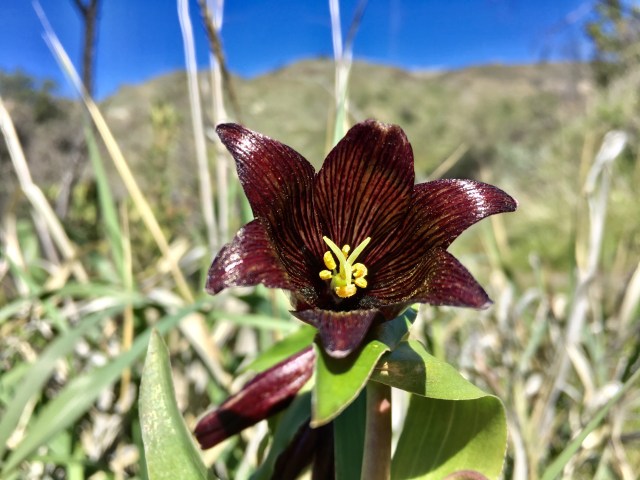 Fritillaria biflora
 A rather large lily standing over a foot tall. Many years they only reach about half that size.