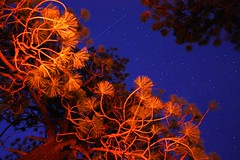
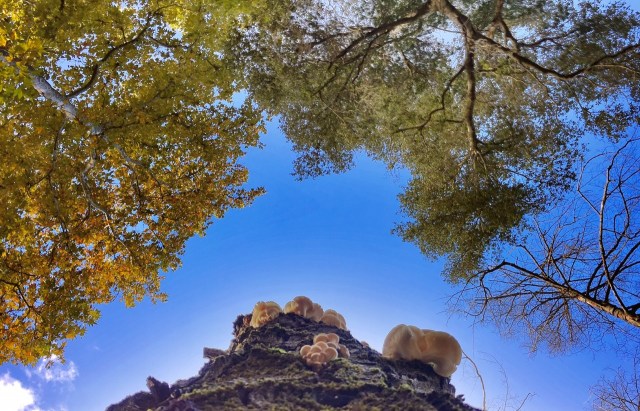
 Oysters on a standing dead cottonwood tree in the Santa Ynez Mountains. You can see where the deceased tree’s canopy had filled in the now empty sky above, the other trees wrapping around it.
“The hunter-gatherer lives on what is conceptually the ‘fruit of the earth.'”
—Max Oelschlaeger, “The Idea of Wilderness”
With winter rains sprout the fruit of the forest, mushrooms. The fruiting bodies of wood fungus, they come in a wide range of flavors from the earthy and savory chanterelle to the meaty oyster to the lobstery hericium to the sweetish honey mushroom and more. Wild mushrooms are the most delectable of all the forest’s eyeless edibles, I’d say.
Something profound happens when a human enters the woods. When a person begins to look intensely and discerningly at the land by way of hunting, either that of animals or plants and mushrooms, something magical happens. (The necessary prerequisite, of course, is that one must take an active interest in keen observation, and walk among the wild things slow enough to be conscious of what surrounds them, and be an open and willing recipient of what the forest offers.)
In these experiences the patient observer begins to see land as Aldo Leopold described it. The observer gazes upon the land as a complex living community, “land the collective organism,” rather than a mere landscape scene that is beautiful.
The observer’s penetrating gaze, an ocular spear cast into the land targeting the finest detail within the intricate weave of a living tapestry, the threads intertwined and so tightly woven that no one fiber can be harmed or removed from the others without altering the big picture all combine to create, that no individual may be damaged without harming the integrity and health of the whole. This is land as a living organism.
The tourist looks. The traveler sees. The naturophilic student of the forest understands what she sees when looking. She gazes upon the land not as a -scape nor as scenery. The dynamic complexity of Earth’s living systems and its flora and fauna are not reduced to a mere object of art stripped of all meaning other than the most superficial, as if it’s a painting on a wall. It is not a landscape. The land is not a Bierstadt. She is not distracted by superficial finicky and shifty notions of beauty. The land is sublime not for its mere physical appearance, but for its ecology. The land is beautiful because it is alive.
What is lost about John Muir on many people, I think, is that he found the mountains and forests “sublime” not for their superficial beauty so much as his understanding of what underlies that physical appearance. He intuitively understood the basic principle of ecology before the word existed, that all life is connected.
“When we try to pick out anything by itself, we find it hitched to everything else in the Universe,” Muir wrote. He knew the land as Leopold later described it.
In this manner the naturophile does not gaze upon the land through her heart but her brain. And it is in the awareness and understanding of intimate details that real and true love is born.
“Once you learn to read the land, I have no fear of what you will do to it, or with it,” Leopold wrote.
Because you don’t abuse what you love and you can’t love what you don’t understand.
‘The objective is to teach the student to see the land, to understand what he sees, and to enjoy what he understands,” Leopold wrote.
Read the land. Read it like a book. Don’t just read the cover and think it looks pretty. Read every page there within, the details, the footnotes, and know the whole story.
In A Sand County Almanac (1949), Leopold wrote of reading pine trees like books on his Wisconsin farm. The “spaces between the successive whorls of branches. . .are an autobiography that he who walks with trees may read at will.” The longer the space between each annual whorl of branches, Leopold advised, the more rain had fallen the previous year. The shortest spaces reflected drier years and droughts.

“But we are all here for the wild hunt. The true one. The oldest one of all.”
—Adam Nevill, “The Ritual”
In “Omnivore’s Dilemma,” Michael Pollan writes about his first experience hunting wild pigs in California. He describes falling into a state of intense focus while everything else in the world vanished from his mind but the collective organism of the forest before him. He describes his ears and eyes “tuning in—everything.” He writes of his otherwise nearsighted vision that, “The sharpness of focus and depth of field was uncanny.” He writes that he felt as if he’d “entered nature through a new door” and for once “was not a spectator but a full participant in the life of the forest.” Later his friend, an avid hunter whom knew the feeling, described his experience as “hunter’s eye.”
I know this phenomenon well. When out in the woods alone I often fall into a trance wherein all senses are exceptionally sharp and responsive and my focus on the forest is laser-like in its intensity. During these states of heightened consciousness, distractions, like a voice in the canyon or scared deer charging away, can rip me free of that trance and it takes a few minutes of staring back at the forest for it to return, as if I’m waiting for my eyes to slowly refocus so that my brain too may refocus.
“The tourist achieves no such immersion or connection; all he sees is a landscape,” Pollan writes. “The tourist remains a spectator to a scene.” The naturophile is not a spectator, but reads the book of nature as an active participant and is fully engaged and deeply immersed in the story.
In the Santa Ynez Mountains, when the coast live oak trees drop bumper crops of acorns during a mast year, the naturophile expects to have competition from mice and rats nibbling and ruining good mushrooms the first year after, and to suffer a horrendous season of ticks when foraging during the second year after the mast.
The tourist will look over the oak trees as a beautiful landscape. The traveler will see through the beauty to notice the unusual amount of acorns. But the naturophile sees the abundant acorns and understands that it will spur a boom in the rodent population which feeds on them, which in turn will lead to a spike in the tick population which feed on rodents.
To the tourist it may seem like magic that the naturophile can stand in an oak forest on a fall day and tell them that in two years the ticks in spring are going to be really bad. But once you’ve been introduced to that page in the storybook of nature it’s an obvious, quick observation.
Pollan quotes Spanish philosopher, Jose Ortega y Gasset, whom in “Meditations On Hunting” describes what it’s like to perceive the forest through the hunter’s eye:
When one is hunting, the air has another, more exquisite feel as it glides over the skin or enters the lungs, the rocks acquire a more expressive physiognomy, and the vegetation becomes loaded with meaning. But all this is due to the fact that the hunter, while he advances or waits crouching, feels tied through the earth to the animal he pursues, whether the animal is in view, hidden, or absent.
. . .
The tourist sees broadly the great spaces, but his gaze glides, it seizes nothing, it does not perceive the role of each ingredient in the dynamic architecture of the countryside. Only the hunter, imitating the perpetual alertness of the wild animal, for whom everything is danger, sees everything and sees each thing functioning as facility or difficulty, as risk or protection.”
What a great description!—“The role of each ingredient in the dynamic architecture of the countryside.” Each thing in the forest, animate and inanimate, pregnant with meaning, tells the hunter something worth knowing and plays the role of a character in nature’s story. This is entirely lost on the casual looker.
Consider Paul Shepard’s description in “The Tender Carnivore and the Sacred Game” of the “rich knowledge of the hunter,” a true knower of wild things:
“. . .think of him as lean and muscular, lying on a sunny ridge amid tundra flowers, surveying a distant herd of fifty horses. He recognizes each individual by sex and age, by its movements, by its role. He sees the drift of the herd in relation to terrain, forage, and predators; rank-order relationships of individuals; subtle signs of sickness and infirmity; the daily round of herd life, feeding, drinking, resting. He compares the pattern of one herd to that of others. He learns their communications and signals, the nuances of seasonal rhythms in behavior, the effect of stress, aware of these in relation to the season and time of day. He is also listening. . .and all sound is voice.”
The nuances of nature and subtle signs are what the naturophilic student of the forest is after. All sound is voice and all voice tells the listener something worth knowing.
Shepard also quotes Jose Ortega y Gasset in a passage about how each element in the countryside informs the hunter.
“[The hunter] will perceive all his surroundings from the point of view of the animal, with the animal’s peculiar attention to detail. This is what I call being within the countryside. Only when we see it through the drama of the hunt can we absorb its particular richness. Articulated in that action which is a minor zoological tragedy, wind, light, temperature, ground contour, minerals, vegetation, all play a part; they are not simply there, as they are for the tourist or the botanist, but rather they function, they act.”
Through this sort of intense observation and personal and intimate experience the hunter is lead to a deep and complex understanding of the land, and a relationship with wildness that is impossible to achieve from the outside looking in or through brief and superficial brushes with wildlands. A person must be an active participant within the countryside.
I don’t think, however, that a person needs to kill animals to achieve this. One may still hunt animals without harming them or choose to participate in the other pillar of our evolution in gathering.
I’ve never hunted an animal to kill in my life, but when I walk in the woods I do so carefully as if in pursuit of a clever and wily creature. I try to take everything in, to absorb into my mind all factors in the natural equation before me and process their meaning individually and as a complex whole. To read the complex living organism that is the land and see what it tells me.
In this pursuit of keen perception the natural world has bloomed before my eyes through the years in ways I never expected, the flower still growing larger and expanding with each new experience out there, becoming ever more attractive and, in turn, so too does my appreciation grow and my desire to conserve and protect the wild. And that is the real point I am trying to make!
Stomping down the trail just to reach a destination—chasing waterfalls, bagging peaks, or to arrive at a campsite—the common hiker, while perhaps admiring superficial beauty along the way, may miss all of these subtleties and as a result their experience is less dimensional and far less rich.
This sort of destination hiker thinks in a narrow, linear fashion. The goal, on the other hand, is to think geometrically like Jason Bourne in Robert Ludlum’s spy thriller novels.
“You’re lacking,” Bourne tells a guy at gunpoint. “You can’t think geometrically.”
“What does that mean?,” the guy asks.
“Ponder it,” Bourne tells him.
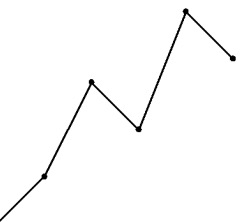
Let us ponder it. Nature works geometrically through what we silly humans have decided to call ecology. Each point, that is each character or element in the forest, is tied to innumerable other points in an ever expanding net of interconnection. Think of a fishing net. In other words, Point A is not “hitched” only to Point B, which is then only “hitched” to Point C. To continue the analogy, think of a length of fishing line to illustrate the linear. Or better yet, click the two links above for a rough illustration of the point.
People ask what I do out there in the forest if not hiking to arrive at some destination, as if there is nothing of worth to be found in nature but end points noted on maps. I wish I could open their eyes and mind to all they are missing. This post is an attempt of sorts to achieve that. On the contrary, there is much more to behold than simple destinations. Destinations are least of the forest’s offerings. The very least. Meager, really. Crumbs.
Paul Shepard on the result of the careful observation of nature by our species through its evolution:
“What emerges from a million years of such study is much more than a practical knowledge for killing—it is a knowledge of the typical life cycle of each species, its details and peculiarities. This is natural history.
But a person must immerse themselves in nature to earn that knowledge. This requires participation. It is not enough to be a spectator on the sidelines. And you certainly will never earn it reading books. “I have a low opinion of books,” Muir wrote,
“They are but piles of stones set up to show coming travelers where other minds have been, or at best signal smokes to call attention. . .No amount of word-making will ever make a single soul to know these mountains. . .One day’s exposure to mountains is better than cartloads of books.”
You must get out there in the thick of it and dirty your hands. Ortega y Gasset would say with the blood of an animal you’ve skillfully hunted and respectfully killed, but I think a sweaty brow and soil under the nails from hunting mushrooms and foraging for wild edibles suffices just fine.
Once earned, a person will be able to stand and gaze over the land and read its many and various subtle signs and only then may they begin to understand something of the sublimity of the natural world.
 My quarry for the day, a humble harvest of but a little that I found.
My favorite way to cook oyster mushrooms is to keep it simple: pan-fried in a cast iron skillet with a little avocado oil and a dash of pink salt to finish. Es todo no mas.
Avocado oil has a high flash point and will not smoke and burn as easily as olive oil, which can taint the flavor of the mushroom.
Use a grill press or another smaller cast iron skillet to press the mushroom down firmly on the hot pan. As the ripply-edged mushroom heats through and begins to cook it will lose its stiffness, wilt and the whole fruit will eventually be pressed flat against the pan like a burger.
In this way you’ll be able to develop the crispy brown steak you’re after. It’s the crispy browning that makes it great. The trick is to fry it slowly on a medium to medium-high flame and give it time to develop that flavor. Too low of flame and you get slimy. Too hot and you get scorched.
These mushrooms don’t taste anything like oysters. They take their name from their growth habit or shape not flavor.
 Plane Jane in appearance, but exceptionally tasty. Especially those curly crispy edges.
I’m big on personal responsibility, and so I don’t much see any reason for warning labels and so-called “trigger” warnings. But I suppose I should try to play the part of a responsible party and offer a warning.
If you eat the wrong mushroom you will die.
Dead.
People in Santa Barbara have died from eating poisonous wild mushrooms.
You need to know what you are doing when eating wild mushrooms.
If you are looking in a book to see if you can or cannot eat the wild mushroom growing before you in the woods, then you do not know what you are doing!
I will leave it up to you the reader to figure out the rest.
Don’t come back and blame me if you die from eating a mushroom after reading this here lil’ ol’ weblog.
A Related Post On This Blog:
Mastodon & Mammoth Sign: Reading Trees in the Santa Ynez Mountains

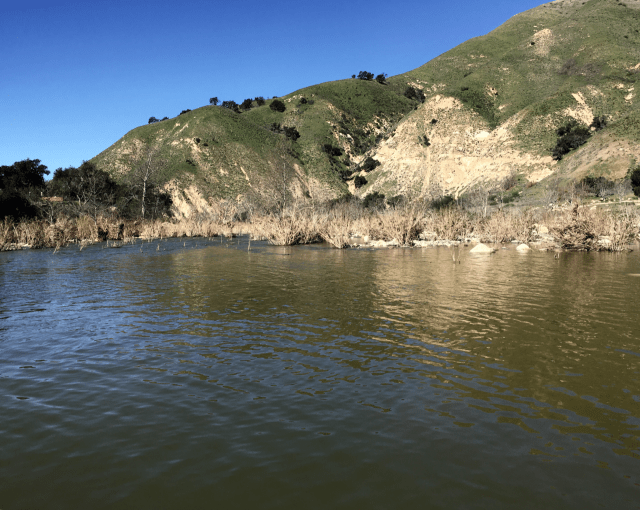 The Santa Ynez River was once hailed as “the most productive of all the little steelhead rivers of the south” in California. (Native Steelhead of Yore)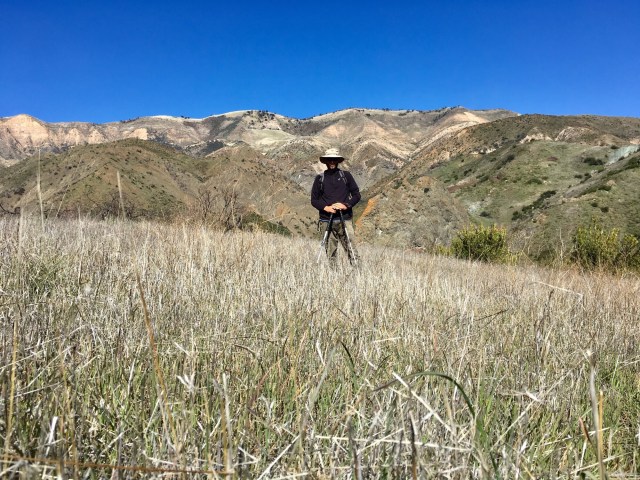
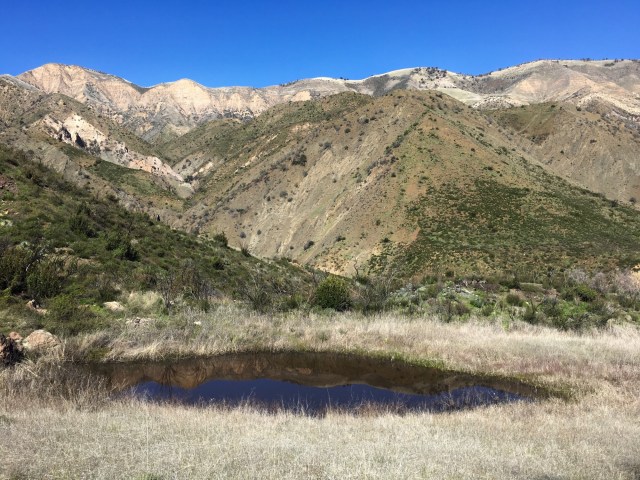 Yeah, Jack likes mud puddles. So what?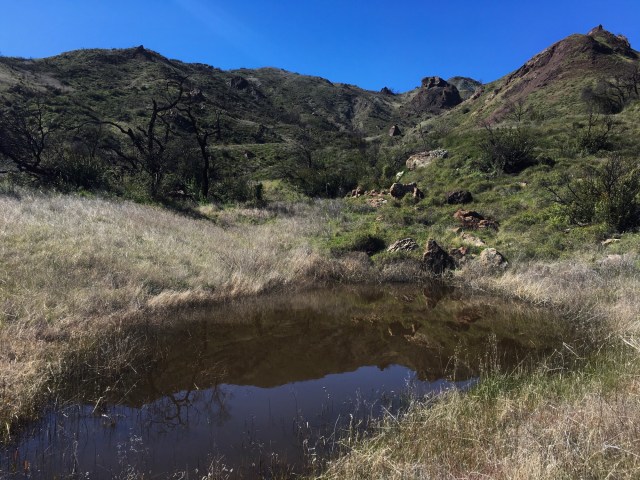
 Santa Barbara County Chanterelle
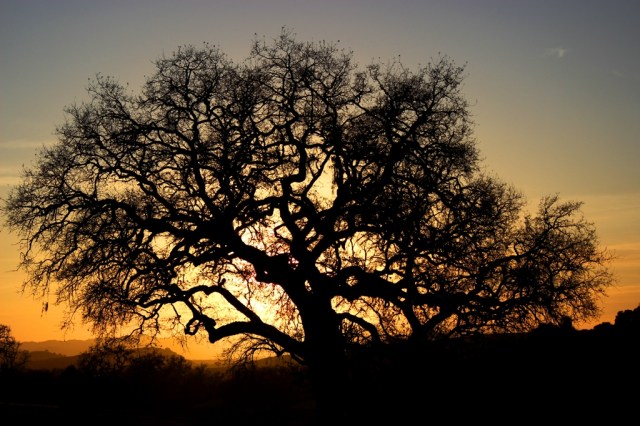 A valley oak in the Santa Ynez Valley.
 A cave’s eye view of San Ysidro Canyon in the Santa Ynez Mountains; the Thomas Fire burn scar and initial regrowth evident.
 San Ysidro Canyon a few days ago looking fairly well cleaned out a year after the Montecito Flash Flood that killed at least 21 people.
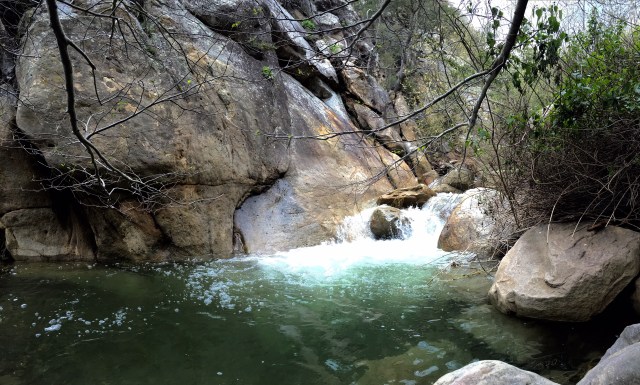 A similar view of San Ysidro Canyon in 2017 prior to the flash flood, when it was full of vegetal growth. This view here shows a point in the creek seen about center frame in the photo above, just as the creek bends leftward around the bedrock outcrop. The reason, specifically, for the close cropped view here was because any wider of an angle and all one could see was a riparian thicket, all of which was swept out and fed to the sea several miles down canyon.
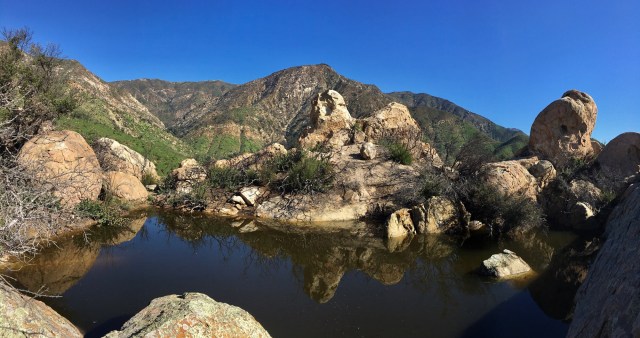 The tank.
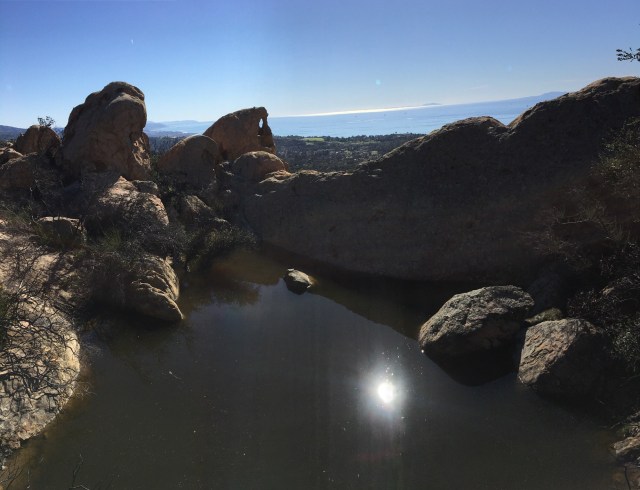 Exceptional views of the Pacific Ocean and Channel Islands National Park can be enjoyed.
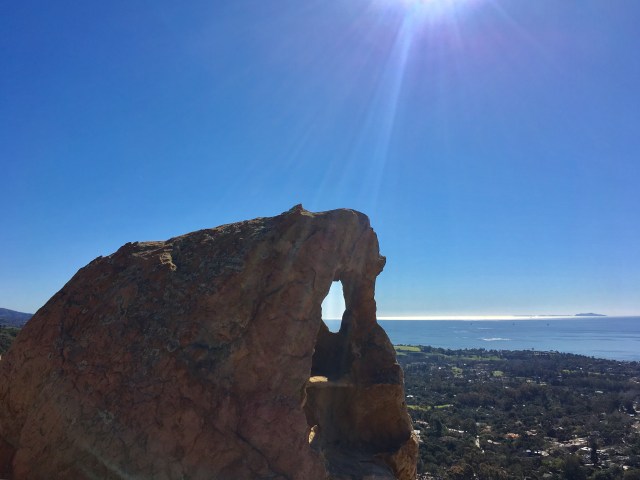 The alcove with a window view of the coast. A body can sit inside the shallow cave and peer out the window.
 Looking south eastward over the pool toward Carpinteria.
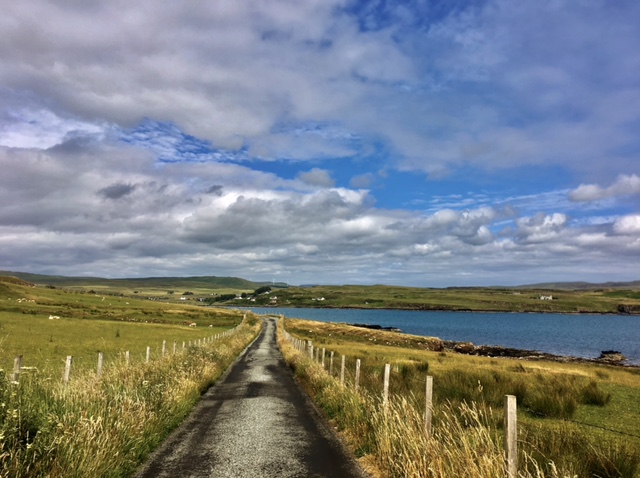 A typical road on the Isle of Skye.
 Loch na cuilce (
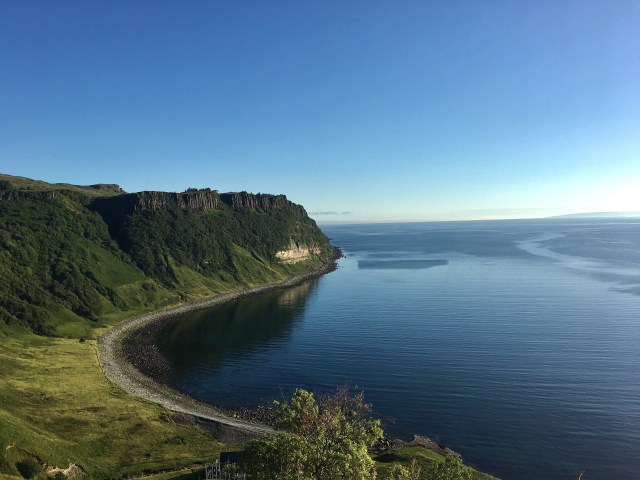 Bearreraig Bay (
 The ruins sit beside a burn or a small creek flowing into the sea.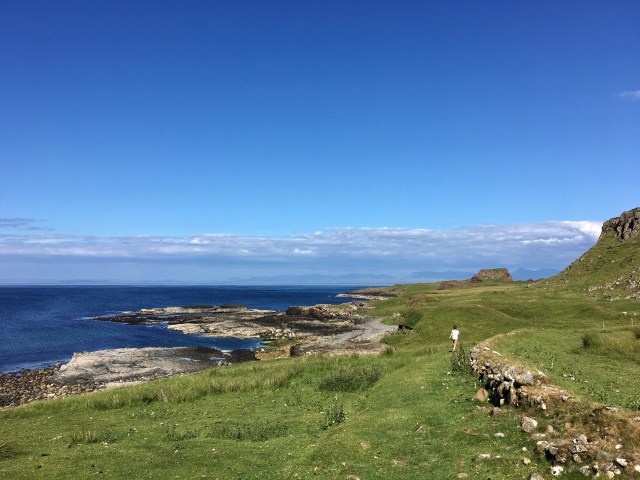
 Same site as noted above. The footprints are found on the beige slab of stone jutting into the sea.
 A Sauropod print on
 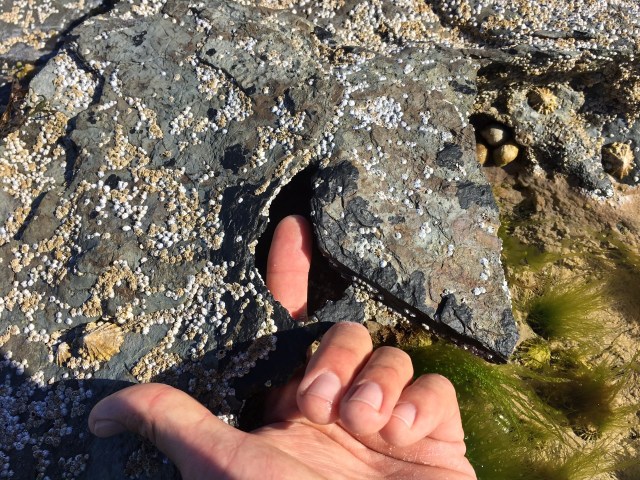 The claw mark left behind as the sauropod’s foot sucked back out of the mud when walking.
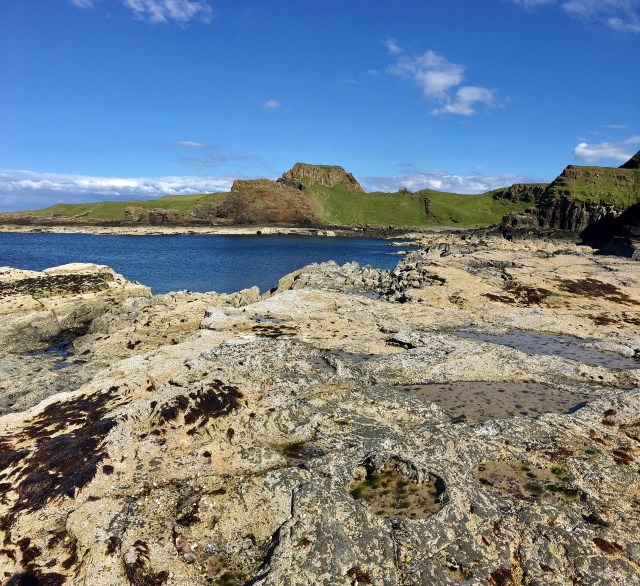 The footprint showing its surroundings.
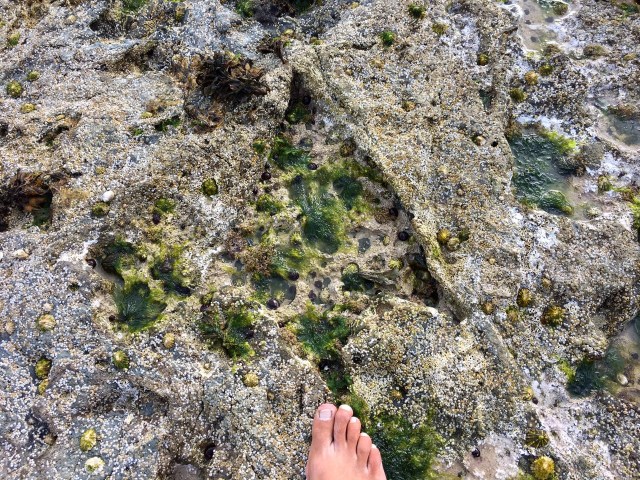 A tridactyl foot print at Brother’s Point. Look for the triangle shape with a fourth point on one side, there at my toe.
 Another dinosaur footprint site holding Brontosaurus tracks.
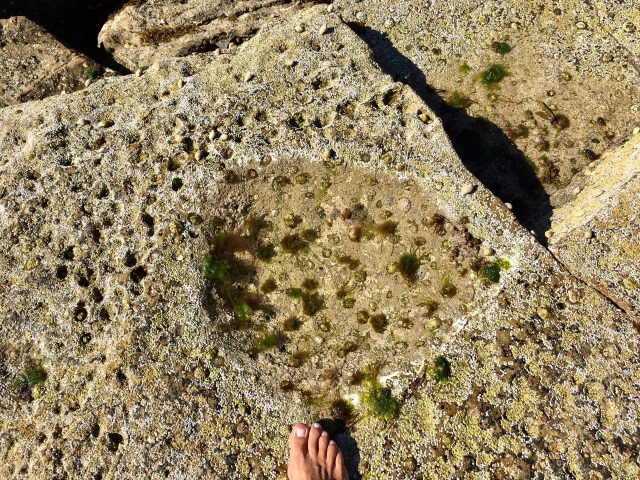 Brontosaurus print.
 Same Brontosaurus print sequence as detailed above showing here four distinct prints filled as puddles on low tide, the three animals Elliott in the background.