Fitzgerald’s Fit: Man Leads Work Crew To Wreck Montecito Hot Springs

Who’s watching?
Tell me, who’s watching?
Who’s watching me?

— Rockwell, Somebody’s Watching Me

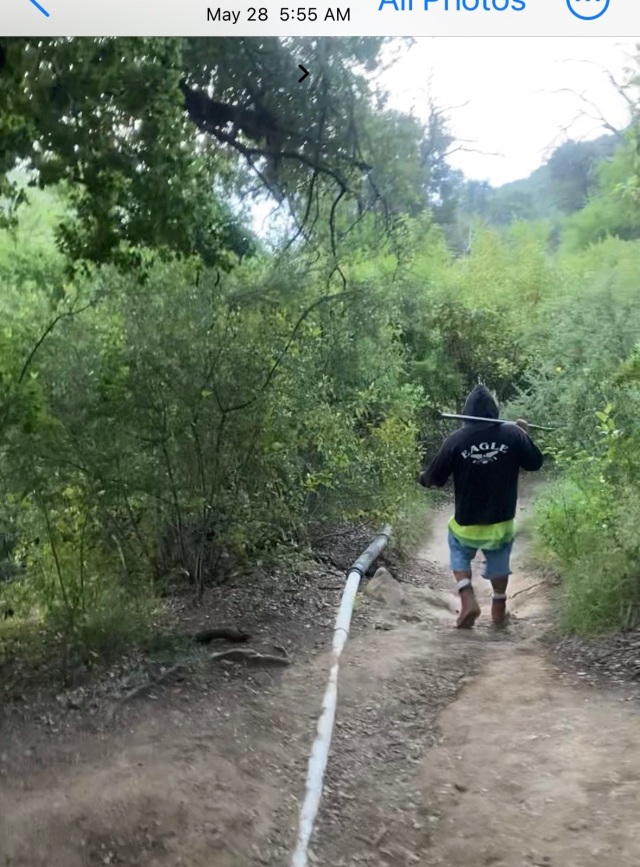
Brian D. Fitzgerald from 999 Hot Springs Lane was caught in Los Padres National Forest leading a work crew of men with hand tools in an effort to destroy the Montecito Hot Springs on the morning of May 28, 2024.

Videos show Mr. Fitzgerald in all black attempting to conceal his identity, and other men dressed in Eagle Demolition company work attire, all marching away from the hot springs that had been damaged.

I received the videos the next morning, May 29. When first played, I was surprised to immediately recognize the voice of Brian D. Fitzgerald, as he attempted to flee the scene at a fast walk, scuffling his way down the trail, arguing and getting testy.

People that know the man would recognize him from his voice alone, of course. A screenshot of his face is surely helpful. And his body type and gait further reveal his identity.

Some people know who he is and what he did, yet remain silent. His attempt at hiding is good only so long as their silence is sustained.

That is if we did not already know his name. And we hold no such reservations.

Private eyes
They’re watching you
They see your every move
Private eyes
They’re watching you
Private eyes
They’re watching you watching
You watching you watching you

— Hall and Oates, Private Eyes

I would swear an oath and take the stand in a court of law to make the identification.

That’s not the point here, but that’s how certain I am that I recognize Brian D. Fitzgerald’s voice.

We had spoken in person on more than one occasion in the days before May 28.

And so it is I know his voice.

I always feel like somebody’s watching me
And I have no privacy
I always feel like somebody’s watching me
Who’s playing tricks on me?

— Rockwell, Somebody’s Watching Me

One time in particular I shan’t soon forget. He had come walking towards me as we spoke at each other back and forth, myself stopping a moment from a hike up the trail, himself in his driveway having just driven up.

He finished that brief chance passing between us by turning sour and telling me in a nasty tone, “Go to the hot springs and smoke your weed.”

I had been asking him about the camera he had chosen to mount in the oak tree overlooking the public road. The new camera with a robot voice that yells at passing hikers from afar who are minding their own business, “Hello, you’re currently being recorded.”

The robot voice camera is on private property, indeed, but set with such sensitivity that it triggers and goes off when a hiker walks the adjacent public road.

Another time when I saw him he had yelled at me with admirable spunk and vigor, “You got a problem with that?!”

He had hired laborers to add more stones to the top of the rock wall fronting his fairly recently purchased three-acre trailside estate. I had told him to build his big beautiful wall even higher.

On yet another, later occasion, days after he had been caught and was the known vandal of Montecito Hot Springs, he poked his head over his wall with gusto to speak with me.

He started to speak and when I looked over at him he broke off mid-word, turned his head quickly and walked away.

I told him as he fled that I had videos implicating him. He denied the videos existed. He did not deny his guilt. I think his choice of words was revealing.

In the video, note that he argues about and denies that wrecking the springs is illegal. He does not deny that he wrecked the springs, but accepts the premise of the question that he’s guilty when asked if he knew it was illegal to do it. Again, his particular choice of words is revealing, I think.

On a side note, whether what he did was illegal or not does not matter to us.

I told him as he walked swiftly away from me seeking to hide in his garage, making an obvious effort to conceal his face, that I recognized his voice in the video. I offered to show him a clip to prove it.

It was the dandiest right quick change in behavior you might ever have seen. He went from an authoritative glance over his wall to gladly gone fast as possible and wilted away.

Why so suddenly shy, Brian?

Who’s watching me?
I don’t know anymore
Are the neighbors watching me?
Who’s watching?
Well, is the mailman watching me?
Tell me, who’s watching?
And I don’t feel safe anymore, oh, what a mess
I wonder who’s watching me now
Who?
The IRS?

— Rockwell, Somebody’s Watching Me

On the morning of May 28, I have been told that the gate at Hot Springs trailhead was shut and that the existing chain and keyed lock had been manipulated to appear as if the gate was locked closed and impassable.

This was unusual, presumably having been done to dissuade hikers from taking the trail while Mr. Fitzgerald and crew worked to ruin the hot springs.

Damage to the springs was fairly superficial, delivered in several forms, but readily repaired.

At least a couple of the men dressed in Eagle Demolition sweatshirts and t-shirts have been identified by Dave Docherty at Eagle Construction and confirmed to be employees.

Mr. Docherty was not helpful when first contacted, although he did return my call. He tried to blow me off in a phone conversation. He told me that I was wasting his time.

He told me to talk to the cops, apparently thinking that would scare me off and that I wasn’t for real.

Funnily enough, when I told him that that might be a good idea and that we both could go talk to the police together, he demurred and dropped it.

When I sent him the videos after our conversation he then responded in an email with new found kindness and enthusiasm.  He wrote:

I will get to the bottom of this to be sure, so that whoever paid someone monies to destroy the Hot Springs will be identified.

I haven’t heard a peep from Mr. Docherty since. Apparently he’s still trying to get to the bottom, to be sure.

Shouldn’t Eagle Construction be keenly interested in finding out what exactly happened  and clearing the company’s name posthaste? If that’s possible.

Did Mr. Fitzgerald hire employees from Eagle Demolition to help him wreck the Montecito Hot Springs?

Surely the laboring men in the videos did not wake up early, hike three miles round trip and work for free.

Were the men paid money? If so how much? If they were not paid cash money, how were they compensated?

What do Brian D. Fitzgerald and Dave Docherty have to say?

Come on, boys. Stand up and speak. Inquiring minds want to know.

While both men are expected to remain seated and silent, now there is a permanent record to speak forever regardless.
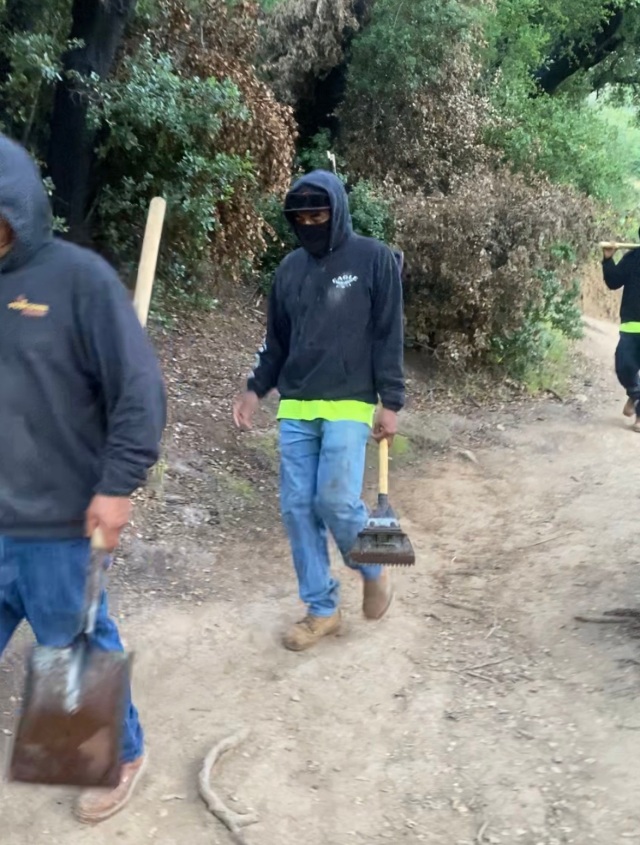
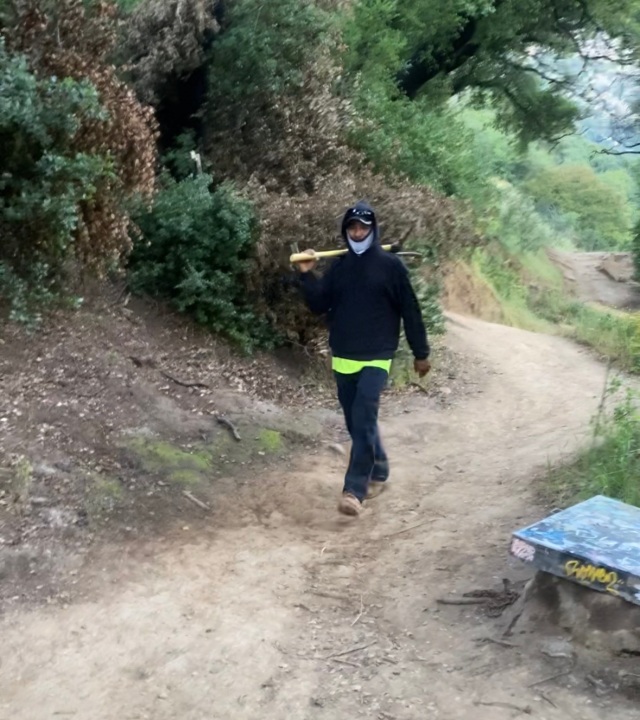
UPDATE: Here is a YouTube video so that everybody can match Brian D. Fitzgerald’s voice. Don’t take my word for it. Watch the two videos. Listen to the voice.

Evolve Media – Brian D. Fitzgerald Full Interview

https://www.youtube.com/watch?v=GeHDhSq-Rq8

Posted in Santa Barbara | Tagged , , , , , , , , , , | 31 Comments

Chief Matilija’s Poppy

We grew up hearing about Chief Matilija and his group of warriors who tried to fight off the ever-present armies. In the myth, the story goes on to tell of Chief Matilija’s daughter, Amatil, who was very much in love with the handsome warrior, Cocopah. Tragically, he was killed in the final battle. Amatil’s love was so deep and so pure that she laid upon her lover and there she died. What remained of that love was a beautiful flower with pure white petals symbolizing their love and a yellow center to represent the everlasting brilliance of their love. We know this flower as the Matilija Poppy.

Julie Tumamait-Stenslie, My Chumash Ancestral Legacy

OjaiHistory.com

On a bend in the Santa Ynez River, at the confluence with an arroyo, a small meadow lies hidden behind a skirt of oak, sycamore, mule fat, yerba santa and other riparian residents.

Trace specks of clamshell midden and chipped stone lay here or there in patches of rocky soil amidst the grasses. 

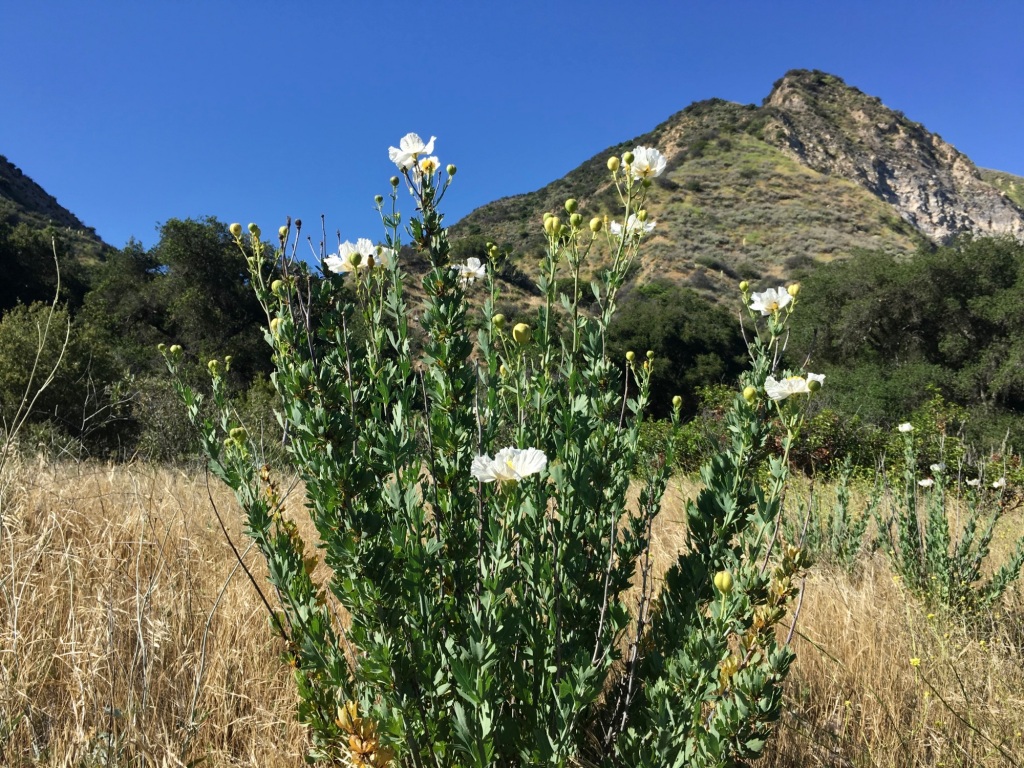
Along the edge of the meadow, where the grassy flat falls away toward the river just below, several clumps of Matilija poppies grow. 

“This species is relatively rare in nature but is very commonly grown in gardens,” the California Native Plant Society notes in their book, Wildflowers of California

Related Post:

The Elusive and Fleeting Fire Poppy

Posted in Santa Barbara | Tagged , , , , , , , , , , | 6 Comments

Sea Cave Sanctuary


A wisp of Santa Cruz Island floats on the horizon in Channel Islands National Park.

The excerpt below details an island sea cave in neighboring Ventura County, not the cave above on the mainland coast in Santa Barbara County.

The description is, nevertheless, fitting in its emotive explication of natural place. And the words may relate the ambience filling any cave found along this stretch of the Pacific seashore.

The authors convey the auditory and visual sensory dynamics inherent in a sea cave, which charge them with an energy and feeling of life most unlike the still quiet of a mountain cave. 

The cave itself lies on the boundary between land and ocean. The incessant sound of ocean waves against the rock fills the cave with a rhythmic pounding.

Even though the environment of the cave has changed with the erosion of the sand floor that was present 20 years ago, the space still retains characteristics of a liminal zone where one might focus attention on cult activities.

Natural formations in the cave, such as ledges and rock shelves, may have provided surfaces for setting items used in ceremony or ritual, or for sitting or lying down.

The natural geological formation of the cave interior may be viewed as similar to that of a whale. The large central portion of the space tapers towards the rear (or tail) and widens at the entrance (or mouth).

If one expands the observation of the cave environment to include its visual and auditory scope, it is a kinetic and changing space.

It appears to be ‘alive’ as witnessed in a variety of lighting and moisture conditions which affect the illumination and coloring of the walls.

The varying sounds of the surf, reflecting tidal and weather conditions with waves crashing onto the entrance or just outside on adjacent rocks make for constantly changing sounds inside the cave.

Depending on the surf conditions, the space acts as a natural amphitheater, magnifying the sounds. At various times of the day, the sun reflects light which plays across the walls and ceiling of the cave.

When these factors are combined with the sounds, one could imagine being inside a wave or perhaps the belly of a whale.

One’s auditory experience often includes the sounds of marine mammals on nearby beaches as well as the sounds of shore birds including gulls and cormorants.

— Cave of the Whales: Rock Art On San Nicolas Island
Kathleen Conti, William D. Hyder, Antoinette Padgett
SantaBarbaraBotanicGarden.org

Posted in Santa Barbara | Tagged , , , , , , , , , , | Leave a comment

Fire Poppy, Baron Ranch Corridor

Fire poppies blooming along Baron Ranch Corridor.

An extraordinary flush of canyon sunflowers now covers many places likely to hold fire poppies.

The curvaceous winding slopes under thickening oak canopy, cleaned by wildfire three years ago, now bulge with sunflower bushes standing four to six feet tall, shoulder to shoulder, as far as eyes can see through the late afternoon gloom of heavy sea fog.

In Refugio Canyon two canyons over, as made privy to by a commenter on the blog, more than 80 inches of rain have fallen this season.

The season prior rainfall county-wide measured in at over 200%-of-normal and in this water year we’re over 140%-of-normal so far.

The swiftly swelling forest is now closing fast, shrouding the mountain and erasing the Alisal Fire scar, disappearing the favored places to sprout of the fire poppies.

Who knows? They may not grow here for decades.

Last year I found two stands of the poppies far removed from each other, a smattering of plants each, perhaps a score, as many as I’ve ever seen at once anywhere, which is never many.

I don’t believe anybody else saw those particular plants or would know they even existed. I’m just telling it how it is. That’s all. 

They won’t let you see the plants.

How can you when they won’t allow a hillwalker to so much as set foot off their narrow little blinkered path?

In their purported “dedication to environmental stewardship and public access,” County of Santa Barbara officials and employees will not allow the few interested folks to see the most beautiful of “Gaviota’s ecological treasures.”

In the name of access and stewardship you can’t go and so you won’t know.

Although one of the growsites this year remains relatively open with some patches of bare soil or gravelly substrate still showing, not one plant could be found on this day by our indefatigable wanderer of lands of lesser interest.

This season a six hour walkabout turned up only two individual plants beside each other, as seen here, “immediately adjacent to the trail.”

Next year I expect none will be found.

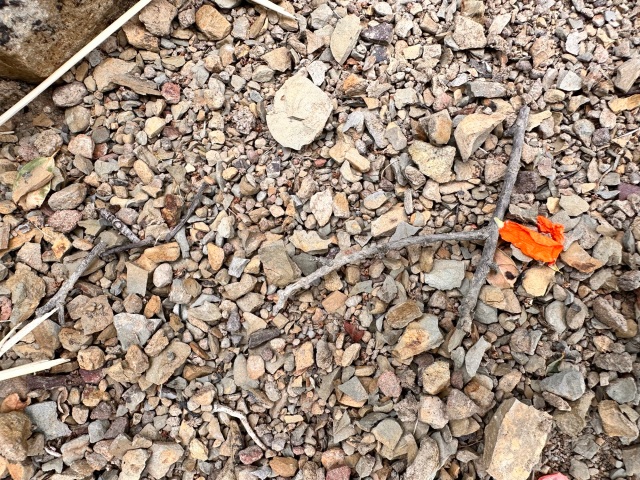
The tender plants grew from this rocky ground.

Related Posts:

The Twelve-Inch Experience, Baron Ranch Corridor

Big Bummer at Baron Ranch; Trashing the Place to Save It

Wind Poppy, Dick Smith Wilderness

Posted in Santa Barbara | Tagged , , , , , , , , , , | 2 Comments

Parks Management Co’s Selective Fee Enforcement

A valley of mixed woods, Condor National Forest, Santa Barbara County.

RULE 4: “Make the enemy live up to its own book of rules.”  If the rule is that every letter gets a reply, send 30,000 letters.  You can kill them with this because no one can possibly obey all of their own rules.  (The besieged entity’s very credibility and reputation is at stake, because if activists catch it lying or not living up to its commitments, they can continue to chip away at the damage.)

–Saul Alinsky, Rules For Radicals (1971)

Does the concession to manage campgrounds granted to Parks Management Company by the US Forest Service stipulate that enforcement of campsite fee payment is subject to the discretion of the company?

It appears the company is not living up to its contractual commitment.

Is the company at liberty to pick and choose who pays and who does not?

Is selective enforcement legal?

Is this official Parks Management policy?

Is the US Forest Service officially aware of Parks Management’s selective enforcement?

We noticed long ago Parks Management had not bothered servicing campgrounds back of Figueroa Mountain during midweek. And Dan McCaslin in Noozhawk noted this a year ago.

We like a little free camping to be enjoyed by savvy locals and the fortunate few lucky others who show up at the right time. We also enjoy stopping in to BBQ at the campsites during hours we know Parks Management will not be there.

But shouldn’t we look at it from all angles?

Would you be frustrated if you happened to speak to a neighboring camper and find they didn’t have to pay, while you doled out nearly fifty bucks?

There are no exceptions to the fee stated on the bulletin board at campground entrances. It doesn’t say midweek is free or payment is only required if reserved online.

If reserved online in advance the base cost midweek starts at $38. Depending on how you decide to pay, you might just camp for free on the very same night other people are paying $48 for a two vehicle one night stay.

If the US Forest Service rule is that there are fees at these campgrounds, and if Parks Management signed onto the service contract as managers, then isn’t the company obligated to follow the rules?

Is not Parks Management responsible for enforcing fee payment just as much as the camping public is expected to be responsible for paying the fees?

If Parks Management is allowed to decide when or if following the rules is necessary, then are recreationists also allowed to decide for themselves at will when and wherever following rules is necessary in the forest?

Related Post:

Parks Management Company’s Red Rock Racket

Parks Management Company’s Red Rock Racket Continues

Parks Management Company’s Red Rock Racket and the Secret Green Ticket

Posted in Santa Barbara | Tagged , , , , , , , , , , | 2 Comments