The Intelligence of Coyote Tobacco (Nicotiana attenuata)

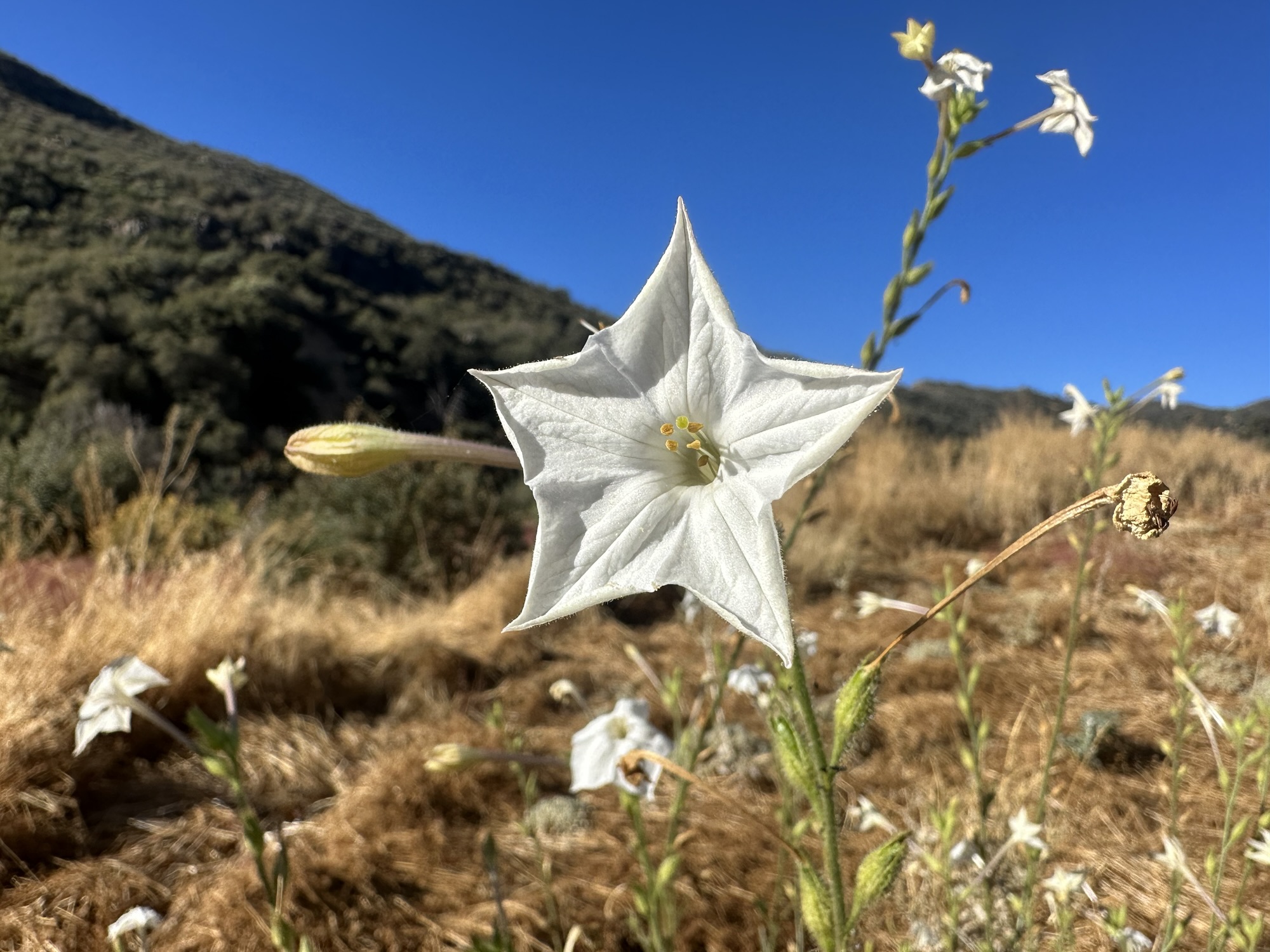
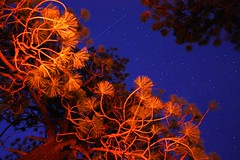
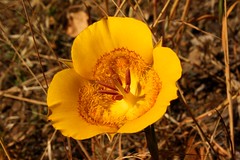
Wild tobacco growing in the Sierra Madre Mountains of Santa Barbara County. (Fall 2024)
If we define intelligence as an ability to perceive, understand and respond effectively to environmental stimuli, then we might attribute to plants what is normally considered characteristic only of humans, and to a lesser extent members of the animal kingdom.

When a person gets bit by a blood-sucking parasitic insect, like a mosquito or a tick, they respond with defensive force to pluck it from their skin, shoo it away or crush it.

A young inexperienced and unlearned child might allow a mosquito to land on their arm and observe the pest as it taps her skin to feed.

Yet it’s not long before the feel of discomfort signals a problem and the child responds accordingly. The child may flinch or cry out or smack the insect dead.

It takes little experience in life to learn that these organisms represent a threat and to learn to identify them on sight and act preemptively.

A person may also learn about a pest from other knowledgeable people without first seeing one for themselves.

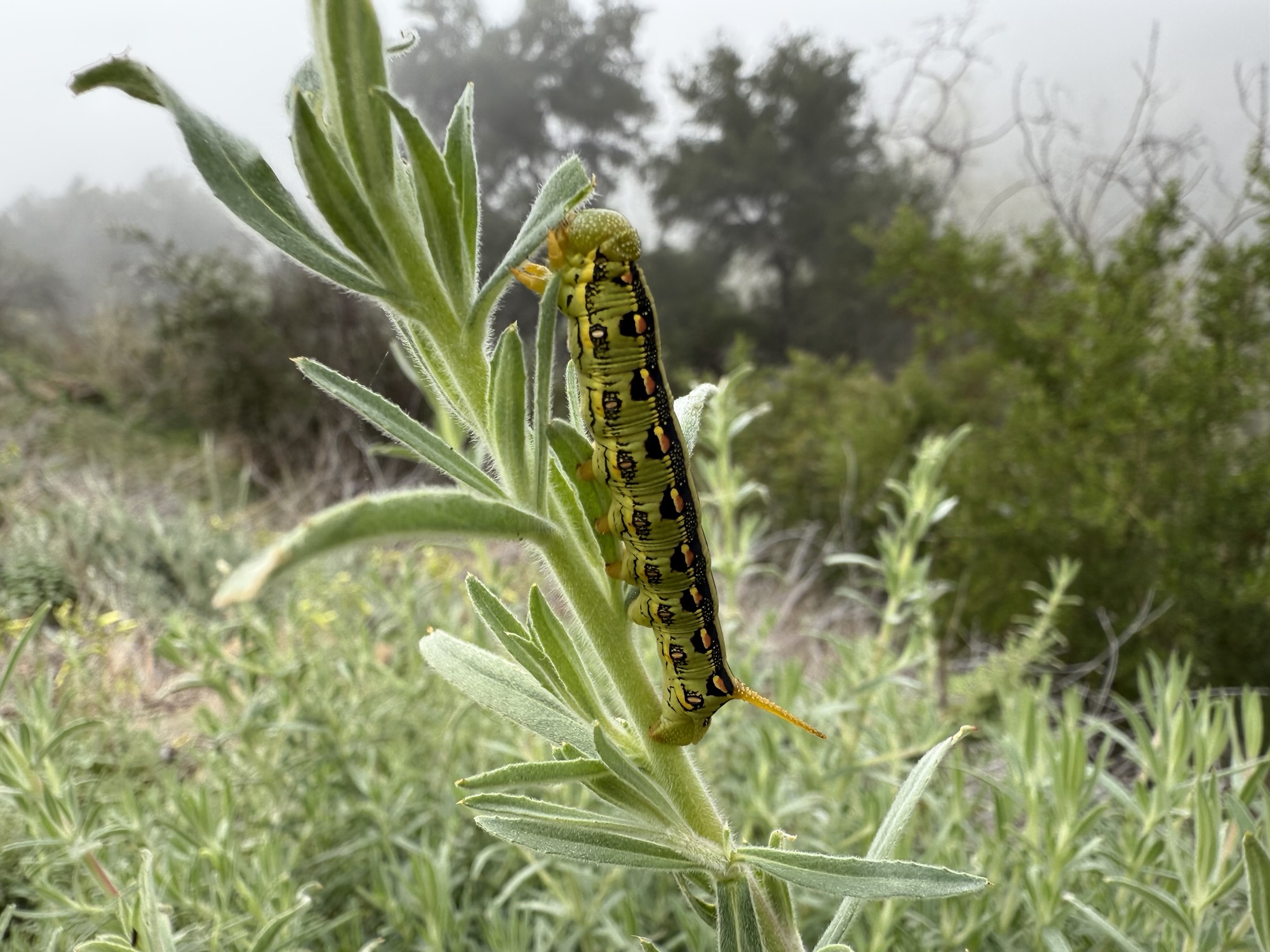
Hornworm, Manduca sexta, feeding on an unknown plant in the Santa Ynez Mountains of Santa Barbara County. (Spring 2025)
There exists many different sorts of human intelligence.

Among them are two broad categories proposed, in 1943, by psychologist Raymond Cattell. Building on the work of others, he defined two strains; fluid and crystallized.

National Library Of Medicine: Hebb and Cattell: The Genesis of the Theory of Fluid and Crystallized Intelligence

Fluid intelligence is an ability to reason and problem solve in the moment without use of previously acquired specialized knowledge.

Crystalized intelligence describes the portfolio of knowledge and skills gained through primary sensory experience.

But what strain of knowledge comes innate, held in seed, and activated at germination?

Crazy Larry

Coyote tobacco is smart enough, if we allow use of such a word primarily reserved for higher life forms, to recognize when it’s being attacked by an herbaceous predator.

Furthermore, the plant can distinguish between different sorts of leaf eating predators feeding on its body and respond in different ways.

Wild tobacco can increase biosynthesis of nicotine, a neurotoxin, in its roots and flush the poison into stems and leaves, to rid itself of the predator.

Tobacco can also emit volatile organic compounds into the air, which can attract natural predators of the insect or worm eating its leaves, thereby calling beneficial insect allies to its own defense.

These defense mechanisms may greatly retard predator attack in both a “bottom up” and “top down” manner, by altering both insect egg laying behavior and consumption rates.

“As a consequence, a plant could reduce the number of herbivores by more than 90% by releasing volatiles,” scientists have found.

American Association for the Advancement of Science: Defensive Function of Herbivore-Induced Plant Volatile Emissions in Nature

Moreover, nearby tobacco plants in the neighborhood may also detect these volatile organic compounds wafting in the air and recognize them as signaling an imminent threat.

Nearby plants may then increase their own levels of nicotine poison to combat insect attack.

“Studies have shown that the chemical signals resulting from injury are directly proportional to the extent of damage the plant has sustained,” scientists have found.

Science Direct: Plant Chemical Defenses Against Insect Herbivores—Using Wild Tobacco as a Model

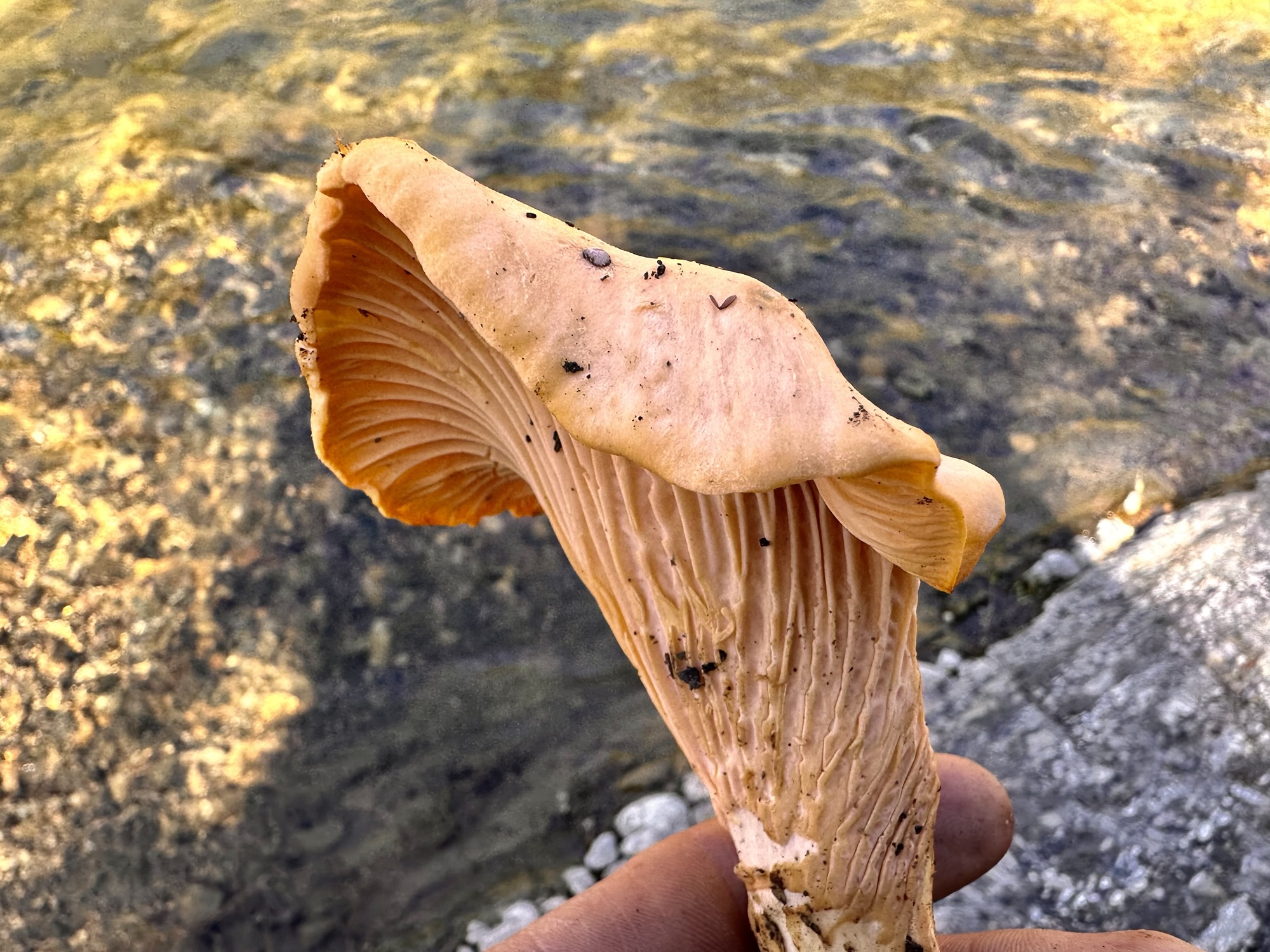
A chanterelle showing its defining feature of decurrent plicated ridges, which sets it apart from other similar looking, inedible and poisonous gilled mushrooms.

Coyote tobacco is not alone in its ability to communicate with other plants and organisms.

In a previous post here six years ago, we discussed how oak trees communicate through subterranean fungal networks established by symbiotic fungus, like the sort that fruits chanterelle mushrooms.

Trees communicate through these fungal networks using chemical signals as well as electrical impulses.

These impulses can travel a third of an inch per second to notify neighboring trees about potential threats like insects or relate information about drought.

In the case of an insect attack, each oak tree connected to the network receives news of an imminent threat from trees already being eaten by bugs, and each tree then responds to the message defensively by boosting their output of toxic and bitter tasting tannins into their bark and leaves.

The Mighty Chanterelle and the Gnarly Oak

(As sourced: Peter Wohlleben, The Hidden Life Of Trees)

Is this not some form of intelligence?

That’s one wily plant!

I think I’ve met some humans in the course of life that exhibit less consciousness and intelligence than plants like these.

Posted in Santa Barbara | Tagged , , , , , , , , , , | Leave a comment

The Journey of a Root (1907) and Plant Intelligence

 Los Angeles Herald, February 24, 1907.

The Journey Of A Root

From Santa Barbara, California, there comes a story of a most interesting freak of vegetable life, which is strictly vouched for.

Through a certain garden ran, some years ago, a sewer made of redwood timber. This sewer was again cased by an outside sewer.

Across the sewer there was built a brick wall many feet high, and in such a way that is was pierced by the inner sewer, which it enclosed tightly, while the outer sewer ended abruptly against the wall.

The outside sewer casing had in course of time decayed, and a eucalyptus tree, standing some sixty feet away, had taken advantage of this and sent one of its roots to the coveted spot in a direct a line as possible.

Here the root entered the outside sewer and followed its course as far as it could. At last it came to the wall which shut off its course, and it could go no further, the inside sewer being perfectly tight.

But on the other side of the wall the sewer and its casing continued, and this eucalyptus tree evidently knew how t0 get there.

Some three feet high in the brick wall there was a little hole an inch or two in diameter, and this the eucalyptus tree was aware of, as its big root began to climb the dry wall and face the sun and wind until it found the hole, through which it descended on the other side and entered the sewer again and followed it along as formerly.

How did the tree know of the hole in the wall?

How did it know that the sewer was on the other side?

How could it direct the root to go and find the place with such precision?

The roots of any plant grow always and unerringly in the direction of its food, just as the eucalyptus tree did.

Thirteen years ago I came across this historic newspaper piece in the archives and filed a copy here on this weblog as an unpublished draft.

Yesterday I was in the book nook at Santa Barbara Botanic Garden, browsing through volumes of interest, when I happened across a single sentence that struck with force, triggered memory recall, and as Will Hunting said, blew may hair back. (Movie clip: Good Will Hunting 1997)

This old newspaper article relates what was at the time an inexplicable feat of plant sentience.

How? How? How? They asked.

Some one hundred years later, we the humans are finally beginning to develop our understanding of plant intelligence, and we have something of an answer to those questions.

The aforementioned sentence of interest:

“Pea shoot roots appeared to be able to hear water flowing through sealed pipes and grow toward them,. . .”

—Zoë Schlanger, The Light Eaters: How the Unseen World of Plant Intelligence Offers a New Understanding of Life on Earth (2024)

The description related in the newspaper article is a remarkable, anecdotal case in point example of what scientists today have discovered.

Pea plants have demonstrated an ability to sense, not only differing amounts of soil moisture, and to use this information to direct their root growth toward primary sources and the wettest places. Which is probably obvious, that roots grow toward water.

But what is not so obvious; plants have also demonstrated an uncanny ability to sense acoustic vibrations in the soundscape made by the force of running water and to act accordingly.

Tree root growing down into the circular tree mold formed when a lava flow covered the forest in Volcanoes National Park and surrounded the trees. The moisture in the tree kept the trunk from burning just long enough for the lava to cool and form the cast. (March 2025)

“Because water is essential to life, organisms have evolved a wide range of strategies to cope with water limitations, including actively searching for their preferred moisture levels to avoid dehydration.

Plants use moisture gradients to direct their roots through the soil once a water source is detected, but how they first detect the source is unknown.

We used the model plant Pisum sativum [pea] to investigate the mechanism by which roots sense and locate water.

We found that roots were able to locate a water source by sensing the vibrations generated by water moving inside pipes, even in the absence of substrate moisture.

When both moisture and acoustic cues were available, roots preferentially used moisture in the soil over acoustic vibrations, suggesting that acoustic gradients enable roots to broadly detect a water source at a distance, while moisture gradients help them to reach their target more accurately.”

—Gagliano, M., Grimonprez, M., Depczynski, M. et al. Tuned in: plant roots use sound to locate waterOecologia (2017)

“Acoustic gradients enable roots to broadly detect a water source at a distance,” say, for example, sixty feet away, through open air and dry surfaces.

Wild man, wild.

Posted in Santa Barbara | Tagged , , , , , , , , , , | Leave a comment

Santa Barbara County Morels

Morel growing under a coast live oak tree with California poppies. (April 2025)
Related Post:

March is For Morels

Posted in Santa Barbara | Tagged , , , , , , , , , , | 3 Comments

Hollyleaf Cherries Golden Morph

Tafoni on a slab of exposed bedrock beside the golden cherry bush. It recalls the mind warp rock n’ roll nightmare of local band, Rich Kids on LSD, and the bubbles on their Reactivate album cover.

“Of all our native shrubs, there is none more beautiful than this wild cherry with its rich, deep green holly-like foliage and sprays of white flowers.”

—Theodore Payne, California Native Plants, (1941)

Golden cherries ripening riverside in October, 2024.

Never had I seen a holly-leaf cherry, Prunus ilicifolia, with golden fruit until we spied this bush clinging to a fractured bedrock outcrop, overlooking the Wild and Scenic Sisquoc River.

It’s not uncommon to see some cherries with patches of yellowish or golden hues as they ripen.

Most generally, however, the cherries ripen to a deep burgundy or plum color, almost black when at their best. “Red to blue-black,” as listed by the University of California Jepson Herbaria.

I regularly eat mountain cherries seasonally when walking the wildlands of Santa Barbara County.

The fruit is sweet and with good flavor profile; a rarity in the forest. If less than fully ripe they may hit the palate with a tinge of astringency.

Sisquoc River serenity.

When in the way out of Condor National Forest—meant by Craig Childs as a far-off place, as in way out there, not a trail leading out—these juicy and sugary wild fruits are a big score, when all I have with me is what little I can carry, “self-contained, a kind of casual turtle carrying his house on his back.”

Although there is only a slim layer of fruit pulp to enjoy, and a massive seed stone to spit out, it’s still very much worth eating as a tasty treat.

The skin tastes pleasant, too, not like that tart bite characteristic of, for example, Burbank’s Santa Rosa plum.

And this waxen seed sheath provides the added benefit of fiber, which offers a small shot of sustained energy.

The cherries ripen in timely fashion, during the height of the forest’s hottest, driest time, in September and October.

A ten minute’s respite trailside nibbling wild cherries is rather enjoyable at this time of season, in a land of meager provisions and a dearth of sweetness and juice.

Related Post:

Holly-leaf Cherries

Sisquoc Falls: A Little Known Region In California Explored (1884)

Posted in Santa Barbara | Tagged , , , , , , , , , , | Leave a comment

Barefoot Prints In Volcanic Ash, Hawaii (1790)

Western slope of Mauna Loa (13,100′). The old trail of footprints lies somewhere beneath the cloud cover.

 A few months after arriving in Hawai‘i, Perkins was in the Kona area of the Big Island collecting on the western slopes on Mauna Loa, which are characteristically covered with sharp clinker lava flows called ‘a‘a. This rubble-like ground cover is not only treacherous to any confident footing, but the razor sharp edges of the ‘a‘a can do quick damage to the foot coverings of the uninitiated. It was only a matter of days before the boots Perkins wore were torn to shreds. Instead of spending more of the Committee’s scant funds to purchase more boots, he opted to go barefoot while collecting. This proved so successful, that he continued his barefoot collecting throughout most of his sojourn in the wilds of Hawaii’s forests, to the amusement and concern of his sponsors and family.

—Barefoot On Lava: The Journals and Correspondence of Naturalist R.C.L. Perkins in Hawai’i, 1892-1901

The Ka’u Desert.

Thirty minutes into the desert afoot I pull up short to survey the ragged land.

Scanning the lava field in a 180 degree fan, I observe and ponder matters of geography and hydrology.

Then I set out deeper into the sere wastes following no trail.

A sloping deposit of soft, deep sand, textured by wind.

I navigate by line of sight, with no directions or coordinates to follow on a digital device.

I’m old-school analog. Reliance on electrified devices and screens dull senses and lessens experience.

I do not own a handheld computer to access the U.S. government’s Global Positioning System and I have no list of coordinates I keep on file.

Soon into the blackened desert and I’m within it, consumed by it, and concerns of getting disoriented and lost creep into my mind.

These feelings of insecurity add to the adventure and sharpen senses.

I leave only slight marks on intermittent patches of packed sand and nothing on lava stone.

To the untrained eye—myself included—it might be difficult if not impossible to retrace my steps.

In usual fashion, as is my habit wherever I walk, I avoid if possible stepping on sand or any sediment fine enough to leave a trace.

I dislike leaving footprints as much as I dislike seeing them.

If I must pass over untracked sand I do so on the periphery, along the borderline of scrub or stone and sand.

I constantly check my back trail. The way back always looks different than the way forward.

Looking back from where I came I trace my route physically with a finger held aloft, while reciting my perceived course out loud.

To see, say and scribe imprints this information onto my mental hard drive with greater accuracy and assurance that I will remember it.

Maybe.

Early morning started with blue skies and few clouds.

Yet, now with even the respite of building cloud cover I feel taxed, light headed and drained to an extent disproportionate for how little ground I have covered.

The heat and humidity in this high desert of 3,500’ is punishing.

I’m covered head to toe in thin fabric attire, thumbs through sleeve loops, hat, hood and sunglasses.

I bare only the oval of my face and half of each hand to the relentless sun.

The hotter it gets the more I wear, not less, like the Saudis, who would be caught dead if in t-shirts and shorts.

bird brain

I sip shots of tepid water from my backpack through a silicone nipple.

It’s local and natural water, recently fallen from clouds into an old-growth jungle not too far from where I am now in desert, a jungle wherein trees have been dated to 1,500 years old and giant Hawaiian tree ferns grow in stands over ten feet tall, trunks 12 to 14 inches or more in diameter.

The radical change in land comes quick and close together, jungle abutting desert.

The rainwater I drink is taken from a catchment system, carbon filtered and purified by ultra violet rays.

Threads of volcanic glass called Pele’s hair cover the Ka’u Desert in thin filaments and windblown windrows, looking remarkably similar to blonde human hair.

Pressing on I come to the first particular spot I feel holds real potential.

I did not know what I was looking for, but this looks like it.

The outcrop looks like hardened mud compared to its surroundings.

It’s a small panel of exposed canvas, so to speak, notably different than the surrounding ragged, smooth or rumpled lava rock and more permanent than the shifting sand.

The thin layer of ashen mudstone, undercut by runoff, whereupon lie the foot prints.

Tiny balls of mud permeate the ash deposit, as seen with a close look at the previous photo. Once liberated from the deposit by erosive forces, the bb-sized balls litter the desert floor. Did these concretions fall from the sky as muddy rain drops, caused by the thunderstorm rains of 1790?

The deposit runs only one to two inches deep, once covering the entirety of the volcano’s foot, but now only visible in busted plates.

It’s solidified mud made of volcanic ash.

The ashen mudstone lies across the land in sparse patches, here or there, not much, not large, mostly buried in sand and broken and washed away from thunderstorm runoff over the last 230 years or more.

The ash was first deposited as mud falling from the air during thunderstorms triggered by a terrific volcanic ash eruption around 1790.

The muddy ash rained over the land and the people thereon.

In the area under the clouds, as shown in the very first snapshot in this post, the prints cross through middle frame here, the western slope of Mauna Loa in the distance.

I see the first print! And it’s astonishing.

I look in the direction of travel. It looks like hell on earth, even more ragged and less plant life than where I stand.

A moment later I find another panel with two different trails of tracks comprised of several prints.

It appears as if two people were walking together side by side at a slight distance, although it might be that these people passed at different times.

Some tracks are small and shallow, maybe that of women or children. Others are larger and deeper and might be men’s.

This particular place and these prints were once a frequented trail of importance.

Three toe prints left, two erased by erosion. (March 2025)

Foot held aloft, not touching the ground.

This is one of the deeper, larger footprints, showing most prominently the heel pressed into the mud, pebbles sitting in it like a bowl. The print lies at the broken off edge of a plate of mudstone, which has been undercut from runoff. The toes and ball of the footprint have been erased by erosion and washed away.

A hand for scale showing a print measuring less than nine inches long.

Further Reading:

Hawai’i Volcanoes National Park Archeological Inventory of the
Footprints National Register Site: Keonehelelei – The Falling Sands (PDF)

Posted in Santa Barbara | Tagged , , , , , , , , , , | 1 Comment