Discreet Sensitive Habitat Signage, Sespe Wilderness

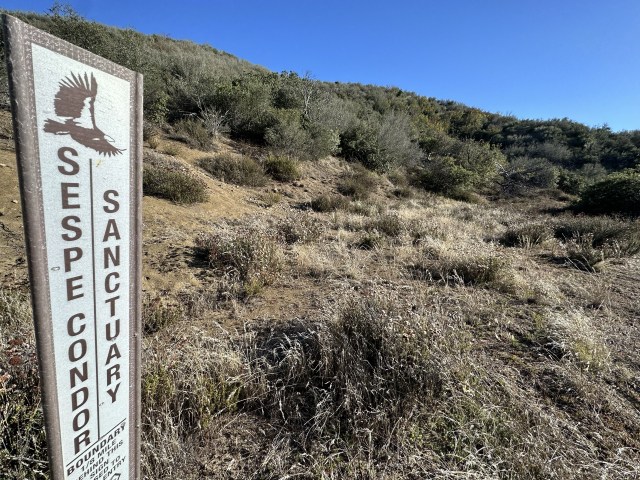
A thin sign in Sespe Wilderness only but several inches wide with not another sign in sight.
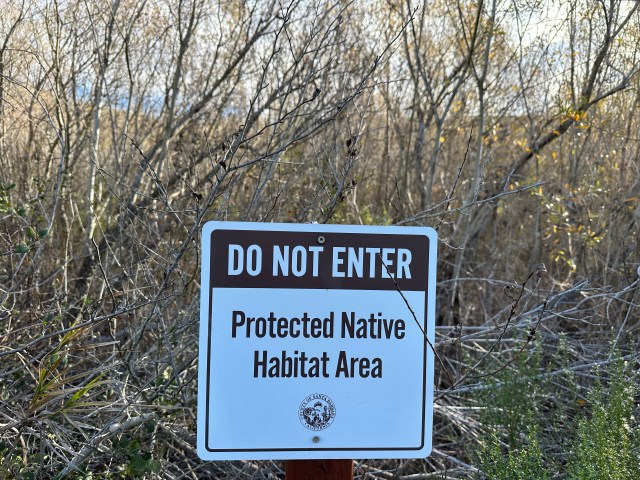
Once upon a time not long ago, following wildfire, thoughtful land managers in Ventura County reposted sliver-thin signs along Sespe Wilderness trail, there marking the condor sanctuary boundaryline.

This is federally designated critical habitat of the highest order.

What other wild creature in America has been the focus of more investment in time and money through as many decades to save a single species? A national icon.

A hiker walking beyond the boundary might accidentally drop a piece of shiny and wiggly plastic microtrash, which could be mistaken for food by a condor that might then choke or die a long, slow and miserable death by starvation from a trash-clogged gut.

And yet the sensitive habitat signs for the condor are rather discreet and few and far between. A light touch. 

In the size and placement and in the number installed the signs are respectful of place and of people.

Does doubling the size and number of signs, and placing them twice as close together, accomplish twice as much protection for red-legged frogs and southwestern pond turtles in Baron Ranch?

Some of the signs are placed in brush too dense for anybody but a masochist to even bother trying to enter. 

The arroyo is of no interest to average folks and uninviting in its overgrown appearance, but for the openess where the trail itself crosses.

And neither the frog nor turtle are currently listed under the Endangered Species Act like the California condor. 

So why the gauntlet of hamfisted signage? 

The gratuitous institutional glare of the Baron Ranch signs stand in stark contrast to the slim, embellished condor markers.

Would that when the next wildfire sweeps the canyon clear at Baron Ranch, less trace will be left by land managers, and instead their work will be accomplished with a lighter touch.

Why not?

The overbearing sign installation along Arroyo Quemado Trail in Baron Ranch. A person can stand at one sign and see the next one not far off, on either side of the trail. At some point in the not too distant future brush trimming work will be required to keep some of the signs visible.
Related Post:

Big Bummer At Baron Ranch: Trashing the Place to Save It

Posted in Santa Barbara | Tagged , , , , , , , , , , | 7 Comments

Indian Head Test Pattern (1939)

In my years at University of California earning a degree in American history with a minor in Native American studies I never heard tell of the Indian Head Test Pattern.

I first learned of it reading Tommy Orange’s novel, There There.

The image on TV and its utility for the industry has been written about in fine detail, in matter of fact fashion. The use of a tool described.

In popular mainstream culture the stylized image is recounted with fondness and steeped in the warmth of nostalgia and Americana.

People suggest the cartoon chief was featured in a dignified manner or out of admiration and respect.

Native American author Tommy Orange offers a different perspective to consider.

An excerpt from There There:

“There was an Indian head, the head of an Indian, the drawing of the head of a headdressed, long haired, Indian depicted, drawn by an unknown artist in 1939, broadcast until the late 1970s to American TVs everywhere after all the shows ran out. It’s called the Indian Head Test Pattern. If you left the TV on, you’d hear a tone at 440 hertz—the tone used to tune instruments—and you’d see that Indian, surrounded by circles that looked like sights through rifle scopes. There was what looked like a bullseye in the middle of the screen, with numbers like coordinates. The Indian head was just above the bullseye, like all you’d need to do was nod up in agreement to set the sights on the target. This was just a test.

In 1936, Santa Barbara National Forest was renamed Los Padres. The same year the Santa Barbara Bowl was built to celebrate Old Spanish Days-Fiesta and the Padres baseball team was named.

The padres were celebrated as pioneers of civilization and domestication, taming the unruly wilds.

In 1939, the Indian Head Test Pattern was created to be broadcast on screens nationally.

It was just a test.

Related Posts:

The Case For Renaming Los Padres National Forest 


Renaming Los Padres: Names Of the 1930s

Posted in Santa Barbara | Tagged , , , , , , , , , , | 1 Comment

Spring Potrero Mutilated, San Marcos Foothills Preserve

Restoration travesty (January 2023)

“Paths are human; they are the traces of our relationships.”

Robert Macfarlane 

Channel Islands Restoration, her purported protector, deflowered the virgin.

A screaming outrage. A grotesque violation.

This was not restoration. This was mutilation.

I met a guy once. They took a sharpened piece of metal to the soft flesh of his face. He came out of prison looking like he had tried to French kiss Freddy Krueger without an invitation. 

That’s what they did to Spring Potrero in the San Marcos Foothills Preserve.  

Out came the long knives to carve a wicked, winding wound plumb through the heart of the small bowling pocket of grassland above the one-and-only spring.

The Preserve covers no less than 200 acres with miles of trails and this, of all places, is where they chose to plow out a jumbo-sized walking course.

There was no need for it. Another thinner trail had long existed, the people’s path, let’s call it.

Now, mind you, the experts will tell you the new walking course is for the birds.

And they’re right about that.

The original thin little footpath, newly decommissioned, but still regularly walked by the usual suspects. (January 2023)

The Channel Islands Restoration walkway looks like the work of a high school student striving to meet the soulless standard of some urban planning or design academy. 

The path is not organic and not natural, and it very much looks it. It looks corporate or institutional or of housing tract development origins. 

It looks nothing like the real, natural footpaths created by common walkers in our local open spaces.

The new walking course consists of mindless meanders, like the go-cart track at Golf’n’Stuff in Ventura or a racetrack, winding and weaving for no apparent reason other than to wind and weave and for distance.

It’s reminiscent of tricycle tracks at preschools.

It appears designed solely for those needless reasons alone, carved into the land without any care or consciousness whatsoever for its natural character and the aesthetics of place. 

Bachelor’s Button on West Mesa, San Marcos Foothills Preserve

Small signs placed in the potrero postinteritus made the dubious claim that the hideous new walkway had somehow increased the value of San Marcos Foothills Preserve. 

The new path leads nowhere remarkable or anywhere of interest. Nor does it serve to connect anything of import.

The plain simple truth is that there was no need for development of this caliber and in this particular spot so that the birds were given some consideration and protection.

And why locate a new trail crossing right over and through the headwaters of a creek anyway?

A seasonal seep flows from the potrero and joins runoff from the spring into the tiny drainage.

Go there this winter, once the coming El Nino rains hit, on top of the preload of last winter’s epic rainfall, and you might see the seep flowing from where the new trail crosses back and forth.

Don’t get me wrong. It’s not a creek bed. But the water does indeed flow out of Spring Potrero and it is visible, at times, toward the lower portion. Otherwise, the seep issues from the ground a little lower down slope, immediately east of and adjacent the spring site. 

Why even bother forever marring Spring Potrero in an open space otherwise consisting of 200 acres? Why here? Why not anywhere else if anywhere at all?

We walk the preserve, the two of us, five miles never retracing a single step and we still have plenty of trail options left for further distance if desired.

There was not a lack of existing trail beforehand, before the developers showed up many years later under the guise of restoration and enhancement. Not in overall total distance nor in variety of terrain and destination.

If any pathway was needed, then there was no lack of open space elsewhere to locate it.

“Paths are the habits of a landscape. They are acts of consensual making. It’s hard to create a footpath on your own.

Paths connect. This is their first duty and their chief reason for being. They relate places in a literal sense, and by extension they relate people.

Paths are consensual, because without common care and common practice they disappear: overgrown by vegetation, ploughed up or built over.

Like sea channels that require regular dredging to stay open, paths need walking.”

–Robert Macfarlane, The Old Ways: A Journey On Foot

The people’s path by contrast is organic and natural, a beautiful cultural creation that compliments the land.

Our path had been laid down one step at a time, by a multitude of people, over the course of years, each step by each walker a vote registering on the land like a signature to form the unspoken consensus of its most frequent users, who are closest to this place in body and mind, and then signed off on by all other walkers who followed thereafter.

Yet, beyond this raw democratic ideal, the people’s path is smart and discreet, skirting Spring Potrero and leaving it and the viewshed nearly untouched.

Our trail winds intelligently around the land sensitive to natural character and aesthetics, cognizant of Spring Potrero’s station afore the Santa Ynez Mountains when approaching from the west. 

When walking the original slim footpath the trail was hardly visible and Spring Potrero lay untouched before you, spotless in front of the mountain backdrop. 

That is no longer the case.

Sunset glow on an iris in the preserve.

People’s paths come into being as necessary, when necessary. Often times in casual defiance of the overwrought designs of urban planners. There is a name: desire paths.

The people’s paths are cultural creatures that live and die, shrink and grow, for better or worse, one footstep at a time. 

People’s paths grow in width as necessary, only when necessary. The path will begin its life looking little different than an animal trail. With use through time it becomes an evident human footpath, but remains thin singletrack.

If more people walk the path it may grow in size to accommodate the increased traffic, but only as much as is needed. Not by the guess work of a designer or laborers, but out of practical necessity by the people actually using the trail. People paths shrink and grow along the way depending on the surroundings. It’s never one-size fits all.

The people’s path chosen by many is by unintended consequence–by design of the invisible hand–never too big nor too small and never misplaced.

The people’s path is always just right, naturally.

The new walking course was at best a wild guess at what was needed, where it was supposedly needed, and decided on by a select few and then imposed.

View of Spring Potrero as it looked in 2016. 

Looking over the spring denoted by the blue dot and onto bowling Spring Potrero noted by the large red line. The other two red slashes underline the course of the people’s path, hardly visible. 

The view showing the course of the new pathway in red and the old trail in yellow. (January 2023)

Mindless meanders.

I commented to friends online in January 2023:

Our trail of less consequence is hereby recommissioned. I saw a guy yesterday take our old trail and shun the new one. It’s not just me. It’s arrogant and ignorant what they have done here. And many are not going to go along with it. We’ll vote with our feet. And our passive resistance will be seen in the continued life of the trails they seek to terminate.

They stormed in like a bull in a china shop, rude and insensitive and destructive of people’s places and things.

They posted signs saying our trail was decommissioned and they chopped up the path trying to encourage non-use and natural reseeding of the grassland.

It has not worked. It appears it will not work.

People saw the signs and promptly recommissioned the old path and the trail has since been in regular use.

This was not restoration nor enhancement, as they left behind in our open space a far larger footprint than what existed beforehand, and they destroyed a defining feature of the land.

Posted in Santa Barbara | Tagged , , , , , , , , , , | 7 Comments

Big Bummer At Baron Ranch: Trashing the Place To Save It

Yikes. Alright already, sheesh. A wall of nearly impenetrable willow needs no sign. Nobody is going in there.

And we destroy everything we can find
And tomorrow when the human clock stops and the world stops ticking
We’ll be an index fossil buried in our own debris

–Bad Religion Part IV (The Index Fossil)

Buried in signs. Automatic Man strikes again.

They’re ruining the place to save it at Baron Ranch Preserve.

Like they ruined the spring at San Marcos Preserve to protect it.

The actions of leading officials and their subcontractors appear terribly insensitive and lacking in critical thought, and exhibit no creative or pragmatic vision for the future.

They unnecessarily patronize and perpetuate existing economic systems of heavy industry and the resultant downstream ideas of heavy development, which are parts of the larger problem at issue that we need to reduce and strive to wind down.

This is a public disservice and the wrong road to take leading into our future.

I was born on planet EarthThe rotating ball where man comes firstIt’s been around for a long, long timeBut now it’s time to watch it die

–Bad Religion, Watch It Die

There was no problem with destructive bicycle traffic in the willow thicket along lower Arroyo Quemado creek in the Baron Ranch Preserve, such that warranted the installation of this signage.

Nevertheless, the county employee standing before both of us on that previously mentioned day insisted the signs, which she told us cost $3 million all told, were important for the protection of sensitive habitat.

When I asked why, she was adamant. She told us that bicyclists and hikers had been running roughshod through the creek.

“You could step on a turtle,” she said.

I asked what sensitive meant. I wanted to know. I still want to know.

I also asked: “If a human foot tramples a small creature to death by accident, but the dynamic biological systems at play create more to fill the void, and the populations are stable or growing, is that sensitive habitat?”

What documentation exists–studies, data, anything at all whatsoever–suggesting there was a problem in lower Arroyo Quemado?

She did not have a reasonable answer, and did not offer anything beyond lackluster opinion and empty rhetoric. She also could not define the word on the signs she said cost so much.

Sensitive appears to mean nothing more important than that some leading official(s) somewhere personally desires the exclusion of humanity for some reason.

The word on the sign is as meaningless as it is elastic. They might stretch it to cover anything they wish at any time, because it does not have a defined meaning.

Pursuit of the positive ends they envision justifies their negative means in practice, I guess.

There is no reason for the common bicyclist to go into pointless and dead end willow thickets and brambly places. To suggest otherwise defies common sense.

There is nothing to see in the arroyo but an unremarkable wide and thin seasonal wash, and nowhere to go, but out the other side of the thicket to somewhere a road already leads, but which is off-limits and dead ends anyway.

And so most people never went in there, never would, never will.

And yet the signs. Lots of them.

Trailside bloom, Erigeron foliosus. A fantastic native perennial for the home garden that is drought-hardy and grows in sun-blasted hot areas, throwing flushes of three-foot-high mounds of flowers.

Sign, signEverywhere a signBlockin’ out the sceneryBreakin’ my mindDo this, don’t do thatCan’t you read the sign?

–Five Man Electric Band, Signs

I told the lady that the purchase of industrial products shipped from across the country was an outrageous waste of money and resources and a terrible pollutant.

That such practices run contrary to the spirit and principles of preservation, conservation and the long-view vision of biological sustainability that undergird it all.

The employee’s retort was that the signs were purchased locally. This was a bogus answer, and an insult.

To suggest the signs are locally sourced is a major misrepresentation.

I noted that the base components of the signs were manufactured by different companies in heavy industry, located in different places throughout the country or world. Then it’s all shipped by air, rail and truck, and done so multiple times over.

Those signs cannot possibly come from town, but necessarily must come from many other places far away.

Like simple wood pencils, metal signs are something everyone uses, but no single person can make by themselves.

Have you considered that no one person even knows how to make a sign all by themself? It’s actually a major industrial endeavor.

See I, Pencil by Leonard E. Read.

You could trace the metal sign components all the way back to the original source in intensive, extractive mining operations and the earth ripped asunder.

To the industrial plants where the raw materials were shipped to be manufactured into base components.

To the factories producing sign blanks and hardware and lumber and ink.

And what about the printer? You need a machine to letter the signs. How many components make up that machine and where do they all come from? What about the machines that make those components?

Add on the cost of silviculture and logging of trees prior to being made into lumber for the signposts.

Add on the chemical production for the anti-rot preservative treatment that’s California compliant.

And so on and so forth. How far do you want to trace it?

At some point down the long disfiguring and dirty industrial chain, we come to the little local Santa Barbara sign seller in town.

The only things local are the words chosen in the abstract within somebody’s head in town to be printed onto the sign.

None of it was necessary. A tremendous waste, so outrageously thoughtless.

And now the trail looks like hell for it.

Local Livelihoods and a Culture of Craft

Probably one of the most valuable yields coppice woodlands could provide is a renewed local economy based on home-scale production of useful and necessary products.

As our current globalized economic system self-destructs before our eyes, we must begin to think about strategies to create a meaningful, right livelihood that enables people to express their skills and creativity and contribute to the renewal of our communities.

It seems clear that we need to build a new modern economy around the production of goods and management of land-use systems that serve the people who use them.

In the very same way that coppice sustained a skilled and independent class of craftspeople and land managers historically on the European continent, could we see a similar evolution of a productive community of citizens providing products for neighbors and community members today? I believe so. In fact, I believe it is and will be essential!

While this is no small task to design and implement, human history proves time and again that we cannot separate ecology from economy.

—Mark Krawczyk, Coppice Agroforestry: Tending Trees for Product, Profit, and Woodland Ecology

I told the county employee that the smart way to protect the riparian corridor along the willow thicket was to use the willow itself.

Coppice the willow and use the wood poles to weave an aesthetically pleasing, natural fencing.

A wildcrafted willow fence compliments the existing wild ambiance of a natural place and welcomes walkers with warmth and dignity.

I wrote of coppicing in the post about the trashing of San Marcos Preserve spring. In my home garden I coppice a mulberry bush after harvest and use the poles for fencing and supports for vegetables and fruit trees.

Yet such a practice goes much deeper in its wisdom than mere utilitarian function.

By coppicing the willow in Baron Ranch Preserve, we could provide a never ending supply of a local resource produced sustainably and grown effortlessly on-site.

A fence that is gloriously free of the pollution and negative economic externalities associated with the manufacture and shipment of industrial products.

Moreover, if wildcrafted from green poles the willow fence would take root and begin to grow into a living structure that could be pruned and formed as desired.

When my children attended The Oaks Parent-Child Workshop nursery school in Santa Barbara we built a rough interpretation of the traditional Chumash willow pole house or ‘ap. Some of the poles were still green when pushed into the earth and took root after several weeks and began to grow green and leafy.

A willow pole fence could be inspired by natural form like art nouveau with organic and curvilinear lines and loops. It could be made to look more traditional in design like a cottage garden or ranch or farm fence. It might be woven to blend in entirely and not even be seen at all.

Such a fence is wildly adaptable as needed, naturally.

If there arose a problem of destructive traffic in the creek, the use-trail or hole in the bush leading in could be plugged with a section of willow fence without degrading the ambiance of place, and done so quickly, and cost nothing but a person’s time.

The entire trail along the arroyo does not and would not need fencing, but if it did, that is certainly possible too, and with a light touch.

Otherwise if woven from fresh yet dead willow poles, after so many years of use, when it became too old and rotten, the fence could be biologically recycled on-site back into the Earth and a new fence wildcrafted.

I told the lady, with her sore knees headed to her doctor’s appointment that day, civic functions could be organized.

Invite people of all ages to come volunteer on the preserve to learn and harvest willow, and weave and install the clean, cleverly unobtrusive fence.

Natural fencing that is pleasing to look at and even touch. In fact, you might even feel better after smelling it, because wood is good for you.

We should keep natural places more natural.

Evidence suggests there are benefits to wood for the human mind and mental well-being over metal and other materials. One would think these findings are applicable.

“The effect of wood on the nervous system showed that the brain becomes calmer and less stressed, probably because wood is natural and more familiar for humans.”

–Wood and Its Impact on Humans and Environment Quality in Health Care Facilities, National Institutes of Health

I suggested local scouting groups might earn badges.

School classes could come for field trips.

Volunteer projects could be offered to enthusiasts, while also extending opportunities to local students to satisfy necessary credits for graduation. Community service work could be offered.

This is how to tie people directly to the land and forge deeper relationships as knowledgeable caretakers. To turn people on instead of off. To enrichen and raise up culture while doing the same for the land.

To build sense of communal ownership and enthusiastic responsibility as local stakeholders, as rooted in love of place developed through visceral first-hand personal experience in the field, education and edification.

Telling people no fails to accomplish much if anything positive, and sometimes it can be counter productive.

Guiding behavior through positive reinforcement is usually more effective than shouting no.

Buying costly signs from outside and turning the trail into a gauntlet bristling with negativity is of no benefit whatsoever, for people or land.

The gaiadamned signs are posted so close to each other on either side of the trail yelling at walkers that one sign can be seen from the other.

Aside from the waste and the unsettling ambiance the signs create, the number installed is curiously excessive, the posting oddly heavy handed.

Unnecessary unsightly, costly signage. Nobody went in there anyway.

Change of ideas, change of ideasWhat we need now is a change of ideas

–Bad Religion, Change Of Ideas

Coppicing and weaving willow is a way to highlight the value of California Native Traditional Ecological Knowledge, and to reinvigorate once dying, yet highly effective wildland management practices. The ancient deep ecology that has for too long been ignored.

All these wonderful opportunities of enrichment for the people and the natural world were missed when an obscene amount of money was squandered on the purchase and installation of such heartlessly rude and ugly signage.

We are poorer for it monetarily and culturally. The land suffers too.

Of course, it would take money and resources to fund a willow fencing project and classes and work programs, even if it’s otherwise something simple to do.

I figure $3 million ought to cover it.

Welcome to Baron Ranch Preserve.

Related Posts:

Restoration Travesty, San Marcos Foothills Preserve

Hiking is Not a Crime: Hiker’s Pre-check Forest Entry Pass

The Myth Of Wilderness and Ethnocentrism: Race and Recognition In the Woods

Posted in Santa Barbara | Tagged , , , , , , , , , , | 2 Comments

Renaming Los Padres: Names Of the 1930s

Detail showing Abel Mtn. on a 1938 map of Los Padres National Forest.

Backstory

I’ve long had an interest in place, in the particularity of natural settings and the composition of undeveloped scenes, and in the forest placenames chosen by humanity.

Natural places and language are, of course, the preoccupation of this thirteen-year-old weblog.

Oftentimes we have sought to learn from the land’s Indigenous Peoples, and to view these matters through the lens of California Indian culture and history, for sake of clarity and deeper understanding.

I wrote something of it seven years ago in the post, Sitiptip Flat. I quoted professor Dan Flores writing about Native American place naming habits: “It’s landscape associative.”

That’s reasonable, common sense. Name the land simply for what it is, not out of conceit for some person or people.

In pondering place and name I referenced Richard Applegate in Chumash Placenames (1974). I noted the difference in perspective among Native American cultures as compared to mainstream American culture. I wrote:

“As with the Comanche and Kiowa of which Flores writes, sense of place and the importance of the landscape figured prominently in Chumash culture. Whereas in American culture places are often named after people, the Chumash tended to name people after places.”

One motivating impetus behind that post, previously unmentioned, was the finding of a makeshift memorial at so-called Sitiptip Flat.

The people who saw fit to leave their trace had claimed and named the unspoiled meadow on behalf of their dead friend. 

I again raised the issue of naming places after people a year ago in the post, The Case For Renaming Los Padres National Forest.

“Enough of that!” I exclaimed in exasperation.

This land-centric perspective is one of the underpinning ideals informing our call on this blog to rename the forest, Condor.

Detail of U.S. Forest Service map from 1938.

In 1936, Santa Barbara National Forest was renamed Los Padres.

The new name was “a fitting memorial to its first white users,” wrote William S. Brown not long after in 1945. History of Los Padres National Forest, 1898–1945

Was Brown opining personally or relating popular sentiment of the time?

In The Case For Renaming Los Padres I offered shocking examples of the racist social and political atmosphere during 1930s America to provide cultural context. 

I do not believe we can separate the naming of Los Padres in 1936 with what all else was happening in the country at the time.

We return now to ponder yet another example.

Main Point

Following the renaming to Los Padres, mount Cerro Noroeste in Kern County showed as Abel Mtn. on the official government map.

Cerro Noroeste is a name that has come to us through history from the earliest Spanish speaking residents of the land.

Peter Gray, a blogger, provides us with an eyebrow-raising sketch of Kern County Supervisor, Stanley Abel, after whom the mountain was named.

His write up includes the preceding graphic of a front page newspaper story listing Abel as a member of the Ku Klux Klan.

By 1922, avowed Klan members controlled the Bakersfield mayor’s office, various police departments throughout the county, much of the sheriff’s force of deputies, several judgeships, the city school-district, and the county board of supervisors which included Stanley Abel. Klan members were required to take an oath that superseded any vows of office or citizenship. Police chiefs and sheriff’s deputies literally swore to protect the Klan before enforcing the law. Abel unabashedly wrote that he was proud of “the good work” of the KKK, adding in a front-page newspaper column, “I make no apology for the Klan. It needs none.”

In the 1930s, Kern County Supervisor, Stanley Abel, played a role in having a road constructed to the top of “our” beautiful mountain and consequently the press of the day started referring to the mountain as “Mount Abel.”

Gray notes that as per the United States Board of Geographic Names (BGN) the name Abel was unofficial and that twice the name Cerro Noroeste was reaffirmed by the BGN.

However, one wonders how exactly to interpret that, because after all, the name was used on the Forest Service map of 1938, and thus given the stamp of approval by the federal government.

Surely this aided in popularizing the name and helping it to persist in common use for decades.

As Robert A. Burtness wrote in his local hiking guide from 1962 describing public campsites in the forest, making a casual observation on common practice of the times:

Camp Alto Camp

Spanish for high camp, Campo Alto is located atop Mt. Cerro Noroeste, commonly known as Mt. Abel.

The United States Forest Service still uses the name.

It’s perplexing why the Forest Service prints the name at all, let alone placing it prominently before Cerro Noroeste as if the latter is ancillary.

From June 1, 2023:

Nuance

The need to rename our forest is far less clear and certain when the name itself, Los Padres, is not derogatory and not that of a known Klansman.

Los Padres National Forest was named in 1936. Santa Barbara Bowl was originally built in 1936 as a venue to celebrate Old Spanish Days–Fiesta. San Diego’s baseball team was also named the Padres in 1936.

Los Padres were clearly having their moment of remembrance in California in the 1930s. What could be wrong with that? It all appears so wholesome and communal in a town, a state, with deep Spanish roots.

Whether or not we need to rename the baseball team is beyond the scope of this blog. But, it is indeed an entirely fitting memorial honor for those times that the team was named for a group of white men. Because the game was segregated and black men were not even allowed to play in the major leagues.

So, you see, it’s not so much about the name, per se, but the underlying story about motivations and equality.

Something is wrong with the name Los Padres as it was applied to our national forest and we need to change it.

Posted in Santa Barbara | Tagged , , , , , , , , , , | 7 Comments