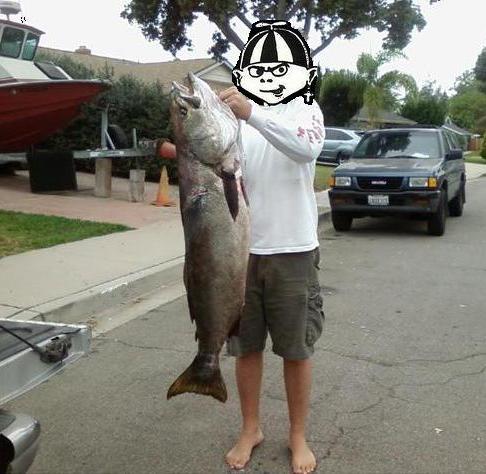
48 Pound White Seabass

About a half an hour before I shot this 48 pound white seabass, I had shot another one of equal size. But I was using a smaller speargun and the spear just bounced right off.

After swimming back to the boat and trading up to a larger gun, I returned to the kelp paddy and began hunting again. It was a flowing tide, which was creating a decent current pushing toward shore, and making it a bit hard to stay in place.

To counter the current I grabbed onto a kelp stringer and allowed the flowing tide to spin me head first into it like a boat after anchoring. But holding the kelp turned me into a human downrigger making it hard to keep my snorkel above the waterline. Despite sucking in several mouthfuls of water and having to blow my snorkel clear making all sorts of noise, my presence still managed to attract a curious fish.

As I lay on the surface of the water fighting the current and trying to remain as still as possible, I scanned the ocean in search of prey. Then as I turned my head to the left, the fish was right there only several feet away beneath several strands of kelp looking at me.
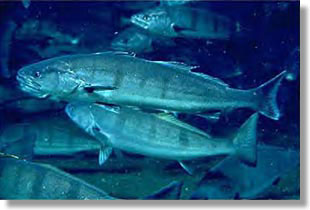
White seabass in habitat. (c) NOAA

Clenching my snorkel with me teeth in excitement, as my heart raced, I slowly brought my speargun, which I held in my right hand, leftward. At about five feet long, maneuvering the gun quickly enough to get off a shot without being too fast and scaring the fish wasn’t easy.

With one hand still holding the kelp, just as the fish began to turn and swim down and away, I fired holding the gun with my other hand. SCHEWP!!! The spear struck at a downward angle behind the pectoral fin and just below the spine.

Upon impact the seabass ran with all it had and the fight was on. I let go of the gun and held the float line, letting the line slip through my hands in small increments as I felt the fish tugging.

The seabass darted around the outside of the kelp paddy in several large circular-shaped swim paths, as I held the float line. It was like flying a fish kite underwater. Sometimes you get lucky and stone them, and they vibrate for a few seconds trying to swim away but go nowhere and then they’re done. Not this one. He ran and wrapped up in the kelp.
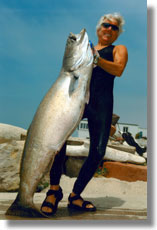
Bill Ernst and his California record 93-pound, 4-ounce white seabass shot off Malibu in 2007. (c) NOAA

The fight lasted probably only a few seconds until the fish succumb and sunk, but as with any exciting fast-paced activity time seemed to slow down. I wasn’t sure if the spear was going to hold and remain lodged in the fish.

But despite not penetrating all the way through the fish due to the angle I shot it from, the toggle-headed spearpoint stayed buried in its flesh. I swam back to the boat with the fish in hand just below the waterline cursing with excitement the whole way.

After we had slipped into the water to begin hunting, a another boat sidled up fairly close to where we were and started fishing with rods. It was foolish of me, and definitely not the type of thing I ordinarily do, but I intentionally made a show of lugging the beast of a fish up over the gunwale as I brought it onto the boat.

Usually whenever I catch a fish, whether on a creek, river, lake or in the sea, I do all I can to keep it concealed and not make a show of it or let people see, if I can help it. I don’t care to attract unnecessary attention to my favorite spots. But this time I just couldn’t resist bragging a wee bit.

White seabass caught around Catalina Island circa 1908. (c) NOAA

 Related Posts:
Halibut

Waterfalls, Trout and Indian Mortars

Posted in Santa Barbara | Tagged , , , | 5 Comments

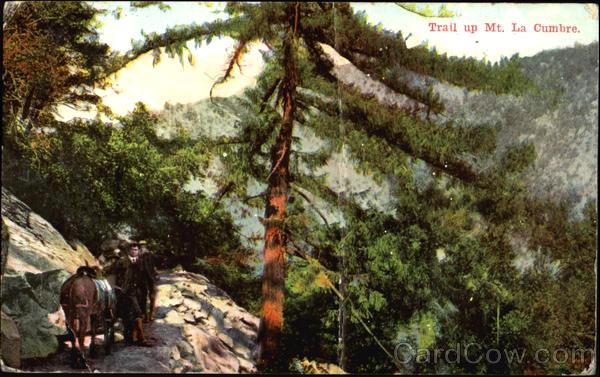
Trail Up Mt. La Cumbre (1914)

A postcard from 1914 depicting the La Cumbre Trail, the construction of which was paid for by the Santa Barbara Chamber of Commerce sometime around the turn of the nineteenth century.

The trail began on Mountain Drive and wound its way up the sun baked south slope of the Santa Ynez Mountains. It led past a rocky prominence known at the time as “Lookout Point” or “El Roca Grande,” which is commonly called Gibraltar Rock these days.

The narrow path continued on skirting the mountain and passing through nearby Flores Flats.

From there it led to the top of La Cumbre Peak for a total distance of about ten miles. The trail was built in an effort to open up previously inaccessible tracts of wilderness to horseback riders.

Bibliography:

Historical Overview of the Los Padres National Forest, E.R. “Jim” Blakley and Karen Barnette, (1985), P. 63.

Posted in History | Tagged , , , , , , | 2 Comments

La Fiesta Pequena at the Old Mission

A view of last night’s opening festivities at the Old Mission. A description of the event by the Independent:

“For 84 years ‘the Little Fiesta’ has served as the official opening of Santa Barbara’s Old Spanish Day’s Fiesta at Santa Barbara’s famed Old Mission. This year marks the 225th anniversary of the founding of the Mission and to honor this special date, not only will the show feature colorful dance performances, singing, and musical acts, but Pequeña program participants are bringing back dance numbers that have been performed since the beginning of this opening event. ”

Posted in Santa Barbara | Tagged , , | Leave a comment

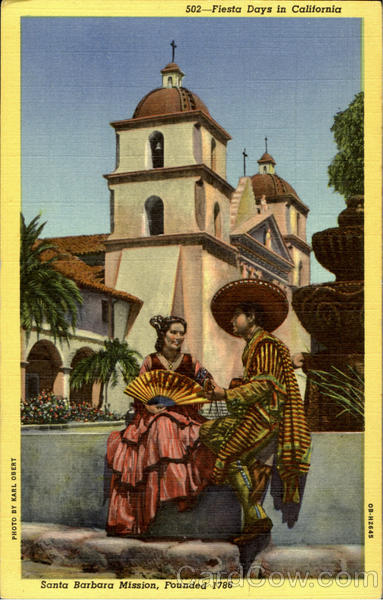
Santa Barbara’s Old Spanish Days Fiesta (1915)

The caption on the back of the vintage postcard shown above:

“California’s glamorous past is recaptured once a year when charming senoritas and gallant senors don colorful native costumes and disport themselves in gay fiestas and pageants.”

A description of Old Spanish Days Fiesta from Santa Barbara: A Guide to the Channel City and Its Environs (1941):

“Beginning with the August full moon and continuing for four days, the Old Spanish Days Fiesta is celebrated by the entire community. Newspapers, newsreels, and national radio broadcasts publicize the event and attract thousands of visitors who join wholeheartedly in the festivities. It is the city’s most democratic festival—men, women, and children from all walks of life donning Spanish costumes and participating in the gaiety. It had its inception on the occasion of the opening of the tradition-surrounded new Lobero Theater in 1924 and, except in 1925, when the earthquake intervened, has been an annual affair ever since.”

Old Spanish Days Fiesta August 3-7, 2011

Posted in Santa Barbara | Tagged , , | Leave a comment

Summertime Chanterelles

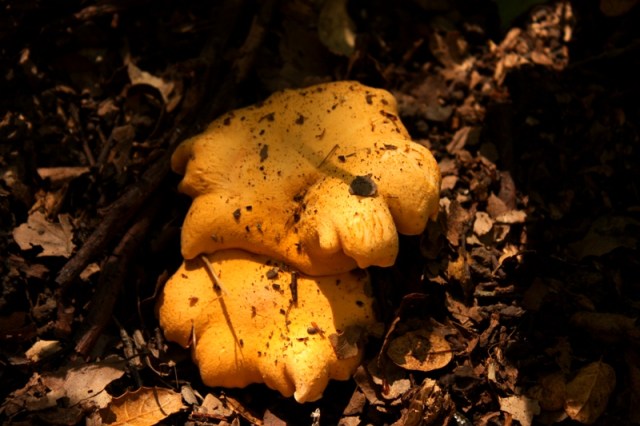
Here is a tiny sampler showing just a few of the clean and pristine gems harvested in July this year. If not rare, then it’s certainly uncommon to find chanterelles in summertime in this corner of California. It happens, but not often.

After abundant rainfall this season, and a mild spring and early summer with dewy nights and weepy marine layers, the conditions came together just right to force an off-season flush of mushrooms in select locations.

Should temperatures remain mild and relatively cool, and the forestland receive any more rain or misty, drippy weather during the next several months, then it very well may be a near year round mushroom harvest this season. The soil still holds a remarkable amount of water for this late in the year and, amazingly, is even moist to the touch in some spots.

As of 7-28-2011, Santa Barbara County normal-to-date rainfall percentages for the season (September 1 through August 31).

Buellton 122%
Cachuma 160%
Carpinteria 125%
Cuyama 138%
Figueroa Mtn 149%
Gibraltar Dam 144%
Goleta 167%
Lompoc 173%
Los Alamos 141%
San Marcos Pass 137%
Santa Barbara 158%
Santa Maria 177%
Santa Ynez 162%
Sisquoc 179%

County-wide normal-to-date rainfall percentage 152%

Santa Barbara County – Flood Control District: Rainfall and Reservoir Summary

I was tramping around picking in poison oak in a t-shirt, shorts and a flip-flops.

Related Post:

Chanterelle Mushrooms

Jack O’Lanterns and Chanterelles

Baby’s First Chanterelle

Santa Barbara County 163% of Normal For Rainfall (3-27-2011)

Posted in Santa Barbara | 2 Comments