Sulfur Mountain Oil Seeps, Ventura County

“California will be found to have more oil in its soil than all the whales in the Pacific Ocean. The oil is struggling to the surface at every available point and is running down the rivers for miles.”

-Professor Benjamin Silliman, Jr., Yale University, describing natural oil seeps near Sulfur Mountain in Ventura County (1864)

A chemist and geologist, Silliman traveled to California in 1864 in search of oil. He had been sent on a private mission by Thomas A. Scott, who was then serving as President Lincoln’s Assistant Secretary of War, and who also founded the California Petroleum Company.

Archaeological evidence indicates humans first began using tar and oil from natural seeps in the Santa Barbara area around 5000 B.C. Portuguese explorer Juan Rodriguez Cabrillo, sailing under the Spanish Crown, witnessed Chumash Native Americans using asphaltum in 1542 to seal their wood plank canoes and subsequently used it himself on two of his ships. In 1772, the Spanish expedition led by Juan Bautista De Anza came across springs of asphaltum oozing out of the ground and flowing into the ocean.

Natural seeps in California had been known of and used for a long time before Silliman’s venture, but he was one of the very first Americans to explore the new state for oil. His trip was launched in response to the stories about seeps that had filtered east through the years. While in California Silliman stopped in Ventura County and called upon a man named George Gilbert.

Fresh sticky oil seeping out of the ground right under the oak leaves.

In 1860, Gilbert noticed oil naturally draining out of the ground in the hills between Ventura and Ojai. Having experience in the whale oil refining industry, Gilbert wisely knew the black viscous substance oozing from the earth was a valuable commodity and set out collecting and processing it for market. Deposits of oil in the ground would help replace the living vats of oil swimming in the sea. While visiting Gilbert’s refinery, Silliman witnessed oil running into a nearby stream and it was that experience he was describing in the opening quotation at the top of this post.

Gilbert’s operation was located somewhere near Rancho Arnaz, which is not a very far walk from where the Sulfur Mountain site noted here is found. At the seep there is no trace of industry infrastructure or equipment that suggests it is the result of a well that was drilled and improperly capped, although that very well may be the case. The earth has been moved and mounded up somewhat around where the oil emerges from the ground, but that is about the only trace of prior activity at the site aside from barbed wire fencing.

The oil flows right down into the creek, which in the rainy season eventually dumps into the Ventura River. There are also a number of other seeps in the near vicinity along the banks of the creek and they all show fresh, sticky black oil. In other places there are hardened tar deposits.

The Sulfur Mountain location today is illustrative of the types of natural seepage that have historically flowed and still flow from the soils and seafloor of California. Numerous local place names reflect this characteristic like Coal Oil Point in Goleta, La Brea Creek on the west end of the San Rafael Wilderness and Oil Canyon near Summerland to name just a select few.

The source of the seep, just a small roundish spot of oil in the dirt.
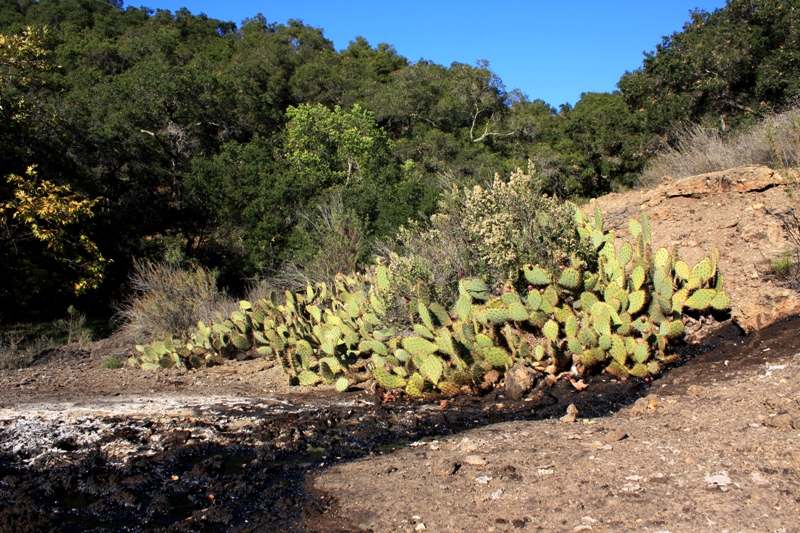
The oil originates just out of frame on the right and flows past this cactus and down onto the flats and into the creek.

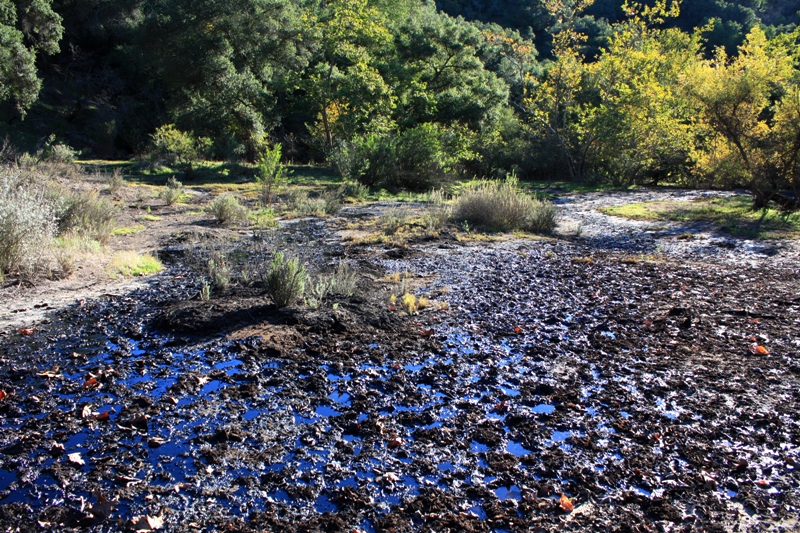
Oil headed toward the creek. Liquid, and freely flowing, it reflects blue from the clear skies overhead. This photo was taken in early fall prior to seasonal rains. What looks like mud is a result of the oil.

Crusty older tar deposits with a mix of water and oil flowing slowly down the slope.

A sycamore tree that is rooted in the creek and coated with oil.

The seep is large enough that it can be seen on satellite imagery using Google.

Bibliography:

Ruth Sheldon Knowles, Greatest Gamblers: The Epic American Oil Exploration (University of Oklahoma Press; Second edition, August 1980), 44.

University of California, Santa Barbara Hydrocarbon Seeps Project
Ojai Valley Museum of History and Art

Venoco, Inc

Posted in History | Tagged , , , , , | 6 Comments

The Flotsam Remains

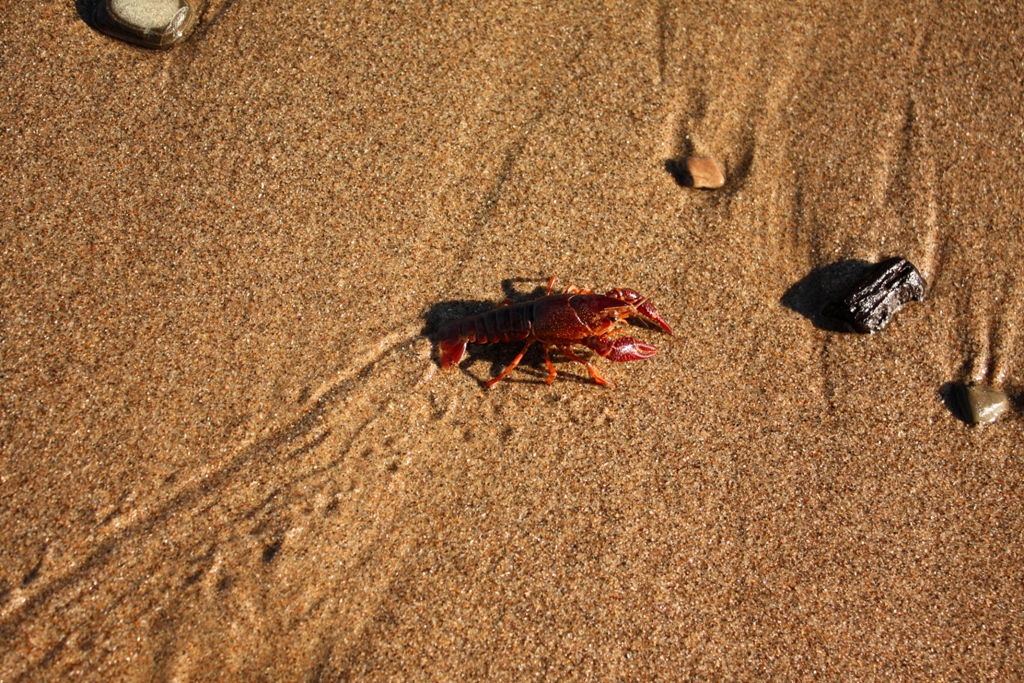
A crawdad headed for the sea.

In the late afternoon I went for a walk on the beach as the tail end of the storm was blowing through. There was a wide assortment of debris and trash washed ashore along with a few other oddities. A cooler, propane gas tank, bike wheels, golf balls, toy dolls, lighters and plastic of all sorts; the usual sort of garbage that is as much a characteristic of the beach in the age we live as the stones and sand.

An inch and a quarter long canine tooth that was probably from a dog, but might have been from a seal. There was a rotting cow foot. Different sorts and sizes of starfish were washed up all over in the gravel bars along the water’s edge and there were dead spider and rock crabs everywhere. Gulls were feasting.

I only saw two lobsters, but there were nearly as many crawdads all up and down the beach as there were dead crabs and many of them were still alive. Somehow they had survived being washed out into the ocean, tumbled through the stormy surf and then pushed ashore at high tide. They were crawling back to the sea along the sand flats at low tide as if headed to a river. They looked like baby Maine lobsters.

I saw a few large dead toads, as well, and one turtle. He looked dead. His legs were fully extended out of his shell and his head was lying on the sand with his eyes closed, but when I poked him he slowly moved. I put him in my pack and walked up the beach to the creek he came from. I set him up lying halfway in the water under a log so he was hidden from the birds. He actually seemed to revive a little after being washed in the muddy water a few times. The creek was flowing like chocolate milk into the sea and it filled the air with the pungent odor of humus.

Posted in Santa Barbara | Tagged , , , | 1 Comment

Mission Falls

I hiked Tunnel Trail to Mission Falls on Monday morning. Not far up the actual trail a heavy drizzle set in and I threw on my rain gear before it turned to a light rain. For a brief moment it turned to frozen slush as I climbed in elevation and the temperature dropped. The roar of muddy swiftwater runoff filled the canyons all around. And the verdant tangle of annual growth carpeting the rocky slopes of the Santa Ynez Mountains right now appeared especially vivid after the torrential rains.

Sunlight striking the rocky slopes surrounding Mission Crags and bringing out the warm colors of the Coldwater Sandstone.

Trailside view.


Related Post:

Tar Creek, Ventura County

Cliff Diving at Montezuma Falls, Costa Rica


Posted in Santa Barbara | Tagged , , , | 1 Comment

First Day of Spring Roars In Wet and Windy

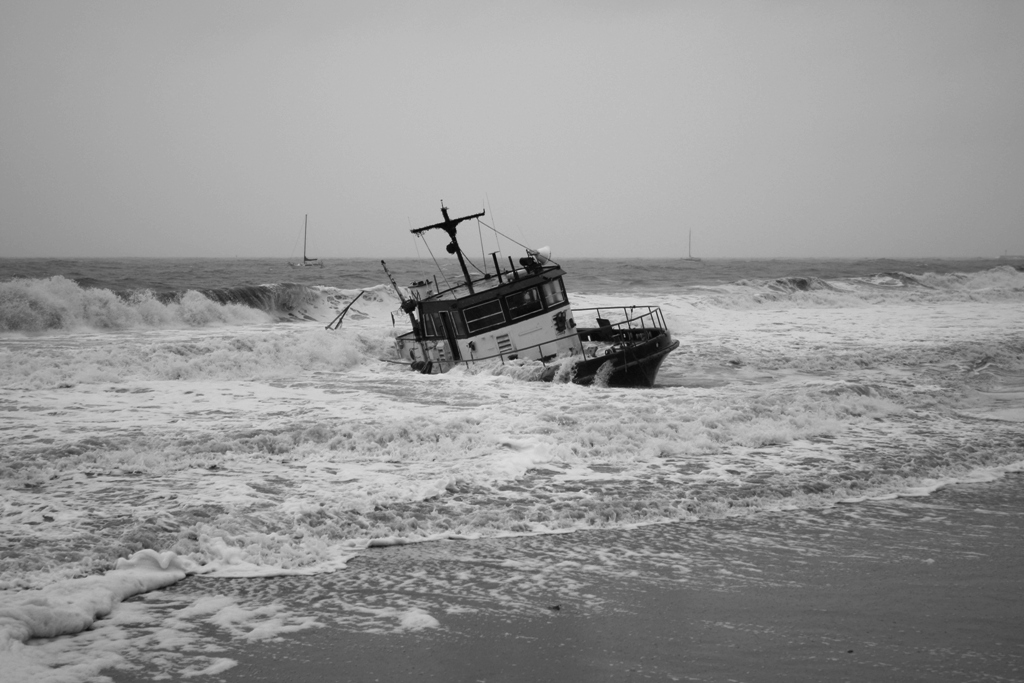
A 50 foot vessel washed ashore on East Beach today.

Select rainfall totals from around Santa Barbara County for the last 24 hour period:

Santa Barbara: 5.29                                                                                                                       San Marcos Pass: 9.55                                                                                                          Figueroa Mountain: 4.05                                                                                                     Cachuma Reservoir: 10.63                                                                                                   Gibraltar Reservoir: 10.78                                                                                                    Jameson Reservoir: 7.64                                                                                                           Santa Barbara Potrero: 3.72                                                                                                        Don Victor Valley: 5.26                                                                                                                New Cuyama: 1.83                                                                                                                   Goleta: 6.03                                                                                                                            Tecolote Canyon: 7.48                                                                                                            Refugio Pass: 6.15                                                                                                                  Gaviota: 3.96

RELATED POST:

Santa Barbara County 163% of Normal For Rainfall

Posted in Santa Barbara | Tagged , , , , , , , , , , , , , , | Leave a comment

The Klutzy Career of Highwayman Dick Fellows

“Horses threw him, ran away with him and from him, led him into trouble and never out of it. Yet this bandit-on-horseback never seemed to learn. No matter what horses did to him, he came back for more. . .[Dick Fellows] emerges from the small fry of his time almost solely because of his persistent error in believing he could ride.”

-Joseph Henry Jackson, Bad Company (1939)

Born George Brittain Lyttle in Kentucky, he turned up in Los Angeles by the handle “Dick Fellows.” (c) Wells Fargo Archives

On March 27, 1882 “California’s most spectacularly unsuccessful highwayman” was sentenced in Santa Barbara County court to life in Folsom prison.

Dick Fellows had been convicted of one count of robbery and one count of robbery with a prior conviction of robbery for twice holding up the stagecoach that ran between Santa Barbara and San Luis Obispo. His prior conviction was in 1870 for holdups in the Los Angeles area.

Wells, Fargo & Co. suspected Fellows of committing up to twelve robberies between 1869 and 1882. During that time he hit several stages in San Luis Obispo and Santa Barbara Counties. Yet it was not his criminal prowess that immortalized his name, but a career of comical mishaps.

One night it took Fellows three attempts to successfully rob a stagecoach including two separate tries at different locations on the same stage. The first two times, the drivers had  cracked the reins forcing the six-horse teams right past him when he had stepped masked and armed before the oncoming stages demanding that they stop. On one occasion his horse took off into the night following the stage before finally returning so he could make his escape.

While on the lam afterward as a recognized outlaw, Fellows was confronted by the owner of a roadside eatery pointing a pistol at him while he was chowing down. Fellows feigned surrender before trying to smack the pistol away from the owner, who fired a shot that hit the bumbling robber in the foot. Fellows managed to hobble off and ride away on his horse, but was later apprehended while seeking medical help. He served four years in state prison.

In another ill-fated sequence of events, only sheer bad luck prevented Fellows from trying to rob a stagecoach in which heavily armed Wells, Fargo Chief Special Officer, J. B. Hume, was aboard for security. He was overseeing the transfer of $240,000. Having spotted Fellows casing the stage earlier in the day, Hume was actually waiting in anticipation for the bandit to make his move. The bank officer had beside him two sawed-off double-barrel shot guns and two Winchester rifles. Three other officers armed with pistols accompanied him.

Only because the hapless highwayman was bucked off his horse before he could attempt the robbery, and landed on his head and knocked unconscious, was the deadly showdown averted. Although perhaps Dick Fellows looked at it as though the unruly horse foiled his plans, rather than saved him from being blasted to shreds by double-aught buckshot.

The original Wells, Fargo strongbox was made from pine and oak and reinforced with iron straps. Fully loaded with gold they could weigh up to 150 pounds. (c) Wells Fargo Archives

Not to be deterred a tenacious Fellows stole a different horse and successfully robbed another stage of $1800 later that same night. His success was short lived. While heaving the bank strongbox onto his horse the spooked animal bolted.

Scrambling to get away in the dark on foot, Fellows heaved the gold laden chest off the road and into the bush and along with himself right off a 12 to 18 drop into a trench. He fell into Tunnel Five, which Southern Pacific Railway had recently excavated, and broke his leg above the ankle. His foot on the same leg was also partially crushed by the strongbox either when it initially fell off the horse or when Fellows plunged over the edge with it in tow.

He was arrested several days later. The boot had to be cut off his swollen, ballooned leg for treatment, but it was not his severe injury that lead to his capture. The Wells, Fargo detective tracked Fellows down by following the unique sign left by a horse he had managed to steal. This particular horse happened to have a mule shoe tacked on to one foot while the other three hooves had normal horseshoes. It was quite easy to track.

Months later following his conviction on highway robbery charges, a relentless Fellows escaped from jail while awaiting transport to prison. He made his way to a farm and stole a horse without a saddle. After leading it to another farm and picketing it outside the barn, Fellows went inside to fetch a saddle. When he came out hauling the stolen tack he spooked the horse, which reared, snapped the rope and bolted for home. Without anything but his two feet to get away he was arrested shortly afterward and served five more years.

After his release Fellows drifted back to highway robbery. In one last escape attempt after his final life sentence conviction in Santa Barbara, he broke free and hastily stole yet another horse. He made it only a short distance clinging to the animal bareback before being tossed onto the sun-baked dirt road where he was quickly nabbed.

He was finally transported to Folsom Prison where he spent 26 years and was pardoned on March 08, 1908. While serving his time Dick Fellows, long known for his smooth spoken articulate manner, had worked as a teacher in the Department of Moral Instruction.

Reference:

Joseph Henry Jackson, Bad Company: The Story of California’s Legendary and Actual Stage-Robbers, Bandits, Highwaymen and Outlaws From the Fifties to the Eighties (Harcourt, Brace and Company 1939), 217-44.

The Misadventures of Tricky Dick Fellows (PDF), Harold L. Edwards, Quarterly Bulletin: Historic Kern, Kern County Historical Society, Vol. 60 No. 3, September 2010

Posted in History | Tagged , , , | Leave a comment