Baby Blue Eyes Wildflower

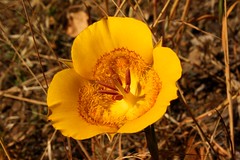
A single baby blue eyes now blooming in the folds of the Santa Ynez Mountains, standing tall and strong though alone, maintaining proper social distancing from family and friends in the background, beneath a blue spot of sky above.

Happy Easter. Happy Sunday.

To health and happiness!

Sunny day
Sweeping the clouds away
On my way to where the air is sweet
Can you tell me how to get
How to get to Sesame Street

Come and play
Everything’s A-OK
Friendly neighbors there
That’s where we meet

Can you tell me how to get
How to get to Sesame Street

It’s a magic carpet ride
Every door will open wide
To happy people like you
Happy people like—
What a beautiful day

Sunny day
Sweepin’ the clouds away
On my way to where the air is sweet
Can you tell me how to get
How to get to Sesame Street
How to get to. . .

Posted in Santa Barbara | Tagged , , , , , , , , , , | 4 Comments

The Sign

Santa Barbara backcountry

The men emerged at dawn from the confine of darkness with strained faces wet and ruddy as writhing newborns and the forested land materialized before their bloodshot eyes by the minute in the lightening day, ever larger, until mountain wilderness reared all around in the faint and colorless twilight and the view was strange and desolate. 

Slopes thick and tangled with bristling chaparral rose from the creek and folded and blended into one another and compressed with distance into an olive drab felted wall of mountains that encircled their world.

They stepped off the main trail pounded bare and wide through the river valley and slunk into the bush to enter the narrow canyon mouth of a tributary creek. 

The stream flowed clear and steady. The cool water pooled among boulders in the shade of alder and willow and sycamore.

Tree tops spread over the creek and the canopy filled the canyon like a lumpy green reservoir pooled between sheer sandstone cliffs framing the canyon mouth.

The men bounded across creek stones through the tunnel of trees.

Native trout flitted between the stones like green torpedoes fired underfoot each time they leaped over the purling water, fish of the oldest origins untainted by the genes of McCloud River rainbows that had by mankind’s hand taken over the world. 

Holt Carson stopped and turned about his small wiry frame, chest heaving, mouth agape.

“We’ll know we’re close to the Indian cave when we see the sign warning us from going there.”

He sucked in a fresh breath through a wry smile and turned and waded onward through the creekside scrub. 

“What?” Daniel Hillman snapped.

Holt kept walking letting his comment hang.

Hillman followed, waiting for him to elaborate. 

“Can’t go there?” Hillman pressed in a confused inflection when Holt offered nothing more.

“Nope,” Holt said, almost sounding pleased.

“What the hell you talking about?”

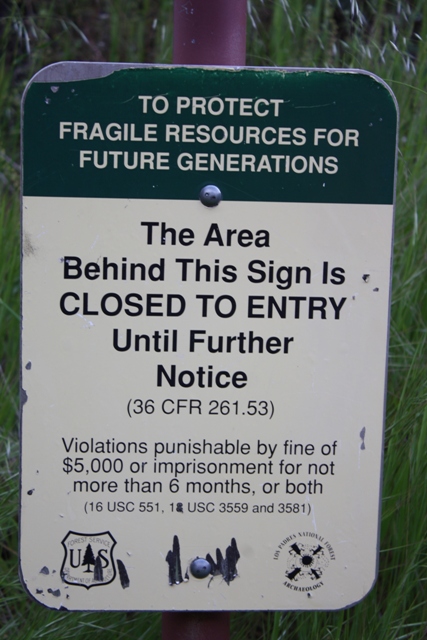
“It’s illegal. Five thousand dollar fine and a six month jail sentence for trespassing,” Holt said.

They kept walking. “Maybe I forgot to tell you that part,” Holt said.

“Yeah pretty fucking sure you never mentioned that tidbit of invaluable information,” Hillman said. “So what’s the deal? We get to leer at this place from afar through field glasses?” 

Holt laughed. Always quick on the rhetorical draw, he fired from the hip: “Well, if you can climb the fence, that might work.”

“A fence? There’s a fucking fence? We’re in the middle of nowhere!”

Holt laughed. They hiked on.

* * *

The blaring white sign reared up in the forest as they approached, an intimidating, bristling hackle of authority unwelcoming of anybody.

“There it is.” Holt pointed up the draw with his chin, hands resting atop trekking poles.

Hillman tramped past him with eyes on the sign and his mouth cracked open. He pulled up short and leaned back on a straight leg, other knee bent, gripping his two trekking poles with tight fists. “Unreal.”

“Read it.”

“Hear ye. Hear ye,” Hillman bellowed in a stentorian blast that resonated from his bearish chest. “To protect fragile resources for future generations the area behind this sign is,” and here he outright yelled to convey that the next few words were printed in all capitals, “CLOSED TO ENTRY.” Then he tagged on the end bit in a low rapid mumble, “until further notice.”

“How ‘bout that?” Holt said. “Guess we have to go home.”

Hillman turned. He fixed Holt in an intense glare through crystal blue eyes. “Horseshit!”

“Here we go,” Holt said, grinning.

“So let’s follow their reasoning. . .”

“Whose reasoning?” Holt interjected, leading the conversation in a direction he knew Hillman would appreciate.

“Good question. Nobody knows. The nameless. The faceless. The unelected. The unaccountable. Some desk-bound cog in the bureaucratic regulatory wheel whose profession it is to revoke without reasonable justification the rights of others on the pretext of supposedly protecting sensitive resources.”

“The wheel that just rolled us,” Holt said, wiping his wet beaded brow with the back of his forearm.

“Ground like grist,” Hillman added.

“No soup for you!” Holt shouted.

They stood in silence, thinking it over, looking about, sucking warm tap water through clear hoses running into their backpacks.

“So the man that lives today,” Hillman began. 

“The man that woke in the wee hours like some tortured lunatic from over the cuckoo’s nest,” Holt declared “and hiked his ass through half the night and all the next damn day.”

“Yes. Yes, indeed. This glorious sentient man of action present before you in the here and now. He is forcibly denied access from his own public lands on behalf of the man that does not exist, for the man that has yet to be born.”

“Insane.” Holt said, shaking his head.

“Utterly. We’ve been stripped of a right that’s been reserved for fictitious people that don’t even exist. What the hell kind of sense does this make?”

“That’s not now a right, my friend,” Holt said. “That’s called privilege.”

“Un-American. Is what it is. What about equal treatment and access and opportunity?” Hillman said. 

“Well, come back in a decade or two, after you’ve been born again as a future generation, and you’re in like Flynn,” Holt said, a double click of his tongue sucking wind through his teeth as if guiding a horse.

They stood silent.

“Or wait here for further notice,” he added.

Hillman grinned and lowered his chin to his chest looking at nothing in particular. He looked up at Holt. “Meanwhile the chosen few come and go as they please, no doubt.”

“Oh yes, of course. It’s all in who you know. We lowly unassociated kulaks get nothing.”

“Nope. We get lectured by Gevlin Dandy. Do as he says, not as he does. He asks for directions to trespass while telling us not to.”

“Yes he does.”

Hillman looked up into the vast cloudless sky, looked ahead, and marched on in a sudden surge of energy, touching the sign with a single gloved finger as he passed. 

Holt fell in behind him. “Just keep to the ravine,” he called ahead.

“Aye.”

Posted in Santa Barbara | Tagged , , , , , , , , , , | 12 Comments

Farewell To The Rock, Gibraltar Party Place

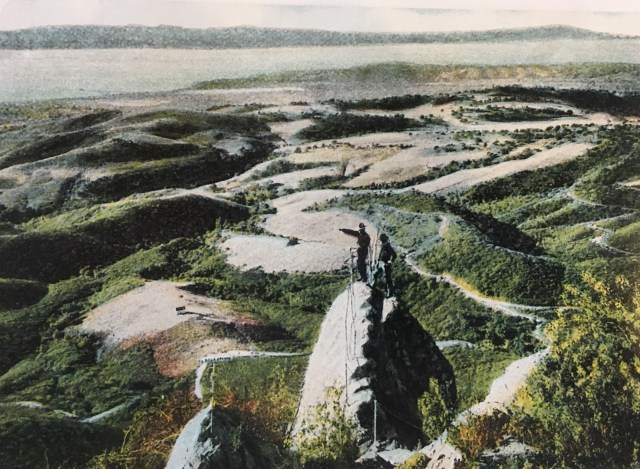
El Roca Grande circa 1909 overlooking the Santa Barbara littoral, Pacific Ocean and Santa Cruz Island in the distance. Note the metal poles and cable handrail.
“In the 1970s this was The Place. Well, if you were a teenager on a Saturday night it was. Located on Gibraltar Road about two miles past Mountain Drive there was a large place to pull off the road to park, party and enjoy the lights of the city below.”

—Neal Graffy, Santa Barbara Then and Now

“There was a time when courtesy and winning ways went out of style, when it was good to be bad, when you cultivated decadence like a taste. We were all dangerous then. We wore torn-up leather jackets, slouched around with toothpicks in our mouths, sniffed glue and ether and what somebody claimed was cocaine. When we wheeled our parent’s whining station wagon out into the street we left a patch of rubber half a block long. We drank gin and grape juice, Tango, Thunderbird, and Bali Hai. We were nineteen.”

—T.C. Boyle, Greasy Lake

“Life should not be a journey to the grave with the intention of arriving safely in a pretty and well-preserved body, but rather to skid in broadside in a cloud of smoke, thoroughly used up, totally worn out, and loudly proclaiming ‘Wow! What a Ride!'”

—Hunter S. Thompson, The Proud Highway: Saga of a Desperate Southern Gentleman, 1955-1967

Party, Graffy writes, a local historian. That comes off far too innocent. There’s a lot packed in that small word.

Boyle nailed it, a local writer. I see him walking his dreadlocked dog by my office window.

Far more was enjoyed up yonder at The Rock than mere city lights, and maybe all those fantastical lights weren’t from the city anyway.

El Roca Grande

Farewell to The Rock.  Somebody will be living there now.

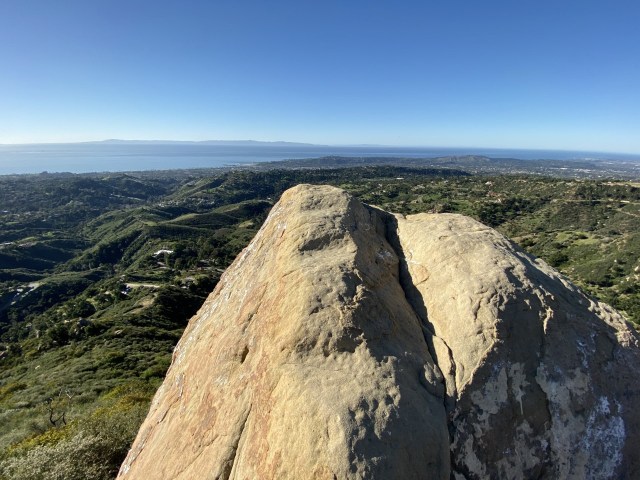
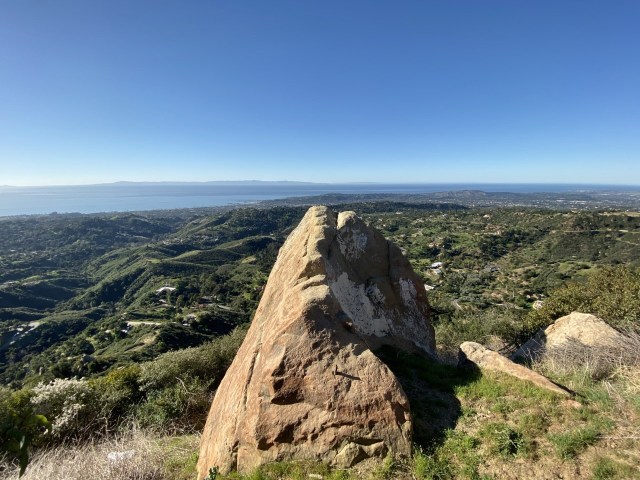
For decades a dirt pullout on Gibraltar Road, the outcrop of sandstone bedrock wrapping the bend in the road, and the long views up and down the coast, along the south face of the Santa Ynez Mountains overlooking the Pacific Ocean, formed a singular attraction known as The Rock.

Here the local intoxicati and psychonauts loitered day and night to take flight. They never left the ground. But boy did they fly high!

Numerous illicit drugs and controlled substances and brain depleting chemicals and vast quantities of alcohol of various kinds fueled savage pursuits of addled depravity worthy of a rambling mutter of approval from the late Hunter S. Thompson.

The bennies, the ludes, the coke, the weed, the ether, the nitrous, the acid, the mushrooms, the mescaline, the XTC, the crack, the crank, and aerosol cans of computer cleaner lifted from high school classrooms.

Animalistic loveless sex in the darkened bushes and silly warm young love in cramped cars with feet out the window.

Warm Santa Ana winds in summer with shirts off at midnight.

The Ratch fell off The Rock. My good friend since fourth grade at Monte Vista, he stumbled over the edge and fell to the road below and broke his leg and had to hobble around Santa Barbara High in a big cast.

Cheech: “Wow, man. That’s some heavy shit.
(Extended pause)
Hey man. . . Am I driving okay?”

Chong: (Slowly looks around through car window)
“I think we’re parked, man.”

—Up In Smoke (1978)

Note the old steps carved into El Roca Grande.

Remnants of the old handrail on El Roca Grande.

Then there were the earlier generations and heroic tales of sheer stupidity from the 1960s and 1970s related first-hand by the family and friends that survived them, and could remember.

A metal pipe once jutted from a knob of sandstone historically known as “El Roca Grande” that protrudes from the mountainside just below Gibraltar Road.

“This was a must-see stop reached by a trail leading up from Mountain Drive and connecting to La Cumbre Trail,” Graffy writes of El Roca Grande.

See related previous post: Trail Up Mt. La Cumbre (1914).

Today’s Gibraltar Road, he notes, was built during the 1930s and was originally known as “Depression Drive.”

Back in the day hikers and equestrians would walk up a series of steps carved into El Roca Grande, along a metal pole and cable setup as seen on the old postcard image above.

Today the remnants of this metal handrail remain.

El Roca Grande noted here, which sits just below Gibraltar Road. The new house still under construction sits stop the larger sandstone outcrop which is just above Gibraltar Road.

For shits and giggles in the 1960s and 1970s the boys would scramble over the sandstone outcrop of El Roca Grande, grab a piece of the old pipe, and dangle over the steep chaparral slope below.

Performing the white-knuckled stunt was a hell of a thrill.

If you were really brave or stupid or a little of both you did it at night.

But nothing compared to “hanging the pipe” in the dark on three hits of acid.

I tell you, I can’t for the life of me imagine why they closed this place down.

Probably the same reasons they closed Goddard: Goddard Campground: The Lost Jewel of West Camino Cielo. I know a guy that was run over on West Camino Cielo back in the day one night by Goddard while lying in the road out of his mind on hallucinogens. He lived to tell his tale, but his face was never the same.

This is classic Santa Barbara.

“When Santa Barbara was first incorporated, back in 1850, of the first 32 business licenses issued by city fathers, 30 were for dealers in spirituous liquors,” Walker A. Tompkins wrote in It Happened In Old Santa Barbara (1976).

These days, Santa Barbara County may be the cannabis capital of California.

Ventura County Star: Santa Barbara County leads California in the number of permits to legally grow marijuana

LA Times: The World’s Largest Pot Farms, and How Santa Barbara Opened the Door

“Santa Barbara County’s famed wine region — with its giant live oaks and destination tasting rooms — and the quiet beach town of Carpinteria have become the unlikely capital of California’s legal pot market.

During the statewide lockdown order declared by Governor Newsom amid the novel coronavirus COVID-19 pandemic, which shuttered most businesses, recreational weed shops were declared “essential businesses” and remained open slinging smoke and various other cannabis-derived intoxicants.

Because getting high in Santa Barbara has always been essential, from the beginning.

After decades of generational use, the authorities placed cement barricades along the dirt shoulder of Gibraltar Road to bar access to the big dirt pullout at The Rock, where everybody parked.

And that was it. They killed it. Dead. Done. In one fell swoop. The end of an era.

Somebody bought the land above the road, where we once stood on top of the big outcrop we called The Rock.

Somebody built a house.

Somebody’s front yard now is where it all happened back then.

Farewell to The Rock.

Standing on the old dirt pullout, now barricaded by cement walls, looking back at what we called The Rock.
Posted in Santa Barbara | Tagged , , , , , , , , , , | 2 Comments

The Privateer; Subcontractor, Dept. of Unauthorized Forestry

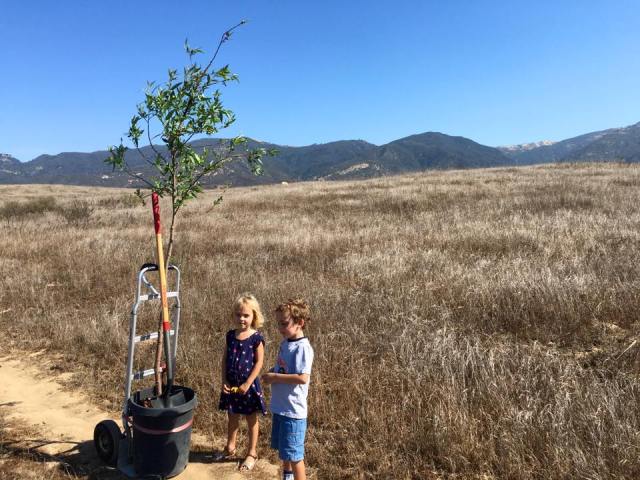
In September of 2016, under cover of broad daylight, assisted by her two trusty partners in crime, whom also served as convenient sweet little innocent distractions to any suspecting walkers in the area, Jackie Willowtree smuggled in and planted the contraband.
“It often tends to be, uh–well the whole concept of legality doesn’t matter much. It’s the intention. As long as you know what you’re doing.”

–So advises Tony Santoro on his pilfered scooter in his Guide to Illegal Tree Planting, as delivered in his profanity-laced classic New York City Italian-American accent.

There’s this gal. It’d be unfair and incorrect to say she hates people, but she doesn’t tend to like them. And that’s different than saying she dislikes them and nowhere near close to saying she hates them. Whatever the particular case may be, she’d rather avoid them, those people, all of those people.

She might like to volunteer with some of the local forest and wilderness organizations and associations that work to maintain open and usable trails or work to restore and revitalize natural habitats.

But these groups tend to be as much of a social club as they are work parties out to actually work. She’d like to work, to lend a hand and help improve and protect the backcountry and wildlife, but she’s not looking to socialize.

Then there is the rigmarole of safety requirements and legal obligations. She is not donning a hard hat like a New York City construction worker only to clip twigs and branches along a flat trail.

So she went out on her own. An unofficial undocumented botanical subcontractor for the Department of Unauthorized Forestry.

As a keen spectator in the stands of America overlooking the public arena and watching the ruling class, political and business alike, she well knew it’s easier to ask for forgiveness afterward than permission beforehand.

And then if caught and interrogated, to claim poor memory. “I don’t recall.”

She imagined, with amusement, the bureaucratic tangle of laws and regulations and rules and policies and protocols the official in charge of the nature preserve would sputter on about having to abide by and fulfill.

She found it impossible to believe she would ever receive a prompt, “Yes! Marvelous idea. Go right ahead and plant that tree.”

Her experiences in such pursuits strongly suggested such quick and easy approval would never occur.

And that’s to say nothing of the personal preferences of the official in charge whom, as kind and upright as they must be, may not appreciate the suggestion of some lone unassociated stranger horning in on their turf or who may have specific opinions of their own about what type of tree should be planted and where, if anything should be planted at all.

Never mind it all. Just plant the damn tree! she thought. A real rebel. Risking nothing.

Jackie Willowtree. Out to, gasp, plant a tree.

She imagined, once more with amusement, being busted for planting a tree, being interrogated and lectured for such a transgression. The teacher’s voice from Charlie Brown.

She imagined the tree ripped from the ground by officials like spray-paint graffiti wiped from a building.

The willow cutting growing strong in July of 2019.

She walked a section of the dry Santa Ynez River in the spring of 2016, where in her younger years a quiet swimming hole once pooled, but which was now choked with sediment and cattails.

What was once a long open gravel beach just a few years ago was now bristling with young willow trees that had sprouted and grown tall during the current record drought and low water levels, the river never running swift enough to clear out its bed.

Here she scanned the thin, tall trees for the straightest, best shaped and healthiest specimens.

She selected a 20 foot sprout and cut the top off and trimmed the large six foot scion, removing the lowermost branches to create a tree-shaped cutting.

She placed the cutting in a bucket of rain water for several weeks, changing the water as necessary until a thick mat of pink and red roots formed.

She planted the huge sprout in a pot where it grew for several months through summer to establish a robust and dense root ball.

Then on a fine late summer day she hauled the rooted clone to the spring at San Marcos Potrero on the North Side.

She dug a hole and sunk it in the ground beside the small puddle that was still, despite the drought, being filled by the reliable little trickle of ground water that poured from the rusted pipe.

Four years later the tree remains, standing much larger and fuller now with a big green bushy head of leaves and a fattened, crazed trunk. The tree casts a cool afternoon shadow over the puddled spring water wherein the frogs swim and where from the mammals and birds drink.

Here at the spring where before no tree stood in what had been a bare naked exposed and shadowless, sun-scorched hot spot.

Now, a green new future grows.

Posted in Santa Barbara | Tagged , , , , , , , , , , | 16 Comments

March is For Morels

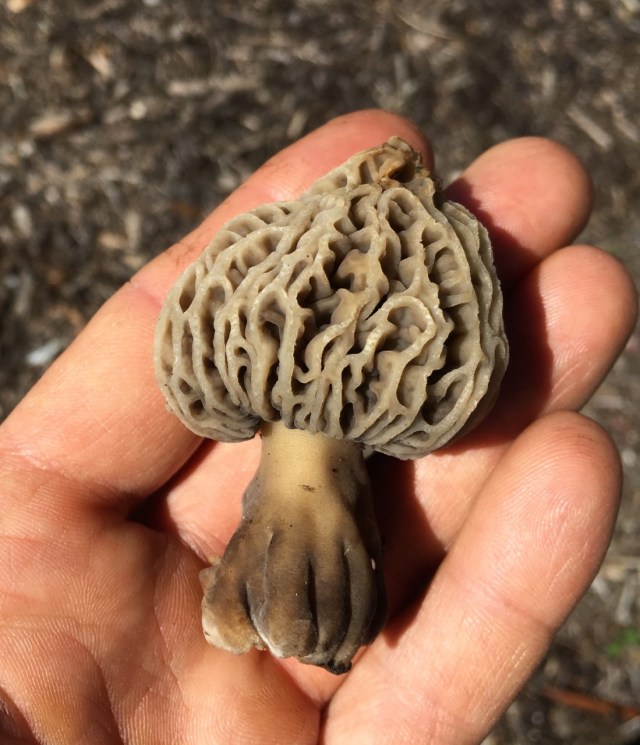
March 2020. “Some of the false morels are dangerously poisonous,” Aurora warns.
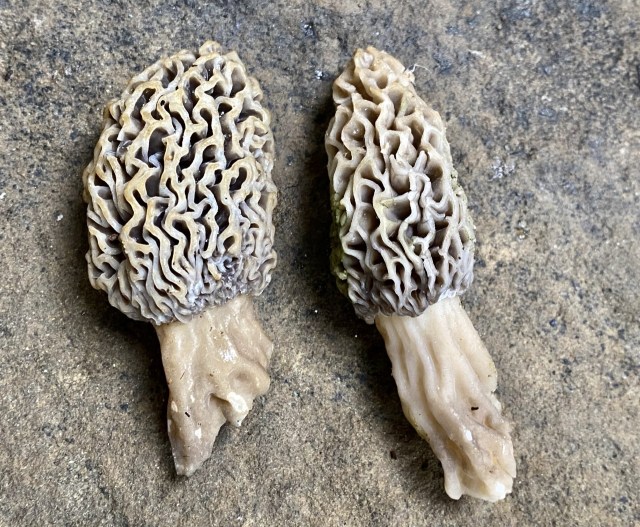
Morels may be the most elusive mushrooms in Santa Barbara County.

“Morels can be extremely difficult to see,” David Aurora writes in All That The Rain Promises And More.

Indeed. They’re probably the most camouflaged and well-hidden mushroom around this neck of the woods other than those found underground. The morel’s neutral and earthy hues combined with its intricate prismatic combed form can, at times, make it impossible to discern from the surrounding forest litter.

I find it amusing how easily and thoroughly these little mushrooms can deceive the most intelligent brains on the planet in Homo sapiens. We’re not as smart as we’d like to think.

Morels do not glow white amid the dark colors of the shadowed forest like hericiums or bright golden yellow like chanterelles. To mention just two much more easily spotted mushrooms.

Moreover, as Aurora notes, morel mycelia “tend to be short-lived, so new ‘patches’ must be found every year.” Mycelia are the vegetative portion of the fungus from which bloom the mushrooms we call morels.

While that is not exactly true, that new patches must be found each and every year, it nevertheless appears to be the case in Santa Barbara County that morels only bloom again from the same patch of ground for two or perhaps three seasons at best before disappearing in latter years never to be seen again.

This stands in contrast to other mushrooms which may be picked in the exact same place for many years and sometimes for decades.

“These factors combine to make morel hunting especially challenging and competitive,” Aurora writes.

Aurora writes in jest about the “demorelizing experience of tramping through the forest for hours, weeks, months, or even years without finding a single one. Only by being skunked repeatedly can you savor the sweetness of ultimate success!”

Or as Nixon advised, “. . .because the greatness comes not when things go always good for you, but the greatness comes and you are really tested, when you take some knocks, some disappointments, when sadness comes, because only if you have been in the deepest valley, can you ever know how magnificent it is to be on the highest mountain.”

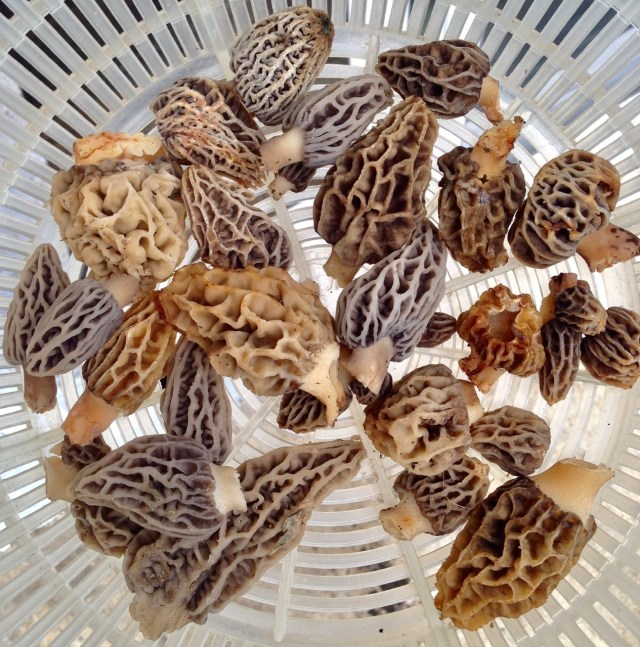
March 2020

The first morel I ever found in my life was growing deep in the Santa Barbara backcountry, as mentioned in this previous post nine years ago: Nira to Upper Oso: An Early San Rafael Experience

I was a teenager and had been out on the trail for several days when, while trudging up a rain-swollen upper Sisquoc River after hard rain the day before that had forced us to take shelter inside the old South Fork Sisquoc cabin, I glanced over and spied the conical combed cap sticking up out from a jumble of flotsam in the river bed.

Well over a decade would pass before I spotted another morel.

The second mushroom I saw while walking back from surfing a point break along Gaviota Coast, while talking with a friend; the dude featured riding one hell of a tube in this previous post: Gabe Surfing Sandbar, Hurricane Marie 8-27-14

We were talking and I glanced to my side for no particular reason and there the morel stood growing from a clump of ice plant. I haven’t talked to him in a long time. I wonder if he remembers.

Another two decades, give or take, would pass before I found more morels.

March 2019

“Mushroom hunting can teach us a lot about the larger world,” Andrew Weil writes in Aurora’s book. “A common experience of mushroom hunters is not being able to see a particular mushroom when they first try to collect it. It’s not a question of visual acuity, but pattern recognition.”

He goes on to tell a short story about a woman that once spent hours searching the forest for morels. After failing to see any sign of a morel, she dropped to her knees and began sifting through the leaf litter. Just as she was about to admit failure and give up, she saw a single morel. Then, a moment later, she look about and discovered that she was surrounded by hundreds of the them.

“A useful lesson can be drawn from this,” Weil writes. “Our brain acts as a filter, screening out what it doesn’t consider significant. . .The larger principle is that what we experience is determined by what we are able to perceive.”

After several decades of mushroom hunting there are still times when out in the woods I look and search and see no mushrooms anywhere. And then just as I am about to give up suddenly a mushroom seems to appear out of thin air. Then suddenly I find a bunch right before me I had somehow not been able to perceive.

Such experiences may make a forest gadabout wonder just how much else apart from mushrooms they may be overlooking and missing when out there in the woods and how much richer their personal experiences may be if’n they could just see what it is they are actually looking at.

I explored this idea of perception an understanding in greater detail in a previous post: Wild Oyster Mushrooms and Reading the Nuances of Nature.

Weil writes that these sorts of experiences leads him to believe we should accept or at least consider other people’s experiences we may otherwise find fantastic, like telepathy or precognition.

“Otherwise we could live in a forest full of morels and never see them.”

March 2019

Posted in Santa Barbara | Tagged , , , , , , , , , , | 2 Comments