Figueroa Mtn Freedom: Violating the COVID-19 Lockdown Order

A vernal pool on Figueroa Mountain. A male and female mallard were seen in the pool. March 27, 2020

I find it difficult to live in a society governed without reason.

My mind operates logically. I am irascible by nature. I am not submissive. I am free thinking and independent. I do not subscribe to dogma nor doxy. I’m off the reservation. I’m wild and free in spirit and mind. My vision is not blinkered. I am obnoxious and loud mouthed with my opinions and points of view and I do not hedge against this trait nor offer apologies. If confronted, I can be rather confrontational. I fire from the hip. My fuse is short. And, as a student of history, I am deeply suspicious of authority and organized power.

What I see transpiring in my hometown of Santa Barbara, the Gilded State within which I live, and these United States at large is a daily irritant that festers with each new headline.

On March 19, Governor Newsom declared a statewide lockdown order that compels by force citizens to remain home. Citizens are only legally allowed to leave home for “essential purposes” such as work, purchasing food or medicine or for healthcare purposes.

Newsom’s dictate is backed by the threat of a fine and jail time. This is a law with teeth, not merely a suggestive guideline.

People are now being arrested in other states for violating these statutory lockdown orders and for being outdoors.

The Chicago mayor stated this in no uncertain terms.

Lightfoot added that spending long periods of time outdoors, anywhere, is not allowed.

And neither is going into closed spaces, like playgrounds.

“You cannot go on long bike rides. Playgrounds are shut down. You must abide by the order. Outside, is for a brief respite, not for 5Ks.”

https://chicago.cbslocal.com/2020/03/25/beck-lightfoot-on-stay-at-home-order-citations-to-be-issued-parks-could-be-shut-down/

Chicago threatens fines, arrests for coronavirus crackdown violators

https://nypost.com/2020/03/26/chicago-threatens-fines-arrests-for-coronavirus-crackdown-violators/

The ruling class tells us to stay home and socially distance and isolate ourselves to prevent our own infection and to prevent ourselves from infecting other people. To “bend the curve” and lessen the ballooning infection rate, they tells us.

Then the same officials threaten to incarcerate us and force us at gunpoint into closed and confined areas with other people, thereby violating their own distancing protocol at the same time prisons are releasing convicts to avoid such conditions for fear of an outbreak.

This is madness!

Headlines:

Checkpoints set up on Kauai, 2 arrests on Oahu as police enforce stay-at-home order

https://www.hawaiinewsnow.com/2020/03/26/kauai-police-begin-islandwide-checkpoints-lockdown-compliance/

Coronavirus behind bars: Prisoners being freed to slow spread in ‘virus vectors’
https://www.nbcnews.com/politics/politics-news/coronavirus-behind-bars-prisoners-being-freed-slow-spread-virus-vectors-n1169881

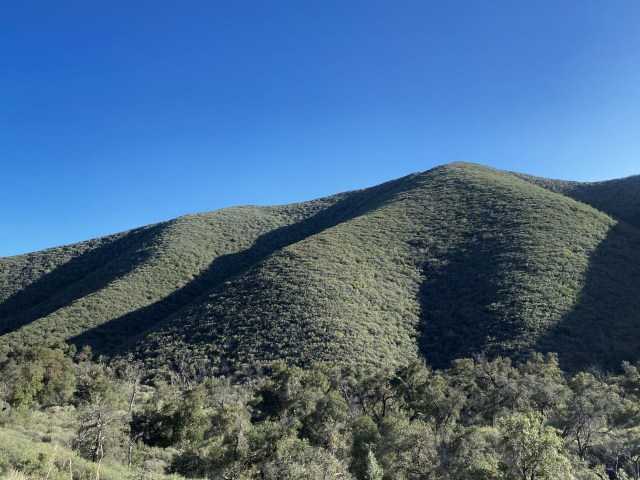
The smooth weathered slopes of chaparral carpeted hills along Sunset Valley.

In Santa Barbara the ruling class has told us that the local recreational marijuana stores are “essential business.” And so they remain open catering to potheads. Because getting high in Santa Barbara is “essential.”

A MESSAGE REGARDING
COVID-19

At Coastal, we are vigilantly monitoring events related to the novel coronavirus outbreak COVID-19. At this time, Coastal will remain open for both medical and recreational customers for normal business hours. . .

Coastal Cannabis Dispensary

These stores operate out of closed and confined spaces–buildings–where it is not possible to maintain the stated six foot “social distancing” protocol and where vectors of disease are set out for patrons to freely handle and set to their faces to smell.

I do not have a problem with adults being allowed to legally purchase weed from documented licensed vendors. I do not care if people want to smoke flowers or the derivatives there from.

But at the same time, the backcountry campgrounds like Davy Brown have been cordoned off and closed and are actively patrolled by goons from the abusive and overreaching moneygrubbing Parks Management Company, as I myself have recently witnessed.

(Previous Posts: Parks Management Company’s Red Rock Racket, Parks Management Company’s Red Rock Racket Continues)

This despite the fact that the campsites are well spaced and it is easy and possible with no extra effort to camp in each site and maintain a far greater distance than the six foot protocol.

Stoners are legally allowed to walk around inside a building and carry on transactions with clerks face to face, exchanging forms of payment and presenting identification and each touching what the other touched, and patrons breathing on and sniffing the same product containers at the display cases.

This is utterly senseless.

Yesterday, the family Elliott spent the afternoon on Figueroa Mountain in gross and flagrant violation of Governor Newsom’s stay at home lockdown dictate. And we were happy to do it.

To take our children to the mountains to play is now illegal and punishable with a $1000 fine and six months in jail, as per the Governor.

(EDIT 3-30-2020 8:08 AM. To clarify, I am taking a strict constructionist interpretation of the Governor’s order. Yes, indeed, the lockdown dictate permits limited outdoor recreation. But as per the Governor these activities are only allowed within your “local neighborhoods.” We have been instructed that “Californians can walk, run, hike and bike in their local neighborhoods as long as they continue to practice social distancing of 6 feet.” I do not interpret that to mean the entire county. https://covid19.ca.gov/stay-home-except-for-essential-needs/#top)

We’re all outlaws now. We will not submit to this madness!

Do not misunderstand. We take the novel coronavirus deadly seriously.

We are highly educated people. We are well read. We follow closely the minutiae of current events on the national and world stage. We have susceptible seniors and old folks in our family like most everybody else. We have family members on the front lines working in the hospitals right now. We do not take this threat lightly!

We removed our children from school before the government finally decided to close them down. We began to self isolate and stopped interacting with friends and family and the public at large before the government decided to issue the various dictates and protocols regarding “social distancing” and home lockdown. In our essential business, which remains open, we formulated specific protocols to limit interaction between employees and clients before any of our professional peers in the county, so far as we know.

In point of fact, we have as a family and as a business been ahead of the curve with respect to self isolation and distancing and proper protective measures.

Santa Barbara County is mostly rural. This is a demonstrable fact. Large swaths of the county are unpopulated if not unpeopled and much of the land here is designated National Forest and Wilderness. Within just a couple of minutes from my doorstep I enter the forest.

Santa Barbara County is not a densely populated metropolis. Yet, the same rigid one-size fits all lockdown dictate applies as much to citizens here as it does to those living in the middle of Los Angeles city proper.

This is senseless.

The Dude will not abide!

To paraphrase Kipling: If you can keep your head when all about you men are losing theirs and blaming it on you. If you can trust yourself when all men doubt you, but make allowance for their doubting too. Well then, you’ll be a man my son!

In Desert Solitaire, Edward Abbey wrote of the wilderness as a refuge from abusive government:

“The wilderness should be preserved for political reasons. We may need it someday not only as a refuge from excessive industrialism but also as a refuge from authoritarian government, from political oppression. Grand Canyon, Big Bend, Yellowstone and the High Sierra may be required to function as bases of guerrilla warfare against tyranny. What reason have we Americans to think our own society will necessarily escape the world-wide drift toward the totalitarian organization of men and institutions?”

UPDATE April 5, 2020: Please see my remarks in the comments for further information and opinion.
Figueroa Mtn Freedom: Violating the COVID-19 Lockdown Order

Posted in Santa Barbara | Tagged , , , , , , , , , , | 27 Comments

Jack’s Custom Deluxe Super Premium Los Padres Liniment

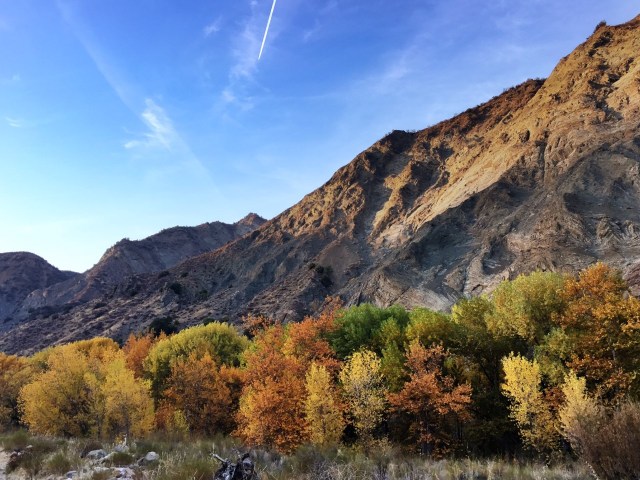
Cottonwood trees showing fall color along the Santa Ynez River in Santa Barbara County.
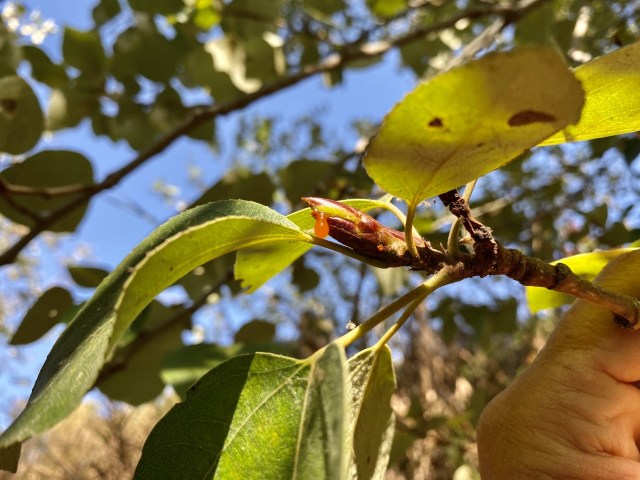
“Well the summertime has gone,” Van Morrison sings. “And the leaves are gently turning.” And come fall season in Santa Barbara County the black cottonwood trees drop leaves and grow buds.

The sappy buds develop and swell in size through winter and as spring approaches a super sticky amber resin oozes from cracks in the bud scale.

The tarry goo has a strong, heady fragrance somewhat similar to the best flowers. The natural fragrance is reminiscent of perfume sometimes.

Over the years I’ve noticed a slight variance in the fragrance of the bud resin of different trees growing in different areas of the county and maybe it’s also to do with the vagaries of weather from season to season or subspecies differentiation.

Depending on how black cottonwood balm is prepared the fragrance varies as well.

A stand of black cottonwood trees budded out and dripping resin casts its sweet scent wafting in the wind for some distance.

I have fond memories of sitting in the sea on a surfboard in winter along Gaviota and smelling the black cottonwood fragrance filling the air from the windblown beachside trees.

Black cottonwood bud oozing resin.

Black cottonwood buds are brown, as seen here, while Fremontii cottonwood buds are green. 

Black cottonwood balm has taken on legendary status in the Elliott home. The bud resin is a remarkable natural remedy.

Each winter I carefully and judiciously harvest buds, which I use to infuse organic avocado oil.

After some time steeping I strain the oil and blend it with beeswax to make an exceptional medicinal moisturizer our family uses in a variety of ways.

I’ve said of it in jest, Jack Elliott’s Custom Deluxe Super Premium Los Padres Liniment.

Or, you know, just cottonwood for short.

I harvest my buds from the Los Padres National Forest and use top shelf ingredients.

The cottonwood, as we call it, is a three ingredient handcrafted product made of local matter.

I use avocado oil because it’s rich in vitamins A, D and E and omega-3 fatty acids, which all benefit the skin in ways that complement the black cottonwood.

Avocado oil promotes skin regeneration and the healing of minor wounds and may help reduce itching and inflammation.

Avocado oil serves as a good vehicle to carry the active ingredients in black cottonwood deeper into the body, because it penetrates the skin more deeply than many other oils.

The oil also absorbs quickly and without a lasting greasy feeling.

Fresh super tacky cottonwood bud resin.

What fingers look like after two hours of harvesting. 

We here in the Elliott household rub this luxurious liniment onto insect bites and stings, minor scrapes, scratches and cuts, dry skin of various causes, burns from fire, heat and sun, poison oak rashes and other issues of dermatitis and most anything else to do with skin.

Black cottonwood soothes minor pain, discomfort and stinging associated with skin injuries and minor wounds and has been used in various forms for thousands of years.

The tree is in the willow family, Salicaceae, and like willows it contains salacin, the basis of salicylic acid from which aspirin as originally named by Bayer was derived.

Salicylates have been derived from the willow tree bark. The Sumerians were noted to have used remedies derived from the willow tree for pain management as far back as 4000 years ago. Hippocrates used it for managing pain and fever. He even utilized tea brewed from it for pain management during childbirth.

In a 1763 clinical trial, the first of its kind, Reverend Edward Stone studied the effects of willow bark powder for treating fever. About a 100 years later the effects of the willow bark powder were studied for acute rheumatism.

In 1828, Professor Johann Buchner used salicin, the Latin word for willow. Henri Leroux used it to treat rheumatism after isolating it in a crystalline form in 1829. In the 1800s, the Heyden Chemical Company was the first to mass produce salicylic acid commercially. It was not until 1899 when a modified version by the name of acetylsalicylic acid was registered and marketed by Bayer under the trade name aspirin.

National Center for Biotechnology Information, U.S. National Library of Medicine

But wait! There’s more.

Black cottonwood is also thought to promote the healing process by stimulating tissue regeneration, acting as a vasodilator or an agent that dilates blood vessels and an antimicrobial antiseptic to keep wounds from getting infected. Reference Michael Moore’s “Medicinal Plants of the Pacific Northwest.”

What more do we need?

When I was stung by a stingray I used the cottonwood to dull pain and heal the wound in the days after the initial excruciating and debilitating explosion of pain had subsided.

When in the past my small wounds reddened and festered the cottonwood put an end to it.

The balm does away with the stinging and soreness of skin scratched by wild roses or blackberry brambles or brush when hiking.

Sometimes within seconds the stinging vanishes.

That I can tell you from personal experience.

Unlike so many other artificially derived and synthesized over the counter products that reek of an unpleasant medicinal odor, black cottonwood fragrance is remarkably pleasant and soothing, even a might addicting to huff so fine is its perfume fragrance.

I smell it up whenever I apply it.

Sometimes I open the jar just for a whiff.

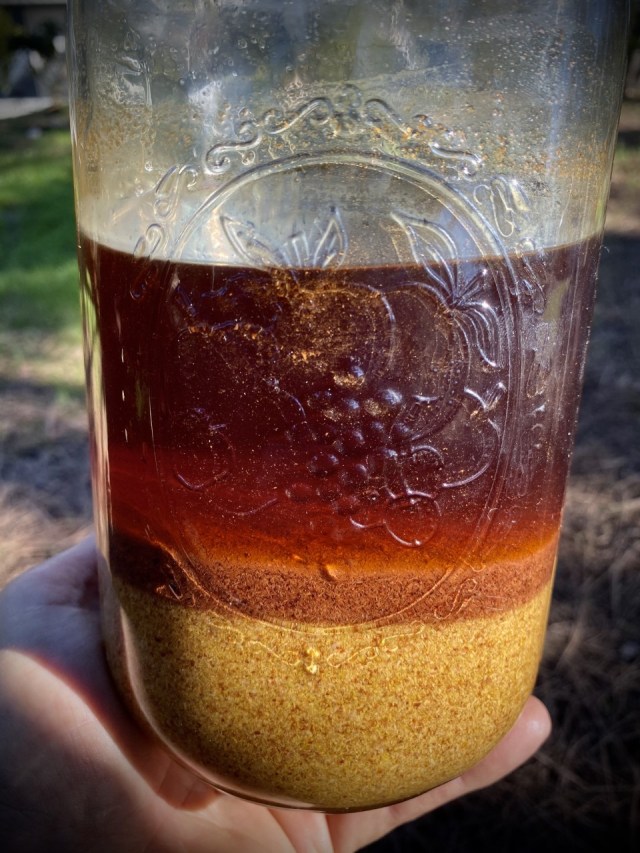
Black cottonwood buds blended in avocado oil and steeped for an extended period of time. This jar sat in a darkened cabinet for 22 months. The oil takes on an amber hue from the cottonwood. The longer it’s steeped the darker it gets.

In short, black cottonwood balm soothes minor pain, prevents infection, promotes healing and moisturizes the skin.

I no longer use store-bought topical antibiotic agents or moisturizers and I take the balm on trips away from home.

I find it remarkable that no mention of the early Chumash having used black cottonwood for similar purposes can be found in Jan Timbrook’s book, “Chumash Ethnobotany.”

That is one of two items missing from that encyclopedic work, which has been a personal favorite of mine since its publication.

And I’m not saying Timbrook left anything out.

There is apparently no reference to the Chumash having used black cottonwood for pain relief and healing in the sources available.

For how well the black cottonwood works, I’m surprised to find no mention of its use.

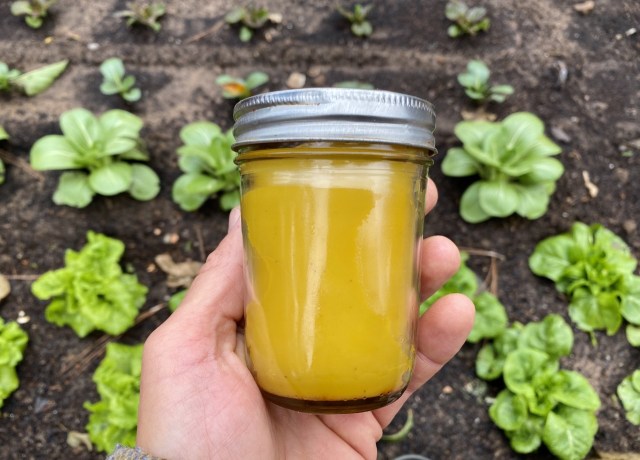
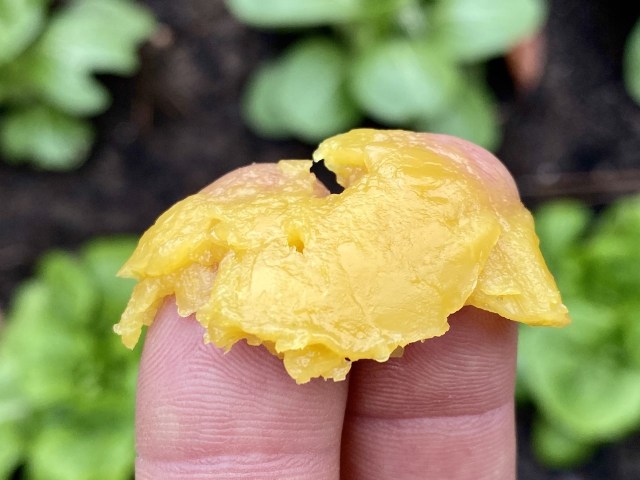
Final product.

One notable problem with harvesting black cottonwood buds is that the twig end dies when the bud is removed.

The twigs do not sprout again.

Pinching off a bud does not result in two or more new shoots sprouting from the broken twig end; it results in a dead twig.

I can tell you this from personal experience through careful observation of particular trees over the course of years.

Therefore when harvesting it is imperative to take just a little from here and there and from various places.

And to take from numerous different trees over some space in order to reduce the harm done to each tree and avoid stunting growth or possibly killing entire branches, limbs or perhaps in time the whole tree if young enough.

Related Post On This Blog

Black Cottonwood Wildcraft

Posted in Santa Barbara | Tagged , , , , , , , , , , | 1 Comment

Native American Cupule Boulder Discovered

Mortar

No trail leads there. A careless body could fall along the way and be bloodied up, break a bone, die busted and splattered across the sharp angular stones of canyon rip-rap and jumbled boulders and bedrock slabs.

Such has happened in the canyons of Santa Barbara County. People perish here hiking in the Los Padres National Forest.

Walking a ridgeline on a different approach during a subsequent visit proved no less precipitous.

I peered down double black diamond dry ravel slopes.

I get soft and fuzzy headed in unstable high places these days. I felt the pull of the void.

I imagined myself loosing traction on the descent and tumbling rag doll head over heals into the canyon’s stony toothed maw.

With luck, maybe, I could have saved myself by glissading the slope on my rear end, trekking poles for stability, but at that steep angle, gravel working like ball bearings, the speed might have been unmanageable.

This place still remains difficult to reach, today, and the strain in getting there impresses upon me how remote it must have been for people in prehistoric yesteryears.

Later, back home, I would ponder with amusement the fact that those people came to this place adorned in finely crafted jewelry. If the tiny cylindrical bead found there was any indication.

Sweating profusely, red and steamy, hot and thirsty and dusty and dirty, hauling a pack with liters of water and calories, pushing and pulling and holding myself in place aside the mountain slope with trekking poles, feet wrapped in protective coverings, covered head to toe in the burly synthetic fiber toughskins of outdoor adventure clothing made to withstand the abrasive brush and rock; I busted my hind end it to get there.

This place where they once hung out so well-adorned and nearly naked by comparison.

The contradistinction between us seemed ludicrous.

I hauled myself up the acclivity, lumbering through the geologic wrack, dragging my body, that suit I came in that now felt like a sack of molten lead.

I didn’t know where I was headed.

I had no destination.

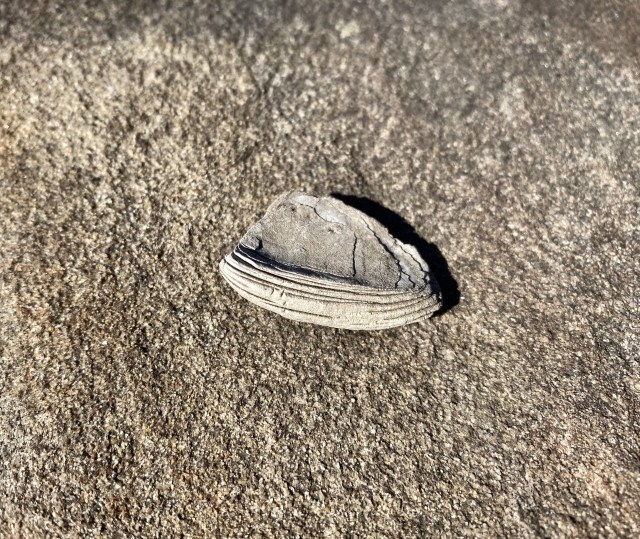
Old seashell found high on the mountain.

In this late year in this long settled and overrun American land, less than fifty miles from the most populace county in the nation in the most populace state, the forest still holds secrets.

Once in awhile the forest yields riches to fortunate souls whom invest time immersed in the other world out there, outside the metropolis, across the fence lines, beyond the end of the road, down the trail and into the wild.

Sometimes the wealth earned is abstract and metaphysical, something that happens in your head when you’re out there.

“Myself, crouched in this cave,” Craig Childs writes in Soul of Nowhere, “I am hoping to become the same, a person who is changed by the land, who puts a pen to paper and tells what I have seen.”

On other occasions, the woods may reveal  something physical to the keen observer and wanderer of wilder places.

I hear murmurs of an extraordinary Native American zoomorphic stone artifact, possibly a cetacean, recently found in a certain canyon above Montecito, revealed after the catastrophic and deadly Montecito Debris Flow of 2018, discovered by a lady out for a hike in one of the most popular canyons in the Santa Barbara frontcountry.

That earth churns and old buried treasures turn up from the dirt may not be surprising.

People have lived around these parts for over 13,000 years (Arlington Spring Man). Some artifacts are found over twenty feet deep in the ground.

But to stumble on a landed artifact several weeks ago myself, sitting around above ground for innumerable years, surprised me.

In the land of lower California in 2020 crawling with millions of people, hidden treasures and secret places still remain in our remnant wildlands.

What a fantastic revelation!

On a hike in late January I discovered a cupule boulder I did not know existed and that was unmentioned in the literature.

“That is a surprise,” he said, the well-known published expert I consulted and whom was unaware of the site.

He suggested I notify John Johnson, Curator of Anthropology at the Santa Barbara Museum of Natural History.

Cupules

Located high in the mountains, this place offers an incredible view over the land spread out far below.

I was stunned! when I made it over the last steep slope and emerged from the trickling creek and I stood straight again and walked instead of clambered and I saw how the forest floor fell out before me into a gulf of open air with a long view over the land below as far as the clarity of the air allowed framed on either side by plummeting ridgelines.

Whoa!!!

I marveled at my surroundings. I weaved a slow uncertain line across this remarkable promontory, struck by its incredible geography that so pleasured my mind.

This place, for its view and geography, is something like the Knapp’s Castle site in Santa Barbara County.

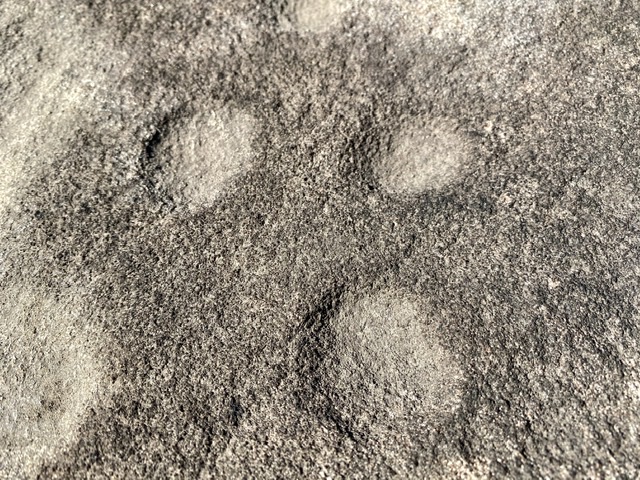
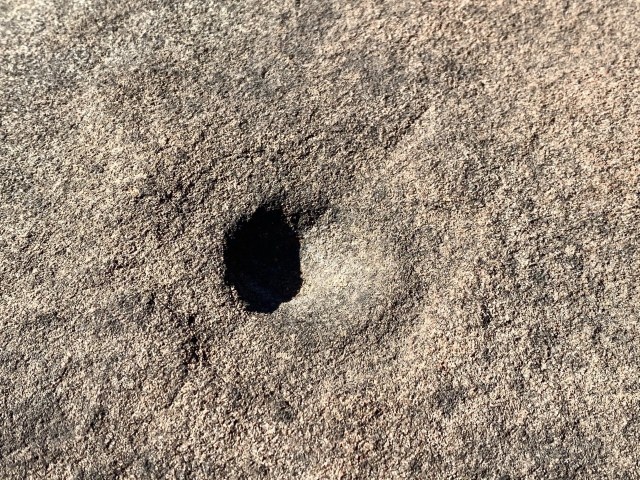
See the faint circular depression surrounding the hole? Is it natural or human-made?
The Chumash long ago discovered all the finest nooks and crannies of the forest or perhaps they inherited them from the Hunting People and the earlier Oak Grove People or whomever.

The places of long views, eccentric and useful rock formations, peaks and valleys and fields and streams and seeps and springs and deep pools and natural stone tanks and tinajas and the differing neighborhoods of various plants and the collections of animals drawn to them.

There is a true story of a deer hunter finding two Chumash bows and a bundle of about 20 or so arrows inside a dry cave in Santa Barbara County in the late 1950s.

The cave is located in a canyon in and around which the modern deer population (circa 1965) had been found to be among the densest in the county.

The old Chumash knew these things by necessity. I struggle mentally and physically to learn what had long ago already been known about this land and then lost.

I recall as a boy driving into this canyon and on a grassy slope beside the dirt road I spied deer antlers through the truck window.

I remember having been rather impressed with the size, and that George, my friend Willy’s dad, pulled rank and ended up taking them much to my disappointment. I wanted the antlers. My boyhood bedroom resembled a museum with shelves burdened with collections of bric-a-brac.

It rained hard on that trip to the house in Peachtree Canyon. We ended up having to hike out in the rain on the sloppy and tacky dirt road with its burdensome heavy mud that stuck to our shoes and made adobe bricks of our feet.

The cupule boulder.

I walked along admiring this high mountain promontory and the view therefrom on an immaculate winter’s day.

I came to a short and flat tabletop boulder, about waist high, and upon it a roundish area appeared worn.

This brought to mind the sort of grinding slicks seen on granite in the desert and in the Sierra that were once used to process seeds or nuts or whatever.

But the wear was subtle enough to remain unclear and the bottom of the bowling depression seemed too rough to have been used. Maybe the rain had made it.

One day the bottom of the depression, worn by sitting water, might be perfectly flat like a miniature dry lake and smooth and hold gallons of water, a tank. I found several such tanks on this day, all dry in this once again droughty winter.

I ran my fingers over the roundish area on the flat boulder, and moseyed on, aimless as usual, so often aimless out there.

I stepped at a slow pace around another much larger boulder and it seemed as though something inside my head told me to look down and when I did there before me lay a small artifact of white chipped stone in a crescent shape.

I stood still, looking at the telltale bit of stone, mentally feasting upon the intellectual meal I had just discovered. People had been here a long time ago.

The artifact appeared to be the back end of an arrowhead protruding from the earth.

Still standing, I could see notches in the stone once used to haft the projectile point to an arrow shaft or so it appeared.

But when I knelt and first picked up the artifact some forty-five minutes later its form differed from the projectile point I had in mind.

I turned the small piece over in my hand and I was surprised to see that it was not a broken half of an arrowhead. The break was not a break, but in fact a finished edge.

Later when I showed it to my young daughter the first thing she said was that it looked like a bear. I hadn’t seen it at first, myself, but when mentioned the resemblance was remarkable and unmistakable, though perhaps coincidental.

Some time after that first artifact, one of many of different sorts found in addition to bone and seashell fragments, I used a tree to hoist myself atop a boulder.

On top of the boulder, in a natural depression, I found some 30 or more cupules.

In another boulder a stone’s throw away and nearer the edge of a cliff I found a single mortar.

Between the mortar stone and the cupule boulder, some person or people had apparently spent much time knapping and crafting stone tools as evidenced by a concentration of light lithic scatter and numerous stone artifacts.

*

At the start of the day, as I began my hike, and later while dragging my body all over the mountain, I wondered what I was doing and why. I thought perhaps I had wasted my day rather than seizing it.

Why do I go to places where few people if anybody else at all ever bothers with?

I wondered if I had wasted my day, because I had no set destination, nothing planned to reach or achieve—no waterfall, no deep pool in the creek, no peak, no trail camp, no flowers, no foraging for mushrooms or other wild edibles and nothing labeled on any map.

And then I stumbled onto this archaeological site by happenstance.

Related Posts on this Blog:

Chumash Rock Art Discovered

The Los Padres Box of Chocolates

Posted in Santa Barbara | Tagged , , , , , , , , , , | 2 Comments

Chaparral


Slopes of chaparral in the Santa Ynez Mountains.

On down the slopes and all the way to the canyons was a thicket of varied shrubs that changed in character as altitude fell but was everywhere dense enough to stop an army.

On its lower levels, it was all green, white, and yellow with buckwheat, burroweed, lotus and sage, deerweed, bindweed, yerba santa. There were wild morning glories, Canterbury bells, tree tobacco, miner’s lettuce.

The thicket’s resistance to trespass, while everywhere formidable, stiffened considerably as it evolved upward.

There were intertwining mixtures of manzanita, California lilac, scrub oak, chamise. There was buckthorn. There was mountain mahogany. Generally evergreen, the dark slopes were splashed here and there with dodder, its mustard color deepening to rust. Blossoms of the Spanish bayonet stood up like yellow flames. There were lemonade berries (relatives of poison ivy and poison oak). In canyons, there were alders, big-leaf maple bushes, pug sycamores, and California bay.

Whatever and wherever they were, these plants were prickly, thick, and dry, and a good deal tougher than tundra.

Those evergreen oaks fingering up the creases in the mountains were known to the Spaniards as chaparros. Riders who worked in the related landscape wore leather overalls open at the back, and called them chaparajos.

By extension, this all but impenetrable brush was known as chaparral.”

John McPhee, “The Control of Nature” (1989)

Everywhere and always around here, chaparral. The woody and wiry brushwood that grows in thickets so tangled and prickly it renders foot travel impossible without being ripped to shreds.

I hate it so much I’ve grown to love it. “Worthy ******* adversary,” to quote Walter Sobchak. Chaparral demands respect.

The hideous overgrown weeds are penetrable only through violent force in most places. “Carrying packs and cutting our way down a brush-choked arroyo with machetes,” Campbell Grant wrote, “we made a mile in two hours.”

Through the years chaparral has defined and many times dictated the day’s (mis)adventures by obscuring trails, barring access and making travel afoot exceedingly difficult and uncomfortable.

I can’t deny feeling a certain degree of pleasure whenever a wildfire scorches vast swaths of chaparral. Take that, vile weed!  And how nice it is to walk freely through open terrain when it’s been reduced to ash and bare sticks. That never lasts long, though.

It’s a rather perverse and maddening feeling to have been “lost” one night within sight of people and the city only because an impenetrable wall of chaparral stood between me and Gibraltar Road. I could see cars driving on the mountain road not too far off from where I was stuck in the dark without a trail, but short of a brutal bushwhack–which might have taken hours to cover only a short distance and require an extreme amount of effort and result in being scratched raw and bloody–I could not make it to the road.

In the land of chaparral, the trail is a thin savior through the thicket. A twelve-inch wide life raft promising safe passage home and a return to the comfort and convenience of civilization and the bottomless well that gushes at all hours everything anybody wants.

To lose the trail is to fall from the raft and be cast adrift in rolling seas of chaparral that stretch to the horizon. A puny human marooned in an ocean of dangerous wilderness. A castaway caught amidst heaving peaks and steep mountain slopes that rise and fall like monstrous green swells.

Posted in Santa Barbara | Tagged , , , , , , , , , , | 3 Comments

The Rescue of a Baby Lion

The fleeting, odd bit of noise sounded mechanical when it first hit my ear. But we were in a designated wilderness wherein nothing of the sort is allowed. And so brief was the sound I almost wasn’t sure I heard it.
Then it sounded again. Definitely something humanmade.  Maybe it was a horse since it couldn’t be a machine. It didn’t sound like a horse. I was grasping for meaning. It didn’t sound like anything to do with any horse.

“Did you hear that?”

“Yeah.”

“What the hell is that?”

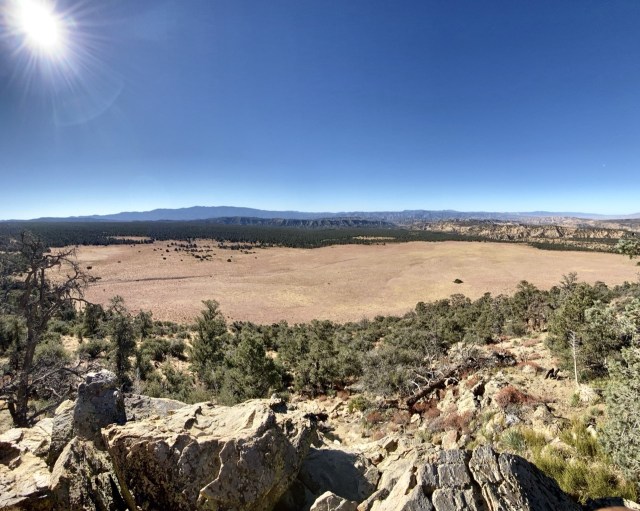
Silence. A thin wisp of air through pine needles. That far out spacey, desolate sound. Two men and their thoughts. A long wondrous view overlooking a huge swath of piñon forest.

And there was that noise again. A metallic rattle from the direction of our camp where we had left behind our packs with our food, and so now there was another concern.

Other odd sounds drifted over, impossible to decipher and unsettling in the midst of wilderness. More rattling. Muffled rustling. Something.

“Sounds like a bear getting out food.”

I don’t know if it sounded like a bear shredding packs to get food, but the mind imagines and I had no other idea what else it could possibly be.

The noise was loud from such a distance. Whatever it was wasn’t small. It wasn’t a bird nor a rodent.

I stood on a rock gazing over the forest down toward our camp and I saw the tall tree the camp was under. I saw no movement but nor could I see our packs.

“I’ve never had any problems with bears in the Los Padres.”

“Neither have I.”

The afternoon sun struck the south slope of the high desert foothills with an unseasonably warm intensity for November.

We sat in the rocks for an hour or so watching the forest and the sun set behind mountain peaks in the far off distance and several times we each unsettled a yellow jacket nest in the ground nearby and they swarmed out to investigate our intrusion and we withdrew for fear of the tiny buggers.

And the bewildering noises continued.

“Wanna go see if we have anything left to eat?”

Just after the sun fell below the horizon we moseyed back to camp to see if the bear had left anything for us to pick through.

Nothing was touched in camp. No sign of any animal could be found.

Then the metallic rattle erupted as we stood in camp. The noise was nearby. A stone’s throw, perhaps.

“What the hell is that?” The mutual question.

The noises had been carrying on now for quite some time, inexplicably, and became ever more vexing.

Maybe it was a can rattling among rocks in the wind. But there was no wind, just a breeze too light to cause such a noise.

We walked from camp not many yards across the adjacent glade and to its far edge where the piñon pines began again. The noises continued intermittently.

Then we heard the yowls.

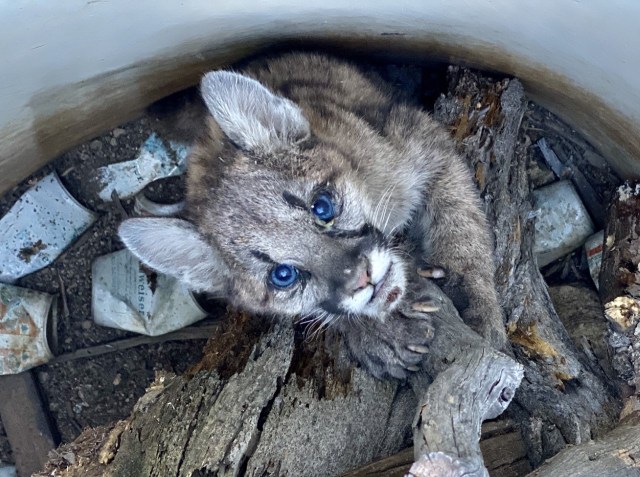
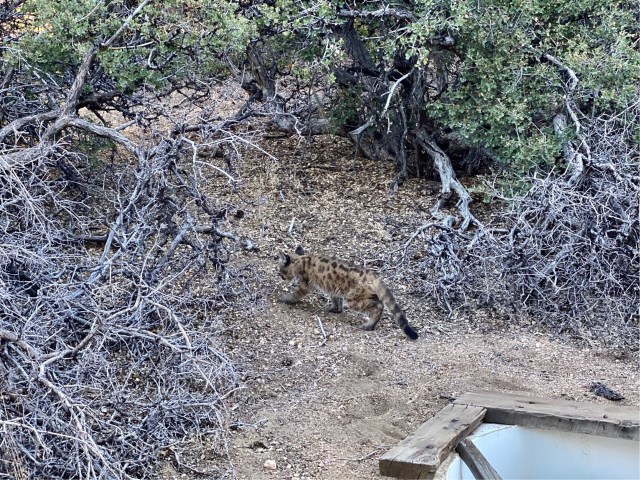
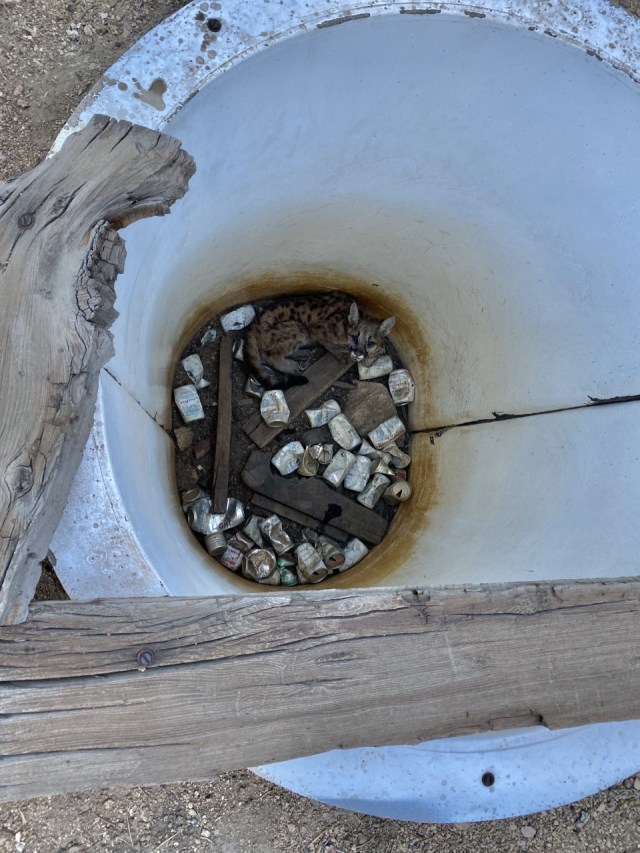
The lion cub as found.

The voice was that of a mammal. Finally we had some solid sense of. . .something. No doubt it was. . .hairy. It was a bloody milk drinker! Of some kind.

We surmised either a cat or possibly a bear was over in yonder darkening forest. Maybe a bob cat or lion. Maybe it was a young cub of some sort playing with trash, a can perhaps.

Bingo! Finally something was beginning to make sense way out there in the woods. Yes. Of course. It was a cub playing with a can. A curious and playful kid.

The first visit I made to this camp some number of years ago I found numerous old pull tab beer cans scattered about the trees. Imagine that.

There must be a trash dump a young animal got into, I thought. But the noises continued. On and on. And on. It made no sense.

“What kind of animal could possibly be occupied by a ******* can for so long?!”

None. No animal, of course. We couldn’t figure it out. The longer it carried on the stranger it seemed.

In the lingering twilight of autumn with an intense and fiery sunset burning up the tree silhouetted horizon, we walked through the glade spotted with Great Basin sagebrush to see if we could find a clear way into the piñon pines and scrub oak and take a gander at whatever it was out in the woods there.

We found no open natural easement through the forest with a cursory glance and so pulled up short and stood looking into the woods, not seeing much.

“Want to go see what it is?”

We stood along the treeline in a darkening forest. We’d have to push through some scrub and light branching and enter a more enclosed area within the trees, listening for the odd noise or a screech and trying to pinpoint. . . something. . .in there.

“I’m not inclined.”

Very funny. Some poor fool walked into the woods one fine fall night to investigate an eerie noise and he was promptly ripped to shreds by a mother mountain lion protecting her cub. That was the hypothetical news story imagined at the time.

No. We’re not entering Pan‘s lair to investigate. The origin of the word “panic.” We’ll save that for mañana, ese.

I returned my rather large and freshly sharpened carbon steel blade to its leather sheath. Maybe I wouldn’t have bled out from catastrophic lacerations and puncture wounds about the body and face after I liberated myself from the lion’s jaws and paws using my knife, and I would have instead crawled home like Hugh Glass. Very dry humor, indeed. It was all we had besides the deterrence of our presence, two lumbering bipedal primates.

We moseyed back to camp which took all of thirty seconds or so. The noises continued. Of course they did. I thought of the Blair Witch Project.

“What the hell is going on over there?”

It was too late to see. We’d wait ’til morning.

I had a nervous twinge. Not that I’d suffer harm. But the animal we thought for sure must be over there, because we heard its voice earlier, that animal was not actually acting at all like we know animals should normally act.

The animal didn’t seem to care about our voices or our loud walking about in the crunchy and sparsely covered soil or our scratching through the wiry scrub brush as we walked or our scent. And no animal plays with trash for hours on end.

We laid out beneath the Milky Way in the warm night. Stars shot across the speckled firmament. White dots drifted unblinking in orbit, satellites and space junk. And the noises rattled on once in awhile.

Maybe there was a cat den over there. But even so, we’d expect silence and not hours worth of loud noises and no seeming concern whatsoever for our presence.

At four o’clock in the morning I rose from my cot to irrigate the bushes and I stood within a trillion points of light sparkling all around even despite the beaming moon. The air was not cold. All was quiet. Finally.

But the noises had not ceased through the night, so my friend advised the next morning after sunrise, suffering as he had a fitful night of virtually no sleep, listening to the beast in the bush rattle around on occasion.

After coffee and a few slices of a Renaud’s almond croissant we finally went to investigate the noise. By this time I was thinking an animal had somehow gotten tangled up in old trash, like fencing or wire, and it was thrashing about trying to free itself.

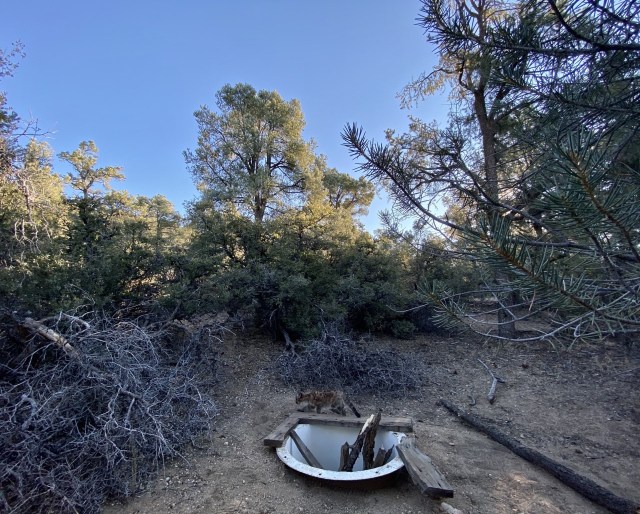
We found an old latrine pit without a lid. Trapped inside the hole was a baby lion three or four months old.

I have only seen two mountain lions in the Los Padres National Forest in all my time out there. The first was a desiccated body of a young lion that had been hit by a car on the 101 freeway along Gaviota Coast and crawled into the creek and died in a cave. The second lion was this one here trapped in an excrement pit among beer cans.

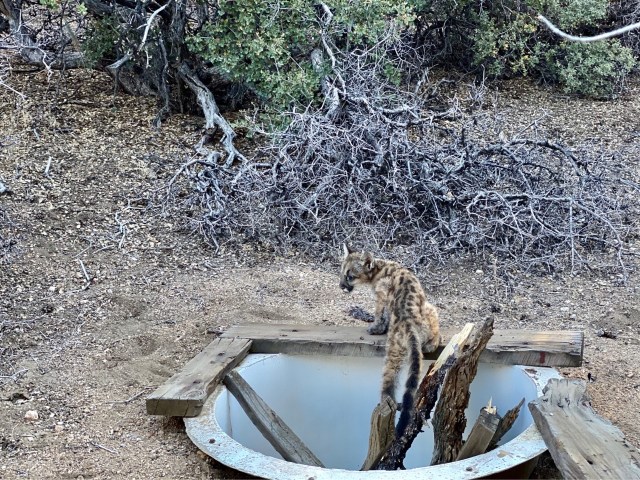
We collected a few old bits of cut wood and tree limbs and stacked them inside the pit as a ladder for the lion to climb out. The poor animal was terrified, shaking.

The lion eventually climbed to the rim of the pit and stood there for a long time on the branches looking around at the forest, its head silently turning in the quiet morning air with a real slow fluidity that almost looked machine-like.

The little cat waited quite some time before venturing out. Then it finally crawled ever so slowly from the pit and crept off in slow motion, slinking, super leery, as if not wanting to provoke a chase and get eaten should it run for freedom. Then it did bolt and was gone.


Posted in Santa Barbara | Tagged , , , , , , , , , , | 12 Comments