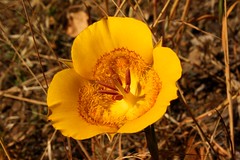
The Allure of Grass

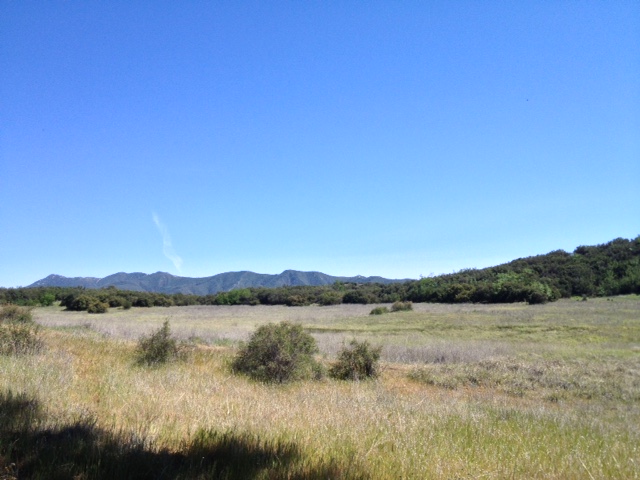
Escondido Potrero Los Padres National Forest Dad Ramey stillA small, but remarkable potrero in the Los Padres National Forest that is a short distance away from Mollisol Meadow.

“But it is upon the grass, mediator of soil and sun, that the human gaze has always tended to settle, and not just our gaze, either. A great many animals, too, are drawn to grass, which partly accounts for our own deep attraction to it: We come here to eat the animals that ate the grass that we (lacking rumens) can’t eat ourselves. ‘All flesh is grass.’ The Old Testament’s earthy equation reflects a pastoral culture’s appreciation of the food chain that sustained it, though the hunter-gatherers living in the African savanna thousands of years earlier would have understood the flesh-grass connection just as well.”

Michael Pollan, “The Omnivore’s Dilemma”

“It seems likely that the Santa Barbara coast in pre-European times was dominated by grassland and oak savanna. … Indian burning may also have been an important factor in maintaining the openness of oak savanna in coastal areas.”

Jan Timbrook “Vegetation Burning by the Chumash

The historic population of Chumash in the Santa Barbara area would have well-understood the flesh-grass connection mentioned by Pollan, as they routinely burned the landscape to encourage new plant growth, fresh green shoots and seeds, and thus increase their available food supply. While it is speculative, as per what little we know from historical sources, perhaps they also burned the forest to spur fresh plant growth to attract game to hunt.

But what is the appeal of grass for a modern day urbanite like myself? Few other features of the Los Padres landscape capture my attention like an open patch of grass, the potrero as they’re commonly called.

There is aesthetic value. I enjoy looking at a potrero, the golden brown hue of dry grass set against a dark green, shadowy backdrop of oaks or chaparral carpeted hills and a clear blue sky above. In other ways, as well, fields of grass are instantly pleasing to gaze upon.

Grassy flats serve a utilitarian purpose, too, providing uncommon open and level spaces for ancient habitation, early American homesteading and modern-day camping in a forest that is often densely covered in impenetrable chaparral and folded about by inhospitable mountain slopes. The role potreros have played in shaping the human condition fascinates me.

I like to analyze the character of potreros in this context. Consider their particular componentsgnarled old oaks providing shade there, a creek running along the fringe here, an exceptional view of nearby sandstone crags over thereand decide on the best place to locate a campsite. I choose plots where I’d build a cabin and consider where the garden and orchard would go. I wonder about past peoples that have lived, camped and hunted in the potreros 100 years ago or 500 or 1000 years and more. I consider grass gazing a legitimate form of recreation, to relax in the shade of a tree on the edge of a quiet backcountry potrero and watch it lie there. And ponder.

Yet while I have an aesthetic as well as utilitarian interest to these swaths of grass surrounded by trees and brush, sometimes it seems there may be something far more to it than mere superficial attraction and historical curiosity. There is no doubt that I like to go sit around in a potrero for no particular reason.
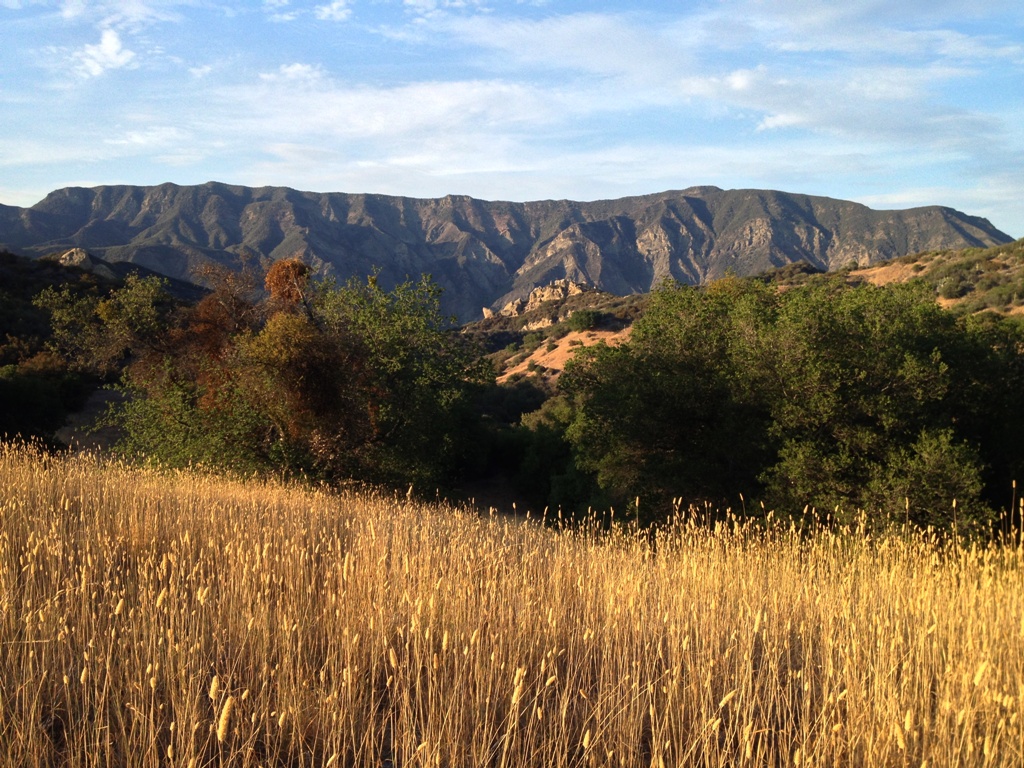
Matias Potrero Los Padres National Forest hikes campingMatias Potrero, Santa Ynez River environs.

Pollan suggests a far deeper connection to grassland habitat stemming from humanity’s prehistoric roots as hunter-gatherers. He notes that people’s appreciation for grass is often cited as an example of biophilia, the theory posited by E. O. Wilson, a two-time Pulitzer Prize winning evolutionary biologist at Harvard. Wilson’s hypothesis holds that humanity possesses, as a legacy of evolution, an innate bond or instinctual attraction to nature.

Wilson was recently featured in a Washington Times article mentioning biophilia and, specifically, his belief that grassland ecosystems are particularly attractive to humanity:

“Wilson believes that there is an innate tendency to want, as a human, to be in certain types of natural environments — particularly, he says, those that mimic African savannahs where we evolved. ‘People say, ‘I go there and in a short while, I feel somehow completely at home,’ Wilson says of traveling to the savannah.”

Washington Post 9-30-15

I first came across bear sign on the creek bank under the oaks, along the shadowy fringe of the potrero shown in the first snapshot above. A few yards away a large oval patch of the deep grass was pressed flat to the soil where the bear had been laying. Funny I should have happened upon a bear’s bed when looking myself for a place to nap. Just a few feet away lay a huge wad of bear scat, gut-processed grass in this case.

For whatever reasons the bear and I were drawn to this small and remote parcel of grass. It seems reasonable that something instinctual led or at least nudged the bear to walk there. I would not be surprised and I don’t think anybody else would be either.

“For the most part we still, somewhat awkwardly, occupy the bodies of foragers and look out at the world through the hunter’s eye.”

Michael Pollan, “The Omnivore’s Dilemma”

“We don’t have to go back to the Pleistocene, because our bodies never left.”

Paul Shepard

If we are in many ways still the ancient hunter-gatherers from which we evolved, then it does not seem far-fetched to think that I, too, the human animal, am subconsciously motivated by prehistoric instincts or atavistic impulses, which compel me to venture into the wilderness for reasons I am not aware of and will never understand.

Related Posts:
Santa Barbara hiking Los PadresSearching For Soul Outside the Cage


Cottam Camp Los Padres Santa Barbara hikes Santa YnezGrass Gazing In Cottam Meadow

Posted in Santa Barbara | Tagged , , , , , , , , , | 9 Comments

Mollisol Meadow

Santa Barbara Hikes Los Padres

“Maybe 7% of the landscape across the world is mollisol.”

-Dr. John Reganold, Professor of Soil Science and Agroecology, Washington State University

“Mollisols (from Latin mollis, ‘soft’) are the soils of grassland ecosystems. They are characterized by a thick, dark surface horizon. This fertile surface, known as a mollic epipedon, results from the long-term addition of organic materials derived from plants roots. …

Mollisols are among some of the most important and productive agricultural soils in the world and are extensively used for this purpose.”

University of Idaho, College of Agricultural and Life Sciences

I crested the ridge picking my through the scrub, pushing through paths of least resistance in the tangle of wiry hardwood brush, and there it lay below, a remarkable meadow. The grassland covered a sloping depression which was enclosed entirely by chaparral and accented by two large coast live oak trees.

Walking through the grass of the meadow some minutes later it was evident that this field was an exceptional tract of land like few if any others in the vicinity. This was not an  average dry meadow or potrero thinly covered in wild oats, star thistle and skinny grasses and floored by hardpan.

The grass, whatever it’s make up, I’m not sure, thickly covered the soil in a dense mat and my feet didn’t feel to be plodding on solid earth, as is the case in most fields I’ve walked across in the backcountry, wherein each footfall stomps the grass firmly down flat against the ground.

The grass was so dense it kept my feet well above the soil on uneven clumps and tufts. I had to tread carefully to avoid twisting an ankle. Despite so little rain in this fourth year of what may be the worst drought in California in 1200 years, and despite the unusually warm winter which at times had felt like summer, the forage was still, amazingly, tinged green and showed no signs of thinning to reveal bare dirt. Grassy fields elsewhere were already dead brown. Clearly the underlying soil was thick and nutrient-rich and held a remarkable amount of moisture.

The north and south sides of the field sloped toward its center and into a slight crease where rainfall naturally funnels. There in the center the grass was especially thick and even greener. In years of abundant rainfall it may be a boggy spot. From that spot there meandered a foot to two foot wide channel carved by flowing water, but which was dry. It led from the meadow, between hills, and turned into a small creek.

I walked over to the largest of the two trees, a skyscraper of an oak, rising unusually straight upward from the soil before branching out high overhead, lush and full and apparently enjoying an uncommon supply of water and nutrients. Sitting in its shade I scanned the meadow admiring how exceptional it was, how were I a pioneer back in the day I would of been keen to build a homestead here and “prove up,” where it not so far from a reliable water source. Although that problem may have been mitigated by the digging of a well and collection and storage of rainwater during winter. I daydreamed about returning to camp there during wetter times.

I dug through a foot of crispy oak leaf mulch, down to the soil to level a spot for my stove to brew coffee and boil soup for lunch. A rich organic fragrance hit my nostrils as soon as I exposed the dirt and instantly brought to mind chanterelle mushrooms. Having foraged for wild fungus for years in the Los Padres National Forest, the sweetish scent of good soil never goes unnoticed to me in the woods.

I glanced up and scanned the immediate area around me analyzing it, looking for softball-sized mounds of leaf mulch pushed up by mushrooms hidden beneath. They would have been dry by then and worthless, as it hadn’t rained in many weeks, while the weather had been exceptionally hot.

There were no signs of mushrooms, but judging by the scent of the dark soil it seemed to have had the qualities to support an abundance of edibles in wetter years. The symbiotic relationship between chanterelles and coast live oaks may be another reason why the tree was so large and healthy looking.

I was shocked to find that the soil was still moist. The hills around me were cooking, sage brush having barely the rain needed to sprout but little new growth. In some areas sage leaves were already shriveled and dead and it was only early April. Many creeks had not run for more than a day or so if at all for the last several years.

Yet here, in this rarely visited meadow without a trail, the soil was moist, fertile and thickly covered in dense green grass. I grabbed a palm full of soil and inhaled deeply of its rich earthy fragrance. How I love that smell. Squeezing it tightly the soil clumped together into a clod lined with the imprints of my fingerprints due to its moistness.

Mollisol Meadow Los Padres Santa Barbara hikingThis place, these details, they may be of no import to anybody else and tedious to read. If they even hold one’s attention at all in this age of microwave oven immediacy and short attention spans. To me, however, this meadow is of great interest for various reasons, some mentioned above and some not.

The general point here is that there are or may be places out in the depths of the Los Padres National Forest that pique the personal interests of hikers for a wide variety of reasons, and which they have no idea exist.

On a topographical map these less visited wild places may be nothing more than contour lines, places without names nor labels, and unnoticeable on even the best maps covering Santa Barbara’s backcountry, well-crafted by local cartographer Bryan Conant. They may be unmentioned in the best guidebook to hiking the Santa Barbara backcountry, well-written by local author Craig R. Carey.

These places may even be unremarkable or unnoticeable when viewed online with satellite imagery and may be unknown or never written about nor mentioned even among the more experienced hikers, backpackers and campers of the region.

Hidden in plain sight this way, preserved in perpetuity by law, they are out there waiting to be discovered. If only one may spend the time and effort, and seize the opportunity, to explore the lands of their natural heritage and stumble upon them.

One never knows what they may find in the forest if only they look.

Related Post:

pine-mountain-chorro-springFinding Frontier In the Forest Conquered

Posted in Santa Barbara County | Tagged , , , , , , , , , , | 9 Comments

The Trout

(Author’s note: This story is being republished because of a faulty link in yesterday’s post, which when clicked rendered a “Not Found” memo. Please excuse the double posting if you have already seen this piece. Thank you.)

Trout Pool SB CountyThe pool.

“Once there were brook trout in the stream in the mountains. You could see them standing in the amber current where the white edges of their fins wimpled softly in the flow. They smelled of moss in your hand. Polished and muscular and torsional. On their backs were vermiculate patterns that were maps of the world in its becoming. Maps and mazes. Of a thing which could not be put back. Not be made right again. In the deep glens where they lived all things were older than man and they hummed of mystery.”

—Cormac McCarthy, The Road (2006)

The pool filled the creek bed like ink in a well. Glassy and unusually dark, it had an eerie and mysterious blackness to its depths that hid from sight all there might be within. The boulders forming its edges were swallowed in darkness not far below the water’s surface, and although I couldn’t see or focus on anything at all, I couldn’t stop gazing into the opaque water, mesmerized by the rare liquid gem I had just happened upon.

I had spent the last nine hours strenuously hiking when I walked up on this secluded, seldom seen pool I previously had no idea existed. It was one of those treasures a person may luck upon, if they spend enough time exploring the forest for no other reason than just to see what it all looks like and what may be found.

The pool is not labeled on maps and not written about as a destination. My guess would be very few people know about it, still fewer having been there. I did not see sign of humanity, not so much as a telltale trace. An anomaly in a section of creek with few notable pools, this pool was located high up a mountain, far off-trail, and below a long section of dry creek bed. It seemed to be the last perennial pool in the creek.

I stood there alone in late afternoon shadows cast by rocky cliffs gazing into the water. There had to be fish in there. Trout. Steelhead! Well, at least at one point in time there must have been. I needed to keep getting on down the creek, maintain my pace out, for it was getting well into the afternoon, the fall of night a concern. I had a long hard hike remaining, but I could not leave this pool so fast, could not take my eyes off it.

And then it appeared, floating through the darkened water without concern. I knew it!

steelhead rainbow troutsSteelhead

“Finally there is a glimpse of the snowfed mountain stream, the Santa Ynez River, where dwell the speckled beauties sought by the nimrods and found in abundance.”

—Sausalito News, March 29, 1913

In the weeks and months that followed I pondered the trout, there in that small pool, hole up in a tributary of a tributary, protected from people by a long boulder-filled trench of a brush tangled creek with no trail, and that required near crawling at times just to pass through, and no publicized destination at its end to attract anybody, ignored by all but the most determined explorers, those whom can’t resist beating themselves to a pulp knowing they may find nothing remarkable, yet still seek the satisfaction of seeing a place in person.

One day I would return.

There was nowhere to sleep anywhere near the pool that would afford a wink of rest. It was nothing but uneven bedrock, boulders, and cobblestones and fractured sharp and pointy rockfall. A tent would be completely useless, a minimalistic bed roll no better. A hammock slung between two trees would serve best.

Santa Barbara crawdad crayfish Los PadresFresh trout barbecued over an open wood-fired flame for dinner. Not wanting to be wasteful, but respectful of its life, I thought about simmering the bones and head for broth to be filled with its roasted meat as a soup, possibly accented by a few wild herbs and roasted wild bulbs. The entrails and whatnot used as bait in a small trap to catch crawdads. Roasted miniature lobster tails dipped in a wild sage-tinged hot drawn butter plays well in my mind for lunch the following day.

Then it occurred to me that I had taken for granted this one trout I was lucky enough to spot in this lone desolate pool I was fortunate to happen across. I was surprised to see it gracing waters I otherwise thought long emptied of trout, because I believed other people had fished the creek into decline.

Yet I plotted my own attack to take it for myself as soon as I saw the fish. A sort of tragedy of the commons playing out in my mind, I was acting the lead role of plunderer. So rare was it in my experience to find a sizable native trout swimming carefree in a creek in the year 2015 in southern California, that I had felt compelled to get mine while I still could and to hell with everybody and everything else! If I didn’t take the trout somebody else would. And if nobody did Mother Nature would. I had resisted catching other trout in previous years only to return and find the pool holding them had gone dry.

I hadn’t questioned my ability to catch the trout. I know how to fool wary fish in small and calm pools from years of experience. And this particular fish would be even easier to catch, as it had not been acquainted with, and thus wary of, every lure known to mankind like most fish in nearly every other trout hole or lake in southern California.

The trout had glided ever so slowly out into open water, not far below the surface, away from the immediate safety and security of surrounding structure, evidencing an uncommon degree of carefree confidence; another sign of the absence of humanity at this remote location.

I felt I could take the unsuspecting trout with one well-placed cast. But was that the point of all this, to so easily hook an unwary fish?

The longer I pondered the matter and thought of the fish and what it represented, symbolically, metaphorically, the more I knew that that was not the point. It would be a meaningless exercise of dominance with little lasting satisfaction.

I might regret it later, might rue the day for decades to come. “There was this one trout,” I might tell my grandchildren, “that I was obsessed with catching,” before trailing off into a woeful fable of shortsightedness and greed.

steelhead rainbow trout Oncorhynchus mykissI began considering ways to take the trout with true skill and ingenuity worthy of the fish; perhaps crafting a rod from a willow or elderberry branch nearby, a hook and line from natural material collected in the area. (Ray Mears: Hooks from thorns; Hooks from twigs and roots; Cordage from willow; Cordage from nettles.)

If I was lucky I might be unfortunate enough to spend years trying to hook a single trout in this fashion. If I ever did, then it would form a memory of angling worth far more than any fishing experience I have ever had.

At that point maybe the previous daydreams of a wild-caught, fireside meal in a distant creek would alone suffice, and I’d ever so gently release the beautiful specimen, a living reservoir of rare and priceless DNA, back into its natal waters to carry on “a thing which could not be put back” once taken for no other reason, but to satisfy the hunger of one man for a few measly hours.

Maybe that is how this game should be made to play out. That the thought alone will serve sufficient.

The trout left in peace.

And remain uncaught.

* * * * *

Last-Ditch Plan Aims to Prevent First Drought Extinction of Native Fish – Scientific American, July 30, 2015

Shasta Lake, California: “The tanks of Livingston Stone National Fish Hatchery are providing refuge this summer for salmon nearly out of water. There, staffers are rearing the only insurance policy that the Sacramento River’s winter-run Chinook have against extinction: a living genetic bank of 1,035 baby fish, selected to reseed the population should it extinguish in the wild.”

Heat, Drought Cook Fish Alive In Pacific Northwest – USA Today, July 31, 2015

“Freakishly hot, dry weather in the Pacific Northwest is killing millions of fish in the overheated waters of the region’s rivers and streams.

‘We’ve lost about 1.5 million juvenile fish this year due to drought conditions at our hatcheries,’ Ron Warren of Washington State’s Department of Fish and Wildlife said in a statement. ‘This is unlike anything we’ve seen for some time.'”

Related Posts:

Santa Ynez River steelhead 1942 YBNative Steelhead of Yore on the Santa Ynez River

Steelhead Fishing, Santa Ynez River (1948)

Salmon Choking the Santa Ynez (1896)

Santa Barbara County Trout

Hand Caught Trout in the Sierra

Posted in Santa Barbara | Tagged , , , , , , , , , , | 2 Comments

Grouch of the Woods

Santa Barbara Hikes San Roque Jesusita Trail StevensThe tentacular limbs of coast live oak trees in the Los Padres National Forest.

“The presence of a jostling crowd. . .a familiar irritation to be borne with resignation.”

Edward Abbey, Desert Solitaire

It’s not that he hated people. He just didn’t like people.

Pulling up to the trailhead his mouth cracked open in disbelief and his grasp on the wheel tightened. Cars lined the road overflowing the small pullout. An audible groan escaped his lips, a slow grumble from deep inside somewhere. He drove on, caught off guard, flustered, and unable to bring himself to park amidst the mob of vehicles and the few chattering people.

It was Sunday. He had expected people to be out on the trails, but was stunned by the lineup. He drove up the road, spun a u-turn, and drove back and finally parked.

He fumbled around in a drawn out act, readied his gear, and tied tight boot laces. Irked by the crowd he tried to think up a plan to escape it.

Sometime later down the well-beaten trail not many seconds after leaving his vehicle he was passing people as if on a downtown sidewalk. Head down, chin pinned to chest and thumbs tucked snugly under shoulder straps, he said hello to exactly nobody, looked at nobody. Through peripheral vision he noted the cocked heads and curious stares of people he passed wondering about this strange fellow storming by as if nobody else existed.

They kept coming, nine, eleven, fifteen. Like ants, they were scurrying up and down the trail everywhere. Voices echoed through the canyon. What the hell is this, some kind of public hiking trail on a spring weekend?!

“I’ve always valued solitude and anonymity . . . Silence is like music to me, and I need some time to myself.”

Kira Salak, The Cruelest Journey: Six Hundred Miles To Timbuktu

Eventually another hiker said hello, which consequently forced from his mouth a gruff “howdy.” It was the sort of mutter to which Mr. Stathakis, his tenth grade English teacher at Santa Barbara High, would’ve asked of him before the class, “Can you mumble a little louder, please?”

Onward he stomped. Growing increasingly agitated. Sixteen, seventeen, eighteen in one fell swoop. Bam! Bam!! Bam!!! At nineteen he had stands all he could stands and he couldn’t stands no more.

At that point, hardly down the trail but a few minutes yet having passed a score of people, he opted to veer onto a different footpath. A contingency made up on the fly to salvage pleasure from the maw of the detestable closing over him. The alternative path would be far less busy, might even be empty, abandoned if he was really lucky. Totally forgotten and completely ignored. What better place to roam?

Let ’em have the oak shrouded cool canyon trail that wound gently along the creek through forest and meadow. He took the exposed and hot south slope and upward huff through the chaparral, as bristly as his own nature, a good match.

It was there amidst the “stillness, solitude and space” that he found “a sense of time enough to let thought and feeling range from here to the end of the world and back; the discovery of something intimatethough impossible to namein the remote.”

It’s not that he hated people. It’s just that what he sought when in the forest was solely the forest.

Related Posts:

Peak 3662 Santa Ynez MountainsSearching For Soul Outside the Cage

Me, Myself and I

Posted in Santa Barbara | Tagged , , , , , , , , | 8 Comments

Gooseberry Wildcraft

Santa Barbara gooseberry Los Padres National ForestCalifornia gooseberry illustration from Pacific Rural Press (1873).

“The California wild gooseberry, red variety (Ribes menziesii), is certainly a desirable variety, and is said to be superior to crabapples for jellies, etc. The plant is exceedingly ornamental when loaded with its reddish-gold fruit.”

-Pacific Rural Press (1893)

I first ate wild gooseberries in the mountains of Oregon as a boy. Sometimes, when my dad and I went trout fishing or when we were staying in the mountains, my aunt would forage for wild berries to make fresh pies or jam.

I ate myself sick in the woods on more than one occasion, shoveling down strawberries and huckleberries by the handful. They were smaller in size than their store-bought cousins, but they burst with superior flavor.

Coastal southern California always seemed like a wasteland by comparison. Trout were small, few and far between. What few wild berries did grow in my local weed patch were sparse and puny.

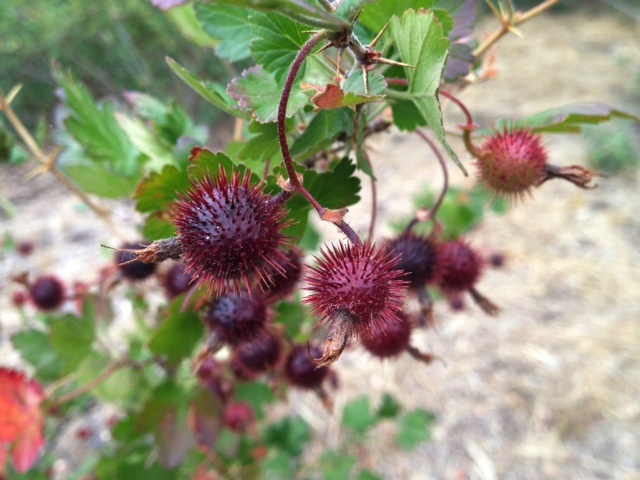
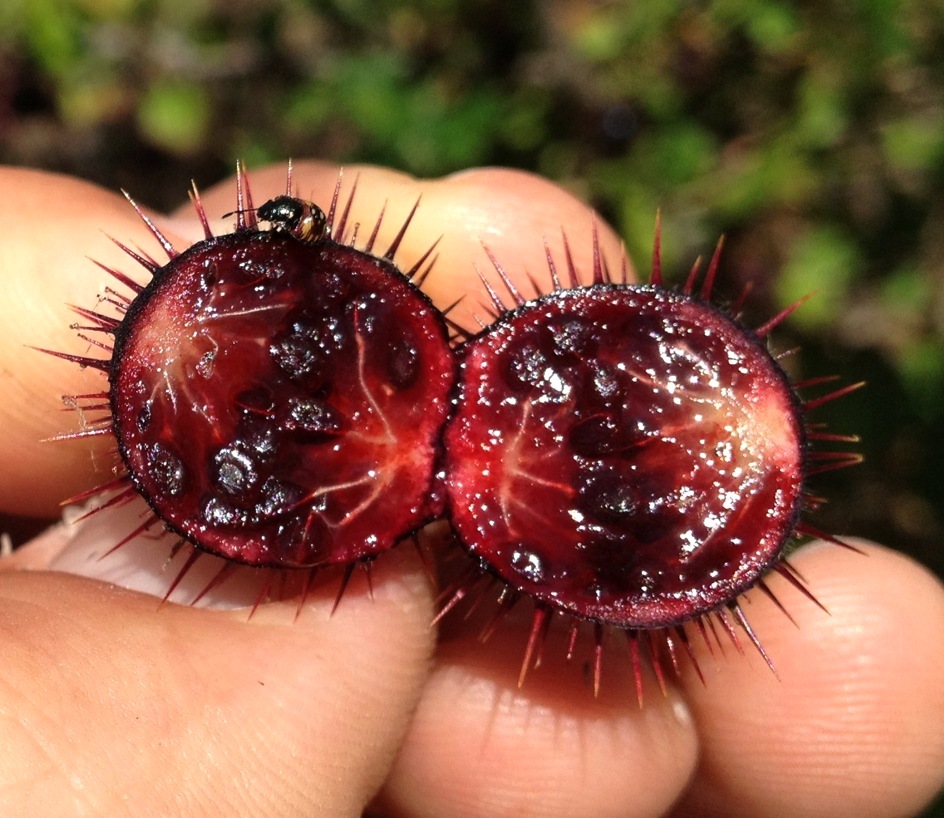
Not only were the gooseberries around Santa Barbara smaller, they were wrapped in an armored shell that bristled with an especially dense coating of evil looking spikes. I don’t think I’ve ever seen a meaner looking gooseberry than those found in the southern Los Padres National Forest.

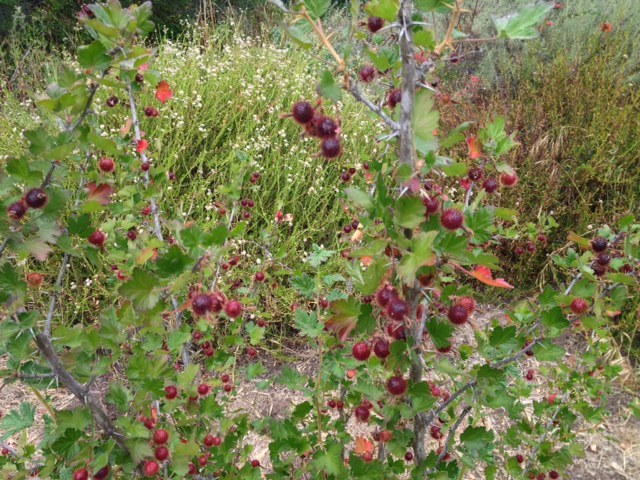
Gooseberries Santa Barbara Los Padres foraging wildcraftingGooseberries (Ribes menziesii) ripening in June in the Santa Ynez Mountains.

A person today may still possibly receive some mild medicinal relief from the bark of a willow tree. Then again, they could just crack the lid on an ibuprofen bottle and swallow a couple of pills.

Not all traditional wilderness knowledge is still relevant. I think, sometimes, that foraging around this here neck of the woods is an eccentric pursuit inspired by a romanticized view of the past.

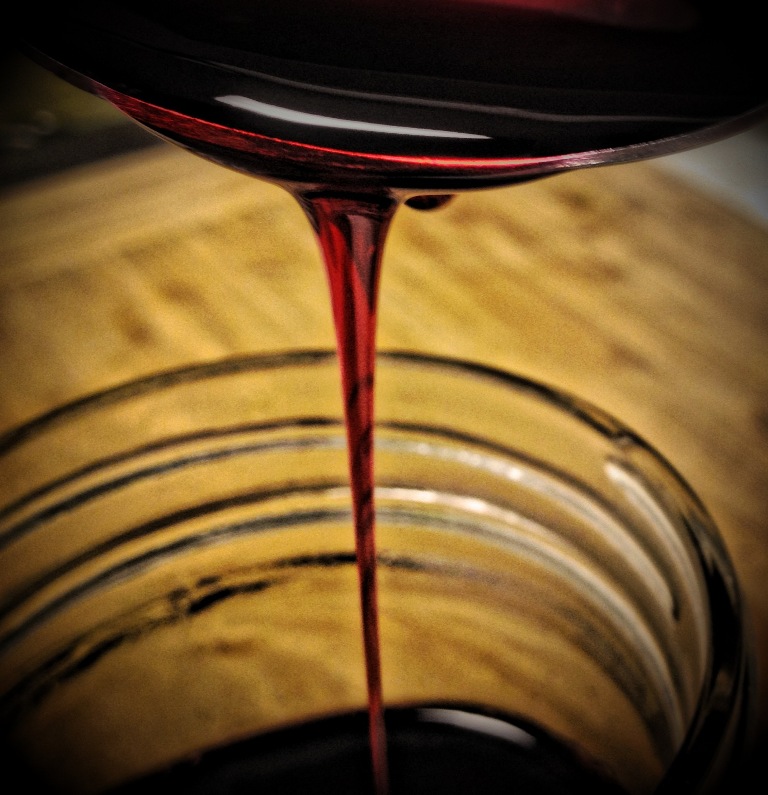
gooseberry syrup Los Padres Santa Ynez Mountains Santa Barbara

Wild gooseberry syrup.

Nowadays foraging is a leisure pursuit of the well-off rather than an existential necessity of hardscrabble times. It’s largely wisdom long since rendered obsolete by the march of civilization, but I like to think some of it’s worth hanging on to.

The Sisquoc River pioneers of Santa Barbara County would probably think it’s ludicrous to waste time and energy hiking into the woods to pick gooseberries, when today we have fully loaded supermarkets, refrigerated shelves stuffed with over-sized blueberries and gargantuan strawberries, and everything available on demand at all times of the year and most hours of the day.

Wild gooseberries, I think pioneers would say, are too much effort for too few calories to be of much worth nowadays. But if the value is found in rare flavor rather than generic nutritional density, then a good ol’ fashioned gooseberry harvest may still be worth while.

gooseberry Santa Barbara Hikes Los Padres National ForestGooseberries are rich in natural pectin which makes for exceptionally thick syrup and jelly without the need of added thickening agents.

Gooseberries are a sweet-tasting wild edible I like to eat right off the plant even though each berry doesn’t offer much. I introduced my children to them when they were only a few years old, and while the novelty of tasting a wild fruit in the woods was initially exciting, their enthusiasm quickly evaporated.

Gooseberries contain more spines and hard and bitter-tasting seeds than sweet juicy pulp. Having been raised on ridiculously large and sugary domesticated fruit, my kids clearly thought I was crazy and soon lost interest. Nearly everybody else has no interest either so they have plenty of company. There are certainly good reasons why very few people, effectively nobody, eat wild gooseberries around here.

There is yet, however, no supermarket substitute for the uncommon and complex depth of flavor these wickedly spiny little berries hold.

And in that deep burgundy, wild pure juice may be found a reservoir of traditional, natural wealth that perhaps has not been devalued and rendered obsolete by the 24/7 cornucopia of postmodern civilization.

Gooseberries Santa Barbara Los Padres Forest foraging
Related Posts:

blue elderberry wildcraft santa barbaraBlue Elderberry Wildcraft
Fire Roasted Yucca
Manzanita Flower Tea

Posted in Santa Barbara County | Tagged , , , , , , , , , | 11 Comments