Trout

I came across this trout the other day in a thin trickle of a backcountry crick. I’d estimate him to be about to eight inches long. He was keenly keeping to the shadowed portion of a tiny pool and every so often would circle out into the direct sunlight as if on patrol of his domain.

I’ve noticed over the years, through observation in different locations, that the largest fish in a little pool will tend every so often to assert itself among the smaller fish and chase them around.

I peered through the streamside tree branches for a while watching the interplay between him and the smaller trout, as they occasionally darted up to pluck insects from the water’s surface. When the little ones swam too quickly or too close he would chase them around for a second and then drift back to the shallow, shadowy edge of the stream.

Trout fry

Related Post:

Native Steelhead of Yore

Posted in Santa Barbara County | Tagged , , , , , , , , , | 3 Comments

Seven Falls

“The music of falling water comes at intervals upon the ear. The uneven trail winding around huge rocks, upon the edge of precipitous banks or plying through the slippery stones at the bottom of the creek, gives just enough elements of beauty, danger, grandeur and loneliness to make a ride here thoroughly enjoyable. Near the head of the canyon is what is known as ‘Seven Falls.’ The water here falls into seven stone basins in succession. The rocky banks are broadcast with delicate maiden hair ferns and are green with moss. This is a favorite resort. At the head of the canyon is a large rock over which the water leaps with considerable force in the rainy season. This fall can be seen from the city.”

—Geography of Santa Barbara, Francis W. Conrad (1889)

“How much farther do we have to go?” he said. Not, “. . .are we going,” or “. . .is it to the pool.” But “do we have to go.” It wasn’t asked out of sincere interest, but a complaint with a question mark on the end. Sort of like a kid in the backseat on a long drive pestering dad with “do we have to go?” and “are we there yet?” questions.

I had walked up behind the twenty-something year old guy and his lady friend right as I reached the most difficult section of the trail. For the previous ten minutes before his question I had stood around waiting as the agile young lady patiently coaxed and cajoled her friend up a steep slope of bedrock, and then across a near vertical sandstone wall above a pool of water about eight feet below. This was after he had already asked if they could stop hiking and just stay where they were.

She was leading him up the creek, and had hoisted herself up the first wall with little effort, and then with fluid ease systematically picked her way across the next section above the water. As her male companion slowly made his way along at a snail’s pace with far more difficulty, and serious reservations about continuing up the trail as he made abundantly clear, she praised every step he finally decided to take assuring him he was doing good.

An illustration looking up the same section of creek as shown in the previous photo, as originally published in the San Francisco Morning Call on February 03, 1895.

One of her other friends on a different occasion, she repeated several times, hadn’t been able to make it and turned back. I suppose such encouragement was her only hope of dragging this guy at least a little farther up a trail he obviously had no interest in hiking.

All the while the guy was griping about one thing after another. It was all in the peevish tone of his comments and questions, rather than outright complaints. He was whining. The wall-like section over the water he took at a painfully slow pace. It’s a one-person-at-a-time section of trail with small handholds chiseled out of the rock because of its steepness. Which left me standing around waiting patiently for my turn. I wasn’t in a hurry so the delay didn’t matter, but it was plenty long enough for me to get my fill of the guy’s whining.

After making it up and across the two steep slopes of bedrock he had asked the question he really didn’t want to hear the answer to. “How much farther do we have to go?”

“Uh,” she answered, “like thirty minutes more.” I suspect she would have made it in ten to fifteen minutes were she alone. By the guy’s reaction to her answer one might have thought she said thirty miles.

“Thirty minutes!” he repeated with shock and deep disappointment. “Well I’ll just stay here for thirty minutes,” he said. Uh, that would be an hour, I thought. Thirty up means thirty down and nevermind any time spent actually enjoying what she had hiked to see. And so much for her company. Slouch.

“Are you regretting it,” she asked.

“Yeah,” he admitted without hesitation.

After he crossed the section, I swung my way across the short, but steep rock face in less than ten seconds and continued on my way hopping from bedrock to boulder on up the creek.

Emerald pools

I don’t think badly about people that have less skill or experience in an activity than I have. Although I confess to sneering at hype and hyperbole when people exaggerate what they do. But I’ve been in plenty of situations where I was the person of lesser ability. And whatever I do there is always somebody that does it a lot better. I’m a man of mere average means.

But I have no tolerance for complainers.

Go ahead and say you are having a hard time doing something, having trouble or finding it difficult or even that you are not able to do it. Make the observation or let people know. Fine. No problem. I don’t expect people to remain utterly silent in the face of fear or discomfort until they keel over from exhaustion or plummet to their death on the rocks below. Even though I might act like that myself at times.

But don’t ever gripe about it! Mention it, sure, but don’t pester others with incessant complaints. Listening to the guy on the trail droning on and on I felt bad for the girl. Nothing like a whiner to ruin a good outing.

Looking downstream over the section of creek shown above.

A postcard of “Seven Falls, Mission Canyon” from the early twentieth century circa 1910. Mission Creek is shown here far more coniferous than I have ever known it to be in the nearly thirty years I have been hiking to Seven Falls. Although there are conifers on the mountain in the area, I never recall the creek being shrouded by so many of them even before the Jesusita Fire torched the canyon in 2009.

Upper Mission Canyon looking over the section where Seven Falls is located.

California newt (Taricha torosa)

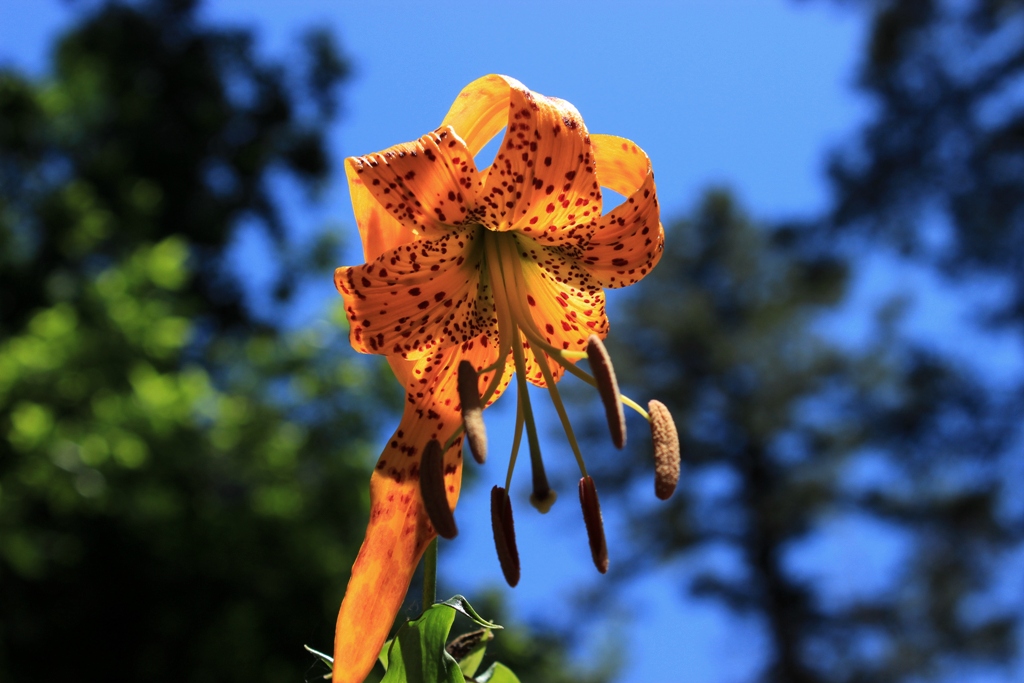
Humboldt Tiger Lily (Lilium humboldtii)

This bloom was on a clump of prickly pear paddle cactus that grows just above the top pool at Seven Falls. I believe it is a native cactus of genus Opuntia.

Related Post:

Mission Falls (Mission Falls is the waterfall mentioned but unnamed in the above opening quote from 1889: “At the head of the canyon is a large rock over which the water leaps with considerable force in the rainy season. This fall can be seen from the city.”)

Posted in Santa Barbara County | Tagged , , , , , , , , , , , , | 5 Comments

Mushroom Man Rock

The sentinel of West Camino Cielo Road in the Santa Ynez Mountains, Santa Barbara County.

Posted in Santa Barbara County | Tagged , , , , , , | 3 Comments

Pine Mountain and Zaca Lake Forest Reserve (1898)

Zaca Peak left of center, as seen from Figueroa Mountain on June 14, 1937. (credit: J.E. Patterson)

“As a result of his 1903 visit to California, Roosevelt was to create the Santa Barbara National Forest out of the Pine Mountain and Zaca Lake Forest Reserves. This was the land that McKinley had set aside on March 2, 1898. … later known as Los Padres National Forest.”

Walker A. Tompkins, The Yankee Barbarenos

The following article appeared in the Los Angeles Herald newspaper on September 25, 1898. It announces the establishment of the Pine Mountain and Zaca Lake Forest Reserve, which took place on March 2, 1898 by presidential proclamation. The new forest reserve stretched through Santa Barbara and Ventura Counties in California. It established what was, in part, the beginning of what today is known as the Los Padres National Forest.

President McKinley established the Pine Mountain and Zaca Lake Forest Reserve under the Forest Reserve Act of 1891, which allowed presidents to set aside protected tracts of land by proclamation. The mention in the L.A. Herald of the reserve being a “gift of Congress” was apparently erroneous or meant indirectly.

On December 22, 1903, the Pine Mountain and Zaca Lake Forest Reserve was combined with the Santa Ynez Forest Reserve (est. October 2, 1899) to create the Santa Barbara Forest Reserve. Over the next sixteen years, additional acreage taken from the existing reserves of Monterey, Pinnacles, San Gabriel, San Luis Obispo and San Luis was added to the Santa Barbara tract. The land was subsequently reclassified as a national forest, and on December 3, 1936, Santa Barbara National Forest was renamed the Los Padres National Forest by the executive order of President Franklin D. Roosevelt.

As conveyed in the article, such forest reserves were originally set aside with an emphasis on protecting crucial mountain watersheds in order to provide water for agriculture and human consumption. The reserves were intended to protect native flora, but only in so far as it was necessary to maintain the quality and availability of water. Certain passages in the story make it clear that the protection of native fauna was not a priority.

The black and white illustrations are original to the article as published, while the leading black and white photograph above, and the other color photographs, it should be obvious, have been added.

A U.S. Forest Service map from 1933 showing the Santa Barbara Forest.

THE NEW FOREST RESERVATION

Pine Mountain, Containing 1,666,000 Acres, Gift of Congress
to Southern California-Enormous Possibilities of the
AreaImportance of Forest Protection

Information is timely regarding that most recent and generous gift of congress to California, and Santa Barbara and Ventura counties. In particular, Pine mountain reservation, covering 1,666,000 acres.

So large is the area, and so wildly rugged, that the government found two
commissioners necessary: B. F. Crawshaw for Santa Barbara county and W. N. Slosson for Ventura county.

Originally Edgar B. Davison, H. H. Doyle (the present county clerk of Santa
Barbara county), Henry Robinson (editor of the Santa Ynez Argus), Mrs. Flora Haines Loughead and others suggested to Congressman McLachlan that Zaca lake and a few sections adjacent be set aside as a government reservation. Mr. McLachlan fathered the idea at Washington. Nothing further was done until Mr. Doyle formulated a petition
and Mrs. Loughead and others circulated it, obtaining many signatures. Thus revived, Mr. McLachlan’s successor, C. A. Barlow, took hold and amplified the bill to cover most of the mountainous part of Santa Barbara and Ventura countiesall in deed not hitherto preempted and settled. Mr. Barlow succeeded in pushing the measure to a successful goal and it became law de facto. Before this the magnificent pine forests were being rapidly destroyed. Mr. Davison’s articles in the country press had great influence in forming public opinion to be ready to support the petition.

Thus Pine mountain park was born. It is truly a magnificent reservation. The writer, listening in love of nature to her various language, has in past days often heard her curse the vandals who fired her forests, ranged stock over the uplands to the destruction of young tree growths, and stretched barbed-wire fences over miles of territory to restrain the public from travel.

Zaca Peak

I have stood in the valleys and seen Zaca peak, visible for forty miles, one vast blazing torch, lighting the big Santa Ynez valley the night through. It was an awful and a glorious sight, but saddening to the soul. Other peaks, indeed the whole range of pine-clad mountains, have similarly lit the night in that region and left but desolation behind. Yet miles and miles of untouched forest remain, and under government care will bless the slopes of the San Rafael and Santa Ynez mountains, preserving the priceless heritage of their bountiful watersheds to the valleys of Santa Barbara and Ventura counties.
In one thing this reservation is unique. From any of its high peaks, as San Rafael (4400 feet), for instance, one can turn from gazing eastward over a wilderness of stupendous crags and abysmal canyons and view the “Balboan sea.” Away to the northwest, across the intervening valleys of the Santa Ynez, Los Alamos, Santa Maria and others, Port Harford is visible, and beyond it cold ocean, blue-gray on the horizon. Thence southerly, down the coast to Point Conception, Lompoc, Gaviota landing, Santa Barbara (city) and below Ventura to the headlands on the Los Angeles county shores. All this lateral scenery. In the foreview loom the channel islands. From that high point the geological contention that these islands are but submerged spurs of the Coast Range mountains is easily realized.

Zaca Lake

In the spring these slopes and precipices are the Golden State’s own vernal glory. Change the view point to Zaca peak. Right at one’s feet seems to lie Zaca lake, as lovely a stretch of water as the California mountains hold. Away down, 1500 feet below the spectator, it lies, like a sapphire or dew-drop amidst the pines. The lake is not large, but the judicious expenditure of a couple of thousands of dollars on the cracks in the strata in the lower end of what is termed “the sink” would make it a body of water a mile and a half long, half or three quarters of a mile wide and perhaps one hundred and twenty feet deep. It now covers thirty acres, eighty feet deep. Such a body of water, apart from its being henceforth a popular resort for many hundreds of visitors, would be a natural reservoir whereby the five hundred square miles area of the Santa Ynez valley would be made to blossom as the rose. The lake, even now, undeveloped, is always overflowing into a small stream which runs some twelve miles down the canyon; and this, too, after our long season of drought.

Colonel Crawshaw, who has just returned from his first visit to the reserve and the lake, says truly that the park is one of the grandest scenic portions of this state, and compares it to the scenery of Switzerland. If the government will furnish a sufficient force of rangers, Commissioner Crawshaw will see that the reserve is protected from fires and depredators.
The reserve is an aggregation of terrific canyons, separated by unscalable mountain walls, and communicating with each other only at such long intervals as to make it a day’s journey, or even longer, to go from one to another. Such are the Manzana, Cachuma, Santa Cruz, Santa Ynez headwaters, etc. There are five of these vast gorges in Santa Barbara county and others in Ventura. A ranger is absolutely necessary for each of these larger canyons, in order to properly protect the watersheds from forest denudation by fire, stock rangers and wanton timber cutters.

No more excellent hunts of big game, such as mountain lion, bear, deer and like animals are to be found than these grand chasms. Lovers of nature can find in the remaining forests, and in the new forests the protected future will mature, more true recreation, better hunting and fishing, than elsewhere in the state, perhaps excepting the ranges of Northern California and those near the Nevada line. And this is all within forty or fifty miles of Santa Barbara city. Only this month George Owen killed seven big mountain lions on the reservation.

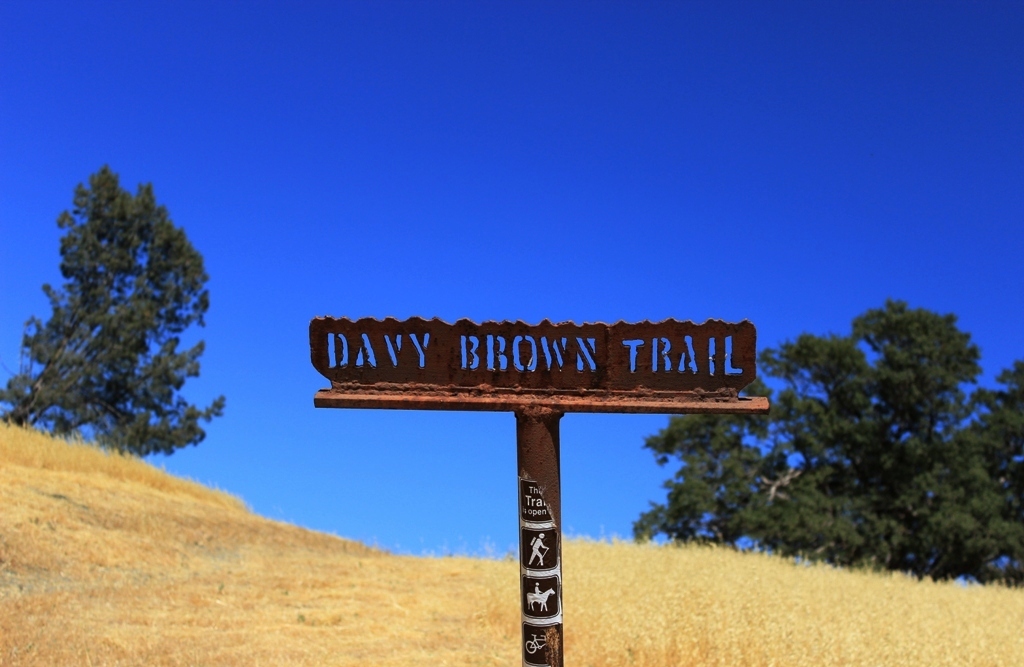
“Uncle Davy” Brown’s cabin, in the Manzana canyon, is one of the few traces of human life as yet to be found. Brown lived in that lonely gorge, twenty miles from anybody, nature’s child, and but little less rugged than his surroundings, for thirty years. He was 95 years old when at last he sought the valleys for care in his old age and at his death, which took place this year. Gentle as a woman, notwithstanding his ruggedness, kindly welcoming all freely to his home, “Uncle Davy” was a character loved by all who knew him.

The Hon. Benjamin F. Crawshaw, the first commissioner for the Santa Barbara district is a Pennsylvanian. He is an old newspaper man and an experienced official in the Interior department, having been there for twelve years. He has been a resident of the city of Washington for the past eighteen years. He is a lawyer, and has been admitted to practice before the United States supreme court. He is also an Odd Fellow of high degree, and in 1892-3 was grand master of the District of Columbia.

For the eastern half of the reservation Hon. Willis N. Slosson is commissioner. Mr. Slosson is a native of New York. In the fall of 1871 he moved to Kansas and eight years afterward to Michigan. He was a member of the Michigan legislature in 1889, and deputy collector of internal revenue under the Harrison administration, and sergeant-at-arms of the Michigan senate in 1895. He is a Knight Templar and thirty-second degree Mason. His headquarters are at Nordhoff, Ventura county [known today as the town of Ojai].

Edgar B. Davison, who has done as much as anyone else to procure the reserve for Californians, is a young man, a resident of Ballard, near the reserve. He is 29 years old, and has lived near or on the tract for fifteen years past. Pleasing to state is the fact that his zealous efforts to secure the state a splendid reserve have not been unrecognized at headquarters. Mr. Davison is now one of Commissioner Crawshaw’s assistants, and has his headquarters in Brown’s cabin, on the Little Manzana.

A pool on “the Little Manzana” or what is today known as Davy Brown Creek.

As showing how desperately necessary it has become for the government to use the most stringent measures, especially against fire-setters, on these reservations, the following is conclusive:

A dozen years ago water was abundant at definite levels in all wells throughout the Santa Ynez valley. The Santa Ynez river, rising in the reservation, ran 3000 inches in November. Today, vast fires having raged in the forests every year since, all wells have to be sunk ten feet deeper to reach water at all, and more feet to strike abundance, while the river is a mere brook long before November days bring lowest water.

Restoring the forests will bring again the old conditions, when, a hundred years ago, the old mission padres and their Indians tilled a valley full of streams and of forests. Today it is, by comparison, almost a desert. Plant the pines again; the spruce, the firwhich all grew there. Plant, fort low growths, the pepper, which thrives amazingly in those hills. Severe though the penalty for fire-setting be, it is not enough. A five-thousand-dollar fine sounds big. Irresponsibles who wantonly destroy forests are never able to pay a tenth part of that sum. Alternative punishment is only two years in prison. To many this sentence has small terror. I would suggest that those two years be put in by the criminal who, by carelessness, will fire a forest, at replanting the area ravaged, under guard of United States troops, a body of whom might well be on every reservation, subject to the rangers’ needs for extinguishing fires. Our forests are our wealth, more so than our mines, for agriculture is impossible without water, and water is not where forests are gone.

F. S. OLIVER.
Santa Barbara, September 22d.

Related Posts:

The Storied Life of Davy Brown

Davy Brown’s Cabin (1898)

John Muir Writes of Davy Brown

Camping out in California: Pine Mountain Narrative (1887)

Reference:

The National Forests of the United States (PDF), The Forest History Society

Posted in Santa Barbara County, Ventura County | Tagged , , , , , , , , , , , | 4 Comments

Buckeye Butterfly

A buckeye butterfly (Junonia coenia) on a coreopsis flower at the Santa Barbara Natural History Museum’s Butterflies Alive exhibit.

Posted in Santa Barbara | Tagged , , , , , | 2 Comments