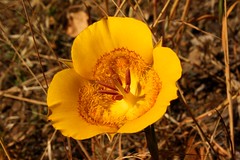
Wild mustard in bloom within the Ventura River Preserve.
I lay on my back aside El Nido Meadow, sprawled across a trailside bench in the dappled light filtering through the oak tree canopy. Staring up at a patch of blue sky framed by bushy green oak branches, I listen to the chorus of bird songs filling the shallow canyon, and watch the branches overhead bounce in the light afternoon breeze. My backpack and a water bottle sit at the foot of the bench.
A human voice interrupts the solitude. My attention is refocused on the voice as it slowly grows louder coming up the trail along the creek. I guess that it’s a small group of walkers out for a stroll before hearing the rhythmic clip-clop of horse hoofs on the packed dirt. I’m not paying attention to what is being said, but just listening to the approach of whoever it is loudly making their way up the trail toward me.
As the talkative lady approaches her words begin to register. She is telling her friend about her relationship with another person. I could have cared less, I wasn’t trying to listen with any interest, but it wasn’t like I could avoid hearing the conversation. Then she veers into quite an unsuspected, very personal topic.
“We have sex and it’s fun, you know,” she says having no idea that I’m laying on the bench within earshot. Whoa! I think, surprised at what I just heard before considering what was said. Well that doesn’t sound very convincing, I think. “It’s fun, you know” isn’t exactly a rave review.“He’s a really sexy dancer,” she adds trying to pad the guy’s extracurricular resume before continuing her previous thought. “But he just doesn’t have the drive.” Doh!Yep, somebody ain’t makin’ the cut.
“Oh! Hello there,” she says in surprise as she finally sees me. She wasn’t actually talking to me. It was more a nervous reaction than a greeting, like a feigned laugh in response to an uncomfortable question. “Well, he looks tired,” she continues and mutters something else to her friend as they pass by obviously embarrassed. I lay still continuing to look skyward, relaxed on the bench about fifteen feet from the trail, as if sleeping and they weren’t even there.
I thought of making a friendly comment to acknowledge the embarrassing yet somewhat comical situation, but refrained. I didn’t want to turn an already awkward moment into something bizarre, or even creepy, with a failed attempt at humor in my effort to ease the uncomfortable situation. I decided that a lone dude lying around in the woods rising from a bench to comment on two lady’s conversation about sex wasn’t a wise idea. A thought my wife confirmed as accurate later that afternoon when I recounted the story to her. I lay hidden in plain sight behind my sunglasses and hat as they passed on by and left me to continue my lounging. As their voices faded the canyon once more filled with bird song.
“Cabrillo’s description of the Chumash of the Santa Barbara mainland is the oldest ethnohistoric document concerning California Indians.”
—The Natural World of the California Indian, Robert F. Heizer & Albert B. Elsasser, University of California Press (1980)
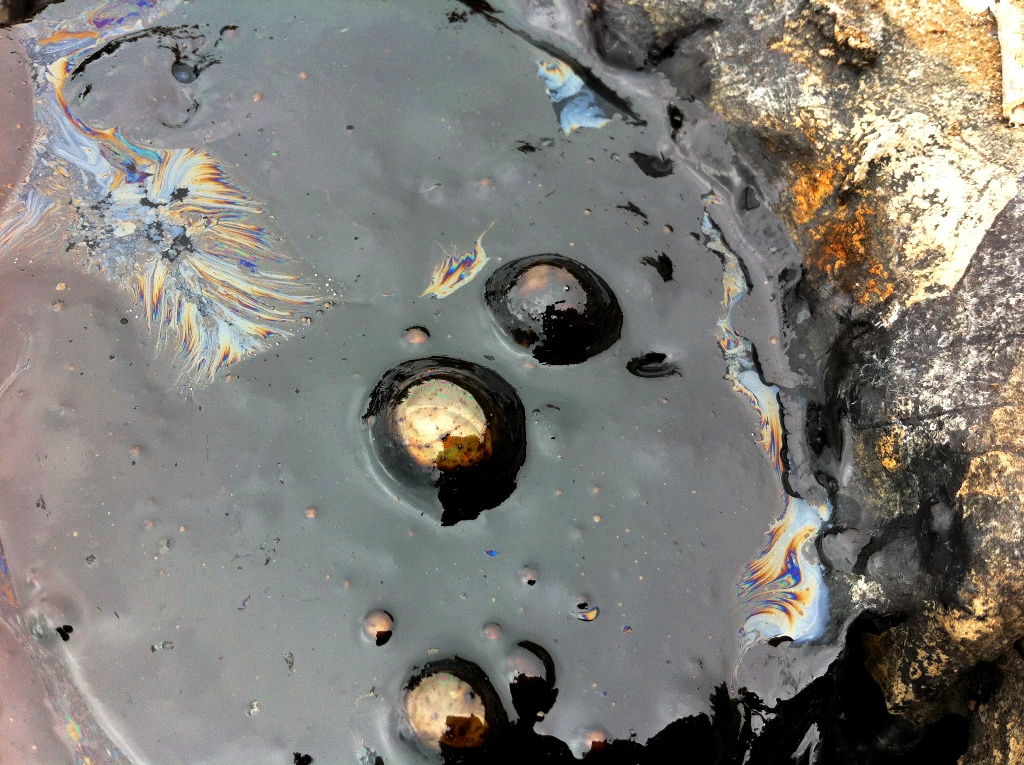
Naturally occurring oil seeps have long been a defining feature of Santa Barbara County. In numerous locations, both on land and at sea, crude oil, or asphaltum, naturally oozes from the earth.
Being born in Santa Barbara, and spending a significant amount of time at various local beaches throughout my childhood, I grew to love the endemic fragrance of crude oil wafting in the beach breeze. Similar to a 21 year old that drinks themselves into a sickly stupor on their birthday, and for weeks afterwards cringes at the smell of alcohol, the scent of raw crude oil triggers vivid memories for me. But pleasant feelings rather than stomach turning repulsion.
As one might sniff a flower for its pleasing aroma, I love the sweet smell of crude oil. After travels through foreign lands, when I return to the California coast and catch its odor in the wind, I know I’m home.
Archaeological evidence indicates humans first began using oil from natural seeps in the Santa Barbara area around 5000 B.C. Several early Spanish explorers recorded numerous entries in their diaries about oil seeps, and their use by Chumash Indians in California.
A wood plank Chumash canoe, or “tomol,” caulked with a mix of pine pitch and asphaltum, called “yop” in their native language. The canoe was built in 1912 under the direction of 73 year old Fernando Librado Kitsepawit (b. 1839-1915),the last full-blooded island Chumash. The canoe is displayed at the Santa Barbara Natural History Museum.
In 1775, Spanish soldier Pedro Fages wrote of seeing asphaltum springs while exploring California. In San Luis Obispo County, near the old Spanish mission, he noted “as many as eight springs of a bitumen or thick black resin that the Indians call chapopote; it is used chiefly by them for caulking their small watercraft and tarring the vases and pitchers the women make for holding water.” Fages described the wood plank canoes built by the Chumash natives as being “. . .well joined and caulked, and of quite graceful lines.”
In 1772, the Spanish expedition through California led by Juan Bautista De Anza came across asphaltum oozing out of the ground and flowing into the ocean. Friar Pedro Font wrote of seeing “a good-sized spring of asphalt” near the base of what is today known as Conejo Grade along US freeway 101 in Ventura County. He also commented on the craftsmanship of Chumash plank canoes:
“They are very carefully made of several planks, which they work with no other tools than their shells and flints. They join them at the seams by sewing them with very strong thread and fit the joints with pitch by which they are made very strong and secure.”
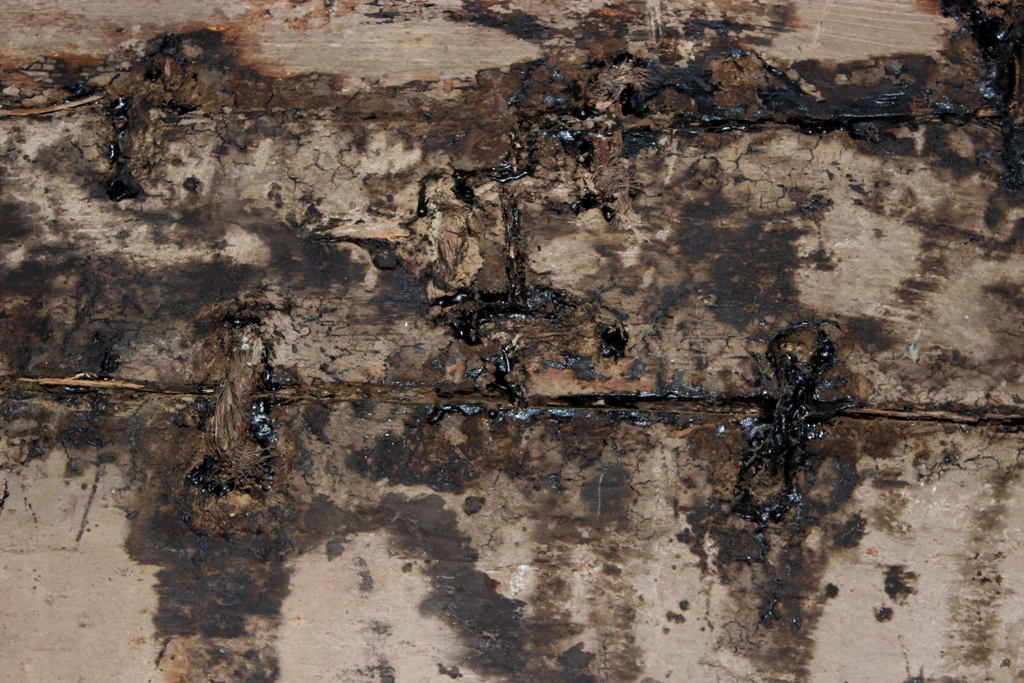
A close up view of the asphaltum and plant fiber used to seal and caulk the Chumash wood plank canoe at the Santa Barbara Natural History Museum.Oil stained stone caulking tools used by the Chumash in the crafting of canoes. The wood planks were hewed with stone adzes and sanded with shark skin.
Historical marker in Carpinteria, California at a towering, old sycamore tree a short walk from the oil seep featured in the video below.
In 1769, Spanish explorer Gaspar de Portola witnessed Chumash Indian craftsmen building canoes near their village Mishopshnow. The soldiers of his expedition named the village La Carpinteria or the Carpenter Shop. Today the small seaside town 10 miles southeast of Santa Barbara is still called Carpinteria.
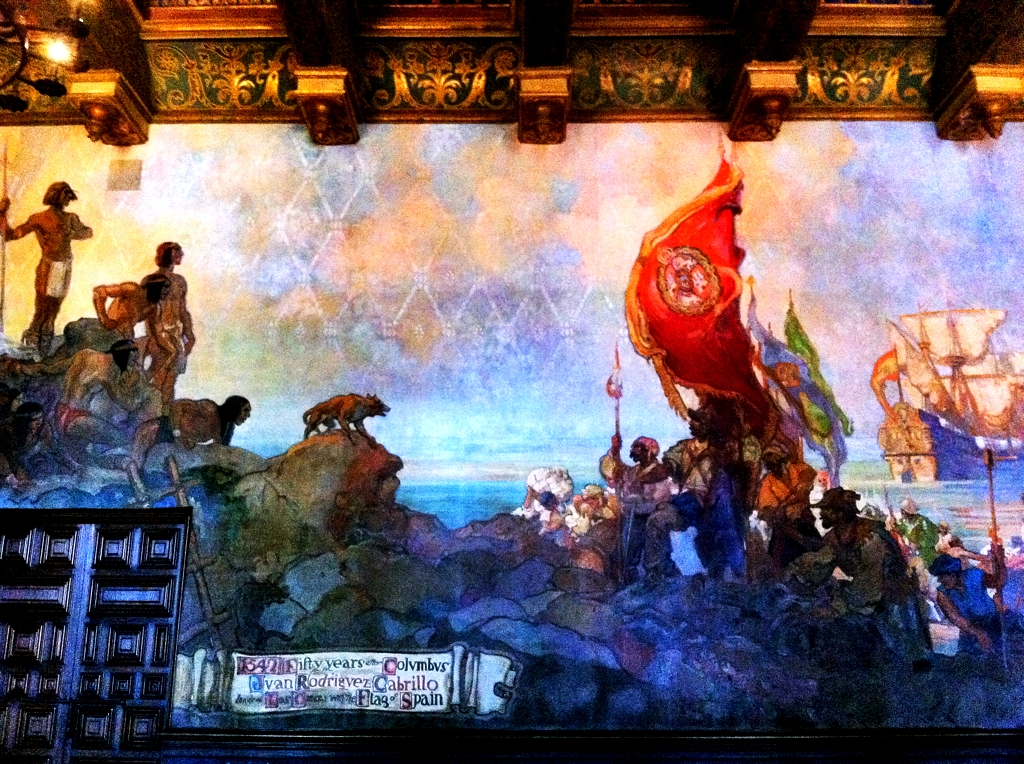
A mural depicting Cabrillo meeting the Chumash, as seen inside the Santa Barbara courthouse.
Some two hundred years earlier, Portuguese explorer Juan Rodriguez Cabrillo, sailing under the Spanish Crown, had recorded a similar account of the Chumash building canoes at the village of Mishopshnow. In 1542, the expedition he led witnessed the Indians using asphaltum from nearby seeps to caulk their canoes, and Cabrillo subsequently used it himself for similar purposes on two of his caravels.
In addition to using asphaltum for sealing their seagoing canoes, the Chumash used the naturally occurring crude oil for a wide variety of decorative and practical purposes. The black viscous substance was used to waterproof water jugs made from plants and to make basket hopper mortars, whereby a bottomless basket was attached to a stone mortar base using asphaltum.
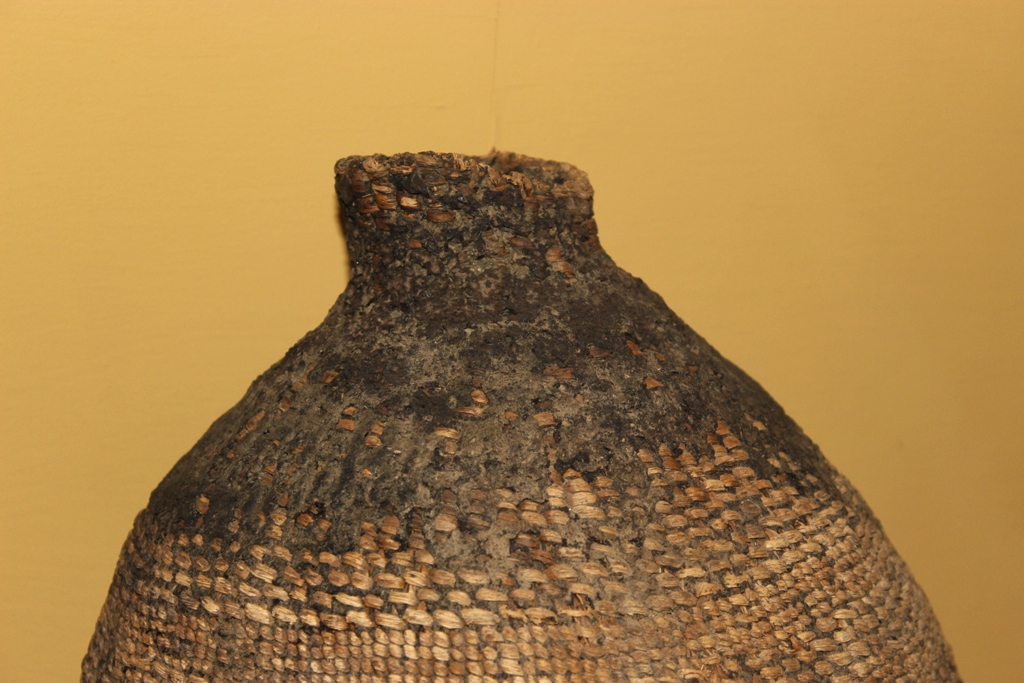
Asphaltum sealed Chumash water bottle on display at the Santa Barbara Natural History Museum.
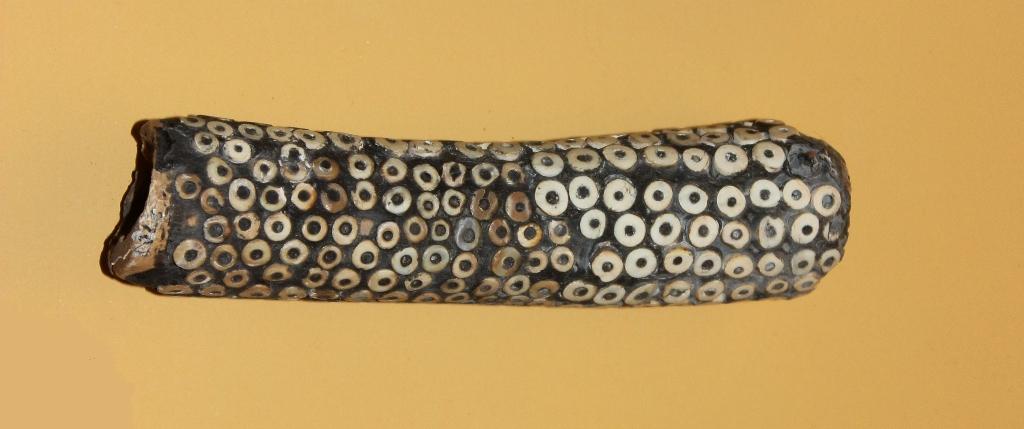
Beads made of shell glued to animal bone using asphaltum.
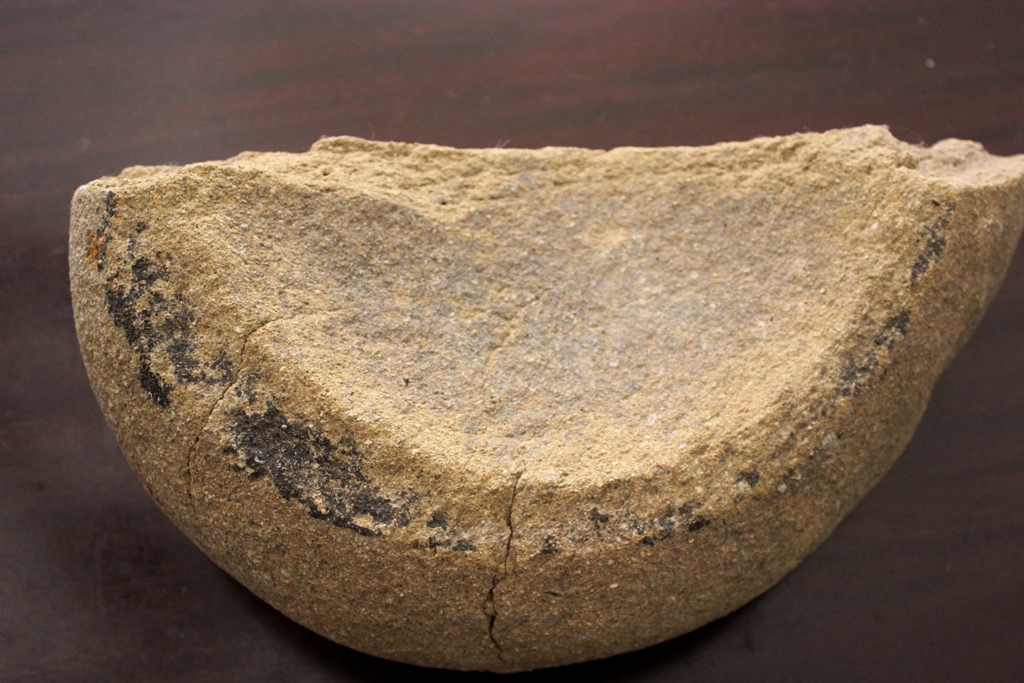
A remnant half of a basket hopper mortar with the faint black stain of asphaltum still visible around its edge.
At Carpinteria State Beach, a few minutes walk from the historic location of Mishopshnow, oil flows freely from the ground and onto the seashore. Long after the Chumash first collected the asphaltum, Americans began recovering it from the same deposits and used it to pave some of the first streets in San Francisco and Santa Barbara. The same sort of crude oil springs once used by the Chumash to waterproof their renowned tomols and later to develop American cities can still be seen today.
“Two or more people disturb the ecologic complex of an area. I had to go alone and I had to be self-contained, a kind of casual turtle carrying his house on his back.”
—John Steinbeck Travels with Charlie In Search of America
There are three partners whose character is all the same. Not that they don’t enjoy a good hike with a fellow friend, because they do, but at the same time, they are each other’s own best company when out on the trail.
They never have to wonder or concern themselves with whether or not they should keep hiking long hard miles, or slow the pace to a crawl, or stop for hours just to observe nature or to daydream; or should they hike up that creek or down another; or should they expend energy and time hiking over to investigate an interesting rock formation or not. The answer to any of these questions for all of them is inevitably yes.
When out on the trail there is never a distraction from the keen observation of their surroundings and the natural world around them. As such they are far more likely to see things that would, in the company of one or more other people, be overlooked, missed or simply not pondered.
Their attention is entirely focused on the environment through which they pass making for a sensory experience not likely possible should they be accompanied by anybody else.
“He may be just a tramp, a guy that likes to roam about this great country without any special aim, just to thank the Lord for these beautiful mountains.”
-B. Traven, The Treasure of the Sierra Madre
“. . .here, where there are still the silences and the loneliness of the earth before man, . . .”

 A buckeye butterfly (Junonia coenia) on a coreopsis flower at the Santa Barbara Natural History Museum’s Butterflies Alive exhibit.
















 Jack Elliott's Santa Barbara Adventure