“I’m gonna fill this whole thing,” I cried leaping into the air. A thin sliver of moon glowed in the star speckled canvas overhead, as I tromped down the road in my Halloween costume with my friend Matt. We set out in the cool fall night with pillow cases eager to collect our loot, but it wasn’t long before we noticed trouble makers were out and our cheerful mood was dampened.
“I hope nobody smashes my pumpkin,” Matt said, as we walked by the remains of several splattered jack-o’-lanterns.
“My dad put ours in the front window,” I said. “Last year Brody smashed our pumpkins all over the driveway.”
“How did you know it was him?” Matt asked.
“I thought it was him,” I said. “He lives around the corner and teases me every time he sees me. Then one day at school he said he would smash my lunch like he smashed my pumpkins if I didn’t give him my bag of cookies.”
“Hope we don’t see him tonight,” Matt said.
“I know.” The excitement of trick or treating vanished. I felt my stomach clench into a knot. “My dad told me if I stand up to Brody he will leave me alone.”
“You gonna fight him?” Matt asked.
I could sense the concern in his voice. “No.”
“He punched a kid on the playground the other day,” Matt said.
“Yeah. I know.”
“You’re lucky he didn’t punch you for the cookies,” Matt said.
“He didn’t have to.” The quiet of the darkened neighborhood seemed to press in on me making it harder to breath. “I. . .” The words caught in my throat and trailed off into a second of silence as I turned my head away, my chin drawn tight against my shoulder. “I gave ’em to him,” I said, a slight vibration trembling through my bottom lip.
I felt better as we passed by other kids laughing and having fun. We made our way from house to house and our bags began to bulge with candy, our excitement returning with each grab from the candy dish offered by neighbors with big smiles. It wasn’t long before our pillow cases were loaded down and we slung them over our shoulders to head home.
“I must have twenty pounds of candy!” Matt said, letting his bag drop to the ground with a crinkly sounding thud and a big cheesy grin.
“It’s like a sack of bricks,” I said, swinging my pillow case around like an Olympic athlete training for the hammer throw.
“Well isn’t that cute.” Brody’s voice shot through my chest like tiny red hot needles. “Little smelly butt crack Elliott and his dorky friend Matt the moron.” The inflection of his voice on the last word made it sound as if his jaw was wired shut, the em forced through his lips like an oversized shirt through too small a wringer.
My dad’s advice echoed in my head. “My name is Jack,” I said. I tried to act brave, but felt puny.
“Whatever you say, butt crack. I bet you have lots of candy for me.”
“Just leave us alone,” I said. It was more of a plea than a demand.
“You wish. How about I take your candy instead?”
“No!” I snapped. My mouth seemed to act on its own. My cheeks flushed with blood and felt hot and I stood stiffly feeling the sweat bubble up on my forehead.
Brody lunged. He grabbed my bag just beneath my hand and yanked it side to side.
“Hold on, Jack,” Matt yelled from behind me.
Matt’s support gave me a burst of confidence and I pulled with all my might. My bag flew back against my chest and I stumbled backwards a few steps, as Brody fell on his butt. I ran down the street as fast as my short legs would carry me and darted into a driveway behind a hedge next to some garbage cans. My chest heaved like a bellows sucking air as I gasped for breath. I thought I heard movement, something other than the rapid pulse of blood pounding in my ears. I peered around the hedge and on the other side of a parked car I saw a silhouette. A wave of cool relief rippled through me at the sight of my friend.
“Matt,” I whispered in a breathless voice. “I’m over here. Where’s Brody?” I walked out from behind the hedge slightly hunched over.
“Thought you escaped, huh?” Brody asked.
I froze. My mind went blank. What now? I was cornered. And I was alone.
“Hand it over,” he said. The syllables flowed with restrained force from his unmoving mouth, slowly and evenly. I stood there. “I said hand it over fatso!”
Matt appeared in the background in the faint orange glow coming from the street light down the road. “This is my candy.” I felt better knowing I was no longer alone, but also dreaded the thought of being humiliated in front of my friend. “I’m not giving it to you.” I couldn’t imagine losing so much candy.
Brody spat his words at me from under a curled lip. “Then I’ll just have to beat you up and take it.”
“No.” I said, and turned sideways holding my bag away from him.
“What the fuck you just say?”
My mind fluttered searching for an escape; something; anything. His curse intensified an already frantic and tense situation. There was no more running this time. The feeling of having given in to his demands at school was unbearable. This time it would be worse. Matt was watching.
“You may be bigger than me, but there are two of us,” I said. Brody looked over his shoulder toward Matt’s lanky figure standing off in the shadows. He looked back at me.
“Well. I’ll let you go this time,” Brody said. “I don’t really feel like candy right now anyway.” The venomous edge to his voice had vanished. “I’m going to smash more pumpkins,” he said and stormed off.
I felt drained, as if I had run a marathon and taken a math test all at once. Matt traipsed over. “You stood up to him,” he said, his voice tinged with awe and surprise.
“Yeah. Yeah, I guess I did,” I said. “Come on. Let’s get home and count our candy.”


 Gem-studded puffball mushrooms grow in a wide variety of areas throughout Santa Barbara County. The specimens pictured here were growing trailside at the edge of dense stands of chaparral. Unlike the sort of giant puffballs I have found in Oregon, which can reach the size of a soccer ball, this particular variety remains much smaller, tending to be no larger than one to two inches in diameter.
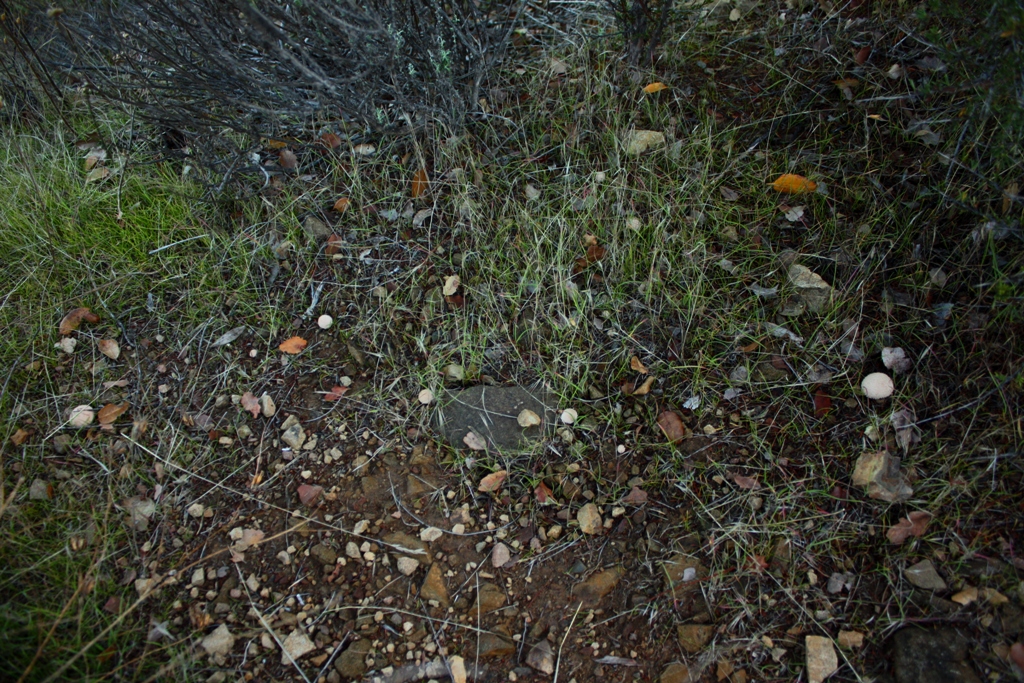 There are least 10 gem-studded puffballs in this photo.
 This bedrock mortar made by Chumash Indians is located along San Roque Creek above Stevens Park, about 1/5 of a mile upstream from the Foothill Road bridge which spans the canyon.











 Jack Elliott's Santa Barbara Adventure