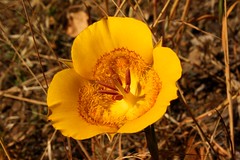
Rocky Peak Park, Santa Susana Mountains

The bedrock plated, boulder strewn hills of Rocky Peak northeast of Simi Valley are made of the Chatsworth Formation, a 6000 foot thick sandstone deposit formed at the bottom of the ocean at the time of the dinosaurs.

The sand that makes up the rocks of today was washed off mountain slopes 70 to 75 million years ago during the late Cretaceous period. Rivers carried the sediment to the ocean and currents pushed it offshore. It settled to the sea floor accumulating in delta-like fans in submarine canyons thousands of feet deep and it was these deposits that fused into stone creating the Chatsworth Formation. Shifting climates, sea levels and fault lines would eventually leave the sandstone high and dry and form new mountains.

Over the last several million years a bend has developed in the San Andreas fault, which has forced the Pacific Plate and the Continental Plate to collide into each other, in addition to sliding past one another. The resulting compression has rippled the land south of the fault in Southern California and formed a series of hills and valleys or anticlines and synclines. Simi Valley, for example, is located in a syncline while nearby Big Mountain Ridge is an anticline.

The tectonic folding of earth’s crust from the pressure of the bending fault line fractured the Chatsworth Formation and thrust it skyward, where it weathered into the tan- and pink-tinged rocks of today. The busted up formation is riddled with caves, overhangs and tunnels providing hikers with the opportunity for hours of recreation exploring the range.

Here I am poking my way through one of the many tunnels in the sandstone. During periods of heavy rain, runoff flows through this channel. In other areas seasonal runnels appear and disappear falling into underground caves.

Along the west end of the Hummingbird Trail, in a section that crosses through a convenient gap in a prominent outcrop, there is a remarkably long cave that is about 100 feet long. Scrambling through the hollow is akin to what an ant must feel like crawling through a deep crack in a sidewalk, where a tree root has split and uplifted the slab. The sequence of photos below shows the cave as I made my way through from one end to the other.

Looking back at the entrance.

Looking down the throat of the cave from the same spot as the last photo.

Looking back at the entrance on the left, as seen from a little further down.

Continuing down the cave.

A shot of me.

The bottom exit hole on the right.

What that exit looks like from the outside. The lower opening of the cave seen here as the darkened area at the bottom center of the photo.

Looking over the giant crack in the sandstone plate where the cave is located.

Bibliography:

Patricia Havens, Simi Valley: A Journey Through Time (1997)

Posted in Ventura County | Tagged , , , , , | 1 Comment

Freediving For Spiny Lobster

We’re in the midst of the frantic first four days of lobster season. Those initial 96 hours when recreational fishermen get a jump on the commercial trappers. And, in my experience, piss off a few of them by taking what they would have trapped.

Commercial fishermen are legally allowed to set out their unbaited traps prior to opening day. This provides a convenient trail of markers all along the coastline showing recreational divers and hoopnetters exactly where the hot spots are located. That is if’n you don’t know where to hunt already.

I spent some time freediving yesterday afternoon on the high tide combing the reef for bugs. I didn’t stay out too long. Just enough time to grab a couple of lobsters and one rock crab for me and the ‘ol lady’s dinner last night.

The first zone I checked was really murky, almost muddy looking. So I moved on to the next spot. Two bottle divers were suiting up when I got there. Doh! I was actually surprised that there were only two cars parked, but it’s a popular spot, and I figured it was probably combed hard on Saturday and I didn’t want to deal with competing with SCUBA divers already on their way out. I moved on to the next spot, but again decided against it due to murky conditions.

I settled on my fourth choice, although a dive boat was already out with four heads in the water. I stood watching the boat and contemplating my options, which were rapidly dwindling. I decided that, although the boat was working a specific area I wanted to dive, the overall hunting grounds were large enough that I felt I stood a decent chance. I suited up as fast as possible and was on my way into the water when the boat began motoring over in my direction. Great. Fortunately, the boat went on by and left me my own area to work while they jumped in a few hundred yards down the beach. I spent the next two hours in the water and managed to bring home some grub.

I boiled up some butter or “ghee” as a dipping sauce. If you’ve never tried ghee you’ve been missing out. It is far tastier than regular hot drawn butter!

Related Posts:

19 Inch Halibut

27 Inch Halibut

48 Pound White Seabass

Posted in Santa Barbara | Tagged , , , , | 2 Comments

Laguna Blanca Lake

Laguna Blanca lake surrounded by the sprawling green fairways of La Cumbre Country Club.

The shifting of earth’s crust along nearby fault lines created the depression known as Laguna Blanca Basin in Hope Ranch, an unincorporated suburb in Santa Barbara County. Tectonic movement also rerouted the course of the creek that once ran through the area from the north, as well as blocked the basin’s southward flowing drainage outlet to the Pacific Ocean. The end result was a low spot that filled with water creating a natural pond.

Some time long ago, either Cieneguitas Creek or Arroyo Burro Creek flowed through the Laguna Blanca area and cut a gorge through the hills and into the ocean at Hope Ranch Beach (see map below). Movement along the More Ranch Fault eventually deflected the stream’s course, either west if it was Cieneguitas or east if Arroyo Burro, and left behind a stream cut and wind gap leading to the sea. Uplift along Lavigia Fault blocked further outflow from the basin and created a dam of raised land behind which formed Laguna Blanca.

Historically, though natural, the lake appeared periodically based on the vagaries of weather and the amount of seasonal rainfall. The water level would rise and fall, the pond fill and evaporate. When it went dry the lake bottom crusted over in a layer of hard mineral evaporite and turned white. This may be the origin of the Spanish place name “Laguna Blanca” or “White Lake.”

A standout feature of the landscape, the wetland habitat has long lured wildlife to its shores, as well as some of the region’s earliest people. To the Chumash Indians the pond was known as “Chaco” or lake-without-a-mouth.  A few miles away, in an area now defined by Modoc Road, Hollister Avenue and El Sueno Road, an Indian village was located when the Spanish explored the area in 1769. The Indians became known as the Cieneguitas Indians due to their village location near the swampy marsh land or, in Spanish, the “cieneguitas.” Early reports about Laguna Blanca, prior to it being artificially filled year round, tell of arrowheads being found on the flats when the lake went dry.

The American development of Hope Ranch started in earnest around the last decade of the nineteenth century. Laguna Blanca became the centerpiece of the exclusive neighborhood that took shape, but the region’s drought cycles continued to ensure that the pond occasionally went dry turning an oasis into an eyesore. In order to keep it filled a horizontal well was bored into the upper reaches of San Roque Canyon in the Santa Ynez Mountains.

Fresh spring water flowed to the pond through an eight-inch pipeline, but by the 1960s the artesian artery had deteriorated and was abandoned. A new well was subsequently drilled near Modoc Road as a replacement source to permanently sustain the lake. Although in the interest of water conservation the small lake has subsequently been allowed to go dry during droughts.

Today Laguna Blanca serves as the focal point of La Cumbre Country Club. While the surrounding landscape has been forever altered beyond recognition from its past, the lake remains an attestation to the area’s natural history.

A map showing the locations of Laguna Blanca and surrounding geological features. The red lines show the courses of Cieneguitas Creek on the left and Arroyo Burro on the right with the center red line being the old drainage channel from the lake to the sea. The fault line locations in purple are rough approximations.

As an historical aside of a different type: The map bears the label “Las Positas y La Calera” over the land of what is today Hope Ranch. The name reflects the historical legacy of the area, which was deeded as land grants by the Mexican government in the nineteenth century. The Las Positas Rancho was one of the last land grants issued by Mexico before California fell under American ownership following the Mexican War (1846-48). Las Positas was named for the numerous pools found around Veronica Springs, which is labeled on the lower right-hand corner of the map. The La Calera Rancho was named after the old lime kiln built by Franciscans in their construction of the Santa Barbara Mission. The kiln was located south of Laguna Blanca, east of Laguna Blanca School and alongside Las Palmas Drive.

Bibliography:

Robert M. Norris, The Geology and Landscape of Santa Barbara County, California and Its Offshore Islands (2003).

Walker A. Tompkins, Santa Barbara Neighborhoods (1989).

Posted in Santa Barbara | Tagged , , , , , | Leave a comment

Santa Barbara Seen Through A Sailor’s Eyes (1835)

A drawing of Santa Barbara in 1839 from Alfred Robinson's book, "Life in California."

In the following passage taken from his acclaimed travel narrative, Two Years Before the Mast (1841), Richard Henry Dana, Jr. describes landing on the beach at Santa Barbara on January 14, 1835 after a five month voyage from Boston.

Dana was a Harvard scholar and a lawyer that shipped off as a common seaman on the brig Pilgrim, whereupon he worked along the California coast for two years loading cattle hides aboard the ship for transport to market.

He is commonly remembered today as the author of the aforementioned memoir and the namesake of Dana Point, California. In the excerpt below he relates an early view of Santa Barbara and its surroundings. The text has been edited to include Santa Barbara specific references and the lengthy paragraphs broken up.

“We came to anchor in the spacious bay of Santa Barbara, after a voyage of one hundred and fifty days from Boston. . . . The captain’s orders from home were to put in at Santa Barbara, the central port of the coast, and wait there for the agent, who transacts all the business for the firm to which our vessel belonged.

The bay, or, as it was commonly called, the canal of Santa Barbara, is very large, being formed by the main land on one side (between Point Conception on the north and Point Santa Buenaventura on the south), which here bends in like a crescent, and by three large islands opposite to it and at the distance of some twenty miles.

These points are just sufficient to give it the name of a bay, while at the same time it is so large and so much exposed to the southeast and northwest winds, that it is little better than an open roadstead; and the whole swell of the Pacific Ocean rolls in here before a southeaster, and breaks with so heavy a surf in the shallow waters, that it is highly dangerous to lie near in to the shore during the southeaster season, that is, between the months of November and April. …

.It was a beautiful day, and so warm that we wore straw hats, duck trousers, and all the summer gear. As this was midwinter, it spoke well for the climate; and we afterwards found that the thermometer never fell to the freezing point throughout the winter, and that there was very little difference between the seasons, except that during a long period of rainy and southeasterly weather, thick clothes were not uncomfortable.

The large bay lay about us, nearly smooth, as there was hardly a breath of wind stirring, though the boat’s crew who went ashore told us that the long groundswell broke into a heavy surf on the beach. There was only one vessel in the port—a long, sharp brig of about three hundred tons, with raking masts, and very square yards, and English colors at her peak. … She was a fast sailer, as we frequently afterwards saw, and had a crew of Sandwich-Islanders on board.

Beside the vessel, there was no object to break the surface of the bay. Two points ran out as the horns of the crescent, one of which– the one to the westward– was low and sandy, and is that to which vessels are obliged to give a wide berth when running out for a southeaster; the other is high, bold, and well wooded, and has a mission upon it, called Santa Buenaventura, from which the point is named.

In the middle of this crescent, directly opposite the anchoring ground, lie the mission and town of Santa Barbara, on a low plain, but little above the level of the sea, covered with grass, though entirely without trees, and surrounded on three sides by an amphitheater of mountains, which slant off to the distance of fifteen or twenty miles.

The mission stands a little back of the town, and is a large building, or rather a collection of buildings, in the center of which is a high tower, with a belfry of five bells. The whole, being plastered, makes quite a show at a distance, and is the mark by which vessels come to anchor.

The town lies a little nearer to the beach — about half a mile from it — and is composed of one-story houses built of sun-baked clay, or adobe, some of them whitewashed, with red tiles on the roof. I should judge that there was about a hundred of them; and in the midst of them stands the Presidio, or fort, built of the same materials, and apparently but little stronger.

The town is finely situated, with a bay in front, and an amphitheater of hills behind. The only thing which diminishes its beauty is, that the hills have no large trees upon them, they having been all burnt by a great fire which swept them off about a dozen years ago, and they had not yet grown again. The fire was described to me by an inhabitant, as having been a very terrible and magnificent sight. The air of the whole valley was so heated that the people were obliged to leave the town and take up their quarters for several days upon the beach.

Just before sundown, the mate ordered a boat’s crew ashore, and I went as one of the number. We passed under the stern of the English brig, and had a long pull ashore. I shall never forget the impression which our first landing on the beach of California made upon me. The sun had just gone down; it was getting dusky; the damp night wind was beginning to blow, and the heavy swell of the Pacific was setting in, and breaking in loud and high ‘combers’ on the beach. …

We put our oars in the boat, and, leaving one to watch it, walked about the beach to see what we could of the place. The beach is nearly a mile in length between the two points, and of smooth sand. We had taken the only good landing-place, which is in the middle, it being more stony toward the ends. It is about twenty yards in width from high-water mark to a slight bank at which the soil begins, and so hard that it is a favorite place for running horses.

It was growing dark, so that we could just distinguish the dim outlines of the two vessels in the offing; and the great seas were rolling in regular lines, growing larger and larger as they approached the shore, and hanging over the beach upon which they were to break, when their tops would curl over and turn white with foam, and, being at one extreme of the line, break rapidly to the other, as a child’s long card house falls when a card is knocked down at one end.”

Another illustration of Santa Barbara from Robinson's "Life in California."

Posted in Santa Barbara | Tagged , , , | Leave a comment

Paleopit

In deep west of the Good Land.

Pipe cleaner shot from the beanie cam.

Posted in Santa Barbara | Tagged , , , , , , | 2 Comments