Big Bummer At Baron Ranch: Trashing the Place To Save It

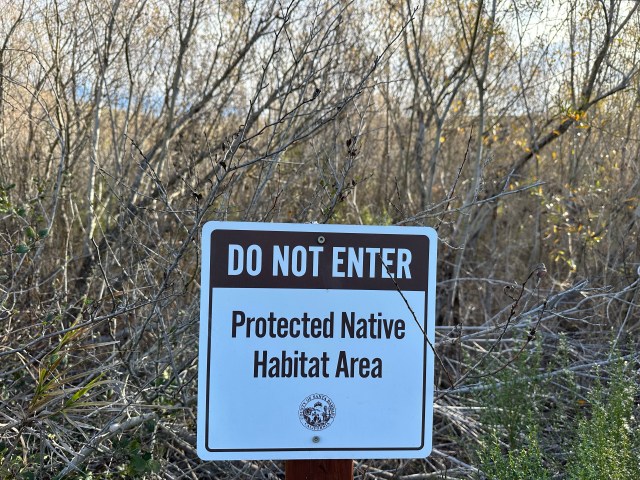
Yikes. Alright already, sheesh. A wall of nearly impenetrable willow needs no sign. Nobody is going in there.

And we destroy everything we can find
And tomorrow when the human clock stops and the world stops ticking
We’ll be an index fossil buried in our own debris

–Bad Religion Part IV (The Index Fossil)

Buried in signs. Automatic Man strikes again.

They’re ruining the place to save it at Baron Ranch Preserve.

Like they ruined the spring at San Marcos Preserve to protect it.

The actions of leading officials and their subcontractors appear terribly insensitive and lacking in critical thought, and exhibit no creative or pragmatic vision for the future.

They unnecessarily patronize and perpetuate existing economic systems of heavy industry and the resultant downstream ideas of heavy development, which are parts of the larger problem at issue that we need to reduce and strive to wind down.

This is a public disservice and the wrong road to take leading into our future.

I was born on planet EarthThe rotating ball where man comes firstIt’s been around for a long, long timeBut now it’s time to watch it die

–Bad Religion, Watch It Die

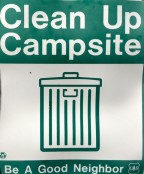
There was no problem with destructive bicycle traffic in the willow thicket along lower Arroyo Quemado creek in the Baron Ranch Preserve, such that warranted the installation of this signage.

Nevertheless, the county employee standing before both of us on that previously mentioned day insisted the signs, which she told us cost $3 million all told, were important for the protection of sensitive habitat.

When I asked why, she was adamant. She told us that bicyclists and hikers had been running roughshod through the creek.

“You could step on a turtle,” she said.

I asked what sensitive meant. I wanted to know. I still want to know.

I also asked: “If a human foot tramples a small creature to death by accident, but the dynamic biological systems at play create more to fill the void, and the populations are stable or growing, is that sensitive habitat?”

What documentation exists–studies, data, anything at all whatsoever–suggesting there was a problem in lower Arroyo Quemado?

She did not have a reasonable answer, and did not offer anything beyond lackluster opinion and empty rhetoric. She also could not define the word on the signs she said cost so much.

Sensitive appears to mean nothing more important than that some leading official(s) somewhere personally desires the exclusion of humanity for some reason.

The word on the sign is as meaningless as it is elastic. They might stretch it to cover anything they wish at any time, because it does not have a defined meaning.

Pursuit of the positive ends they envision justifies their negative means in practice, I guess.

There is no reason for the common bicyclist to go into pointless and dead end willow thickets and brambly places. To suggest otherwise defies common sense.

There is nothing to see in the arroyo but an unremarkable wide and thin seasonal wash, and nowhere to go, but out the other side of the thicket to somewhere a road already leads, but which is off-limits and dead ends anyway.

And so most people never went in there, never would, never will.

And yet the signs. Lots of them.

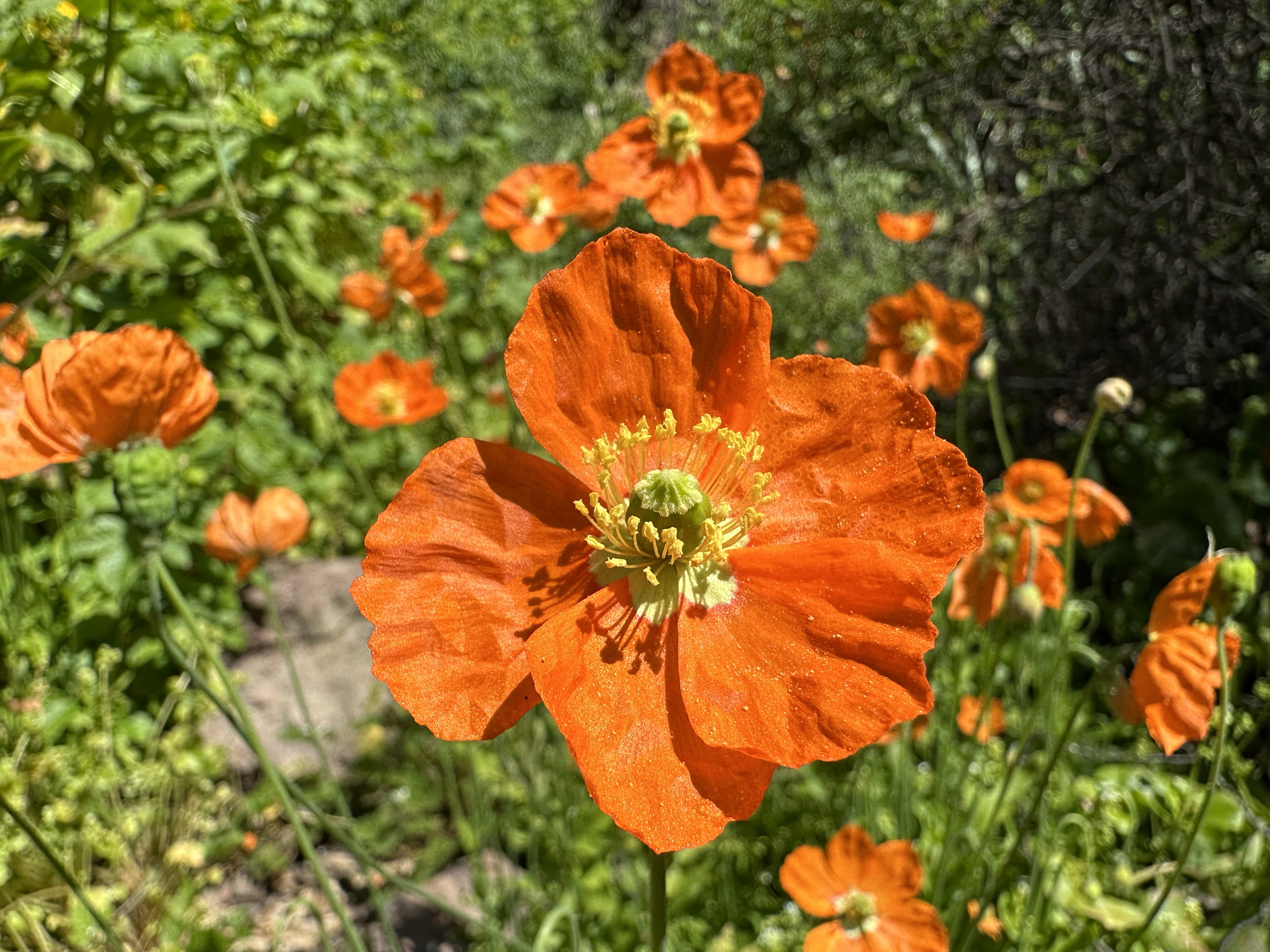
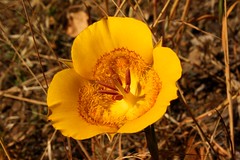
Trailside bloom, Erigeron foliosus. A fantastic native perennial for the home garden that is drought-hardy and grows in sun-blasted hot areas, throwing flushes of three-foot-high mounds of flowers.

Sign, signEverywhere a signBlockin’ out the sceneryBreakin’ my mindDo this, don’t do thatCan’t you read the sign?

–Five Man Electric Band, Signs

I told the lady that the purchase of industrial products shipped from across the country was an outrageous waste of money and resources and a terrible pollutant.

That such practices run contrary to the spirit and principles of preservation, conservation and the long-view vision of biological sustainability that undergird it all.

The employee’s retort was that the signs were purchased locally. This was a bogus answer, and an insult.

To suggest the signs are locally sourced is a major misrepresentation.

I noted that the base components of the signs were manufactured by different companies in heavy industry, located in different places throughout the country or world. Then it’s all shipped by air, rail and truck, and done so multiple times over.

Those signs cannot possibly come from town, but necessarily must come from many other places far away.

Like simple wood pencils, metal signs are something everyone uses, but no single person can make by themselves.

Have you considered that no one person even knows how to make a sign all by themself? It’s actually a major industrial endeavor.

See I, Pencil by Leonard E. Read.

You could trace the metal sign components all the way back to the original source in intensive, extractive mining operations and the earth ripped asunder.

To the industrial plants where the raw materials were shipped to be manufactured into base components.

To the factories producing sign blanks and hardware and lumber and ink.

And what about the printer? You need a machine to letter the signs. How many components make up that machine and where do they all come from? What about the machines that make those components?

Add on the cost of silviculture and logging of trees prior to being made into lumber for the signposts.

Add on the chemical production for the anti-rot preservative treatment that’s California compliant.

And so on and so forth. How far do you want to trace it?

At some point down the long disfiguring and dirty industrial chain, we come to the little local Santa Barbara sign seller in town.

The only things local are the words chosen in the abstract within somebody’s head in town to be printed onto the sign.

None of it was necessary. A tremendous waste, so outrageously thoughtless.

And now the trail looks like hell for it.
Local Livelihoods and a Culture of Craft

Probably one of the most valuable yields coppice woodlands could provide is a renewed local economy based on home-scale production of useful and necessary products.

As our current globalized economic system self-destructs before our eyes, we must begin to think about strategies to create a meaningful, right livelihood that enables people to express their skills and creativity and contribute to the renewal of our communities.

It seems clear that we need to build a new modern economy around the production of goods and management of land-use systems that serve the people who use them.

In the very same way that coppice sustained a skilled and independent class of craftspeople and land managers historically on the European continent, could we see a similar evolution of a productive community of citizens providing products for neighbors and community members today? I believe so. In fact, I believe it is and will be essential!

While this is no small task to design and implement, human history proves time and again that we cannot separate ecology from economy.

—Mark Krawczyk, Coppice Agroforestry: Tending Trees for Product, Profit, and Woodland Ecology

I told the county employee that the smart way to protect the riparian corridor along the willow thicket was to use the willow itself.

Coppice the willow and use the wood poles to weave an aesthetically pleasing, natural fencing.

A wildcrafted willow fence compliments the existing wild ambiance of a natural place and welcomes walkers with warmth and dignity.

I wrote of coppicing in the post about the trashing of San Marcos Preserve spring. In my home garden I coppice a mulberry bush after harvest and use the poles for fencing and supports for vegetables and fruit trees.

Yet such a practice goes much deeper in its wisdom than mere utilitarian function.

By coppicing the willow in Baron Ranch Preserve, we could provide a never ending supply of a local resource produced sustainably and grown effortlessly on-site.

A fence that is gloriously free of the pollution and negative economic externalities associated with the manufacture and shipment of industrial products.

Moreover, if wildcrafted from green poles the willow fence would take root and begin to grow into a living structure that could be pruned and formed as desired.

When my children attended The Oaks Parent-Child Workshop nursery school in Santa Barbara we built a rough interpretation of the traditional Chumash willow pole house or ‘ap. Some of the poles were still green when pushed into the earth and took root after several weeks and began to grow green and leafy.

A willow pole fence could be inspired by natural form like art nouveau with organic and curvilinear lines and loops. It could be made to look more traditional in design like a cottage garden or ranch or farm fence. It might be woven to blend in entirely and not even be seen at all.

Such a fence is wildly adaptable as needed, naturally.

If there arose a problem of destructive traffic in the creek, the use-trail or hole in the bush leading in could be plugged with a section of willow fence without degrading the ambiance of place, and done so quickly, and cost nothing but a person’s time.

The entire trail along the arroyo does not and would not need fencing, but if it did, that is certainly possible too, and with a light touch.

Otherwise if woven from fresh yet dead willow poles, after so many years of use, when it became too old and rotten, the fence could be biologically recycled on-site back into the Earth and a new fence wildcrafted.

I told the lady, with her sore knees headed to her doctor’s appointment that day, civic functions could be organized.

Invite people of all ages to come volunteer on the preserve to learn and harvest willow, and weave and install the clean, cleverly unobtrusive fence.

Natural fencing that is pleasing to look at and even touch. In fact, you might even feel better after smelling it, because wood is good for you.

We should keep natural places more natural.

Evidence suggests there are benefits to wood for the human mind and mental well-being over metal and other materials. One would think these findings are applicable.

“The effect of wood on the nervous system showed that the brain becomes calmer and less stressed, probably because wood is natural and more familiar for humans.”

–Wood and Its Impact on Humans and Environment Quality in Health Care Facilities, National Institutes of Health

I suggested local scouting groups might earn badges.

School classes could come for field trips.

Volunteer projects could be offered to enthusiasts, while also extending opportunities to local students to satisfy necessary credits for graduation. Community service work could be offered.

This is how to tie people directly to the land and forge deeper relationships as knowledgeable caretakers. To turn people on instead of off. To enrichen and raise up culture while doing the same for the land.

To build sense of communal ownership and enthusiastic responsibility as local stakeholders, as rooted in love of place developed through visceral first-hand personal experience in the field, education and edification.

Telling people no fails to accomplish much if anything positive, and sometimes it can be counter productive.

Guiding behavior through positive reinforcement is usually more effective than shouting no.

Buying costly signs from outside and turning the trail into a gauntlet bristling with negativity is of no benefit whatsoever, for people or land.

The gaiadamned signs are posted so close to each other on either side of the trail yelling at walkers that one sign can be seen from the other.

Aside from the waste and the unsettling ambiance the signs create, the number installed is curiously excessive, the posting oddly heavy handed.
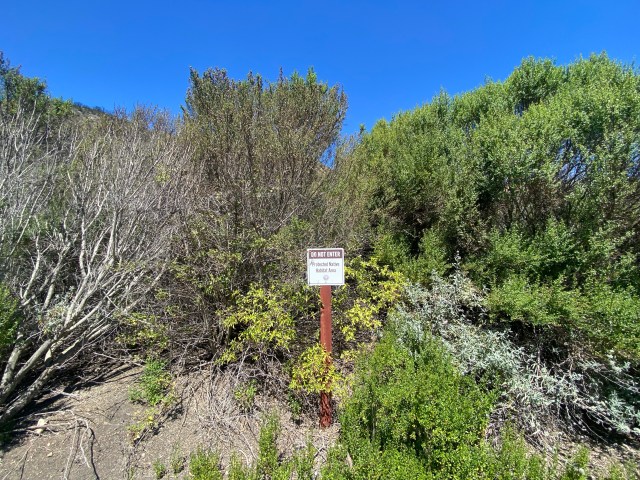
Unnecessary unsightly, costly signage. Nobody went in there anyway.

Change of ideas, change of ideasWhat we need now is a change of ideas

–Bad Religion, Change Of Ideas

Coppicing and weaving willow is a way to highlight the value of California Native Traditional Ecological Knowledge, and to reinvigorate once dying, yet highly effective wildland management practices. The ancient deep ecology that has for too long been ignored.

All these wonderful opportunities of enrichment for the people and the natural world were missed when an obscene amount of money was squandered on the purchase and installation of such heartlessly rude and ugly signage.

We are poorer for it monetarily and culturally. The land suffers too.

Of course, it would take money and resources to fund a willow fencing project and classes and work programs, even if it’s otherwise something simple to do.

I figure $3 million ought to cover it.

Welcome to Baron Ranch Preserve.

Related Posts:

Restoration Travesty, San Marcos Foothills Preserve

Hiking is Not a Crime: Hiker’s Pre-check Forest Entry Pass

The Myth Of Wilderness and Ethnocentrism: Race and Recognition In the Woods

Posted in Santa Barbara | Tagged , , , , , , , , , , | 2 Comments

Renaming Los Padres: Names Of the 1930s

Detail showing Abel Mtn. on a 1938 map of Los Padres National Forest.

Backstory

I’ve long had an interest in place, in the particularity of natural settings and the composition of undeveloped scenes, and in the forest placenames chosen by humanity.

Natural places and language are, of course, the preoccupation of this thirteen-year-old weblog.

Oftentimes we have sought to learn from the land’s Indigenous Peoples, and to view these matters through the lens of California Indian culture and history, for sake of clarity and deeper understanding.

I wrote something of it seven years ago in the post, Sitiptip Flat. I quoted professor Dan Flores writing about Native American place naming habits: “It’s landscape associative.”

That’s reasonable, common sense. Name the land simply for what it is, not out of conceit for some person or people.

In pondering place and name I referenced Richard Applegate in Chumash Placenames (1974). I noted the difference in perspective among Native American cultures as compared to mainstream American culture. I wrote:

“As with the Comanche and Kiowa of which Flores writes, sense of place and the importance of the landscape figured prominently in Chumash culture. Whereas in American culture places are often named after people, the Chumash tended to name people after places.”

One motivating impetus behind that post, previously unmentioned, was the finding of a makeshift memorial at so-called Sitiptip Flat.

The people who saw fit to leave their trace had claimed and named the unspoiled meadow on behalf of their dead friend. 

I again raised the issue of naming places after people a year ago in the post, The Case For Renaming Los Padres National Forest.

“Enough of that!” I exclaimed in exasperation.

This land-centric perspective is one of the underpinning ideals informing our call on this blog to rename the forest, Condor.

Detail of U.S. Forest Service map from 1938.
In 1936, Santa Barbara National Forest was renamed Los Padres.

The new name was “a fitting memorial to its first white users,” wrote William S. Brown not long after in 1945. History of Los Padres National Forest, 1898–1945

Was Brown opining personally or relating popular sentiment of the time?

In The Case For Renaming Los Padres I offered shocking examples of the racist social and political atmosphere during 1930s America to provide cultural context. 

I do not believe we can separate the naming of Los Padres in 1936 with what all else was happening in the country at the time.

We return now to ponder yet another example.

Main Point

Following the renaming to Los Padres, mount Cerro Noroeste in Kern County showed as Abel Mtn. on the official government map.

Cerro Noroeste is a name that has come to us through history from the earliest Spanish speaking residents of the land.

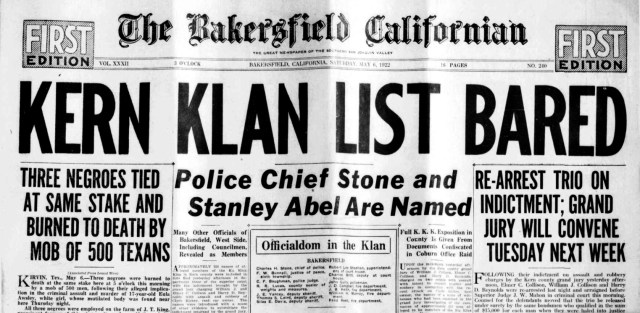
Peter Gray, a blogger, provides us with an eyebrow-raising sketch of Kern County Supervisor, Stanley Abel, after whom the mountain was named.

His write up includes the preceding graphic of a front page newspaper story listing Abel as a member of the Ku Klux Klan.

By 1922, avowed Klan members controlled the Bakersfield mayor’s office, various police departments throughout the county, much of the sheriff’s force of deputies, several judgeships, the city school-district, and the county board of supervisors which included Stanley Abel. Klan members were required to take an oath that superseded any vows of office or citizenship. Police chiefs and sheriff’s deputies literally swore to protect the Klan before enforcing the law. Abel unabashedly wrote that he was proud of “the good work” of the KKK, adding in a front-page newspaper column, “I make no apology for the Klan. It needs none.”

In the 1930s, Kern County Supervisor, Stanley Abel, played a role in having a road constructed to the top of “our” beautiful mountain and consequently the press of the day started referring to the mountain as “Mount Abel.”

Gray notes that as per the United States Board of Geographic Names (BGN) the name Abel was unofficial and that twice the name Cerro Noroeste was reaffirmed by the BGN.

However, one wonders how exactly to interpret that, because after all, the name was used on the Forest Service map of 1938, and thus given the stamp of approval by the federal government.

Surely this aided in popularizing the name and helping it to persist in common use for decades.

As Robert A. Burtness wrote in his local hiking guide from 1962 describing public campsites in the forest, making a casual observation on common practice of the times:

Camp Alto Camp

Spanish for high camp, Campo Alto is located atop Mt. Cerro Noroeste, commonly known as Mt. Abel.

The United States Forest Service still uses the name.

It’s perplexing why the Forest Service prints the name at all, let alone placing it prominently before Cerro Noroeste as if the latter is ancillary.

From June 1, 2023:

Nuance

The need to rename our forest is far less clear and certain when the name itself, Los Padres, is not derogatory and not that of a known Klansman.

Los Padres National Forest was named in 1936. Santa Barbara Bowl was originally built in 1936 as a venue to celebrate Old Spanish Days–Fiesta. San Diego’s baseball team was also named the Padres in 1936.

Los Padres were clearly having their moment of remembrance in California in the 1930s. What could be wrong with that? It all appears so wholesome and communal in a town, a state, with deep Spanish roots.

Whether or not we need to rename the baseball team is beyond the scope of this blog. But, it is indeed an entirely fitting memorial honor for those times that the team was named for a group of white men. Because the game was segregated and black men were not even allowed to play in the major leagues.

So, you see, it’s not so much about the name, per se, but the underlying story about motivations and equality.

Something is wrong with the name Los Padres as it was applied to our national forest and we need to change it.

Posted in Santa Barbara | Tagged , , , , , , , , , , | 7 Comments

Brian Sarvis In Noozhawk Echoes Jack Elliott, No Hat Tip

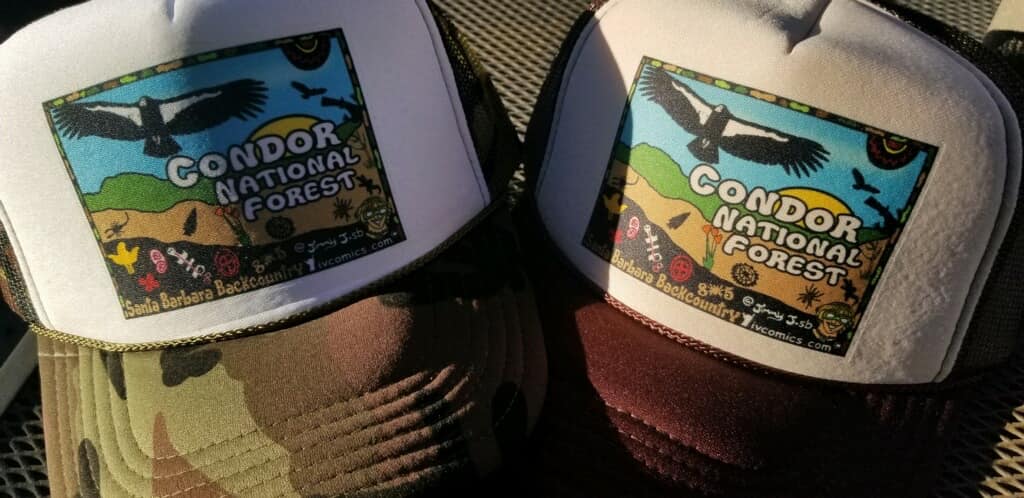
Jimmy J merch. Prototype run, January, 2023.

After six years of silence, Sarvis suddenly spoke. He once more found his voice, in somebody else’s writing. 

We made it easy by providing inspiration and all source material right here on this blog. Which he apparently lifted without attribution to cobble together his own CliffsNotes-version rehash.

Silly Sarvis. 

His misstep is not that he called for forest name change or that he promoted the name Condor. That’s not a problem.

The similarity in Sarvis’ writing to what I had already written is way too close to dismiss as mere happenstance. That’s a problem. 

Dan McCaslin, an outdoor columnist at Noozhawk, two months ago mentioned Jack Elliott and the Condor National Forest name change idea.

The willing suspension of disbelief is required before thinking this similarity is a mere innocent coincidence and that Sarvis was unaware of The Case For Renaming Los Padres National Forest.

This is a blatant ripoff.

Sarvis is a retired superintendent of Santa Barbara Unified School District, which makes this embarrassing faux pas particularly amusing. 

If a student did this at the academy he would receive a failing grade, and then have to answer to the dean if not be thrown out of school. 

A banana slug in the Santa Ynez Mountains, Condor National Forest, June 2023.
I wrote: “Los Padres did not locate their missions within the forest nor carry out their most passionate work there.”

Sarvis writes: “Los Padres National Forest is not the homeland of the Spanish padres and none of our missions is in the national forest.”

And he follows it with: “I have seen no evidence of Spanish padres in the national forest.”

I wrote about the Padres “cutting down trees and diverting water from the forest.”

And I followed it with: “Today’s Mission Pine Spring Camp and Mission Pine Basin Camp in the Santa Barbara backcountry are references to Los Padres’ cutting of timber for construction of the mission in Santa Barbara.”

Sarvis writes: “There is one site where pines were felled by native labor and hauled to build roof rafters for at least one mission.

And, of course, water flowed to the missions just as it flows today to many of our towns and cities.”

It’s not only those instances, but more.

Sarvis writes about “the folly of naming something as magnificent as a national forest after people” and that the “recovery of condors represents an appropriate symbol of our commitment to the environment.”

This came after I wrote about the need to “celebrate the forest itself” with the name Condor, and that “the name would refocus our attention on the forest itself and the wildlife therein, rather than humanity in the form of some dudes or dudette like Cleveland or Los Padres or Lady Bird Johnson. Enough of that!”

I wrote about the condor recovery program that likely saved the bird from extinction and how Los Padres National Forest was its last stronghold of critical habitat prior to capture and captive breeding. Sarvis commented on this as well. 

Everything is math. It actually could happen. It’s not impossible. 

It’s not impossible that Sarvis just may have unwittingly written in Noozhawk about the very same things that I had already written about on this blog and that McCaslin had already mentioned in Noozhawk.

That’s many things, but not impossible.

Unlikely is one of those things.

I can think of a few others.

Sarvis failed to note the reason why it matters that Los Padres did not work or live in the forest and so left no evidence of their presence.

I had mentioned the lack of Padre presence in the forest in challenging the narrative of William S. Brown, found in his book, History of Los Padres National Forest, 1898–1945. 

Brown wrote that the name Los Padres National Forest was “a fitting memorial to its first white users” because they built the missions “adjacent to the national forest area.”

I made the point that Native Americans had actually lived and worked within the forest proper and for no less than ten thousand years.

I noted the absurdity of naming the forest in honor of foreigners who lived nearby, while ignoring the long tenure of Native Americans who lived therein.

I drew this stark contrast between Los Padres and California Indians to make a larger point regarding the racial and racist cultural context of the times.

I offered a number of other shocking historical examples to further flesh out my main point:

The name Los Padres as applied to our national forest was a product of its time motivated by racialist sentiment at best or outright racism at worst. Therefore, the name is illegitimate and no longer acceptable.

Sarvis shied away from that hot potato red button issue and in doing so rendered meaningless his reference to the absence of Los Padres in the forest.

That may be true what he said, but it does not justify a name change. His argument does not fit in with common practice and must be rejected.

This is an important point to make in maintaining the integrity of our original argument on this blog, which we believe to be strongest bar none.

We cannot allow our argument to be highjacked and sidetracked and watered down by a fellow proponent of forest name change.

Highway 126 in neighboring Ventura County is named as a memorial in honor of Korean War veterans.  Of course, American soldiers never fought communists along Highway 126 in California.

The logic of Sarvis’ argument calls into question the memorial names of places and things throughout our country, for which no connection exists to the people who’ve been memorialized.

Clearly, his argument is far too broad in scope and will not suffice.

Posted in Santa Barbara | Tagged , , , , , , , , , , | 1 Comment

Native American Trout Gutter

April 2023

A place in the canyon caught my eye. 

The character of the mountain. The viewshed through the canyon of the Pacific Ocean and Santa Cruz Island.

Geography and aesthetics.

I felt compelled to go there. Years passed before I went. 

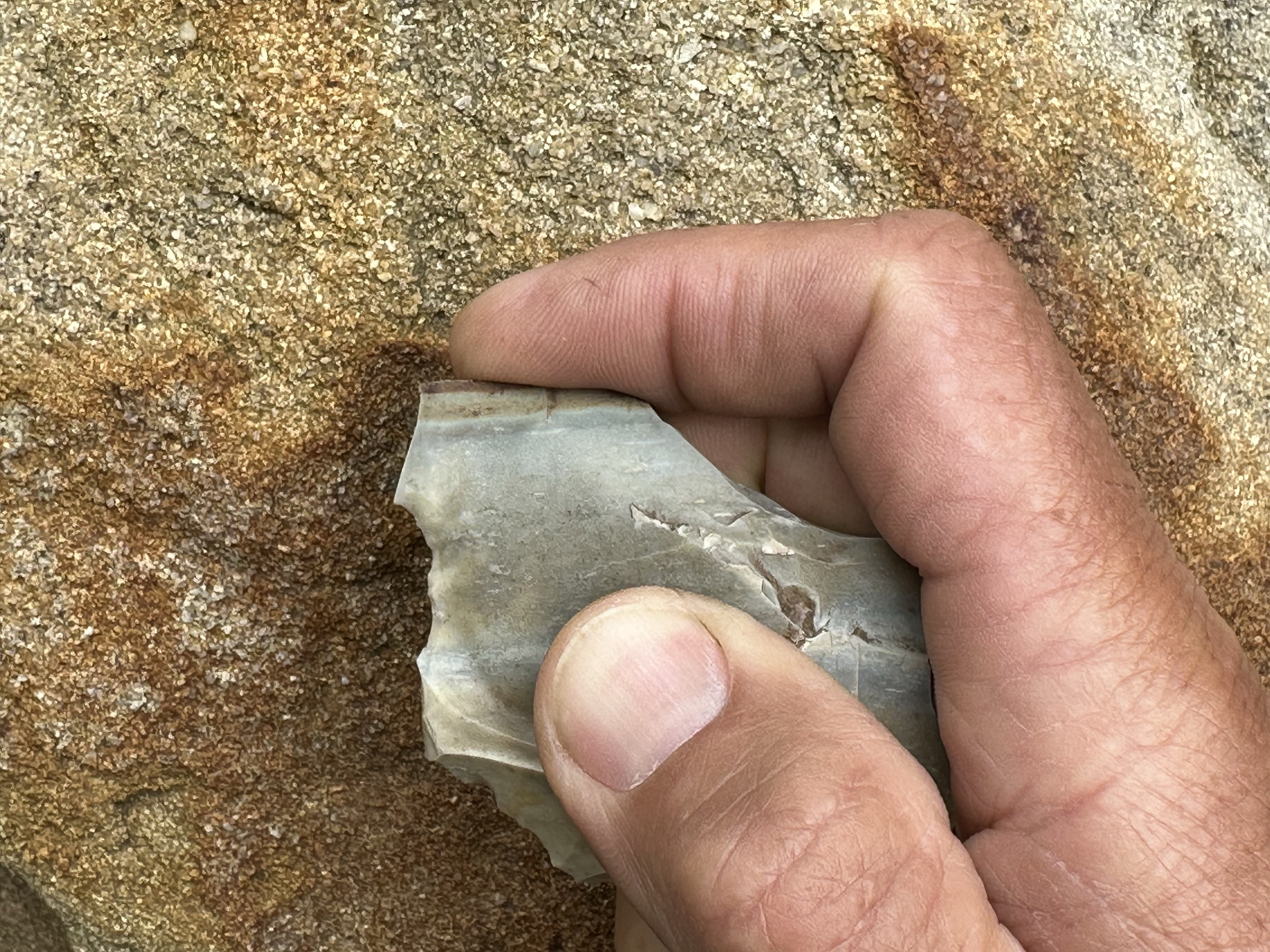
A comfortable and firm fit with flat surfaces for thumb and forefinger.

I walked through the forest and this chunk of stone gleamed from the shadows, down in the surface of the dark soil, rain polished.

On a mountain of golden gritty sandstone, in the gloom of heavy marine layer overhead, the glassy bright chert stood out like a light in the night.

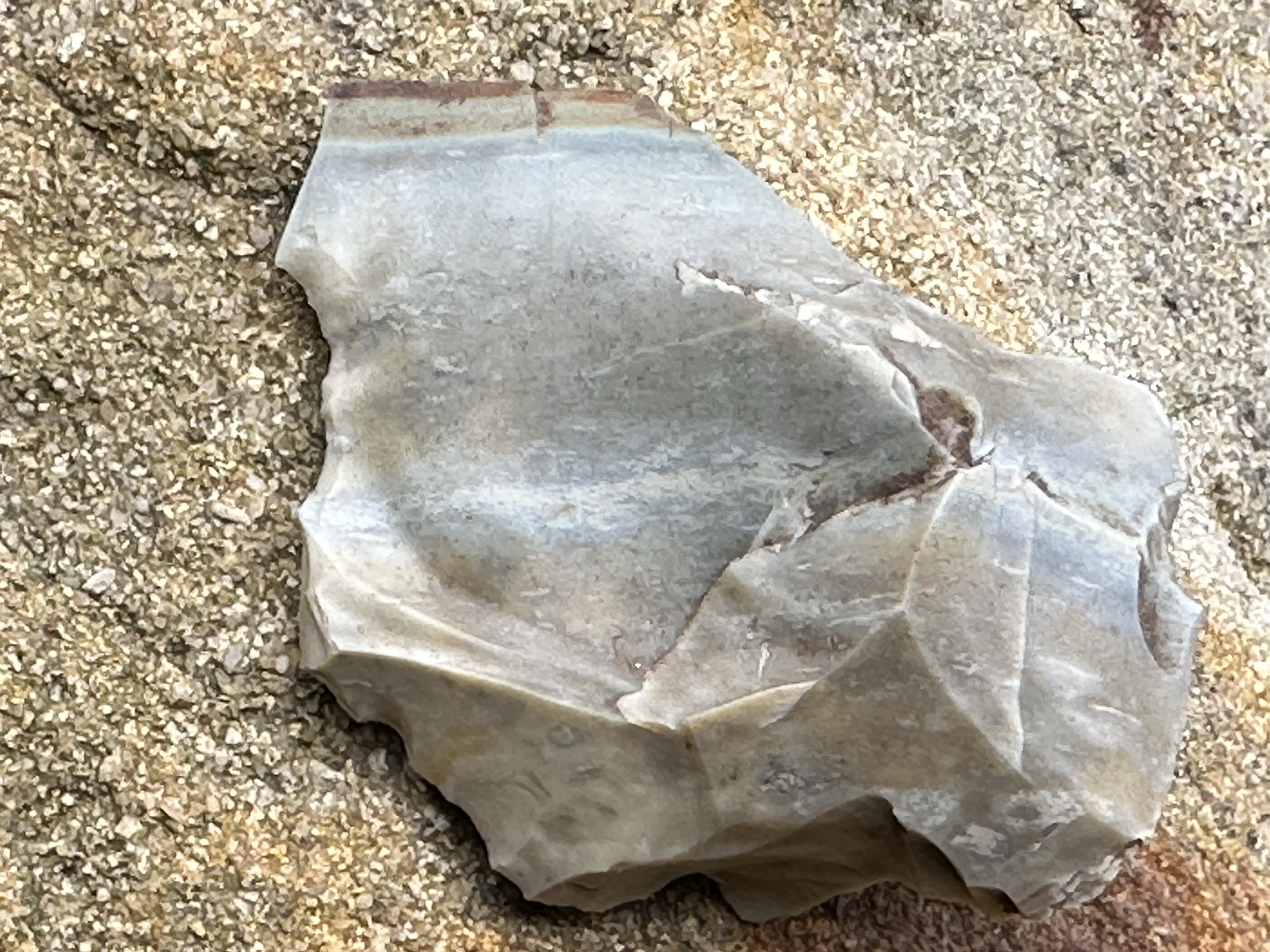
On closer inspection, an artifact, a tiny blade of a sort crafted by human hands, Chumash hands.

The wad of stone may have looked ordinary and natural at first glance, but it held subtle signs of having been knapped. I could see tiny pressure flakes that had been popped from the stone one at a time in overlapping sequence to create a serrated edge.

The particular design was striking, too, a form I had never seen. The small crescent shape along the serrated edge calls to mind a gut hook on a hunting or fishing knife.

Yet, I think the hook form may have been even more pronounced when originally made. It appears to have been broken off and that the crescent edge may have been larger.

I like to think of the artifact as a Cold Springs Canyon trout gutter. Although I imagine it could have been used for numerous other purposes, and I’m assuming the original Native locals processed such fish in a similar manner as we do today.

Who knows how the tool was used?

We fished the creek for the last time thirty years ago. Before the protective prohibition on coastal stream fishing of the 1990s to protect southern steelhead.

The latest official assessment was just reported, its findings grim. With sharp declines in southern steelhead numbers the species remains the most critically endangered on the West Coast.

We’d catch and release wild rainbow trout with barbless artificial lures. The trout were eellike and wiry, but ferocious in their fight, true to the species. The artifact rested in relatively close proximity to where we’d fish.

The point edge is remarkably sharp and slices through a callous on the palm. It would work well for opening the gut cavity of trout to be cleaned. But again, it appears broken so that sharp point edge at the top of the crescent may be incidental. 

And although it may appear like nothing more than a rough chunk of naturally broken stone like so many others, it feels smart in the hand and fits quite well when gripped properly.

Posted in Santa Barbara | Tagged , , , , , , , , , , | 5 Comments

The Elusive and Fleeting Fire Poppy

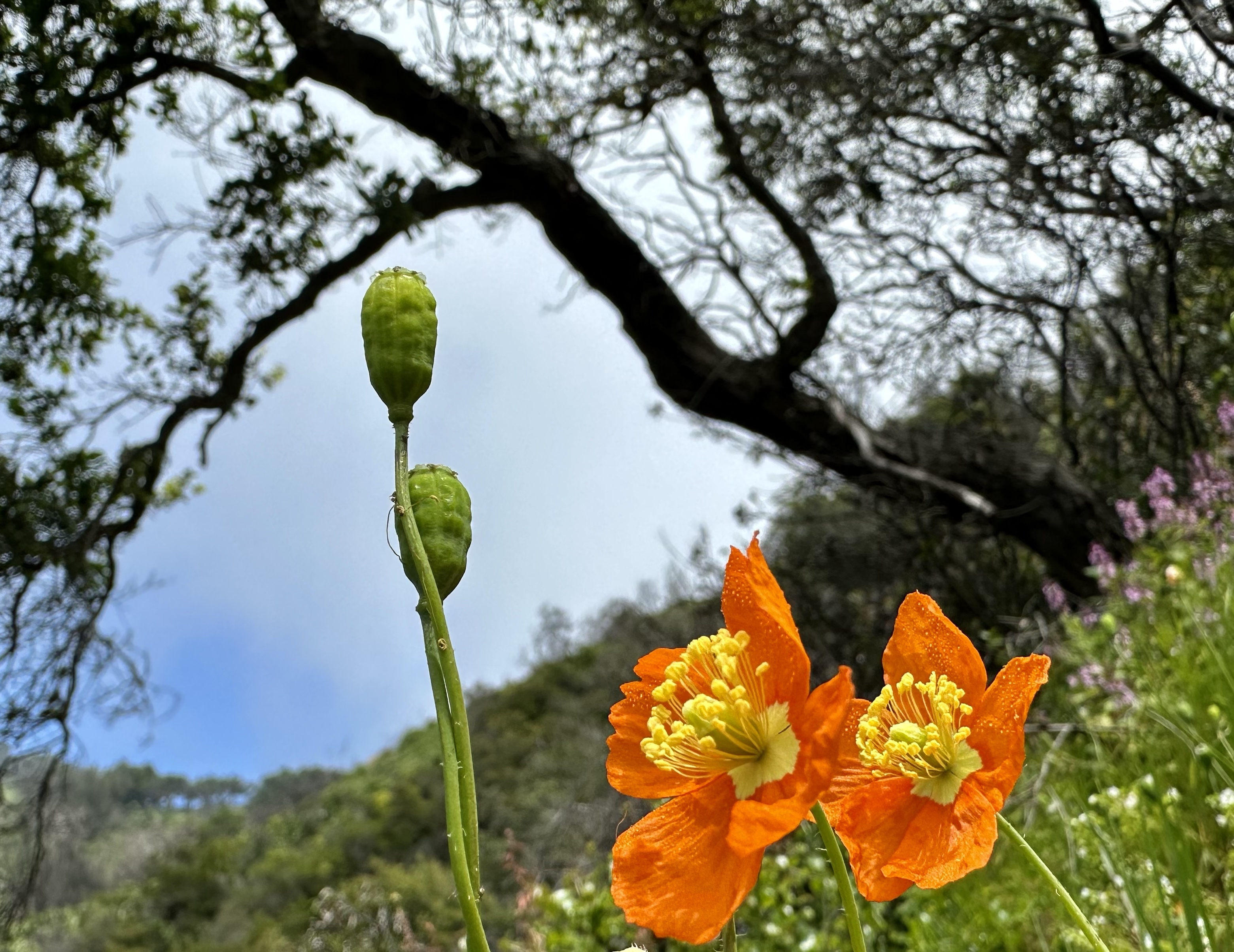
I found the fire poppies once more, trailless along a tributary fork of a coastal creek high in the Santa Ynez Mountains.

Five years had past since my last sighting.

I think the fire poppy, Papaver californicum, may be among the rarest of wildflowers in this neck of the woods, although not officially listed as such by state or federal government. 

Consider the contrast between some seldom seen wildflowers found in Condor National Forest.

The Ojai fritillary is considered rare or endangered by the California Native Plant Society, which says it meets the definition of the California Endangered Species Act and is eligible for official state listing.

The perennial Ojai fritillary is a bulb that sprouts and grows nearly every single year in the exact same spot. It may not be easy to find the first time, but once found it remains so.

Calochortus fimbriatus, the late-flowered mariposa-lily, grows perennially in similar fashion and is also considered rare or endangered by the California Native Plant Society.

By contrast, annual fire poppies may bloom for only a single season in the same place following wildfire or may reseed and sprout again for several years in a row at most.

And then they’re gone, not to be seen again for many years.

Within several seasons the larger woody plants grow back and blot out the sun and the poppies disappear, their seeds buried under heavy leaf litter and shaded by an umbrella of forest canopy.

Other poppy seed may remain viable for a century or more.

The seeds of fire poppies, I presume, may rest dormant on the mountain for decades before finally sprouting again, triggered by wildfire. The blooms are typically few and far between through space and time, elusive and fleeting. 

Posted in Santa Barbara | Tagged , , , , , , , , , , | 2 Comments