Renaming Los Padres: Names Of the 1930s

Detail showing Abel Mtn. on a 1938 map of Los Padres National Forest.

Backstory

I’ve long had an interest in place, in the particularity of natural settings and the composition of undeveloped scenes, and in the forest placenames chosen by humanity.

Natural places and language are, of course, the preoccupation of this thirteen-year-old weblog.

Oftentimes we have sought to learn from the land’s Indigenous Peoples, and to view these matters through the lens of California Indian culture and history, for sake of clarity and deeper understanding.

I wrote something of it seven years ago in the post, Sitiptip Flat. I quoted professor Dan Flores writing about Native American place naming habits: “It’s landscape associative.”

That’s reasonable, common sense. Name the land simply for what it is, not out of conceit for some person or people.

In pondering place and name I referenced Richard Applegate in Chumash Placenames (1974). I noted the difference in perspective among Native American cultures as compared to mainstream American culture. I wrote:

“As with the Comanche and Kiowa of which Flores writes, sense of place and the importance of the landscape figured prominently in Chumash culture. Whereas in American culture places are often named after people, the Chumash tended to name people after places.”

One motivating impetus behind that post, previously unmentioned, was the finding of a makeshift memorial at so-called Sitiptip Flat.

The people who saw fit to leave their trace had claimed and named the unspoiled meadow on behalf of their dead friend. 

I again raised the issue of naming places after people a year ago in the post, The Case For Renaming Los Padres National Forest.

“Enough of that!” I exclaimed in exasperation.

This land-centric perspective is one of the underpinning ideals informing our call on this blog to rename the forest, Condor.

Detail of U.S. Forest Service map from 1938.

In 1936, Santa Barbara National Forest was renamed Los Padres.

The new name was “a fitting memorial to its first white users,” wrote William S. Brown not long after in 1945. History of Los Padres National Forest, 1898–1945

Was Brown opining personally or relating popular sentiment of the time?

In The Case For Renaming Los Padres I offered shocking examples of the racist social and political atmosphere during 1930s America to provide cultural context. 

I do not believe we can separate the naming of Los Padres in 1936 with what all else was happening in the country at the time.

We return now to ponder yet another example.
Main Point

Following the renaming to Los Padres, mount Cerro Noroeste in Kern County showed as Abel Mtn. on the official government map.

Cerro Noroeste is a name that has come to us through history from the earliest Spanish speaking residents of the land.

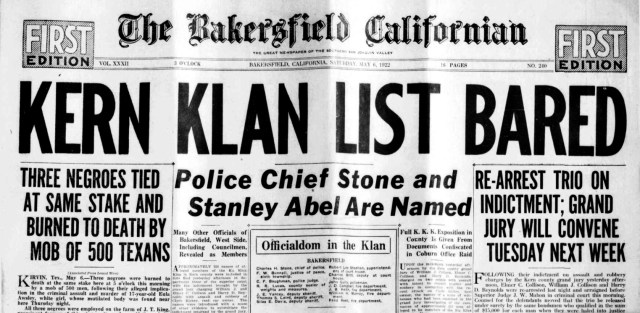
Peter Gray, a blogger, provides us with an eyebrow-raising sketch of Kern County Supervisor, Stanley Abel, after whom the mountain was named.

His write up includes the preceding graphic of a front page newspaper story listing Abel as a member of the Ku Klux Klan.

By 1922, avowed Klan members controlled the Bakersfield mayor’s office, various police departments throughout the county, much of the sheriff’s force of deputies, several judgeships, the city school-district, and the county board of supervisors which included Stanley Abel. Klan members were required to take an oath that superseded any vows of office or citizenship. Police chiefs and sheriff’s deputies literally swore to protect the Klan before enforcing the law. Abel unabashedly wrote that he was proud of “the good work” of the KKK, adding in a front-page newspaper column, “I make no apology for the Klan. It needs none.”

In the 1930s, Kern County Supervisor, Stanley Abel, played a role in having a road constructed to the top of “our” beautiful mountain and consequently the press of the day started referring to the mountain as “Mount Abel.”

Gray notes that as per the United States Board of Geographic Names (BGN) the name Abel was unofficial and that twice the name Cerro Noroeste was reaffirmed by the BGN.

However, one wonders how exactly to interpret that, because after all, the name was used on the Forest Service map of 1938, and thus given the stamp of approval by the federal government.

Surely this aided in popularizing the name and helping it to persist in common use for decades.

As Robert A. Burtness wrote in his local hiking guide from 1962 describing public campsites in the forest, making a casual observation on common practice of the times:

Camp Alto Camp

Spanish for high camp, Campo Alto is located atop Mt. Cerro Noroeste, commonly known as Mt. Abel.

The United States Forest Service still uses the name.

It’s perplexing why the Forest Service prints the name at all, let alone placing it prominently before Cerro Noroeste as if the latter is ancillary.

From June 1, 2023:

Nuance

The need to rename our forest is far less clear and certain when the name itself, Los Padres, is not derogatory and not that of a known Klansman.

Los Padres National Forest was named in 1936. Santa Barbara Bowl was originally built in 1936 as a venue to celebrate Old Spanish Days–Fiesta. San Diego’s baseball team was also named the Padres in 1936.

Los Padres were clearly having their moment of remembrance in California in the 1930s. What could be wrong with that? It all appears so wholesome and communal in a town, a state, with deep Spanish roots.

Whether or not we need to rename the baseball team is beyond the scope of this blog. But, it is indeed an entirely fitting memorial honor for those times that the team was named for a group of white men. Because the game was segregated and black men were not even allowed to play in the major leagues.

So, you see, it’s not so much about the name, per se, but the underlying story about motivations and equality.

Something is wrong with the name Los Padres as it was applied to our national forest and we need to change it.
Posted in Santa Barbara | Tagged , , , , , , , , , , | 7 Comments

Brian Sarvis In Noozhawk Echoes Jack Elliott, No Hat Tip

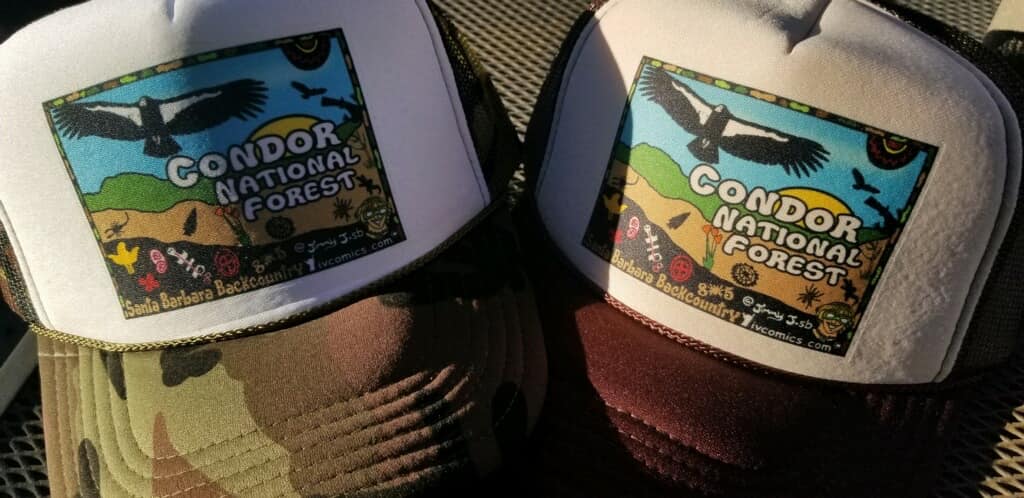
Jimmy J merch. Prototype run, January, 2023.

After six years of silence, Sarvis suddenly spoke. He once more found his voice, in somebody else’s writing. 

We made it easy by providing inspiration and all source material right here on this blog. Which he apparently lifted without attribution to cobble together his own CliffsNotes-version rehash.

Silly Sarvis. 

His misstep is not that he called for forest name change or that he promoted the name Condor. That’s not a problem.

The similarity in Sarvis’ writing to what I had already written is way too close to dismiss as mere happenstance. That’s a problem. 

Dan McCaslin, an outdoor columnist at Noozhawk, two months ago mentioned Jack Elliott and the Condor National Forest name change idea.

The willing suspension of disbelief is required before thinking this similarity is a mere innocent coincidence and that Sarvis was unaware of The Case For Renaming Los Padres National Forest.

This is a blatant ripoff.

Sarvis is a retired superintendent of Santa Barbara Unified School District, which makes this embarrassing faux pas particularly amusing. 

If a student did this at the academy he would receive a failing grade, and then have to answer to the dean if not be thrown out of school. 

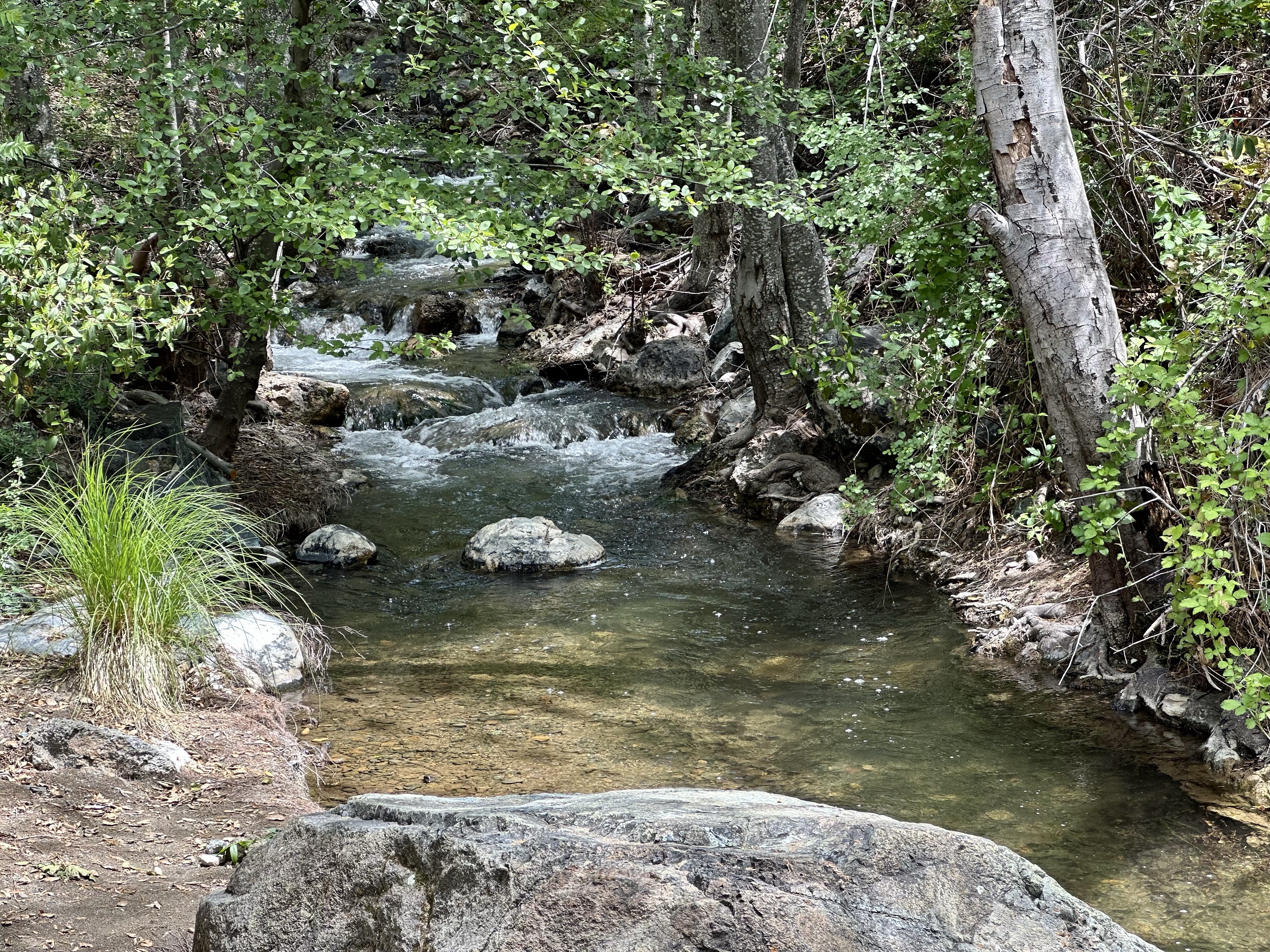
A banana slug in the Santa Ynez Mountains, Condor National Forest, June 2023.
I wrote: “Los Padres did not locate their missions within the forest nor carry out their most passionate work there.”

Sarvis writes: “Los Padres National Forest is not the homeland of the Spanish padres and none of our missions is in the national forest.”

And he follows it with: “I have seen no evidence of Spanish padres in the national forest.”

I wrote about the Padres “cutting down trees and diverting water from the forest.”

And I followed it with: “Today’s Mission Pine Spring Camp and Mission Pine Basin Camp in the Santa Barbara backcountry are references to Los Padres’ cutting of timber for construction of the mission in Santa Barbara.”

Sarvis writes: “There is one site where pines were felled by native labor and hauled to build roof rafters for at least one mission.

And, of course, water flowed to the missions just as it flows today to many of our towns and cities.”

It’s not only those instances, but more.

Sarvis writes about “the folly of naming something as magnificent as a national forest after people” and that the “recovery of condors represents an appropriate symbol of our commitment to the environment.”

This came after I wrote about the need to “celebrate the forest itself” with the name Condor, and that “the name would refocus our attention on the forest itself and the wildlife therein, rather than humanity in the form of some dudes or dudette like Cleveland or Los Padres or Lady Bird Johnson. Enough of that!”

I wrote about the condor recovery program that likely saved the bird from extinction and how Los Padres National Forest was its last stronghold of critical habitat prior to capture and captive breeding. Sarvis commented on this as well. 

Everything is math. It actually could happen. It’s not impossible. 

It’s not impossible that Sarvis just may have unwittingly written in Noozhawk about the very same things that I had already written about on this blog and that McCaslin had already mentioned in Noozhawk.

That’s many things, but not impossible.

Unlikely is one of those things.

I can think of a few others.

Sarvis failed to note the reason why it matters that Los Padres did not work or live in the forest and so left no evidence of their presence.

I had mentioned the lack of Padre presence in the forest in challenging the narrative of William S. Brown, found in his book, History of Los Padres National Forest, 1898–1945. 

Brown wrote that the name Los Padres National Forest was “a fitting memorial to its first white users” because they built the missions “adjacent to the national forest area.”

I made the point that Native Americans had actually lived and worked within the forest proper and for no less than ten thousand years.

I noted the absurdity of naming the forest in honor of foreigners who lived nearby, while ignoring the long tenure of Native Americans who lived therein.

I drew this stark contrast between Los Padres and California Indians to make a larger point regarding the racial and racist cultural context of the times.

I offered a number of other shocking historical examples to further flesh out my main point:

The name Los Padres as applied to our national forest was a product of its time motivated by racialist sentiment at best or outright racism at worst. Therefore, the name is illegitimate and no longer acceptable.

Sarvis shied away from that hot potato red button issue and in doing so rendered meaningless his reference to the absence of Los Padres in the forest.

That may be true what he said, but it does not justify a name change. His argument does not fit in with common practice and must be rejected.

This is an important point to make in maintaining the integrity of our original argument on this blog, which we believe to be strongest bar none.

We cannot allow our argument to be highjacked and sidetracked and watered down by a fellow proponent of forest name change.

Highway 126 in neighboring Ventura County is named as a memorial in honor of Korean War veterans.  Of course, American soldiers never fought communists along Highway 126 in California.

The logic of Sarvis’ argument calls into question the memorial names of places and things throughout our country, for which no connection exists to the people who’ve been memorialized.

Clearly, his argument is far too broad in scope and will not suffice.

Posted in Santa Barbara | Tagged , , , , , , , , , , | 1 Comment

Native American Trout Gutter

April 2023

A place in the canyon caught my eye. 

The character of the mountain. The viewshed through the canyon of the Pacific Ocean and Santa Cruz Island.

Geography and aesthetics.

I felt compelled to go there. Years passed before I went. 

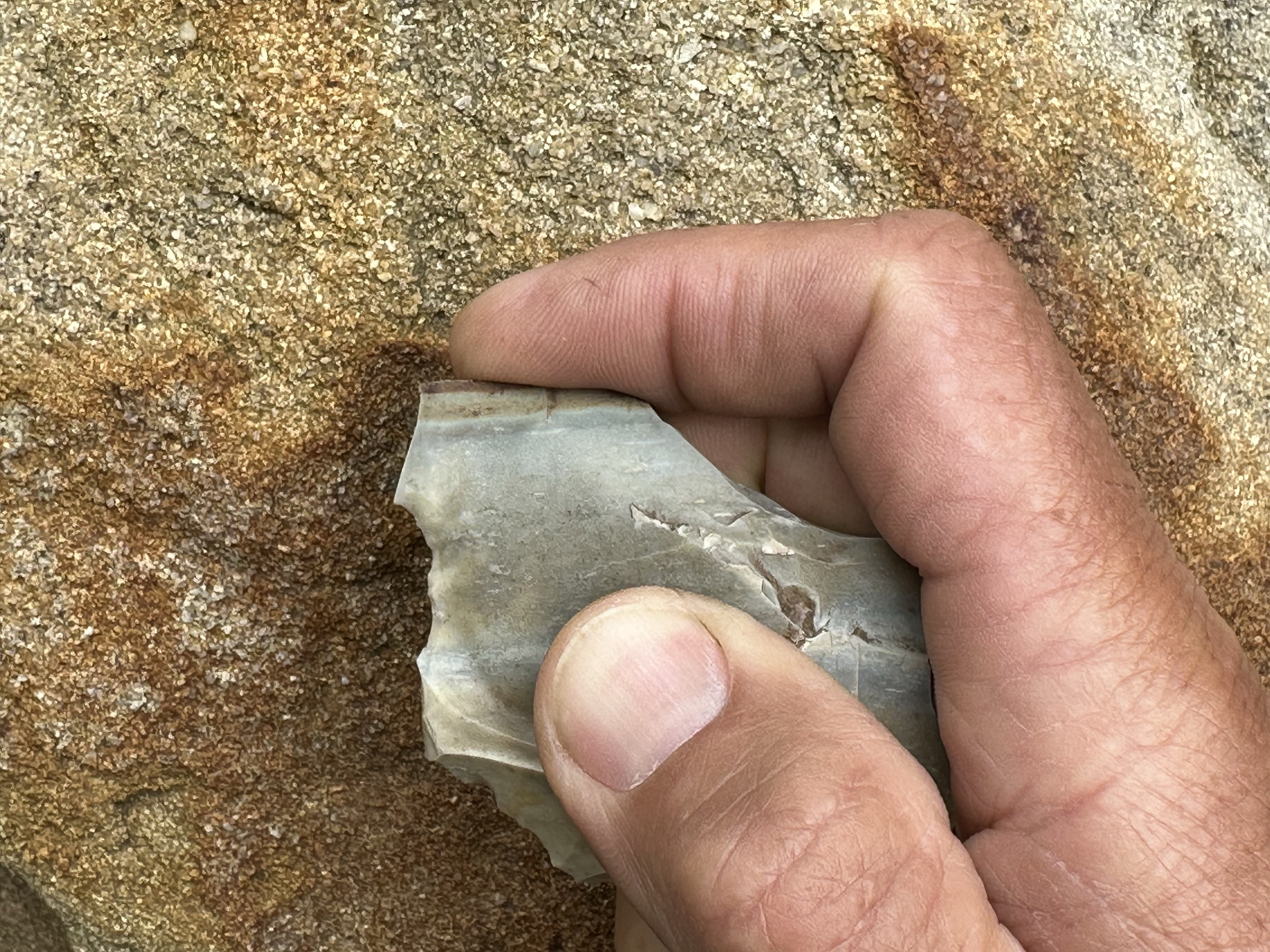
A comfortable and firm fit with flat surfaces for thumb and forefinger.

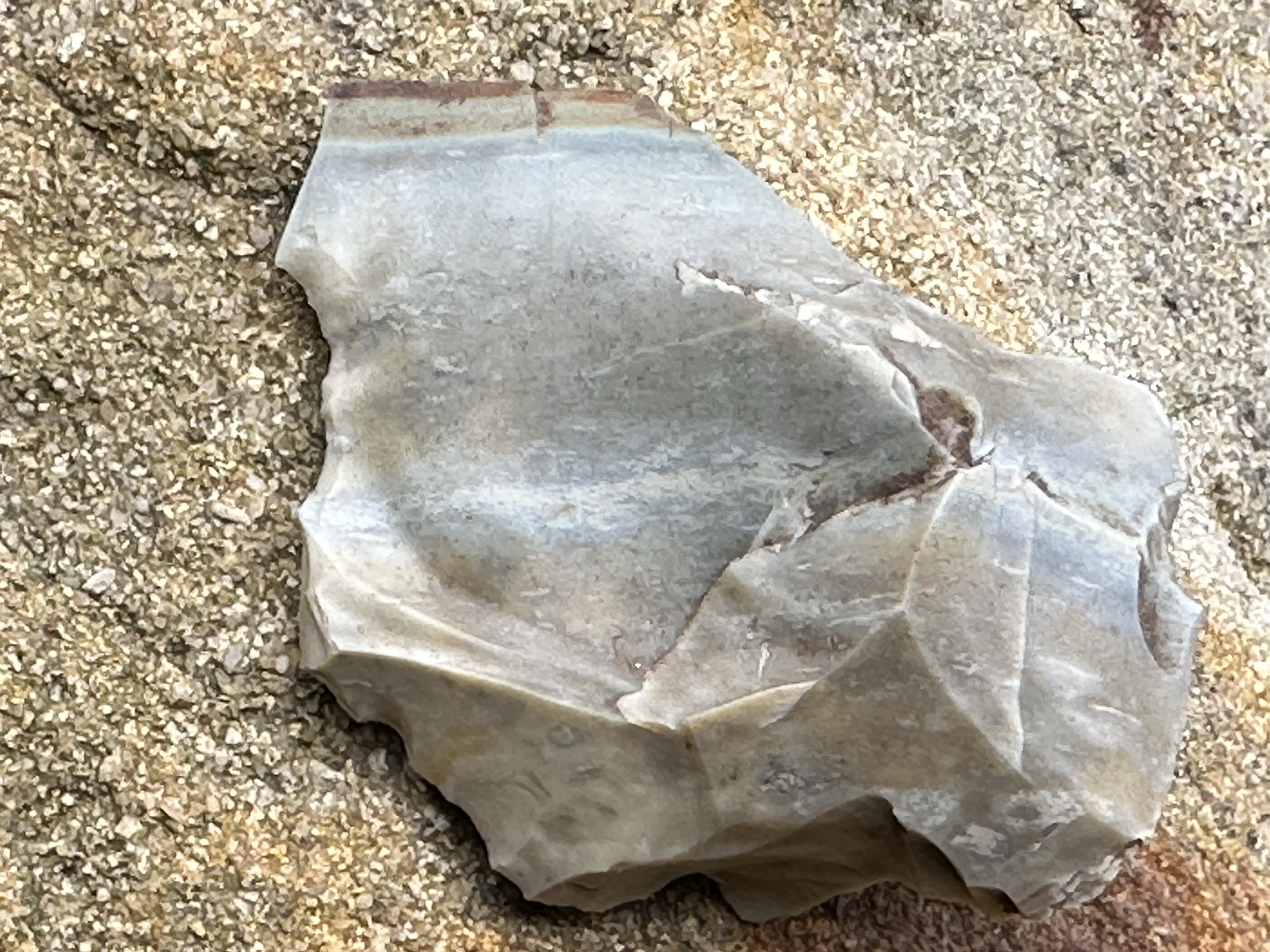
I walked through the forest and this chunk of stone gleamed from the shadows, down in the surface of the dark soil, rain polished.

On a mountain of golden gritty sandstone, in the gloom of heavy marine layer overhead, the glassy bright chert stood out like a light in the night.

On closer inspection, an artifact, a tiny blade of a sort crafted by human hands, Chumash hands.

The wad of stone may have looked ordinary and natural at first glance, but it held subtle signs of having been knapped. I could see tiny pressure flakes that had been popped from the stone one at a time in overlapping sequence to create a serrated edge.

The particular design was striking, too, a form I had never seen. The small crescent shape along the serrated edge calls to mind a gut hook on a hunting or fishing knife.

Yet, I think the hook form may have been even more pronounced when originally made. It appears to have been broken off and that the crescent edge may have been larger.

I like to think of the artifact as a Cold Springs Canyon trout gutter. Although I imagine it could have been used for numerous other purposes, and I’m assuming the original Native locals processed such fish in a similar manner as we do today.

Who knows how the tool was used?

We fished the creek for the last time thirty years ago. Before the protective prohibition on coastal stream fishing of the 1990s to protect southern steelhead.

The latest official assessment was just reported, its findings grim. With sharp declines in southern steelhead numbers the species remains the most critically endangered on the West Coast.

We’d catch and release wild rainbow trout with barbless artificial lures. The trout were eellike and wiry, but ferocious in their fight, true to the species. The artifact rested in relatively close proximity to where we’d fish.

The point edge is remarkably sharp and slices through a callous on the palm. It would work well for opening the gut cavity of trout to be cleaned. But again, it appears broken so that sharp point edge at the top of the crescent may be incidental. 

And although it may appear like nothing more than a rough chunk of naturally broken stone like so many others, it feels smart in the hand and fits quite well when gripped properly.

Posted in Santa Barbara | Tagged , , , , , , , , , , | 5 Comments

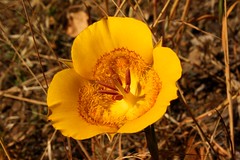
The Elusive and Fleeting Fire Poppy

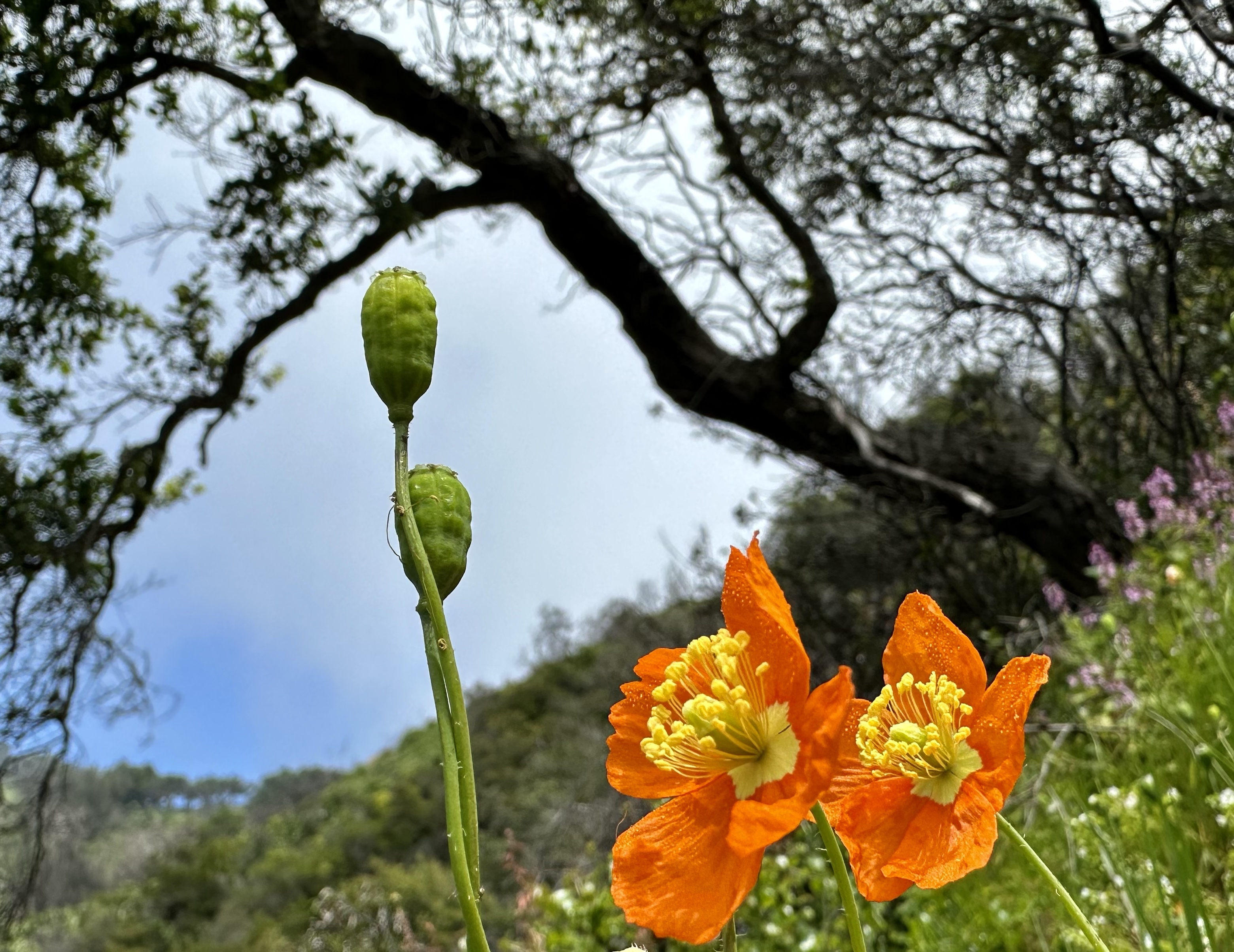
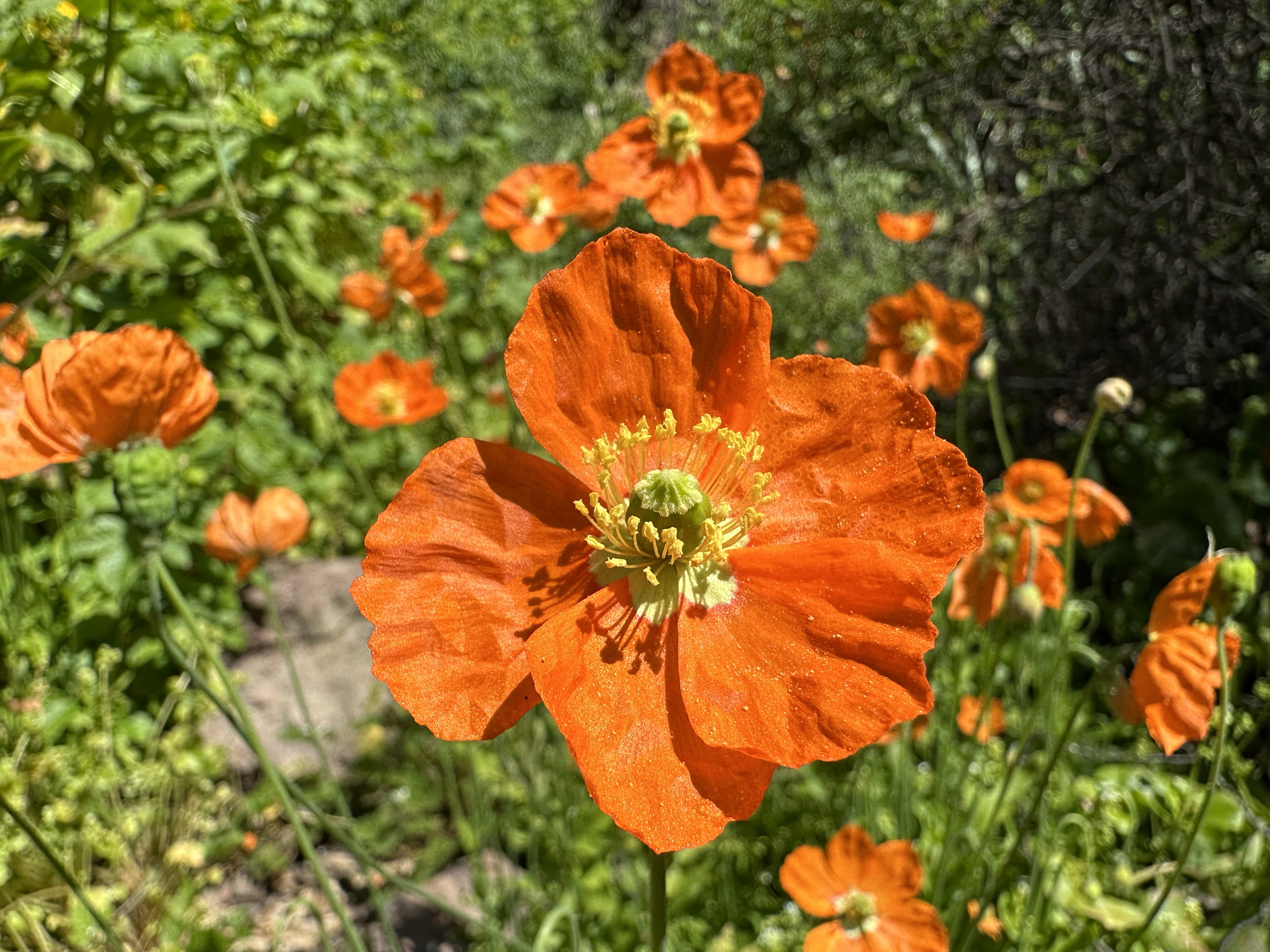
I found the fire poppies once more, trailless along a tributary fork of a coastal creek high in the Santa Ynez Mountains.

Five years had past since my last sighting.

I think the fire poppy, Papaver californicum, may be among the rarest of wildflowers in this neck of the woods, although not officially listed as such by state or federal government. 

Consider the contrast between some seldom seen wildflowers found in Condor National Forest.

The Ojai fritillary is considered rare or endangered by the California Native Plant Society, which says it meets the definition of the California Endangered Species Act and is eligible for official state listing.

The perennial Ojai fritillary is a bulb that sprouts and grows nearly every single year in the exact same spot. It may not be easy to find the first time, but once found it remains so.

Calochortus fimbriatus, the late-flowered mariposa-lily, grows perennially in similar fashion and is also considered rare or endangered by the California Native Plant Society.

By contrast, annual fire poppies may bloom for only a single season in the same place following wildfire or may reseed and sprout again for several years in a row at most.

And then they’re gone, not to be seen again for many years.

Within several seasons the larger woody plants grow back and blot out the sun and the poppies disappear, their seeds buried under heavy leaf litter and shaded by an umbrella of forest canopy.

Other poppy seed may remain viable for a century or more.

The seeds of fire poppies, I presume, may rest dormant on the mountain for decades before finally sprouting again, triggered by wildfire. The blooms are typically few and far between through space and time, elusive and fleeting. 

Posted in Santa Barbara | Tagged , , , , , , , , , , | 2 Comments

Return To Scene Of Lion Standoff

I returned to the place of the lion faceoff, to measure the distance between us on that day; the most memorable day of my life in the Santa Ynez Mountains of Condor National Forest.

Using the yard measurement instrument of the common stride, as taught to us at Monte Vista Elementary school by Dr. Ehrenborg when playing football, I paced off 30 long steps.

And so it was over 90 feet.

Ninety feet sounds far to me when spoken of, sounds really far. Ninety feet also feels close when facing a lion, frightening close.

If asked before I had measured it, while sitting in town telling the story or whatever, I would have said the distance was much closer, maybe half as far.

How many loping strides would it take the big cat to close the distance? Not many. Not enough. Not nearly enough.

I walked up to the spot feeling uneasy. It’s hardly a stone’s throw from the road. I wanted to look around more, but I did not feel comfortable enough walking deeper into the woods, far from the road and my vehicle, with its alarm, the panic button in my pocket.

There are now places in the forest, certain settings, that I do not venture into alone for fear of a possible lion attack. It sounds ridiculous. I’ve never in my life thought much about lions when hiking.

The feeling will subside with time, surely, but for now things are different out there.

I see a lion track now and I turn circles, eyes darting around the creek, the rocks, the hills, wherever, all over. 

Yet, I don’t ever really expect to see a cat. I’d like to think I’m being vigilant, but I know it’s driven by anxiety.

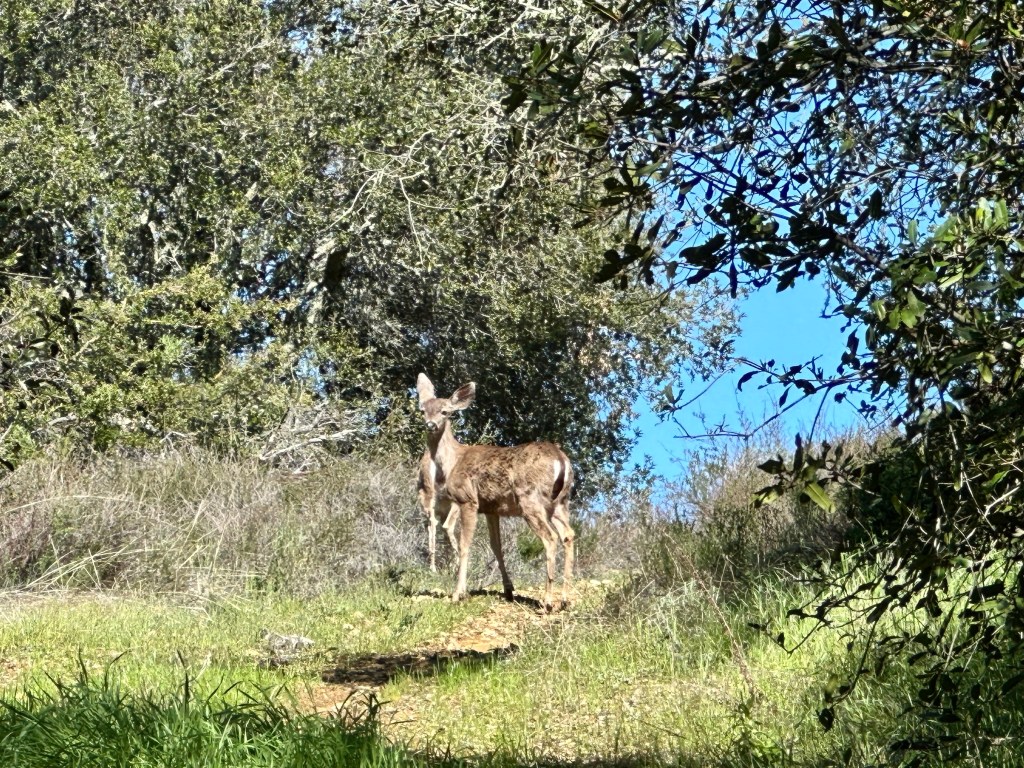
I didn’t even see the deer. Then, suddenly, they were there, staring at me with their big wet eyeballs in the mottled understory light. The deer materialized out of nowhere in an instant as I finally saw what I had been looking at.

There they stood, fifteen feet or so from where the lion had been standing staring me down weeks earlier.

I had walked up oblivious to the presence of deer when looking carefully to avoid a lion.

Posted in Santa Barbara | Tagged , , , , , , , , , , | 13 Comments