
“A great earthquake shook the mountains, ripping a deep gash through the rock formations. . .”
-A Spanish traveler’s account of the great Fort Tejon earthquake of 1857
On January 9, 1857, the 7.9 magnitude Fort Tejon temblor rocked California altering the landscape, ripping trees from the ground, forcing rivers and streams to overflow their banks and in some cases to briefly flow backwards. People fled their homes in terror.
In Santa Barbara ground fissures opened up in the earth. Sandblows, the result of soil deep within the earth being turned to slop by the shaking and then forced to the surface, erupted out of the ground like volcanoes spewing muddy debris into the air.
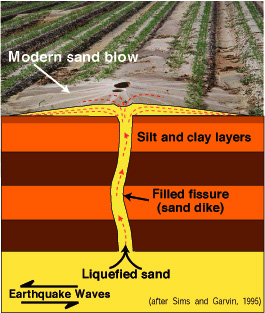
Credit: USGS
A U.S. Geological Survey report published in 1969 notes that, as a result of the great quake, “several new springs formed near Santa Barbara.” (Geology, petroleum development, and seismicity of the Santa Barbara Channel region, California. [U.S. Geological Survey professional paper])
The following excerpt describing the earthquake is from the Santa Barbara Gazette published on January 15, 1857.
On Friday last, January 9th, this city [Santa Barbara] was visited by a succession of earthquake shocks, one of which was the most severe which has been experienced on this coast for a long series of years. …
In this city, the morning of the eventful day was ushered in by the same genial sun; the air was tranquil, and no unusual atmospheric phenomena indicated that any sudden danger was at hand. … At about half past 8, or at 22 minutes past 8 o’clock, according to those who assert that they had the “correct time,” the severest shock commenced, and which continued from 40 to 60 seconds. It was universally noticed throughout the city, and was so violent in its vibrations that all of the inhabitants fled from their dwellings, the majority of whom, on bended knees, and hearts throbbing with terror, made fervent supplications that the imminent and impending danger might be providentially averted.
This “shock” commenced with a gentle vibration of the earth, which gradually increased, accompanied with an undulating motion, until it attained its culminating intensity, and then as gradually decreased, until it ceased its action altogether. … The peculiar motion experienced during is continuance very much resembled that on board a vessel in moderate sea. Happily, it passed without causing material damage to the city.
Harper’s Weekly published an account of the temblor on February 21, 1857 that 
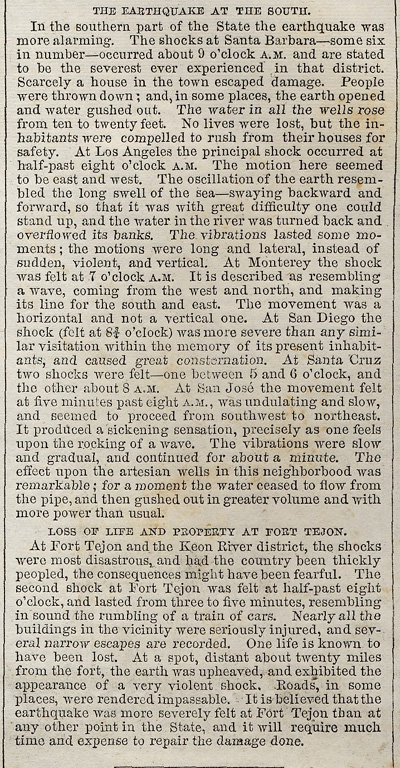 mentioned Santa Barbara.
“In the southern part of the State the earthquake was more alarming. The shocks at Santa Barbara—some six in number—occurred about 9 o’clock A.M. and are stated to be the severest ever experienced in that district. Scarcely a house in the town escaped damage. People were thrown down; and, in some places, the earth opened and water gushed out. The water in all the wells rose from ten to twenty feet. No lives were lost, but the inhabitants were compelled to rush from their houses for safety.”
Evidence of the Fort Tejon Earthquake can still be seen today on the Carrizo Plain in San Luis Obispo County, California, which is about a two hour drive from Santa Barbara. Along the northeastern edge of the Carrizo Plain National Monument, the Pacific Plate and the North American Plate meet in dramatic fashion creating the San Andreas Fault.
The fault line cuts across numerous arroyos and seasonal drainage channels that flow out of the Temblor Range and onto the Carrizo Plain. When the Fort Tejon earthquake struck, the earth literally ripped apart along 200 miles of fault line including the nearly forty mile segment running through the Carrizo Plain. The surface rupture sheered Wallace Creek in half offsetting the creek bed 30 feet resulting in the dramatic z-shaped meander in the creek channel seen today.
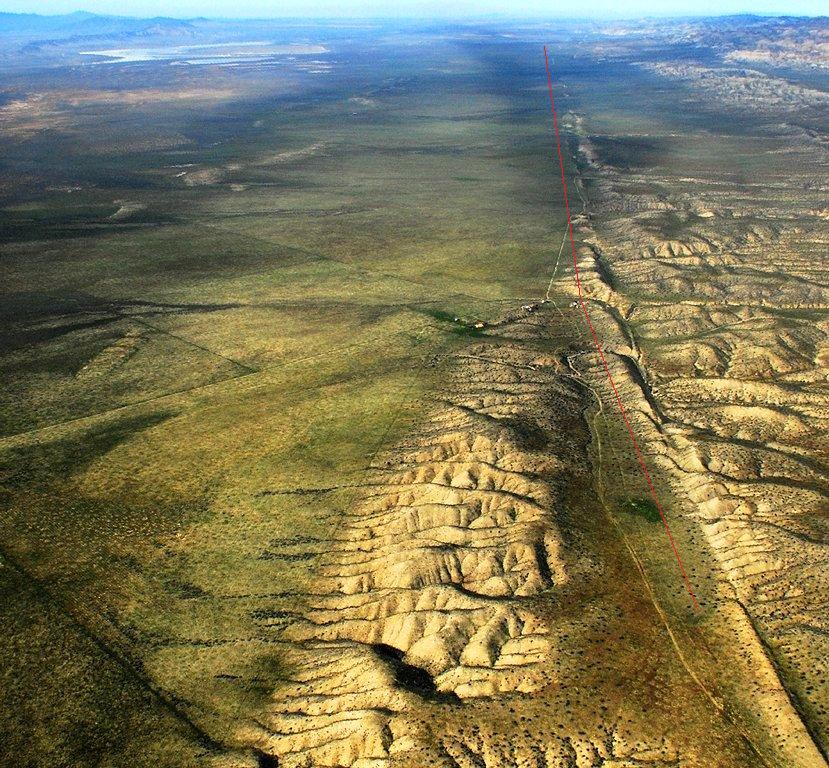
Aerial of Carrizo Plain with the San Andreas Fault running through the frame to the right of the red line drawn for reference.
(Photo credit for aerial: John Wiley)
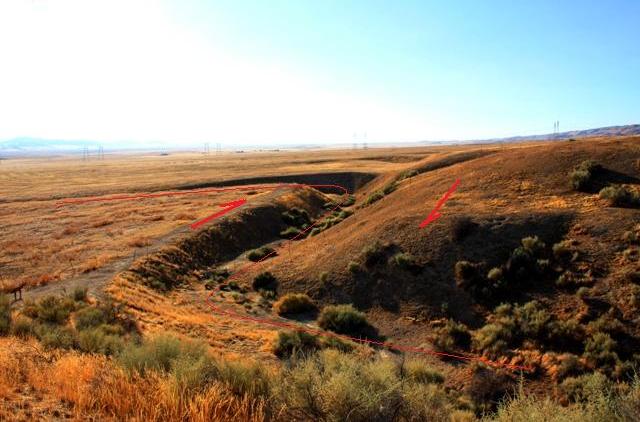
View from hill overlooking Wallace Creek. The curved red line traces the creek bed showing the dramatic shift in the arroyo's channel resulting from slippage of the San Andreas Fault. Arrows show the direction each tectonic plate moved.
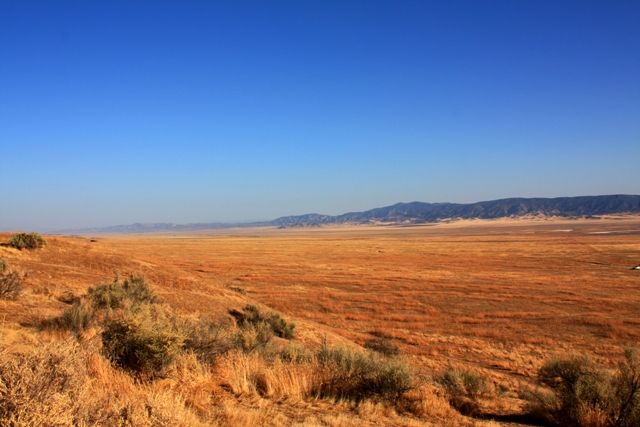
View to the southeast from Wallace Creek overlook. My truck is just visible as a dot on the right. The Caliente Range is in the background.
Read or make a copy of the same Wallace Creek educational pamphlet that is available at the site complete with a detailed graphic showing the creek channel offsets: Wallace Creek Interpretive Trail (PDF).
A detailed self-guided tour of geologic attractions in the Carrizo Plain National Monument including Wallace Creek: Self-Guided San Andreas Fault Tour on Carrizo Plain, San Luis Obispo County, California (PDF).
To reach the Carrizo Plain National Monument take the US-101 north out of Santa Barbara to HWY-166 east out of Santa Maria and through New Cuyama. Or go south from Santa Barbara to HWY-33 out of Ventura and through Ojai. After the 33 t-bones the 166 take Soda Lake Road which leads into the Carrizo Plain valley from it’s southeastern end. Take Elkhorn Road, which skirts the Temblor Range and the San Andreas Fault.
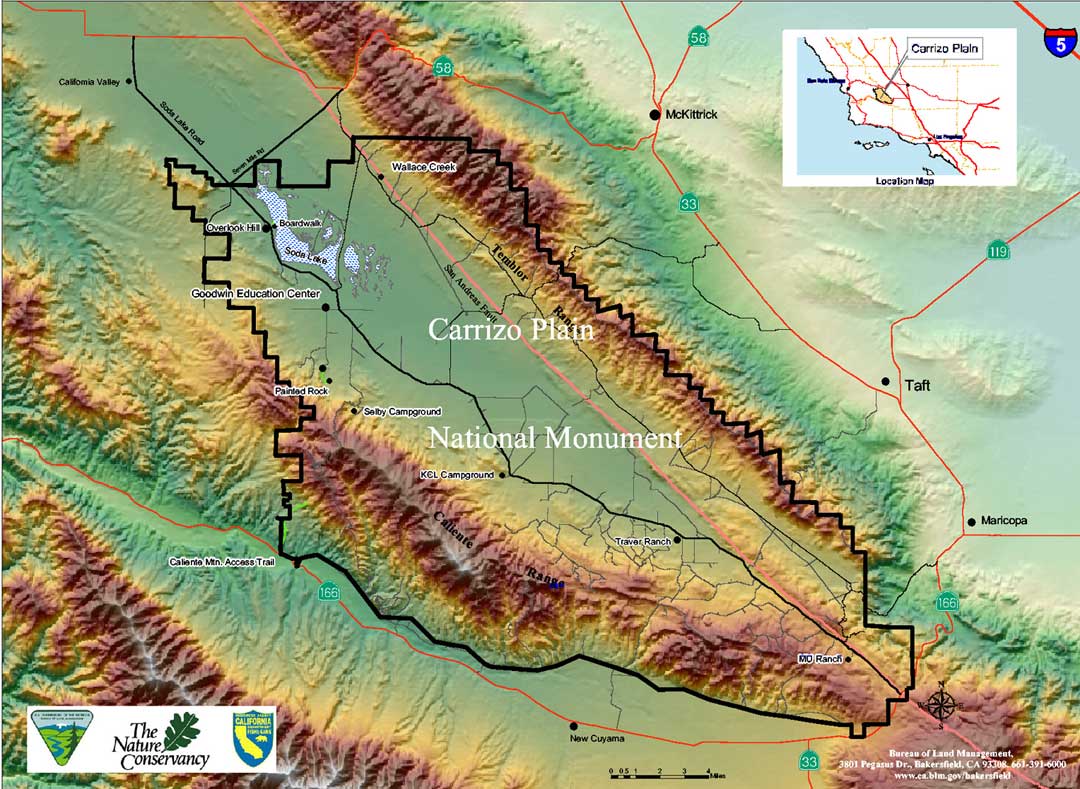
On this map, west on HWY-166 goes to Santa Maria. South on HWY-33 goes to Ojai. Wallace Creek is noted toward the northeast corner of the monument boundary.
Interactive map guide:
For further reading about earthquakes in the Santa Barbara region spanning the years from 1812 to 1978 visit:
Santa Barbara Earthquake History
Sources for historic newspaper quotes:


















 Jack Elliott's Santa Barbara Adventure