Summer of Serpents of Rattlers Beware

California mountain kingsnake on Figueroa Mountain. Not to be confused with a California kingsnake: Killer Kingsnake Eats Water Snake

“To combat the boredom, I occasionally drove over the coastal range and into the Santa Ynez Valley to hike the trails of the Los Padres National Forest. . .Of course, the ticks were happy to welcome us, as were the biting gnats. The rattlesnake wasn’t as felicitous. It was a coil of shadow, 2 feet from the trail, and it was not happy with our presence.”

T.C. Boyle on getting out during the COVID lockdown, excerpted from a piece in the current September-October issue of Westways magazine

I did something, sent some unintentional signal in my appearance or actions and the guy walked over.

He had been eyeing me from across the dirt parking lot at the trailhead for some time. I don’t think he knew that I knew he was watching me.

I ambled about my vehicle readying myself for several days in the woods. He moseyed over. He asked if I knew the area. I said I did, better than most but not as well as some.

He told of coming up against two furious rattlesnakes in the forest somewhere along the trail back yonder in White Ledge Canyon.

He asked if I knew the place he mentioned. Yes, I had been out there the week before, I told him.

He asked what to do in such a situation and I said something about avoiding the snakes and moving on. The common man’s wisdom rooted in the obvious. His question seemed odd. What else would you do?

Well, he abandoned his planned two day loop and turned back, too haired out by the rattlers to continue.

He encountered the snakes about halfway through the loop equidistant from the trailhead no matter which of two ways he chose to return by.

Why not then continue and complete the loop? I wondered. Sidestep the snakes and get on with it.

A California mountain kingsnake hanging from a cascade in Manzana Creek in Santa Barbara County. The snake slithered out from the darkened void between the rocks and hung from the outcrop by what looked like only the last third of its body, wagging in the misted air of the waterfall back and forth above the pool, apparently looking for something. Then the snake pulled itself up and slithered back where it came from.

Rattlesnakes seem rather nonthreatening in my own experience except when pestered or when I come too close. Then they get aggressive or at least loud. Otherwise they mind their own business and keep quiet.

Of course the venomous fangs and the terror triggered in a person’s head by a rattler’s presence alone, just the mere sight of one, can be impossible to ignore.

That wicked and malignant head attached by hair trigger to the latent deadly potential of a coiled body. That’s not inviting.

As Boyle dryly notes, the run-in with a rattlesnake made him feel, “oh, I don’t know, a bit less than welcome.”

Those twenty minutes or so after seeing a rattlesnake when hiking are always especially nerve wracking. I find it annoying as well.

That extra burden of worry I had forgotten about, as every little spot in the forest I had walked over and passed by without regard a moment earlier, I now remember with frightened intensity can be hiding a killer serpent ready to strike. Eggshells and thin ice.

“Meekly, I slunk back home to the lockdown,” Boyle writes, and the “rattlesnakeless shade of the trees of my own yard.”

That guy I spoke with at the trailhead ended up spending his one and only night car camping at NIRA rather than way out in the wilderness on foot backpacking. That’s a bummer man. He got vibed by the locals.

A rattlesnake seen on the lower right of the frame here, coffee cup to the left, between the two I stood.

John Muir wrote of rattlesnakes in ways that match my own experience.

“He carefully keeps his venom to himself as far as man is concerned unless his life is threatened,” Muir wrote.

He was not a herpetologist but he knew what he was talking about from his own common experience.

He wrote of one encounter that the rattlesnake “was coiled comfortably around a tuft of bunch grass, and I discovered him when he was between my feet as I was stepping over him. He held his head down and did not attempt to strike, although in danger of being trampled.”

Muir intentionally trampled the snake to death, an act he wrote about later regretting, “before I learned to respect rattlesnakes.”

“I was on my knees kindling a fire,” Muir wrote of another encounter, and “one glided under the arch made by my arm. He was only going away from the ground I had selected for a camp, and there was not the slightest danger, because I kept still and allowed him to go in peace.”

About another close encounter Muir wrote of pulling himself up a boulder in a canyon and coming face to face with a rattlesnake coiled on top. But “when my head came in sight within a foot of him,” he wrote, “he did not strike.”

Rattlesnake circled on the left, the line showing where I was loitering about, and the coffee cup on the boulder. It appeared the snake was posted up opposite the clump of stones lying in wait for rodents.

There’s something about snakes this season. I’ve seen more this year and in a worse way than ever before.

Not a lot, actually, just a handful. And it’s happenstance, surely. But it’s more than usual. And two scary encounters with rattlesnakes.

I was probably close enough to each snake to have been bitten, but neither moved in the slightest. They held their venom to themselves.

I walked past one and nearly stepped on another in as many days when out backpacking this summer in the Los Padres National Forest. Those were two of the closer encounters of my life, on a single short trip.

At 8,000 feet in the seven o’clock hour on a chill morning I never thought to look for rattlesnakes.

I stood clenching a hot coffee cup, lost in a long stare over the high desert badlands and arroyos fanning out thousands of feet below and the beginnings of the broad wash of the Cuyama River.

I glanced over at some point and saw the viper wedged up in the soil and the pine needles, coiled, locked and loaded and ready to strike.

The mere sight of its presence excited uncontrollable feelings deep within my biological machine and in a fraction of second.

I had stood and stepped around unknowingly so close to the snake that I might have eventually stepped on it had I not finally seen it. The thought rippled through my body in another shiver.

Alone in early morning leaning on a boulder and immersed in a silent moment of extreme serenity, glancing over, the viper registered in my brain like the crack of a gunshot and a primal shock wave of emotion fired through my body.

Visual realization of the snake hit with a physical force. The sensation felt like a string being pulled through my innards from head to toe. The willies. A full-body wet noodle shiver.

I sat there for fifteen minutes or so marinating in the afterglow of having come so close to the hypodermic jaws of catastrophe, maybe death.

I live a sheltered life. I hadn’t felt so alive, old school cave man alive, since I was sixteen and I jumped from a 600 foot bridge in Costa Rica strapped to a bungee cord.

I’d look over at the snake every once and a bit and shudder again.

Even now, writing this, the hairs on the back of my neck stand on end and a shiver shoots down my spine. The old cliches. That’s what everybody says.

The editor of Westways titled Boyle’s piece, “The Shiver.” Because it’s true.

Rattlesnake

On the hike out from camp the morning we left, not much more than a stone’s throw up the trail, where the path lead between two old stump ends of a fallen tree a helpful sawyer had taken care of, I strode past another rattlesnake.

The snake lie coiled in the shadow beneath the log right at the edge of the trail.

I suspect that in my stride through the narrow spot along the footpath my leg swiped by the snake within striking range. I didn’t even see it.

Several seconds later a wild, pinched yowl ripped through the quiet from behind me and I knew immediately what my friend had just seen from the sound of his reaction.

That was the sound of the electric shiver that had just shot through his body like a lightning bolt. The split second moment he caught sight of the rattler as he passed.

That instinctual unthinking knee-jerk reaction from the genetic memory bank of the Deep Past fired by raw emotion. Like flinching without thought at a loud noise, because when fractions of a second may mean the difference between life and death, the process of logical thinking takes too long, is a waste of time.

Hence the rapid fire automatic flinch. And so the shiver.

Properly harnessed these ancient raw emotions can power extraordinary feats.

“I set the world record standing long jump of 25 feet on the Horn Canyon trail in 1984,” local hillwalker E.M. Walker writes of a day of glory long ago in the mountains of Ojai.

The Los Padres Expatriate Hiker: Horn Canyon Vignette

Walker concedes, “Only a rattlesnake witnessed my jump that day.”

But he affirms, “That does not detract from the prodigious nature of the feat. I know what I did. . .”

Related Post:

Pit Viper On Arroyo Burro Trail

Posted in Santa Barbara | Tagged , , , , , , , , , , | 7 Comments

No Halibut, One Arrowhead

The artifact as found sitting center frame. What? Where? 

I found this copy of Chuck Palahniuk’s novel, Diary, tucked into the children’s section for sale at the Goleta branch of the public library.

I mistook it for an oversight in sorting before realizing it must have been carefully placed by a fan of the author’s twisted humor. No doubt somebody delighted in placing a dark humor horror novel in the kiddie section.

Palahniuk wrote Fight Club, later turned into a film starring Brad Pitt and Edward Norton.

Diary is written as if by the wife of a guy that attempted suicide and is now in a coma. Her husband is a building contractor who has raised the ire of clients nationwide for remodels he did on their second and third homes wherein he went above and beyond what was asked.

The trouble is, the contractor, with expert craftsmanship, likes to wall off and hide rooms in homes. Owners return to houses with missing rooms. Sometimes it takes awhile to figure out what’s wrong because they rarely visit these vacation properties.

“Today, a man called from Long Beach. He left a long message on the answering machine, mumbling and shouting, talking fast and slow, swearing and threatening to call the police, to have you arrested. …

A woman calls from Seaview to say her linen closet is gone. …

A man calls from the mainland, from Ocean Park, to complain that his kitchen is gone. …

The woman with the missing closet. The man with his bathroom gone. These people, they’re all messages on the answering machine, people who had some remodeling done on their vacation places.”

The artifact, a root beer-colored stone blade seen here center frame, had tiny bits of tar stuck to it.

I sat hunched on a sandstone cobble the color and texture of stone ground mustard, along the high tide line amid the wrack and rubble of the seashore.

A dead anchovy with two hooks through it lay on the sand seafloor between submerged boulders just offshore, the fishing rod upright on the beach six feet off the sand in a makeshift holder built of a steel fence stake, PVC pipe and metal hose clamps.

There I sat, line out, in the game, reading a novel.

The day before I went out spearfishing in poor conditions with little visibility and when I walked up this next day the clarity looked no better.

Spearfishing was not an option so I threw out a line with dead bait.

Later I’d throw lures at the fish and actively work the shoreline up and down the beach.

But first I’d try bait and wait. And lose myself in story.

The busted point facing down.

I set down my backpack and gear in the rocks and placed my rod holder in the sand some yards away.

Within a certain predetermined area so chosen through decades of personal experience the placement of my rod was happenstance. I could have placed it up or down the beach within some 40 yards of shoreline. But I chose where I chose, for whatever particular reasons on this day. And something happened for it.

I baited the hook twice and I rose from my stone seat several times and held the line feeling for the telltale quiver of a hooked fish. They don’t always run after biting, don’t always bend the rod.

I’ve hooked halibut with my rod in hand and never knew they bit until I reeled in for fresh bait and finally felt the tug.

Between all these actions tending my line I returned to sit on the same stone.

There I’d sit reading Palahniuk, waiting for a halibut.

I fished for about 45 minutes when I once more placed the book down to get up and walk over to check my line.

I reached to place the book down, glanced over, and there lay the Chumash artifact peeking out at me from under another rock.

About three quarters of the artifact shown and it was no different to the unsuspecting eye than any of the thousands of other stones around, but my mind locked onto the thin flat bit of stone nonetheless, several feet away, amid a beach of gravel and cobblestone.

Nice and thin.

The piece is close to complete, but missing the tip of what appears to be a small projectile point of some sort.

The artifact on one side has a flat and rounded end like that of a butter knife and on the other side what appears would have been, if complete, a fine point like a drawn out pin tail on a surfboard.

I caught no halibut, not even a bite. But I saw an arrowhead.

While after food for myself I found instead somebody else’s tool once used in their own pursuit to fill their belly. I wonder what he was after.

Posted in Santa Barbara | Tagged , , , , , , , , , , | 1 Comment

Resuscitation

Car headlights swept the blackness revealing a whirling glimpse of dirt parking lot that flashed in the night. Boulders ringed the empty lot before a backdrop of lumpy drab forest.

Two men stood bound in a sleepless stupor gazing at the tail lights burning red in the dark and the swirling dust like the afterburners of a departing spaceship. 

They rose from bed at a ghastly hour. The sun still would not yet rise for hours.

The car drifted away and disappeared into the moonless black that swallows everything after sundown in its infinite cosmic immensity.

The two figures turned into Condor National Forest hunched beneath loaded packs, not a word between them.

Puny headlamps flung weak splotches of light into insatiable darkness and each man slipped through the night alone in his own orbit encapsulated in a faint bulge of illumination. 

They trudged through ghostly white plumes of glowing condensation billowing from their heaving chests and floating across their faces and eyes in a constant flow that obscured their blinkered vision.

They filed through shadowy corridors pried into the dark by their little blazing diodes of the latest technological design, gazes lowered, eyes locked on a trail peeling relentless as a conveyor belt beneath the swipe of their feet.

Hillman hiked a trail like a trained street fighter systematically pummels a lippy drunk mouthing off at a bar; wickedly fast, brutally unrelenting and with calculated efficiency. He attacked trails with prejudice as if insulted by their empty presence.

Holt plodded along. Hillman’s white dot of alien light bobbed in the depthless night off in the near distance. The drive and sudden predawn physical exertion left Holt queasy and weak, having ripped his resting mind from slumber, confined it to a speeding vehicle, and wound it around the mountain’s many folds to arrive at the trailhead. 

Holt felt the grip of nausea tightening around him during the drive. Hillman at the wheel and hauling ass along twisted mountain roads at three thirty in the morning. Hillman didn’t do much of anything at half peddle. He was full-court press, full-bore, all the time. A human blast furnace of energy.

The pint of coffee and the wad of bagel Holt forced himself to eat had churned into an awful sludge in his gut. Halfway up the mountain he feared his abdominal muscles might seize him by the midsection at any moment and slam his stomach flat and throw its contents all over the back of Freya sitting shotgun in front of him.

Holt walked awkwardly on stiff and bound up muscles feeling the weight of his clogged gut. Skin wrapped his body like a nasty film, tingling and itching as millions of pores opened and oozed an initial burst of sweat and sebum. 

A hike necessitates discomfort, but the physical strain is less tolerable at the start. The muscles and mind need a few miles before each the physical and psychological components of the biological machine warm to the rigors of the long walk and the work of walking becomes, with each passing mile, ever more appealing until the bipedal creature, held up in the metropolis and so ravenous and deprived, craves the toil and hardship of the long walk for which it was crafted.

The grim physicality served as a morsel of much needed sustenance to nourish mind and body, to feed a deep evolutionary hunger, until finally, awash with sweat, hot faced and steaming in the wild night, Holt tore into the trail like an emaciated prisoner of war eating his first meal upon liberation. 

Dew-frosted blades of grass stood like phalanxes of miniature silver swords jabbing into the night along the silty edges of the trail. A million acres of crosswise mountains bristling in chaparral and cut deep by creeks and rivers loomed unseen just outside the shadowed path.

The sun sets and the mountains cool and from the forested land flow streams of incensed air, earthy and herbal, from peaks down into headwaters through canyons and into lowlands where the melange of fragrance pools and steeps throughout the night.

The men plunged afoot through these deep aromatic reservoirs immersed in the redolence of dry chaparral and moist riparian woodlands and they sucked into their bodies and blew out billowing chestfuls of the richly infused mountain air, invigorated by its savory fragrance and fresh cool feel through the nose.

Holt stared at the trail running under a pair of feet whose stride never slowed, mesmerized by the rhythm of the walk, the crunchy footsteps, heavy breaths, the swing of arms jabbing trekking poles into the earth. 

They walked for miles in the dark without stopping and for hours the lulling cadence, legs kneading mind into a perambulatory trance.

They operated by mental model. Automatons locked on a track. Like flinching at a sudden loud noise, automatically. Walking was second nature and they did so without thought of it.

Bodies powered and steered on their own accord, the long walk offered extended periods of otherwise unoccupied time, freeing the mind to wander, and there was a connection between the legs and the mind whereby working the former stimulated the latter. 

The longer the walk the more fertile the mind. Some of the world’s greatest thinkers birthed their greatest ideas in stride.

Each man walked the same trail, but traveled afar through his own thick forest of thought. Neither man would have spoken a word had they been near enough each other to hear it.

Holt stopped. He eased his head back and closed his eyes.

A storm of polychrome noise exploded against the back of his darkened eyelids with hot fizzing specks of brilliant color percolating from a tie-died pool.

His body swayed for a moment. He melted into the inebriating psychedelic soup playing against his closed eyelids like movie screens, before it brought to mind the salt and pepper flecks of an untuned television and his eyes snapped open. 

His headlight drifted up into the night diffuse like smoke in the blackened sky revealing nothing but its own pallid beam against the limitless star sprent dome wrapping overhead.

He inhaled great lungfuls of fragrant air until his hardened nostrils dribbled and ached from the predawn cold and his head began to whirl.

He pulled a long measured breath into his body. He stood tall, inflated with shoulders locked straight, bulging full of the mountain’s invigorating fresh breath. Resuscitated.

A plume of hot vapor flowed from his mouth and for a moment he lost himself in the minuscule world of swirling, luminous aerosolized droplets roiling the crisp air before his wide eyes and lit like tiny floating lanterns by his headlamp. 

His first words in two hours came slow and breathy.

“Alive,” he whispered, feigning an ever so slight maniacal chuckle under his breath.

Crickets and frogs. Nothing else.

“It’s alive,” he said elongating his enunciation and raising his voice.

Now silence. 

“IT’S ALIVE!” he shrieked starward, shaking, glowing orbs tracing winding paths of opalescent light through his darkened kaleidoscope vision. 

Vast and darkened desolation swallowed his squeak in a gulp of indifferent silence. The crickets and frogs resumed their euphonic roundelays. 

He cast a glance back in the direction of the trailhead. Light pollution from the coastal metropolis lit the horizon. The industrial candle never went out. 

Blackened mountains poked into the night sky like Jack-o-lantern teeth, jagged peaks that carved a sawtooth silhouette into the distant city’s warm apricot glow.

“The loony bin,” Holt muttered.

He turned and walked deeper into the forest.

Posted in Santa Barbara | Tagged , , , , , , , , , , | 2 Comments

Wolves, Grizzlies and the Howling Wilderness of Change, Santa Barbara National Forest: Race and Recognition In the Woods

Sierra Madre Mountains, Cuyama, Santa Barbara County

Chief Standing Bear of the Oglala Sioux once stated that his people “did not think of the great open plains, the beautiful rolling hills and the winding streams with their tangled growth as ‘wild.’ Only to the white man was nature a ‘wilderness’ and. . .the land ‘infested’ with ‘wild animals’ and ‘savage’ people.”

Quoted from Roderick Nash Wilderness and the American Mind (1973).

The chief’s statement stands to reason.

Chief Standing Bear and his people stood on a mountain of thousands of years of acquired knowledge about the land around them. The Sioux saw the world through the crystal clear lens of a sophisticated culture born of the land and in tune with its subtleties and they well knew how to live with ease from all nature provided.

The white man knew nothing of it.

To the white man the open wild country where the Sioux flourished appeared as a vast and frightening wasteland that his European culture had not prepared him to face.

In some places of the great prairies in the American Midwest prior to settlement the tallgrass reached heights of six to twelve feet. And that was all there was.

“The plains were not just unlike anything they had ever seen,” S. C. Gwynne writes of American pioneers heading west into the Great Plains. “They were, on some fundamental level, incomprehensible, as though a person who had lived in the high mountains all his life were seeing the ocean for the first time.”

Gwynne writes of a settler seeing the great grasslands for the first time:

“He would have seen nothing but a dead flat and infinitely receding expanse of grama and buffalo grasses through which only a few gypsum-laced rivers ran and on which few landmarks if any would have been distinguishable.

Travelers of the day described it as ‘oceanic,’ which was not a term of beauty. They found it empty and terrifying.

They also described it as ‘trackless,’ which was literally true: All traces of a wagon train rolling through plains grass would disappear in a matter of days, vanishing like beach footprints on an incoming tide.”

“At that point, everything the pioneer woodsman knew about how to survive—including building houses, making fire, and drawing water—broke down. It was why the plains were the very last part of the country to be settled.”

S. C. Gwynne Empire of the Summer Moon: Quanah Parker, and the Rise and Fall of the Commanches, the Most Powerful Indian Tribe In American History

Dan Flores writes that to some folks nowadays such as in the Sierra Club or Edward Abbey fans wilderness is “a worship word, sacred. . . But for many, maybe most, rural West Texans beyond forty, wilderness is what their great-granddaddies fought and their granddaddies conquered in this country. Wilderness is the enemy.”

Dan Flores Caprock Canyonlands: Journeys Into the Heart of the Southern Plains (1990)

The idea of wilderness as an adversary is perhaps what we see in the comment of early US Forest Service Ranger, Jacinto Damien Reyes:

“When I came here this country was a howling wilderness. It was infested with wolves, coyotes and grizzly bears; and they did a lot of damage to our livestock.”

Born in 1871, Jacinto Reyes lived most of his life in Ventura County’s upper Cuyama River valley in southern California. He spent over 30 years working as a US Forest Service ranger patrolling the Cuyama District of what was then known as the Santa Barbara National Forest.

A previous post on this blog mentions in his own words how his family hunted down and killed grizzly bears:

Previous Post:  Gladiator Games of Bulls and Bears: Recollections of Jacinto Damien Reyes (1880)

Grizzlies and wolves no longer exist here in the southern Los Padres National Forest. One wonders how radically the land and its biological systems have changed with their absence.

What trophic cascades were unleashed in the southern Los Padres National Forest and its designated wilderness reserves with the disappearance of such large mammals?

Caroline Fraser puts it simply: “The environment needs predators. They regulate ecosystems in ways we can never re-create artificially.”

Fraser continues:

“When wolves and bears were exterminated in most of the lower forty-eight states, our trigger-happy forefathers unwittingly set in motion a biological experiment in ecosystem impoverishment.”

Caroline Fraser Rewilding the World: Dispatches From the Conservation Revolution (2010)

When wolves returned to Yellowstone an extraordinary and unimaginable series of events occurred that changed the way a river flowed. The video below narrated by George Monbiot discussions the concept of trophic cascades and the far reaching impact of wolves on their environment.

Jacinto Reyes’ expression of a “howling wilderness” was a classic phrase of the day and reflects popular American sentiment of the time. He was, as they say, a man of his times.

As historian Roderick Nash notes, the term howling was a popular descriptor applied to wilderness back in the day by a citizenry leery of it, because they had to battle it daily to live. He quotes numerous primary sources using the term through the years.

Today wilderness is not much thought of as a foe or enemy. Change in popular sentiment came about, Nash writes, as civilization conquered the threat of wildness in most areas of the nation.

Today we may romanticize places that are much different now but were terrifying, dangerous and deadly to those Americans that carved out lives here before us.

We may forget or discount the historical context of the times that influenced and informed their decisions back then which do not always measure up to our contemporary values and ideals now.

Perhaps it is unfair for Fraser to write of people like Reyes as “trigger-happy.” She may have had a different view if she had been the one living in the mountains in 1880 with wolves and grizzlies and was a day’s ride on horseback to and from the nearest town and communication with the outside world.

Jacinto Reyes National Scenic Byway in winter.

The United States Forest Service presents a page memorializing Jacinto Reyes as the first Hispanic ranger rather than criticizing or condemning him as an agent of extinction in a state with the absent grizzly bear on the flag.

The Jacinto Reyes National Scenic Byway was named in his honor and runs through Los Padres National Forest.

A National Parks Service page celebrates his service: History of Mexican Americans In California: Cuyama District Ranger Station, Los Padres National Forest, Ventura County.

And rightly so.

We do not judge the man by today’s environmental standards, while sequestered away from the natural world in a city, and swaddled within our plush and comfy well-stocked homes with running water and electricity and lights and refrigeration and plumbed gas stoves and heaters and supermarket grocery stores nearby and 911 and hospitals a short distance away and paved roads and cars to get us there.

This is the on-the-one-hand-but-yet-on-the-other-hand tight rope we walk when grappling with the muddled mess of history and the multifaceted and multilayered characters we find back there.

And so how much do we overlook of Junipero Serra’s record in order to celebrate him and the padres and name our wildlands Los Padres National Forest?

“I am sending them to you so that a period of exile, and two or three whippings which Your Lordship may order applied to them on different days, may serve, for them and for the rest, for a warning, may be of spiritual benefit to all; and this last is the prime motive of our work. If Your Lordship does not have shackles, with your permission they may be sent from here.”

—Father Serra in a letter to a military commander regarding runaway California Indians

“In the midst of all our little troubles, the spiritual side of the missions is developing most happily. In [Mission] San Antonio, there are simultaneously two harvests, at one time, one for wheat, and of a plague among the children, who are dying.”

—Father Serra referencing the deaths of California Indian children in like manner as harvests of wheat

The Lesser-Told Story Of The California Missions

What in history should we focus on and what should we pay less attention to?

Sunset view from Jacinto Reyes National Scenic Byway

Victor Davis Hanson is a fifth-generation raisin farmer from the Central Valley of California and an historian. He lives in the farmhouse built by his great-great grandparents in the 1870s. He earned a PhD in classics from Stanford in 1980.

In his book Mexifornia: A State of Becoming (2003), Hanson says of the Father Serra matter:

“In the fourth grade we were asked to memorize the names of the California missions. Protestant and Catholic alike learned that Father Serra was a civilizing, if flawed figure that tried to introduce agriculture, transportation and some refinement to a barren California landscape. In contrast, later generations have been told that the friar whipped Indians and forced them to convert to Catholicism. Surely the truth lies somewhere between the romanticism of my own education and the cynicism of the current indoctrination. But what is missing in the new dispensation is any sense that the world in which we live now—the cosmos of universities, the rule of law, antibiotics, surgery and eye glasses—for good or ill evolved from the world of Father Serra, not from the indigenous peoples of California whom he may or may not have oppressed.”

Serra came to California with the Portola Expedition to begin the mission system.

The Forest Service says of Jacinto Reyes:

“Reyes’ great grandfather, Juan Francisco Reyes (1747-1809), was a member of the Portola Expedition that arrived in (Alta) California in 1768.”

A plaque on a boulder at the Santa Barbara Courthouse memorializes the expedition as the “the first white men to march through the wilderness of California.”

The Los Padres National Forest was named in a similar manner.

“It will be seen that the Santa Barbara National Forest was the result of a consolidation of different national forest units. It was located, however, in six counties and residents of other counties somewhat resented the name Santa Barbara. Public pressure was brought to bear on local administrators to change to a name less identified with one county. The four counties of Ventura, San Luis Obispo, Santa Barbara and Monterey, in which the bulk of the national forest was located, were all closely identified with mission history, and the trail of the Mission fathers led over the rugged slopes of the Santa Barbara National Forest. Furthermore, nine of the old missions were located adjacent to the national forest area, already replete with an atmosphere of Spanish and Mexican days. It was quite logical that the name finally chosen, “Los Padres” (The Fathers), would be met with universal approval, so by executive order of President Franklin D. Roosevelt, dated December 3, 1936, the Santa Barbara National Forest became Los Padres National Forest, ‘The Forest of the Fathers’–a fitting memorial to its first white users.”

William S. Brown History of the Los Padres National Forest, 1898-1945 (1945)

Reyes Peak in the Los Padres National Forest in neighboring Ventura County was named for Jacinto’s father, Rafael Reyes.

These matters are intertwined and deeply woven into the cultural cloth of our community from an assortment of ethnic threads and we cannot yank one thread without disrupting the cloth of which it is a larger part.

If we yank one thread out, it may unravel the tapestry, may pull other threads with it, may fray the edges of the cloth and weaken the integrity and strength of the collective whole.

What sort of social trophic cascade may be let loose? And where would it stop?

Posted in Santa Barbara | Tagged , , , , , , , , , , | 6 Comments

The Myth Of Wilderness and Ethnocentrism: Race and Recognition In the Woods

Los Padres National Forest, Santa Barbara County

“The evidence strongly suggests that the prehistoric Indians’ effect on the environment can no longer be ignored by scientists and government agencies charged with stewardship of our natural resources.”

M. Kat Anderson Tending the Wild: Native American Knowledge and the Management of California’s Natural Resources (2005)

The environmental legacy of Native Americans deserves wider recognition, and greater influence in the management of our forests and wilderness areas. If the dignity of all Americans does not demand this, the health of our wildlands may depend on it.

One national creation myth of these United States holds that North America was a pristine continent prior to European contact and the spread of American settlers.

“A virgin, undisturbed, Edenic landAmerica was, in the language of a later day, a wilderness,” Stephen Pyne writes regarding common early American thought.

“It mattered not,” he continues, “that such concepts were not only anthropogenic but also ethnocentric.”

Stephen Pyne Fire In America: A Cultural History of Wildland and Rural Fire (1997)

To early Americans an uncleared, untilled, unfenced land without permanent structures and no obvious sign of capital improvement or development was a land that appeared unowned, uninhabited, and untouched.

They did not recognize all the ways in which many generations of Native Americans through thousands of years had altered the land.

“Much of the landscape of California that so impressed early writers, photographers, and landscape painters was in fact a cultural landscape, not the wilderness they imagined,” Anderson writes. “While they extolled the ‘natural’ qualities of the California landscape, they were really responding to its human influence.”

The myth of original virginal purity and a primeval forest endured and was officially enshrined in the American national consciousness in the Wilderness Act of 1964.

The law describes wilderness as “an area of undeveloped Federal land retaining its primeval character and influence, without permanent improvements or human habitation, which is protected and managed so as to preserve its natural conditions.”

The land is seen as primeval, natural and without human habitation. The law failed to recognize anything about the long tenure of native peoples on the land.

When signing the act into law President Johnson spoke as if Native Americans never existed. He romantically described wilderness as “the world as it was in the beginning.”

The president’s words and the language of the law make it seem as if the Native Americans we all know lived around here for millennia did so like mannequins without effect.

History was ignored.

In the twenty-first century, at this late date, rather amusingly, we still tell ourselves this soothing fairy tale of purity whenever we designate new wilderness areas; perhaps a necessary act of preservation in the face of relentless and insatiable rapaciousness, yet one rooted in myth nonetheless.

A mortar in the forest, Santa Barbara County.

Roderick Nash, professor emeritus of history and environmental studies at the University of California, Santa Barbara, writes about how Americans overlooked native culture when designating wilderness in Alaska.

“From the natives’ perspective the whole concept of wilderness was a curious, white myth that ignored history,” Nash writes regarding Native American sentiment.

He continues, “As anthropologist William Brown recognized, the whole concept of wilderness in Alaska is ‘ethnocentric to the point of being insulting.’”

Roderick Nash Wilderness and the American Mind (1967)

Wilderness was an imposition of a romantic white cultural conceit.

The concept of wilderness as a dangerous place of wild and uncontrollable lifeforms and the word itself came to America from Europe.

“It is revealing that most Native American languages are unable to translate it,” Dan Flores writes.

“Never mind the ethnocentric dimensions,” Flores writes, “Indians obviously had altered and been gazing on the continent for centuries, and what seemed ‘virgin’ was actually a landscape maintained for hunting.”

Dan Flores Caprock Canyonlands (1990)

Living agents of change with a sophisticated and intimate understanding of the land and its plants and animals, Native Americans changed their environment in subtle and significant ways to suit their needs of survival, to thrive and to flourish.

Indian wild gardens in California took the breath away from Europeans and early Americans when they first arrived.

They mistook the beautiful abundance for the work of nature alone without recognizing it was to some extent the creation of humanity.

The use of broadcast fire was perhaps the most important and far-reaching tool.

“It was in large measure owing to the Indian and his Grandfather Fire that the forest primeval had already been widely cleared, converted and otherwise managed,” Pyne writes regarding “the myths of the virgin forest and the forest primeval.”

In the Wilderness Act Americans sought to preserve something that did not exist.

Chumash incised grooves, cultural markings, on a boulder beside a seasonal brook in a mountain meadow, Los Padres National Forest, Santa Barbara County.

The widespread and long-term use of fire altered the distribution and arrangement of plants across the land, which in turn influenced the lives and behavior of its organisms and animals.

The land, though still wild and natural in most respects, became in other regards a product of humanity.

Pyne in Fire In America :

“So extensive were the cumulative effects of these modifications that it may be said that the general consequence of Indian occupation of the New World was to replace forested land with grassland or savannah, or, where the forest persisted, to open it up and free it from underbrush. Most of the impenetrable woods encountered by explorers were in bogs or swamps from which forest was excluded; naturally drained landscape was nearly everywhere burned.”

“Taken in its broadest meanings to include plains, prairies, barrens, savannahs, and wetlands, grasslands were probably the dominant cover type in North America at the time of European discovery. . . .nearly all these grasslands were created by man, the product of deliberate, routine firing. . . .Continuous or not, grasslands followed the Indians nearly everywhere they took broadcast fire.”

In the introduction to Omer Call Stewart’s, Forgotten Fires: Native Americans and the Transient Wilderness (2009), Henry T. Lewis and M. Kat Anderson describe a similar scene:

“Indigenous burning practices are a. . . significant part of almost every habitat’s historical ecology. . . .Indigenous burning practices were so successful in altering pathways of vegetation change that most of North America does not fit the definition of a pristine, uninhabited wilderness at the point of European contact. . . .The success of indigenous economies depended on setting fires.”

The United States Forest Service on California:

“Land use in the Native American period was characterized by hunting and gathering. Ethnographic information indicates that Native Americans used fire as a management tool to facilitate both hunting and gathering of certain plant materials (Lewis, 1973). Fires were set annually in lower elevation grasslands and some chaparral areas were periodically burned in the fall (Aschmann, 1959).”

-Joe R. McBride and Diana F. Jacobs, “Land Use and Fire History in the Mountains of Southern California (PDF),” United States Forest Service

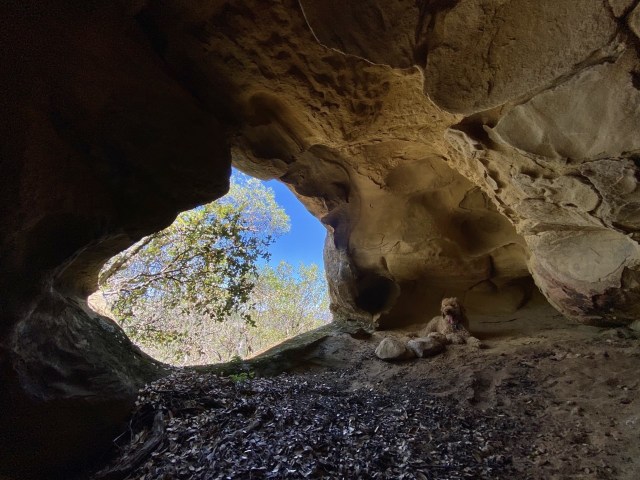
Chumash pictograph cave, National Forest Wilderness, Santa Barbara County

One of the oldest human skeletons found in North America was discovered in 1959 on Santa Rosa Island in Santa Barbara County.

The bones, alternatively having been called the “Arlington Springs Man” or “Arlington Springs Woman,” are believed to be around 13,000 years old.

The Chumash people bridged the gap between the prehistoric and historic periods in this region.

Jan Timbrook, Curator of Ethnography at Santa Barbara Museum of Natural History, cites several primary sources of “ethnohistoric evidence which shows that the Chumash did deliberately use fire in ways which may have had pronounced long-term environmental effects.”

Jan Timbrook in “Vegetation Burning by the Chumash”:

“It seems likely that the Santa Barbara coast in pre-European times was dominated by grassland and oak savanna. … Indian burning may also have been an important factor in maintaining the openness of oak savanna in coastal areas.

Chumash arrowhead, Los Padres National Forest, Santa Barbara County

Wilderness is an American cultural conception, an abstraction existing in the collective minds of the American people.

One day a stretch of wildlands exists out there. The next day a law, words on paper, is passed and the land is suddenly wilderness. Voila!

Nothing changed but the particular way in which the citizenry seeks to categorize and control the land and its wildlife. And then we fight over it ever after. It’s good fun.

That the land to be protected may be the product of Native American stewardship stretching back millennia through countless generations is overlooked.

That Americans changed the land by removing the Indian and ending native management practices rooted in ancient traditional ecological knowledge is overlooked.

The complicated history of the land goes unrecognized or is largely if not altogether ignored in order to prop up and promote the simple national myth.

Chumash petroglyph cave, National Forest Wilderness, Santa Barbara County

Ironically some of the wilderness Americans sought to protect and preserve may have grown as a result of their fellow countrymen’s own actions in settling the country.

“Almost wherever the European went, forests followed,” Stephen Pyne writes. “The Great American Forest may be more a product of settlement than a victim.”

Whereas Native Americans regularly fired large portions of the land across the continent, American settlement brought with it a general reduction in fire, which allowed for the growth of forests.

Pyne in Fire In America:

“The effect of European settlers was in general to reverse that [grassland] frontier, first by occupying the land and then by bringing with them the forest, an environment that Indians found largely uninhabitable. Reforestation, primarily through direct or de facto fire control, has succeeded beyond the wildest dreams of the young aboriculture and forestry movements.”

Aldo Leopold in Sand County Almanac (1949):

“In the 1840’s a new animal, the settler, intervened in the prairie battle. He didn’t mean to, he just plowed enough fields to deprive the prairie of its immemorial ally: fire. Seedling oaks forthwith romped over the grasslands in legions, and what had been the prairie region became a region of woodlot farms. If you doubt this story, go count rings on any set of stumps on any ‘ridge’ woodlot in southwest Wisconsin. All trees except the oldest veterans date back to the 1850’s and the 1860’s, and this is when fires ceased on the prairie.”

John Muir in Boyhood and Youth (1913):

“The uniformly rich soil of the Illinois and Wisconsin prairies produced so close and tall a growth of grasses for fires that no tree could live on it. Had there been no fires, these fine prairies, so marked a feature of the country, would have been covered by the heaviest forest. As soon as the oak openings were settled, and the farmers had prevented running grass-fires, the grubs grew up into trees and formed tall thickets so dense that it was difficult to walk through them, and every trace of the sunny ‘openings’ vanished.”

National Forest Wilderness, Santa Barbara County

Folks nowadays have inherited the environmental product of all those people that lived on the land long before.

Wilderness is not primeval and untrammeled.

Wilderness is an artifact.

There is no going back to “the world as it was in the beginning,” as President Johnson declared when he signed the Wilderness Act.

“Once man had played God. . .he could not stop his intervention. The primeval scene was gone forever,” Alston Chase writes regarding wilderness management of Yellowstone.

He makes a simple point.

“Natural conditions, like virginity, once lost, could never be recovered.”

Alston Chase Playing God In Yellowstone: The Destruction of America’s First National Park (1987)

We cannot go back or return to the beginning because we—Homo sapiens, that is, Native Americans generally, the Chumash specifically in Santa Barbara and the people that followed—long ago intervened in nature and forever altered the course of evolution.

Anderson on the legacy of Native American land management:

A reassessment of the record in California reveals that land management systems have been in place here for at least twelve thousand years—ample time to affect the evolutionary course of plant species and plant communities. . .

When the first Europeans visited California, therefore, they did not find in many places a pristine, virtually uninhabited wilderness but rather a carefully tended “garden” that was the result of thousands of years of selective harvesting, tilling, burning, pruning, sowing, weeding, and transplanting.

*

In many cases these landscapes experienced far greater degrees of managerial care and ecologically sophisticated manipulation than are found today. Over time, indigenous peoples’ investment in time and energy in tending many habitats produced real biological changes in those habitats. Important features of major ecosystems may have developed as a result of human intervention.

Yet even if we cannot return to the world as it was in the beginning it may be tempting to think we can return wildness to wilderness if only we step away and let nature alone to take care of itself.

When Ventana Wilderness Alliance in November of 2019 posted a news story regarding road closures in Monterey County, California and the resulting reduction of forest access for recreationists, a man offered an enthusiastic endorsement of the closures believing that keeping humanity out would lead to a wilder wilderness.

“Praise doggod!” he exclaimed amusingly. “Lack of funding making wilderness more wild!”

Would that were it true. But wildness and wilderness are not the same thing.

We may have a huge tract of designated wilderness, but with not much wildness in it.

Some stretches of wilderness around this neck of the woods today were once home to grizzly bears and wolves and bighorn sheep and condors and steelhead trout and many other species that are now drastically reduced, critically endangered or regionally extinct.

The image of the bear on the California flag represents the last known grizzly that lived in the state. The bear did not die of natural causes. The bear was shot to death.

The wilderness was designated and human access greatly restricted and wheeled transportation and motored machines prohibited, no roads of any sort assured, but such measures did not increase wildness.

Chumash pictograph cave, National Forest Wilderness, Santa Barbara County

A gentleman from a local chapter of the Sierra Club, and whose family has given land that was preserved and protected from development in perpetuity around these parts, offered a similar and common interpretation of wilderness in a newsletter:

“The wildness of the land, wilderness we call it, is a place untouched by the human hand where each of us can go to be in awe of our natural world.”

Paul Shepard drew a sharp and critical distinction between wildness and wilderness.

“Wildness is a genetic state,” he wrote. “Wilderness is a place that we have dedicated to the wildness.”

He goes on to note that, “To his credit Thoreau did not say, ‘In wilderness is the preservation of the world.’ The Great Aphorist did damage enough without confusing wildness and wilderness.”

Instead, Thoreau wrote, “In wildness is the preservation of the world.”

Paul Shepard Coming Home To the Pleistocene (1996)

In the genetic bank of wildness is the preservation of the land; land as understood in the all encompassing sense that Aldo Leopold used the word to describe not only the ground, but the flora and fauna that live in and on it. Everything. The collective biotic systems.

Protecting wildness is much different than protecting wilderness.

Protecting wildness often times requires human intervention, the touch of human hands, and so the setting aside of the myth of an untrammeled wilderness.

A lack of funding to government agencies does not make wilderness more wild. That the road leading to wilderness is closed does nothing for our cause here either.

The condor serves as the greatest icon of both wildness and wilderness in Santa Barbara County.

The bird humanity saved from extinction after nearly causing it in the first place.

Our hands are all over everything. We have left finger prints at the scenes of many misdemeanors and crimes.

Humanity is inextricably bound up in this story of life. Humans play the part of evolutionary engineers picking and choosing intentionally or otherwise. Humans are the ultimate agent of change.

Whether we choose to fire the forest or extinguish fires in the forest, we are selecting one way or the other, and altering the course of life on the land.

Pyne in Fire In America:

“In many environments fire, anthropogenic or natural, is the controlling agent of ecological dynamics, exerting an inordinate influence on the composition of flora and fauna, on their historical arrangements, and on their contemporary energetics.

Fire in natural, as in cultural, systems is as effective an agent by being withheld as by being applied.”

Paul S. Martin in Twilight of the Mammoths (2007):

“We often identify as ‘wild’ conditions those that are in fact heavily influenced by humans. In appraising ecosystems, both ecologists and the general public may overlook, or leave to the anthropologists, or simply take for granted the one mammal of overriding importance — Homo sapiens.”

A cave beside a mountain meadow in National Forest Wilderness, Santa Barbara County

We may be losing wildness within our wilderness because of our hands-off management approach.

The genetic bank of wildness is not what it once was not despite the Wilderness Act, but perhaps because of it.

Wilderness today may becoming less wild without humanity rather than more wild.

Native Americans not only manipulated the ecological succession of the land and its floral composition using fire, but actively tended the wild in numerous other ways as Anderson details.

These practices together carried out through millennia did not just temporarily change the appearance of the land, but reoriented biological systems thus setting the natural world on a new evolutionary course.

In the face of such history the idea of an untouched primeval American wilderness unravels and falls apart. The myth is shattered.

But another crucial point arises.

Native American tending of the wild resulted in an abundant and prolific diversity of plants and animals otherwise not possible without the touch of human hands.

Today, with our national neglect of Native American history and traditional ecological knowledge, this natural richness has diminished and these wild communities of plants and animals may further decline or disappear.

Anderson in Tending the Wild:

“The disturbance caused by California Indians’ use of fire in a variety of ecosystems, occurring at intermediate intensities and frequencies, promoted a maximally heterogeneous mosaic of vegetation types and increased species diversity.”

Rather than becoming wilder without humans it might be said that these places have become less wild as the floral composition of the land becomes more homogeneous, less diverse, without the careful hand in Indian tending.

If we are to think of plants and animals as the denizens of wilderness, then the fewer of these wild characters that reside in the neighborhood the less wild the place is.

We should not conflate the absence of humanity and wildness.

And not only does it appear that we have lost some diverse communities of plants in some places, but the animals and organisms once found there as well.

The land as tended by Native Americans “supported a rich and varied fauna of butterflies, birds, and small mammals that is now largely absent,” Anderson suggests.

The many species previously attracted to these once robust and prolific places have declined or disappeared as the habitat changed with the absence of Indian stewardship.

Anderson in Tending the Wild:

“Removing California Indians from traditional economic and land management roles in California has not led to a prehuman state of nature in our wildland areas. Instead, the hands-off approach to management of wilderness preserves is jeopardizing the long-term stability of many plant communities.”

So what’s a wilderness?

Whatever it is, a wilderness is not primeval and untrammeled at this late stage of the continent’s human occupation.

So why bind ourselves to this romantic national myth any longer in managing our wildlands when doing so may threaten and degrade the very treasures we seek to preserve and protect?

Posted in Santa Barbara | Tagged , , , , , , , , , , | 9 Comments