The Los Padres Box Of Chocolates

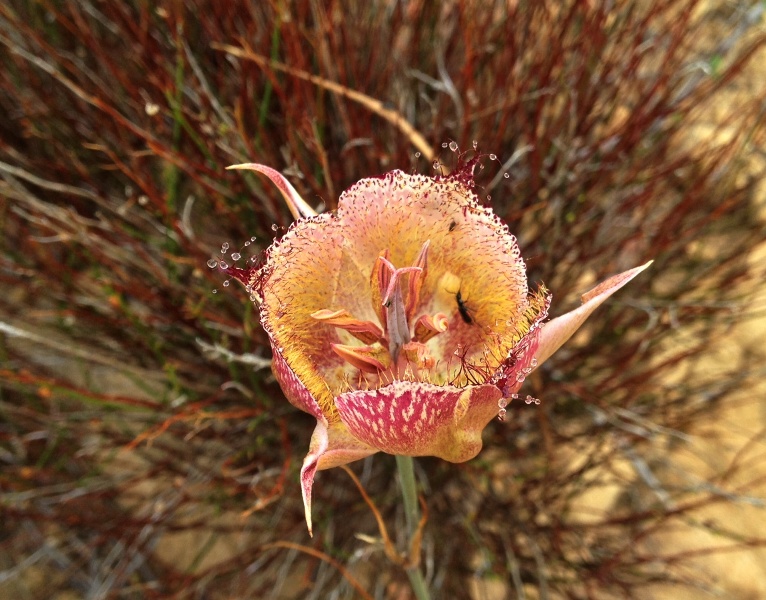
Tiger lily Santa Barbara hikes Los PadresHumboldt lily growing in Los Padres National Forest.

“Sometimes I feel so uninspired
Sometimes I feel like giving up
Sometimes I feel so very tired
Sometimes I feel like I’ve had enough”

Steve Winwood, Traffic – “(Sometimes I Feel So) Uninspired

I often go for aimless hikes. I wander. I need not a notable destination, my only goal to leave the city and immerse myself in nature.

Many times, if not most, I don’t even know where I’m driving to go hike when I leave the homestead until I end up there. This has been, more than usual, my modus operandi of late.

There has been a sharp decline in my activity on this blog for some months now. I suddenly lost interest, inspiration waned and I had had enough, but there is more to it than that alone.

The blog started as a creative work that complimented my existing proclivity toward outdoor recreation in the wild and my love of writing and learning. I could venture out, take a few snapshots and then write about my experiences. The blog added another element of fun to what I already had been doing my entire life.

But my digital offspring mutated like Gregor in The Metamorphosis into this hideous beast that became a burden to keep. The blog turned into something of a cyber despot dictating what I should and should not do.

No longer did I feel I could merely go out just to get out. While I never felt as though I was in competition with other bloggers, I did increasingly feel that in each outing into the woods I had to achieve some notable ends, had to bag the big story and return with a humdinger of a feature. This led to a necessity for more planning than I have ever had any interest in spending time doing. No longer could I just wander without intention or goal. I had to generate content.

swallowtail butterfly lily Santa Barbara Santa Ynez Mountains hiking Los Padres

“My momma always said, ‘Life was like a box of chocolates. You never know what you’re gonna get.'”

Forest Gump

The longer I set aside concerns about chasing waterfalls and caves and long trails and catching interesting material upon which to build a meaningful blog post, however, the more I hiked in relatively average areas with seemingly nothing remarkable about them.

Yet, at the same time, I was increasingly surprised to find during nearly every aimless wander through the supposed ordinary, how I stumbled upon something that made it all well worth my time and energy. It was not ordinary at all. The line from Forest Gump would always replay through my head. I just never knew what treasure I would find next.

A few days ago I was hiking with my dog up a heavily visited canyon, a place I habitually ignore because of its popularity, despite its natural splendor. I had managed to carry my dog over a dry waterfall before coming to a couple more, which I could not get him over.

Frustrated, I turned back early.

Though I enjoyed the hike, it had seemed that in being cut short it had no point. I had not reached a destination. It was the lingering taint of the dictatorial blog burdening my mind.

Then on my way down the creek I took a wrong turn, just a few feet the wrong way into the bushes, really. Turning back I found the path I had intended to follow a few steps later and a lily came into view, which I had not seen on my way up the creek. I stopped to take a gander and a tiger swallowtail butterfly fluttered down onto the bloom.

I had been waiting years to capture a snapshot of a swallowtail on a lily, two of the most striking small varieties of life in the forest. And here was my opportunity. Had I been able to hoist my dog over the waterfalls a short time earlier I would not have stumbled upon this chance.

“I don’t believe in coincidences, only chains of event which grow longer and ever more fragile until either bad luck or plain old human mean-heartedness breaks them.”

Sandy Dearborn in Stephen King’s, From a Buick 8

Of course, such an event can always be looked at as though every little choice made throughout my entire life had brought me to this specific place at this specific time just as this butterfly floated out of the sky to sip the flower’s nectar, after having completed its own long unknown chain of events in its own life.

Anyhow, whatever the case may be, I got the photo. And it made the hike worth every bit of my time and energy. I never set out searching for this chance. I just went wandering with no particular aim and it happened, because in Los Padres National Forest you just never know what you’re gonna get.

Posted in Santa Barbara | Tagged , , , , , , , , , | 13 Comments

The Politics of Rock Art

Santa Ines WinerySanta Barbara County vintage making use of Chumash pictograph motifs.

When one takes an interest in actively seeking out and visiting Chumash rock art paintings they soon learn that there is an emotional and contentious political subculture swirling around these archaeological sites. Certain etiquette dictates, or at least some people would like to think that it should govern, how the sites are expected to be talked about or shared.

The rise of social media outlets have further complicated and exacerbated this matter. When a person infringes upon or violates these unwritten rules they can expect to receive criticism ranging from respectful, tempered and reasonable disagreement, to comments reflecting all reason having been drown in simmering emotion, to unhinged and vicious hostility.

The following quotations are real comments I have received in response to having posted a limited number of photographs of Chumash rock art sites over the course of several years. The comments are followed by my response.

“Get this ******* **** off the Internet!”

It is an emotional issue, for some. This outburst was delivered in response to a post showing a handful of bedrock mortars.

“Rock art isn’t meant for consumerism and materialism.”

Nobody really knows, unequivocally, what rock art was meant for because the people that created it no longer exist and they left no written record detailing their motivations. All that is said to be known is rooted upon a questionable foundation of differing degrees of conjecture based on empirical information obtained by scholars while visiting the sites in question, and educated presumption based on the testimony of a scant few secondary sources, as derived from the ethnography of a single white man.

Pictos

A screenshot of an advertisement that popped up on my computer.

What is known about Chumash rock art represents a slim sliver of the entire body of facts surrounding the work, the vast overwhelming majority of this information having been forever lost when the people who created the art and their immediate descendants died or were killed or murdered.

What rock art is meant or not meant for will never be decisively known. Such a statement as quoted above is, therefore, an opinion more than anything else. It is a normative statement, and whether it holds any more validity than the beliefs of anybody else is a matter of opinion itself.

When I attended the Santa Barbara Harbor Festival last October there was a “Chumash Education Booth” which was selling t-shirts adorned with rock art motifs. They obviously had no concerns about exploiting the matter for profit for the purpose of “consumerism and materialism.” I did not see anybody from any band of Chumash protesting.

More importantly, the quoted opinion above runs contrary to the manner in which the most visible and socially active contemporary Chumash people in Santa Barbara County currently make use of rock art.

Far from shunning “consumerism and materialism,” these people have embraced it with vigor to reap hundreds of millions of dollars in annual material gains selling gambling and liquor, among other things.

Visit the Chumash Casino on the Santa Ynez Reservation and one will see that the Santa Ynez Band of Chumash readily make use of rock art motifs as a means of marketing their gambling house. One can see depictions of rock art on token coins, poker chips, roulette wheels, casino carpeting and the casino logo itself.

Furthermore, rock art motifs have been licensed for commercial use by a Chumash elder and are sold for profit:

Pictographs for profitA screenshot of Larry Carnes’ “Chumash Stone,” a phrase, as denoted above, that has purportedly been copyrighted.

The opinion that “rock art isn’t meant for consumerism and materialism” is utterly out of line with the practices of the Chumash themselves, which seek to profit from these images in various ways some of which are dubious and morally suspect.

I have been told than many Chumash believe rock art sites are sacred. I don’t know that I needed to be informed of that, it does not come as a revelation to me. But again, the actions of their leaders, and by extension the common folk themselves, reflects a very different feeling. And as the cliche goes, actions speak louder than words.

Is something sacred to be sold for profit? To be used as a marketing tactic to sell gambling to the tune of billion dollar profits?

One may object to note that the Chumash should be free to use the rock art left by their ancestors in any manner they wish, which is certainly a reasonable point. However, the assertion here is not who gets to use it for what purpose, but that it is not meant for certain uses by anybody.

The person that wrote that quote does not have a drop of Chumash blood in his veins.

“You treat it like a museum attraction that everyone has a right to.”

The corollary being exclusivity, that only some people have this right. It appears this person does not know what a right is, but is instead speaking of privilege.

This I am accused of for merely posting photographs of rock art. It is a statement that reeks of elitism and reveals a mentality of exclusive entitlement, that only a select chosen few should be allowed to lay eyes upon a photograph of rock art.

If a person is not among the coterie, or is not known and approved of by the ruling class elite, but rather a member of the untitled public lacking credentials, a mere commoner, they should be prevented from even so much as seeing a photograph of the rock art found within the National Forest, which is essentially owned by We the People.

It is a sentiment that I would posit runs contrary to the very founding principle of the National Forest system of conservation, as founded by President Roosevelt and Gifford Pinchot during the Progressive Era of American history.

At that time a few powerful men of vast financial means and influence sought to use the American forests for their own purposes, while dismissing the right of the people to have any claim to them.

Roosevelt and Pinchot waged a political war against powerful congressmen, senators and their allies in business to secure for posterity national forests and the resources therein for the many people, over the select few special interests.

Pinchot and his colleagues and peers often did this at their own personal expense without recompense from the government. This fact being a reflection of their earnest, selfless commitment to preserving the forest for all people.

Furthermore, it is a sentiment that runs contrary to the actions of the United States Forest Service, which has installed numerous register boxes at rock art sites throughout the Los Padres National Forest, wherein visitors can sign their names, leave their address and comment on their experiences when viewing the rock art in person.

In addition, the USFS created campgrounds at some of these rock art sites, which have been listed on publicly available maps created by the United States Geological Survey, both federal agencies, by definition, being of, by and for all American people.

Moreover, the man that wrote this comment above in response to me posting a few photos of Chumash rock art has published online, by way of a world renowned magazine with a world wide audience, numerous photos of pictographs. He also regularly publishes to the world via Instagram, as noted below under his quote about supposedly “not flaunting where I’ve been,” photos of rock art sites he visits. In other words, I have done nothing different than what he does himself apart from having a far smaller audience.

PictographA screenshot of a freely accessed scholarly journal article by Dr. Thomas Blackburn, recipient of the Fredrickson Lifetime Achievement Award of the Society for California Archaeology. Many other such articles are readily available to the general public.

“Archaeological information is limited to fellow archaeologists. . .”

This assertion is demonstrably false.

Archaeological information can be readily accessed by the public through various physical locations, such as libraries or book stores, and much of it including peer reviewed scholarly journals can be freely read by the public online or accessed through subscription sites whose only limiting factor are paywalls.

Furthermore, any American citizen can obtain archaeological information by filing a Freedom of Information Act request (FOIA). Authorities have some discretion in choosing what they release with respect to concerns about protecting sensitive sites, but this does not equate to a blanket ban on the release of such information, which they are otherwise obligated by law to provide anybody that asks.

“. . .or conscientious people that can keep a secret. . .”

Were it a secret this person would not know the location of any archaeological sites. It is apparently okay for them to be told and for them in turn to tell others, but you should be prevented from being one of those told or doing the same yourself.

“This info should only be accessible to people who have paid their dues, . . .”

Another self-anointed arbiter and gatekeeper of the public’s resources for whom if others do not act in specific accordance with their own personal opinion, then they should be barred from access and denied opportunity.

That is not a reasonable basis upon which to deny anybody anything.

It is a meaningless statement reflecting the capriciousness of individual opinion. What exactly is due? It is certainly not a sound basis upon which to found public policy governing public resources.

“shouldn’t be online.”

That battle was lost years ago on account of the federal government and leading scholars and authors in the field of Chumash archaeology, all of which have published to the world far more detailed, revealing and sensitive information than the limited number of photos I have put out, which comprise a puny percentage of the content on my blog.

This person is concerned about the figurative mist leaking from the wee hole that is my blog, when the leading figures in this field responsible for protecting these resources and studying them have blown a gaping chasm in the dam the person wishes would hold back the reservoir of knowledge they do not want revealed.

“I don’t think you do the wild secrets of the backcountry, their long standing remoteness and sparse visitation rates, or the communities who love and visit them any good by doing this. . . This is backcountry pornography whether you will ever admit to it or not. And YOU are whoring it out.”

This may be the most reasonable criticism I have received to date. I have to confess that I cannot think of any good my posts have done for these sites themselves as places other than perhaps increasing knowledge and awareness, which in turn helps build support for their protection, because you cannot possibly hope to protect something that people do not know exists, do not know about and do not understand.

That argument, however, can be flipped on its head and it can be said that such exposure, on balance, creates far more damage than good, through increased visitation by way of making more people aware of something they otherwise might not know about.

But again we hear of supposed “secrets” needing to be kept, supposed secrets that exist on public land in the nation’s most populace state, but which the public should never enjoy nor see, and shame on me for revealing them, even though I provide no directions but only a few carefully selected photos which are not dissimilar in presentation on my blog relative those photos published to world be leading scholars.

These secrets will be erased by nature alone in time rendering this entire debate meaningless and irrelevant.

Edward Abbey

“My lips are in general sealed”

Yet this is the same person that unexpectedly called me one afternoon and proceeded to inform me that he knew of many rock art sites, which he promised to lead me to or provide directions to once he returned from a trip to Belize.

This from a person I had never spoken to in my life. An utter stranger that rambled on for long minutes, as I listened in silence, dumbfounded as to why he was telling me all this information I had not even asked for or suggested I was interested in receiving from him.

This is the same person that commented on one of my blog posts that there was some really nice rock art nearby the location I mentioned in the post and that he hoped I saw it. This was a post that had nothing whatsoever to do with archaeology nor did it mention rock art. He made these public comments on my blog anonymously, which suggests to me he did not want his name to be tied to such a revelation, which I presume was because he really did not think what he was doing was the proper course of action for somebody in his professional position as a leading scholar of rock art in California.

Apparently, there is a lot covered under the rubric of “general” in this statement about supposedly having sealed lips. And if this was the case with me, that this stranger called me to say they would give me directions to archaeological sites, it seems reasonable to assume it happened to other people, as well.

And in point of fact, I know it has indeed happened and that this person has revealed  information to another person whom he did not know personally, somebody that he knew had a history of publishing photos on the Internet of pictograph sites. And because this person with supposedly sealed lips freely gave out specific directions more photos were posted online of an exceptional, unique rock art site that may well have never been previously shown publicly on the Internet.

Perhaps earlier scholars and government agencies made a mistake in making information about pictograph sites publicly available. Whatever the case, the leaks, if that is what they are, continue today straight from the mouth of a somewhat prominent California archaeologist who could hardly contain his eagerness to unload this information to me, a perfect stranger who never asked for it.

“I’m not flaunting where I’ve been and don’t feel the need to”

I could provide a photograph of this person posing beside, very close to, a large pictograph in the San Rafael Wilderness, but out of respect for his privacy I will refrain from doing so. This is not personal, but business. I seek not to embarrass anybody but to expose their sophistry. The photo is, however, found on the Internet, published to the world, but apparently not flauntingly.

I could provide a link to this person’s Instagram page whereupon he has posted photos of numerous pictographs, including one he published just four days ago as of the time of this writing. The photo is captioned with text describing how he is looking forward to visiting the rock art site in the photo, which is shared to the world without restriction.

More to the point, I do not post content to my blog to flaunt where I have been. My motives are far removed from any desire to flaunt or brag about anything. Such an allegation misses the point entirely.

“Why is there the NEED to share something like this in the way you did?”

If we are going to emphatically speak of needs, then let us note the fact that there is no need to do anything on the Internet and in fact no need for the Internet itself. Civilization operated just fine prior to the advent of the world word web. So we can cast this question out with much of the other empty, thoughtless criticism as it lacks any reasonable basis whatsoever.

The way I shared was only different than the books, the magazine articles, the peer reviewed scholarly journals, the international licensing agency peddling photos of the site, in that I did not name the particular creek upon which the painted cave is located, while all the aforementioned sources did specifically name the site’s general location thereby revealing it to the world.

That is the difference. And it is a rather notably big difference.

In that it can be confirmed that I exercised more discretion than the purported professionals, a fact which appears to be in-line with the previously expressed sentiment by this person, that what is acceptable behavior for the clique is not acceptable for those people outside of or those people unaccepted by the elite chosen few, the self-anointed gatekeepers.

“I honestly feel that blogs like this are selfish”

I am being accused of selfishness for sharing.

United States Forest Service chumash Rock Art Pictograph SignThis sign was erected years ago by the United States Forest Service near the site of a relatively well-known Chumash pictograph site in the remote Santa Barbara backcountry.

Generations not yet living cannot possibly possess a moral claim over current living generations on the ownership of present day public resources.

“Can it be conceived that there are men so absurd as to love posterity better than the present generation; to prefer the man that is not, to him who is; to torment the living under pretense of promoting the happiness of those who are not born, and who may never be born?”

-Jeremy Bentham, British philosopher (1843)

“‘If the law supposes that,’ said Mr. Bumble, squeezing his hat emphatically in both hands, ‘the law is a ass — a idiot.'”

―Charles Dickens, Oliver Twist (1837)

Posted in Articles | Tagged , , , , , , , , , | 17 Comments

Wildcrafted Salad

miner's lettuce Claytonia perfoliatumMiner’s lettuce (Claytonia perfoliatum) growing in profusion along a shady bank of Alder Creek in the Santa Ynez Mountains of Santa Barbara County.

Skills Are Weightless

“You have to travel light. . . And you have to be self-reliant. . . Bushcraft is a knowledge of nature that enables you to travel safely and relying upon nature to some extent for your sustenance, self support. It’s the knowledge our ancestors had. It’s the knowledge of First Nations. . . At its core is a love and understanding of nature.

Bushcraft transforms your view of the forest, that is for sure. In time you become much more perceptive. You look for tiny things in nature. It’s the small things that you notice that tell a big story. You gain this experience. . . With experience your subconscious can pick up all of those details and interpret them and use them to read the landscape.

The really sad thing is that when this knowledge is lost an interface with the land is lost. That’s the one thing that First Nations have that we should aspire to is this close tie to the land.”

-Ray Mears, “We Belong To It”

Miner’s lettuce was the first wild edible I learned to identify as a young boy, which is funny because the last thing I wanted to eat as a kid was something green and leafy that tasted bitterly of chlorophyll. Nowadays, however, I recognize what once seemed like trivial knowledge as great value.

The seasonal burst of annual herbs in the mountains of Santa Barbara County offers foragers an excellent opportunity to harvest wild edibles. Perhaps wildcraft is most valuable to overnight hikers far out on a distant trail in the remote stretches of roadless wilderness, where all supplies and most necessities to sustain and nourish the body, what so very little one can physically carry, must be laboriously lugged over rugged terrain in a backpack.

Wildcraft skills, like bushcraft, enable a person to limit the amount of bulk and weight they must carry on their back while in the forest. Knowledge and skills weigh nothing and take up zero space in a backpack.

What a person carries in their head they need not carry on their back.

Miner's Lettuce Claytonia perfoliatumMiner’s lettuce in bloom. The Chumash Indians harvested the tiny seeds for food.

A Typical Trip

Imagine a common backpacking experience. Let’s say we’re ten or twenty or thirty miles into the wilderness on foot, and for days we’ve been grinding away on and filling our bellies with nothing but dry and rehydrated foods.

Prepackaged backpacking meals, dense and grainy energy bars, nuts, jerky, pasta or maybe some warm and oily salami and cheese. It’s all decent trail food. But it sure isn’t fresh, succulent nor refreshing.

Nor does it invite one to look deeper and more keenly into the forest and ponder the natural value surrounding them, thus learning and acquiring a more intimate knowledge, understanding and, therefore, appreciation and respect for the wild world.

Johnny Jump-ups Viola pedunculata California native Santa BarbaraJohnny Jump-ups (Viola pedunculata) blooming beneath oak canopy in the Santa Ynez Mountains.

Epicurean Class

One afternoon on our multiple day hike we spend time collecting a bundle of fresh wild greens from the forest surrounding camp. Grabbing a stick, we dig up and clean a handful of Calochortus flower bulbs, toss them in olive oil and fry them up over the campfire or set them atop a rock beside the flame to roast, which we later toss into the salad mix for added flavor and nutrients. We pluck fresh wild peas from the vine. We collect a handful of edible wildflower blooms like Johnny Jump-ups to add a colorful eye-catching accent to the lettuce, nutty-flavored roasted bulbs and crunchy sweet peas.

We lightly toss the freshly harvested fare with a smidgen of honey mustard balsamic vinaigrette we whipped up fresh at home before we hit the trail. Using our trusty bush knife we slice off a handful of cheese shavings from a small chunk of Parmigiano-Reggiano we’ve totted along, and we sprinkle a dash of black pepper to top it all off.

The result?

Well, it’s “good stuff, Maynard.” And good for you.

calochortus Los Padres National Forest hikesA Calochortus bloom seen along the Santa Ynez River.

calochortus bulb Santa Barbara Los Padres National ForestRoasted Calochortus bulbs rank among my top five favorite wild plant edibles for their exceptional flavor.

Value-Added

There is also value beyond good flavor and fresh healthy sustenance. One great aspect of foraging is that it provides a wonderful reason to get out into the woods off-trail and roam and meander about in no particular direction, when one might not otherwise venture into the forest for lack of a reason to do so.

Many times a hike is almost entirely about the destination: a peak summit, a waterfall, a swimming hole, a campsite or sometimes it’s just for the exercise and fresh open air.

Foraging cuts against that all too common grain and encourages wandering into the less visited nooks and crannies. And in that ramble one never knows what they might find, either tangible or intangible, or how they may be enlightened and enriched.

Foraging is an activity that draws one closer to nature both in being observant and aware of minute seasonal details in the forest that otherwise, and often, go unnoticed, as well as in its requisite knowledge of native plants.

And when one begins to use nature, respectfully of course, it can lead to a depth of understanding and appreciation that, I think, is impossible to acquire by those people who treat the woods like a museum, something to be looked at but not touched, or those people who stomp down the trail only casting fleeting glances at their surroundings with little aim other than reaching their destination.

Foraging and wildcraft offer up, figuratively, new trails of adventure to explore. One may have hiked through a certain section of forest for years and never paid much if any attention to such fleeting seasonal details. In doing so they have missed the forest’s small embellishments that combine to create a much richer and interesting natural tapestry.

Perhaps nature is like a stereogram poster. It looks like one big blur at first glance, but if one gazes long enough an intricate and marvelous picture materializes that once was hidden from plain sight. All one must do is look for it.

Miners Lettuce saladMiner’s Lettuce (Claytonia Pefoliatum) and Johnny Jump-ups (Viola pedunculata), two native California edibles which can be found growing together seen here along the Fremont Trail in the Santa Ynez Mountains.

Don’t Just Survive, Thrive

Drawing on a little knowledge of nature, and with a bit a foresight and preparation, a backpacker far from the city can wildcraft a fresh, succulent and nutritious delicacy worthy of an classy urbane restaurant.

And while a salad may not alone serve sufficiently as an entire meal, I imagine the grim and rugged crowd scoffing at the thought of a wimpy salad after hiking all day in scorching sun, it surely provides an exceptional side dish to accompany whatever else is prepared in camp.

Although, when done well, that salad may just steal the show.

wild edibles peas Santa Barbara foragingNative wild peas in the pod.

wild peas Los Padres Santa Ynez Santa Barbara hikingThese wild peas are tender yet crisp, and sweet tasting. Their flavor may be as good as some of those one might buy at a grocery store, they’re just smaller in size. Toss ’em in a salad plain or collect a pot full to boil over the campfire and smother in butter or extra virgin olive oil.

Posted in Santa Barbara County | Tagged , , , , , , , , , | 4 Comments

Yosemite Falls

Lower and Upper Yosemite FallsLower and Upper Yosemite Falls, March 2015.

“One of Yosemite’s oldest historic trails (built 1873 to 1877), the Yosemite Falls Trail leads to the top of North America’s tallest waterfall, which rises 2,425 feet (739 m) above the Valley floor.”

-National Park Service

And then there is Yosemite National Park. What can be said of Yosemite? What can be said that has not already been said ad nauseam?

I have been there a couple of times since I began this weblog, but I never mentioned it nor posted a photo because it seemed cliched to do so, a snapshot of Yosemite Valley a cliche on film. It is so near perfect, and has been photographed so many times, anything I thought to offer up seemed superfluous.

The wilderness park’s iconic characters, whether waterfalls or granite monoliths or grassy conifer-framed meadows, have seemingly been photographed in every light at every season from every angle and described with every word and turn of phrase conceivable. 

What could I possibly add?

I do not want to add to the excess in an attempt at translating into language the natural majesty of Yosemite. And I doubt that I could cobble together a fresh and original string of words with a few images that was worthy of the place.

I typically hate using well-worn words like this, and do not like telling but prefer language to show. This time, however, I’ll just say, despite my recent posting of a critical opinion of trip reports and not wanting to “waste the time of readers with unnecessary, empty words and pointless rambling,” that the hikes in the park are awesome in the true sense of the term. (Ugh. That was awful!)

Here I offer a few snapshots from the Yosemite Falls Trail. Round trip it’s 7.2 miles with at least 5400 feet of elevation gain/loss. There are 66 switchbacks in the first mile alone! The trail climbs steep talus slopes up a wall of granite. From the valley below it looks impossible that a trail leads up the mountain.

Yosemite Falls Hike

Yosemite Hikes WaterfallsMrs. Elliott heading into yet another series of switchbacks as we near the top of Upper Yosemite Falls.

Half Dome Yosemite Falls Trail hikeUpper Yosemite Falls rainbowsDouble rainbows at the bottom of Upper Yosemite Falls.

Upper Yosmite Falls Half Dome

Yosmite Falls HikeTopping out and heading toward the precipice.

Upper Yosmite Falls creek pool hikeA pool above Upper Yosemite Falls.

Yosemite Falls HikingThe Mrs. scrambling toward the edge, Yosemite Valley far below.

Upper Yosemite Falls viewLooking over the edge at Upper Yosemite Falls.

Posted in National Parks | Tagged , , , , , , , , , , | 7 Comments

Rattlesnake Falls, San Rafael Wilderness

Rattlesnake FallsDavidStillman.com standing beside Rattlesnake Falls deep in the Santa Barbara backcountry on a recent backpacking trip, the creek a tributary of the Wild and Scenic Sisquoc River.

Posted in Santa Barbara | Tagged , , , , , , , , , , | 5 Comments