[EDIT: 12-12-13]
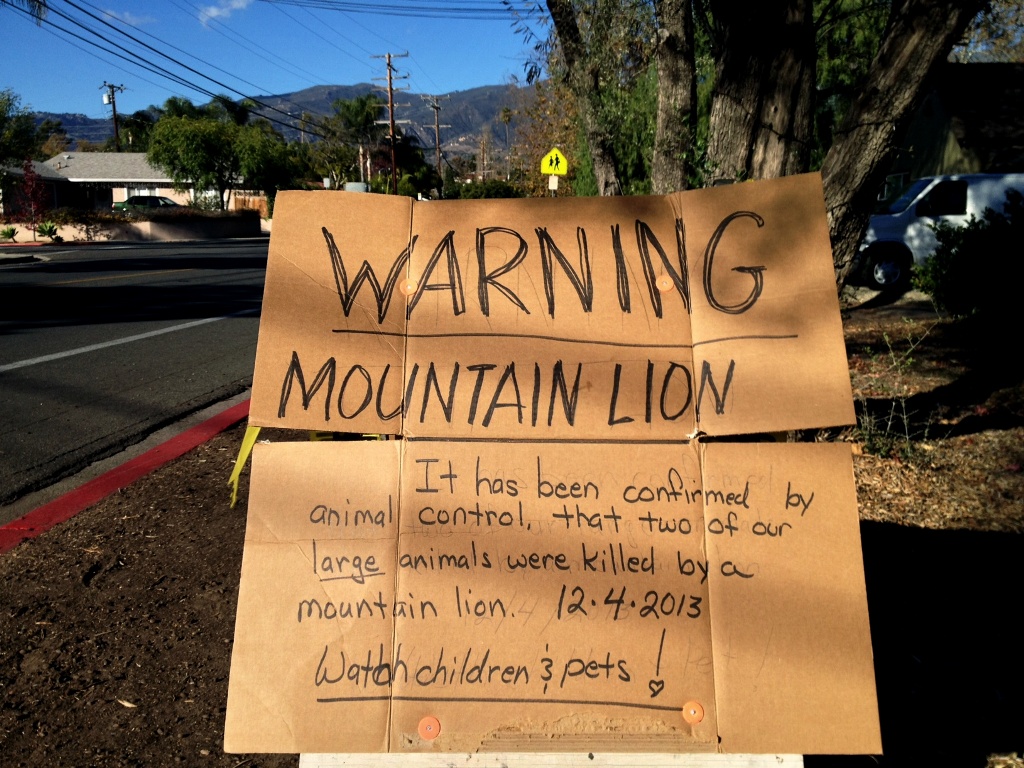
A few days ago a sign was placed beside La Cumbre road warning about a mountain lion that was thought to have killed two pet goats at a house on the bottom of La Cumbre Rd, about a block and a half from State Street.

[EDIT: 12-12-13]
A few days ago a sign was placed beside La Cumbre road warning about a mountain lion that was thought to have killed two pet goats at a house on the bottom of La Cumbre Rd, about a block and a half from State Street.
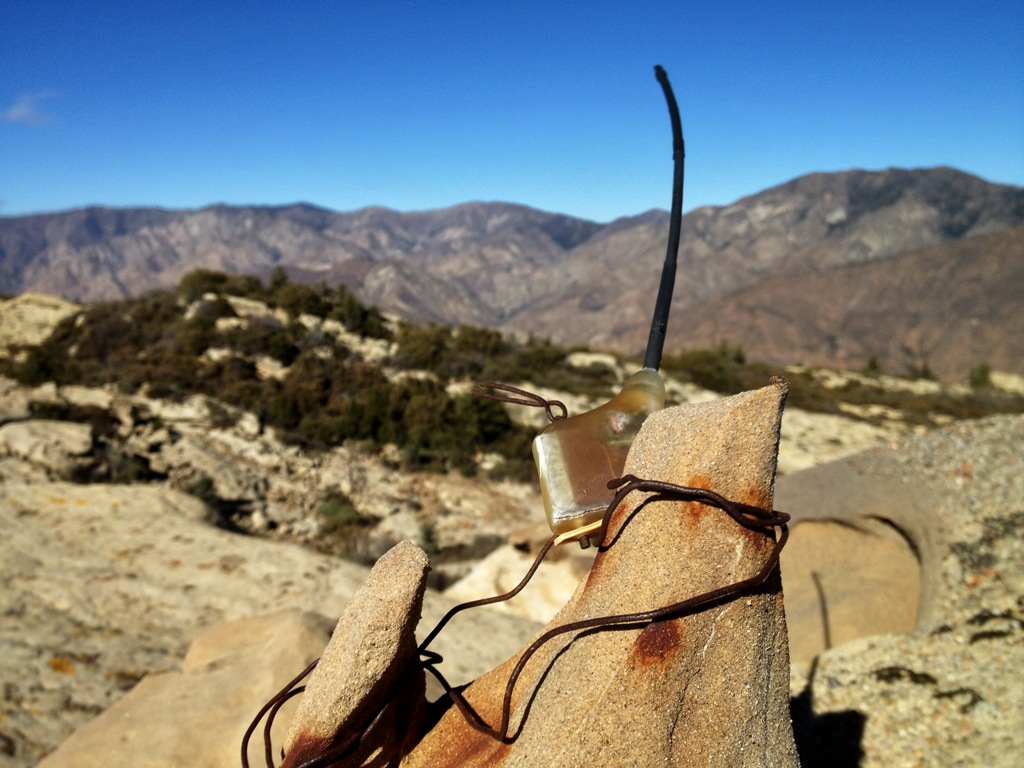 A long lost condor radio transmitter on Whiteacre Peak.
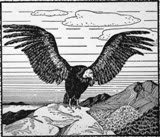
Condors seem to have an eye on Whiteacre Peak in Sespe Wilderness. The first time Stillman (davidstillman.blogspot.com) and I hiked the peak, after having just left the summit, condors came soaring out of the vast blue sky east of the mountain, dark dots in the far distance. Not long after one bird flew over us making a few passes before landing atop the very summit we had been standing on a short time before.
On our latest hike to the top of Whiteacre Peak, the summit of which is polka dotted with white bird poop, a condor once more flew over our heads making several passes, flying into the wind, easing slowly by looking us over before soaring off and disappearing into the distance.
Such relatively close encounters I suppose are rare. The California condor is a critically endangered species whose total population in 1987 numbered in the twenties. Between 1987 and 1992, after all known birds were captured for a captive breeding program, no condors at all flew wild in California. At the time of this writing about 219 free flying California condors are alive with about 53 of them having been released and fledged in southern California. (CDFW)
 Number 92 giving us the beady bird eye from the sky.
From the Dough Flat Trailhead, gateway to Sespe Wilderness within the southern Los Padres National Forest, Whiteacre Peak looks more like a rocky ridgeline than a peak. From some angles along Sespe Trail the summit actually looks to be lower in elevation than the surrounding sandstone outcrop.
Yet, despite it’s appearance from below it’s a notable summit, a rocky knob rising above the surrounding terrain and offering three hundred and sixty degree views of the Sespe Wilderness and far beyond including some of the Santa Barbara Channel Islands.
There were no signatures in the register since we were last there a year ago. And before that time the last signature was logged in 2007. It is appropriately labeled a “Seldom Visited Site” (SVS). While there are some sections of footpath and animal trail on the way to the peak, there is no official trail. It’s a relatively short, but tough hike requiring some scrambling and bushwhacking.
 Stillman and Mark enjoying textbook SoCal winter afternoon weather on Whiteacre Potrero below the peak.
The tilted slab of bedrock forming Whiteacre Peak slopes eastward and is hollowed out by wind and rain in various places to form a number of caves, alcoves and massive overhangs. There are several small grassy flats amongst the uplifted sandstone slabs and boulder piles, which are veined with wiry chaparral and punctuated with the occasional conifer. Several small basins or tanks in the slabs serve as reservoirs on the otherwise dry mountaintop by catching and holding rain.
The peak holds some well-preserved traces of the sandstone’s marine origins including ripple marks from water or wind on sand and rill marks suggesting the erosive work of retreating water during low tide. There are fossilized mollusks scattered about, which are common all over the southern Los Padres National Forest, but there are a few fossilized bones, too, from something relatively large.
It is a landscape I look over and feel compelled to explore, and since our first visit last year I’ve wanted to return, and to stay a night. Despite its relative close proximity to the trailhead, Whiteacre Peak feels very remote and desolate. Add the bear and mountain lion prints we’ve seen along with the condors and the peak is a rather notable bit of wildness in southern California.
 A chunk of what looks to be ancient tidal flat with rill marks and ripples showing the interplay between water and sediment now preserved in sandstone.
 Stillman heading down the rope section.
 Mark climbing up the rope section.
 After the rope climb comes the crawl.
 One of many dry caves on Whiteacre Peak.
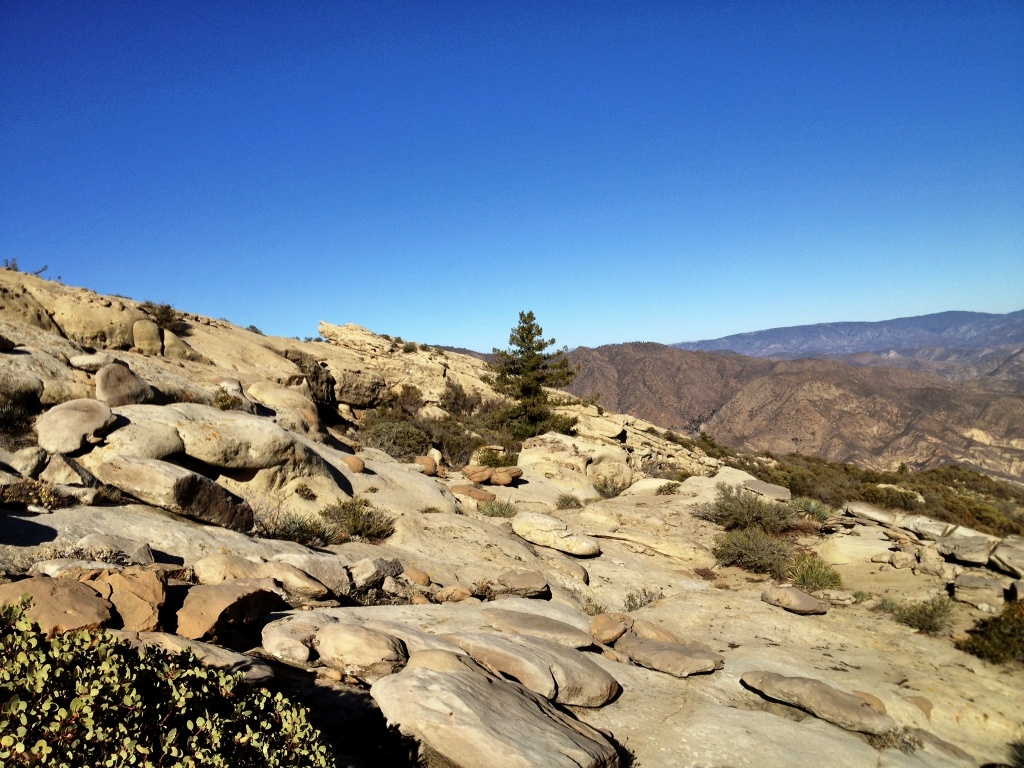 The east facing, backside slope of Whiteacre Peak.
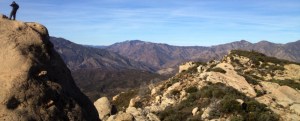
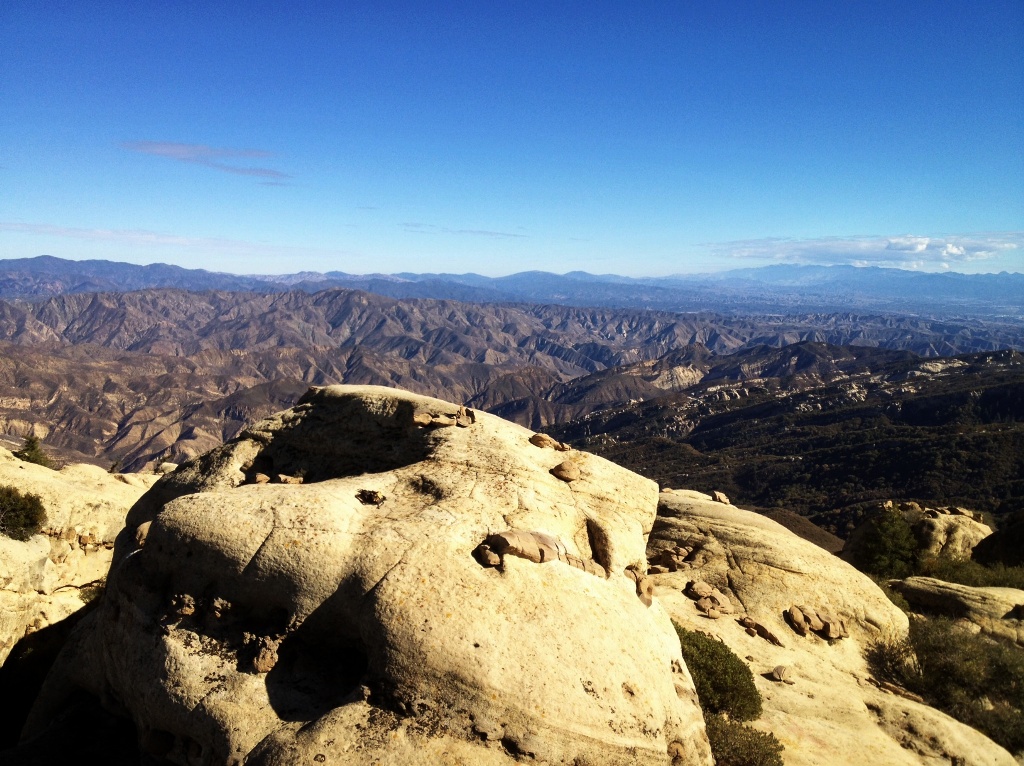 Looking east from Whiteacre summit.
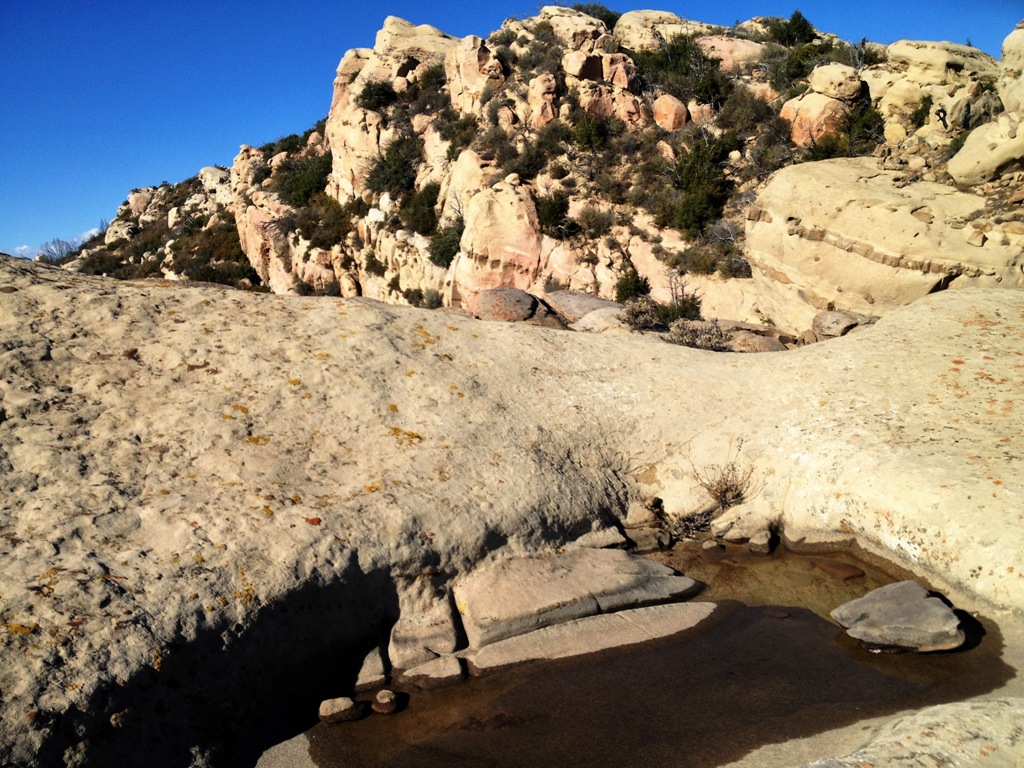 Whiteacre Peak as seen from along its southeast flank.
Related Post:
 Castle Rock, San Rafael Wilderness
Concerns in the wilderness revolve around basic necessities not luxuries. Removal from the busy, overstocked urban realm and immersion in the sparse serenity of pristine nature reduces life to an elemental state. Such experience trims the fat removing excess and in that leanness is found clarity and perspective.
Minimality transforms outlook and attitude. Things are the same but subtly different, as if a ray of light cast from a new angle has illuminated life in a way that reveals its previously unseen characteristics. The common and ordinary take on greater value or perhaps it’s that their true worth is better revealed.
 It is a less sophisticated slower-paced life in the wilderness, where boiling creek water to brew a spoon full of coffee or cook a handful of pasta can be a remarkably pleasurable experience, nearly an end in itself.
At home, caught up in the busy business of urban domestic life, cooking, while one of my favorite activities, can feel like a burdensome chore I just want to complete in order to quickly move on to the next task. Sometimes I wish there was a pill to satisfy hunger like aspirin relieves a headache.
At home I carelessly shovel heaping amounts of fanciful food from an overflowing cornucopia and guzzle a seemingly limitless variety or drinks from a bottomless well, a glutton assuming the never ending supply of endless choices will always be there when and where I demand it.
When in the woods, on the other hand, with only a small quantity of basic provisions, I relish each little bit as though it’s a pinch of a rare treasured commodity selected from a limited cache and held carefully in cupped hands.
Few victuals have ever been more enjoyed and appreciated as much as those simple meals I’ve eaten from a plain metal dish, on a dusty and battered old picnic table or atop my lap, around a flickering campfire out in the backcountry. In the wilderness I come to better appreciate so much of what I routinely take for granted while in the city. And I realize how little is needed to be happy.
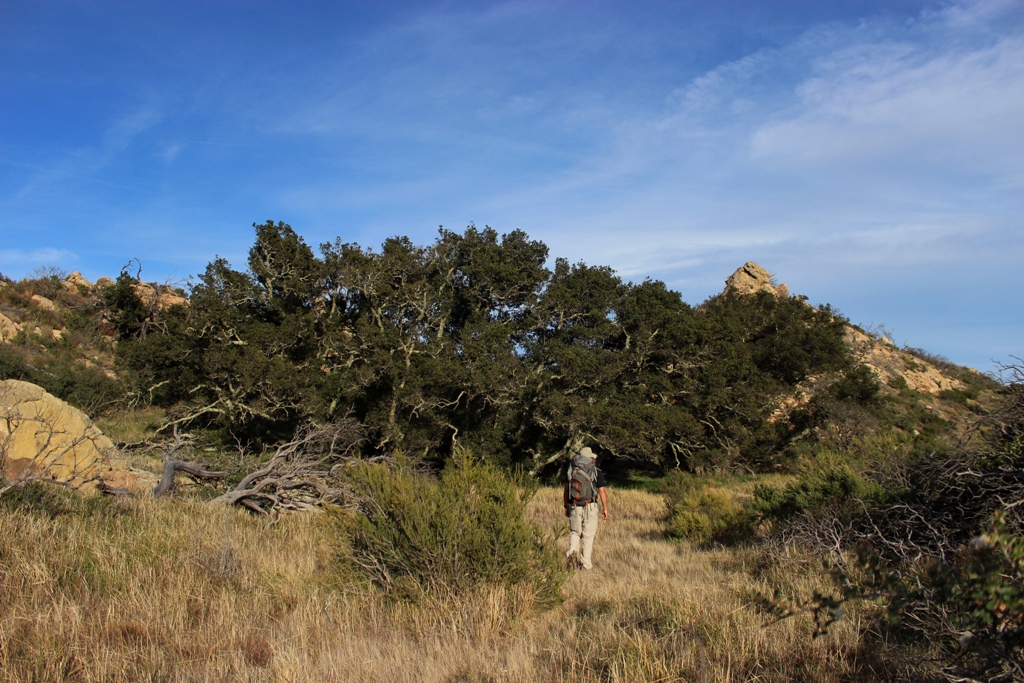 Wandering off-trail in the Santa Ynez Mountains.
 The more time I spend hiking the more important food becomes both in taste and nutritive content. Sooner rather than later it seems every sort of energy bar, snack, meal and caloric form is tried. Some are hard to choke down with any enthusiasm or enjoyment, even though wholesome and well made. Yet even somethings that are enjoyed eventually no longer satisfy and are a chore to chew up and swallow.
Sometimes, to avoid eating what food I’ve brought because it’s thoroughly unappealing, I’ll go most of a day eating very little to the point of precipitating fatigue, headache, stomach pains and a sever decline in physical ability. I’ll get back to my vehicle, slide into the seat feeling like I’ve been tortured, and head straight for the calorie bomb of a freshly made hot meal somewhere which hits the stomach like a bowling ball. If only I could get a good greasy cheeseburger, burrito or plate of enchiladas out on the trail!
 And so with the idea of finding something new and which I actually look forward to eating and that I unintentionally scarf down quickly like a starving dog—a sure sign of tasty fulfilling food—I started frying up miniature pancakes to take out hiking.
I use as a base high quality organic whole wheat pancake mix to which I add organic buckwheat. I supplement the flour mixture with flax seed meal and whole chia seeds to add additional fiber and protein. Chia seeds, for example, pack five grams of fiber and three grams of protein in a single tablespoon and provide sustained energy. While these days chia seeds are renowned by athletes and distance runners as a source of long lasting power, the tiny seeds were long ago eaten by Aztec warriors for similar reasons. The word “chia” is derived from the Mayan language and means “strength.”
In mixing the batter I don’t skimp. I use whole milk for a creamier taste and more calories. I add cinnamon and vanilla extract for additional depth of flavor. I fry the cakes in a generous amount of coconut oil, which also adds flavor as well as calories and that results in a pancake with crispy, wavy edges that are irresistible. Fresh out of the pan I smother the hotcakes in honey to sweeten them, add further calories and provide a source of quick energy.
The result is a deliciously sweet and tasty, healthy treat that provides quick as well as sustained energy.
Related Post:
Jack Elliott’s Custom Deluxe Campfire Cuisine (Soup and Stew)
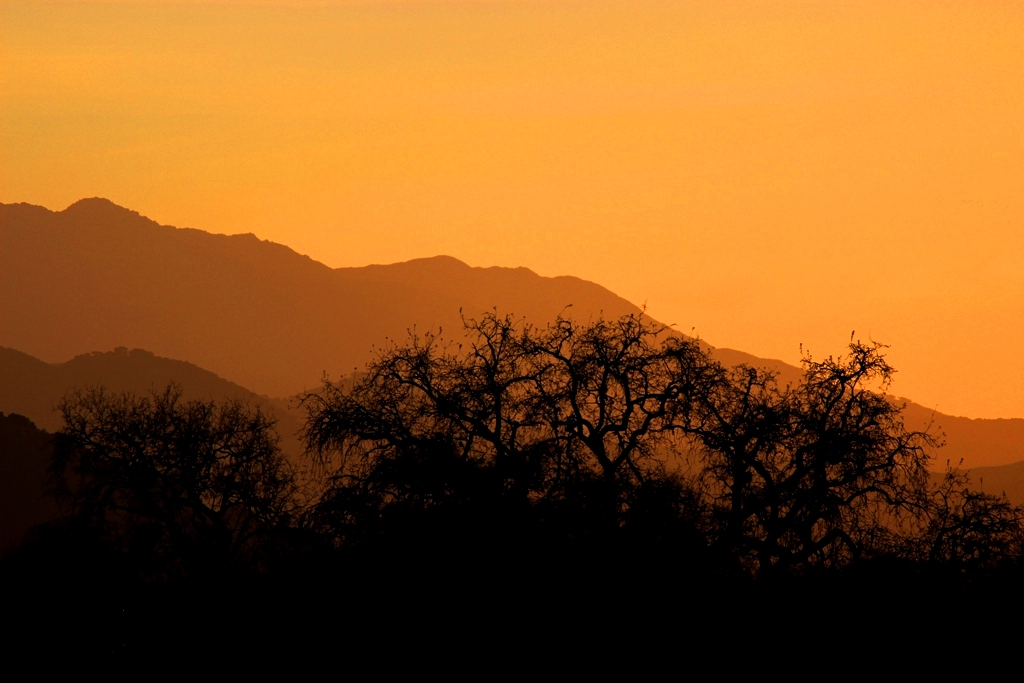 Sunset in fall, Los Padres National Forest.
Rich sensory perception is the essence of human existence and it occurs in nature more strikingly than perhaps anywhere else. In the remote, less visited tracts of unsettled land exists a feeling of aliveness hard to find in any city. Where there are no distractions from the trappings of civilization or humanity’s artificial landscapes and environments, and where such buffers do not insulate a person from the natural world.
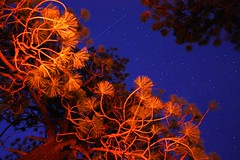
Consider the point in the context of a single basic meal. Squatting beside a wood-fired open flame circled in stones grilling a small meal out in the wilderness makes for a vividly rich sensory experience. The sizzle and snap of burning wood, random leap of unpredictable flames and flickering firelight. The dancing shadows and swirling plumes of spicy wood smoke biting at the nostrils or stinging watery eyes. There is an herbal fragrance from the cooling forest at dusk and a sweet, minerally and moist scent of a nearby stream and its soothing sound of trickling water. The sun’s radiance transferred across 93 million miles to the plant that absorbed its solar energy, used it to fuel the creation of wood, which I gathered by hand and now burns brightly, hot against my face, radiating the sun’s energy back at me through the cool night air. And the star-sprent blackened void of infinite space overhead.
 Transfer the cooking of a meal into the confines of a home’s enclosed kitchen, where bulbs cast never changing artificial light, always from the same angle, and make it day at any hour. I cook by stovetop over a uniform little ring of piped-in, gas-fueled, smokeless blue flame. Wood flooring, stainless appliances, granite and travertine. It’s slick, convenient and as evolutionarily efficient in storing, preparing and consuming food as any one of nature’s iconic animals is at survival. But an entire world of sensually rich experience is lost.
After enjoying a meal beside the campfire I walk down to the creek for water to clean up with and perhaps to replenish supply for a cup of coffee or to drink during the night. A loud cacophony of cricket chirps and frog croaks fires forth from the surrounding darkness. The moist heaviness of the fragrant mountain air intensifies as I approach the flowing stream, the earthy scent of saturated organic matter, mud, and wood and rotting plants. The water is chilly to the touch and makes my fingers ache.
Despite knowing I have nothing to fear, the pioneers and settlers long ago having killed off the wolves and grizzly bears, and not being in the place or time to worry about deadly Comanche raiders or such, I still look apprehensively over my shoulders now and again, alone peering into the blackness of the forest as if some unknown creature or entity is lurking just out of sight. The dark and remote woods, desolate, wild, miles from civilization and well out of cell phone range, makes me feel small and vulnerable as I crouch beside the creek, defensive in some manner. And it sharpens my senses.
I place a bare hand on a gritty and cold cobblestone and lean down to sip the running clear mountain elixir infused with nutrients absorbed from the surrounding land and its flora. It tastes good, sweet and syrupy-like and alive with complexity altogether missing from the sterilized, processed water of the urban realm. I walk back to camp watching the orangy warm glow of firelight flicker in the forest canopy. The mountain air is getting colder and the silvery glint of dew sparkles on the plants and beads up on and weighs down the spider webs.
 Campfire roasted rainbow trout.
Translate the same activity into modern domestic terms and, again, an entire world of sensually rich experience is lost, life’s activities becoming clinical and lackluster. In the kitchen at home, beneath artificial lighting, I load dirty dishes into the dishwasher and press a button. The tap water smells faintly of chlorine. I place a glass to the fridge for a drink and a stream of cold water shoots out, and while filtered so it doesn’t taste bad, it still tastes bland.
There is less feeling. A dearth of stimuli relative life in the open wilderness. Like lunch in the sterile atmosphere of a hospital cafeteria beneath fluorescent lights compared to an open air picnic on a warm sunny day beneath a vast blue sky. And that is but one small facet of daily life. Imagine the span of an entire lifetime and what might be given up the farther from nature life is lived.











 Jack Elliott's Santa Barbara Adventure