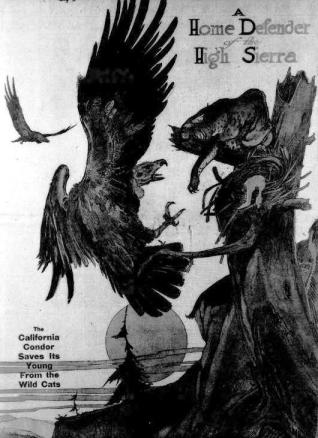
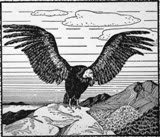
 An illustration originally published in the San Francisco Call newspaper in 1911.
“CALIFORNIA CONDOR
A RARE BIRD WHOSE EGGS ARE VALUED AT $18,000 A DOZEN
It is not generally known that among the fads of the day the collecting of birds’ eggs is one that interests the cultured and wealthy, and one that may be very expensive to indulge in, while it affords a mild recreation to thousands of individuals of moderate means.”
—Fort Worth Gazette, December 28, 1895
American newspapers in the late nineteenth and early twentieth centuries chronicled the exploits of men raiding condor nests in the mountain ranges of California to take eggs as trophy souvenirs and to sell. Eighteen thousand dollars in 1895, adjusted for inflation, equates to over $2 million dollars today.
Many of these newspapers remarked on the dire plight of condors and their declining population and some predicted their inevitable extinction. Yet, ironically, in the same stories, they spun romantic yarns about the heroic adventures of nest raiders.
“Why are the eggs of the California condor so valuable?” an egg raider is quoted as asking in an article titled, “Hunt for a Condor’s Egg,” which was published in the New York Sun in 1900. “Because the birds are almost extinct now,” he answered, “and will be wholly extinct in less than ten years.” The story states that the eggs were worth “$1000 or more each to collectors” and it relates his planned excursion into the Sierra Nevada Mountains in search of condor nests to plunder.
Perhaps most puzzling of all is the fact that some of the most noted egg raiders were ornithologists and zoologists. In other words, they were scholars and scientists one might think would have been more concerned with the preservation of the species rather than trophy hunting and profiteering, actions which obviously would only serve to help drive the California condor closer to extinction.
In a spiraling chain of deadly events that propelled its own momentum, as the California condor became rarer, the value of its eggs increased further incentivizing the taking of yet more eggs. With such remarkable profit as a lure, and virtually no laws or social mores protecting condors of the time, it’s a wonder how the giant vultures survived as well as they did through these precarious times.

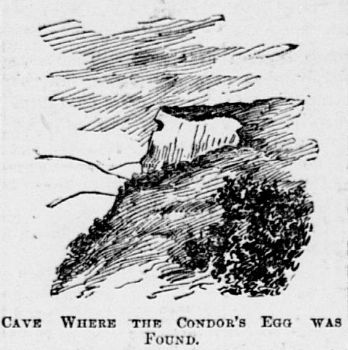
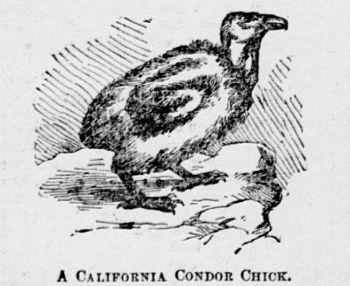 Illustrations originally published in National Tribune in 1895 accompanying a story about the taking of a condor egg.
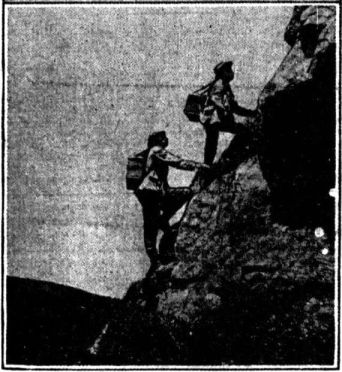 A photo of men climbing in the San Bernardino Mountains “to capture a young condor.” It was originally published in the Arizona Silver Belt in 1908 accompanying the following blurb:
“Among birds threatened with extinction is the condor of California, a very rare species long hunted on account of its plumage and becoming rarer every year. Before long the condor will be harder to find than the epyornis of Madagascar and the dodo. Its eggs are very rare and are valued at from $250 to $300, not to speak of the risks run in securing them. William L. Finley, president of the Oregon Audubon society, has had many thrilling experiences in the San Bernardino mountains studying the condor at close range and photographing the birds. In this picture the scientist and his assistant are shown climbing to a dizzying height to capture a young condor.”
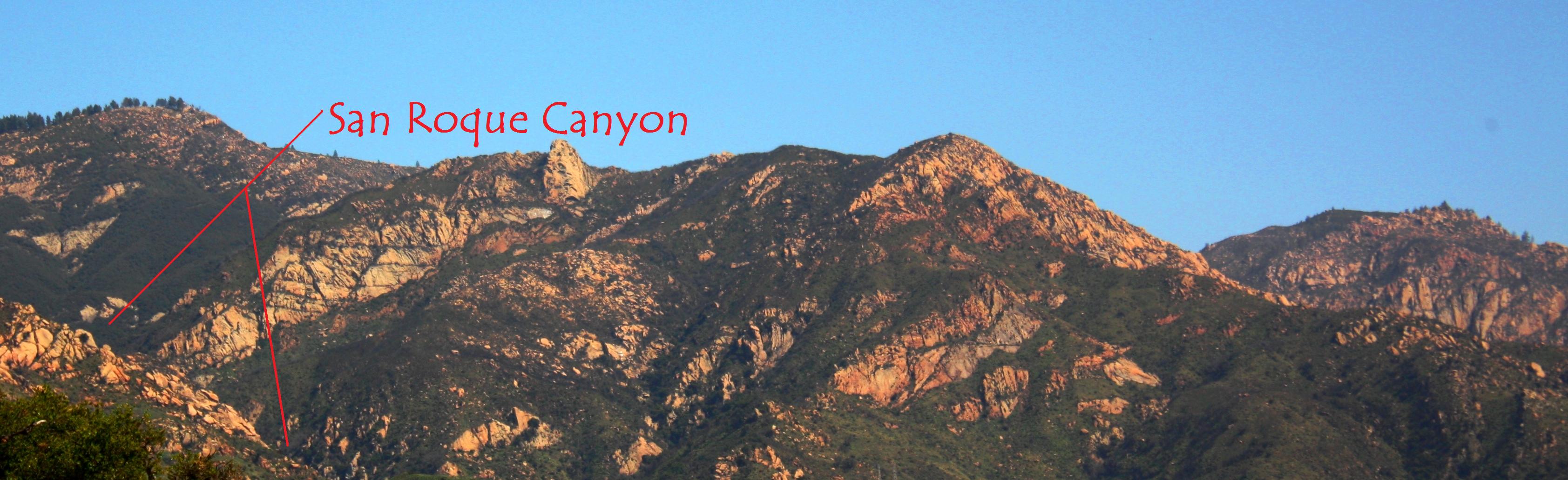
 San Roque Canyon, Santa Ynez Mountains.
In a previous entry on this blog, Desperate Fight with Condors: Narrow Escape of Santa Barbara Man (1899), a newspaper story about the taking of a condor egg from a cave in the Santa Ynez Mountains of Santa Barbara was shared. It features two men, Frank Ruiz and Fred Forbush.
The excerpt below represents a select portion of the official record of this incident, as taken from the book authored by Sanford R. Wilbur, “Nine Feet from Tip to Tip.” The excerpt is shared here with express permission from Mr. Wilbur, who led the U. S. Fish and Wildlife Service’s California condor research and recovery program from 1969 to 1981.
Visit his Website, Condor Tales, for further information. An entire chapter in “Nine Feet from Tip to Tip” is dedicated to egg collecting including in the canyons of the Santa Ynez Mountains. Frank Ruiz, Mr. Wilbur told me, took two eggs “apparently both out of San Roque.”
As an aside, the mention below of the work performed by Frank Ruiz and Fred Forbush for the Pacific Improvement Company, in order to supply the Hope Ranch community with water, ties-in with a previous post on this blog regarding water from a well bored into San Roque Canyon used to maintain Laguna Blanca Lake in Hope Ranch.
 San Roque Canyon as seen from Laguna Blanca in Hope Ranch.
RECORD NUMBER: 32
DATE: 17 April 1899
LOCATION: San Roque Canyon, Santa Barbara County, California
COLLECTOR: Frank F. Ruiz and Fred Forbush
CURRENT LOCATION: Museum of Comparative Zoology (Cambridge,
Massachusetts)
HISTORY: Frank Ruiz and Fred Forbush, employees of the Pacific Improvement
Company, were surveying in San Roque Canyon near Montecito, California,
preparatory to developing a water supply for Hope Ranch. Two condors flying in the canyon 17 April 1899 attracted their attention, and they followed the birds to the nest
site. W. Lee Chambers (Santa Monica, California) apparently purchased the egg from
Ruiz, then sold it to John E. Thayer (Lancaster, Massachusetts). The Thayer collection
eventually was secured by the Museum of Comparative Zoology (Cambridge,
Massachusetts), where the egg is currently.
COMMENTS: The Chambers data slip accompanying this egg gives the collection date
as 13 June 1899. However, a published account that describes the taking of the egg and
gives the date as 17 April 1899, was prepared by the author 2 May 1899 (Redington
1899).
The Chambers data slip located San Roque Canyon in the San Rafael Mountains.
Actually, it is on the south slope of the Santa Ynez Mountains, which are separated
from the San Rafaels by the canyon of the Santa Ynez River.
“On April 17, 1899, an egg of the California Condor was taken in San Roque canon,
near Santa Barbara, by F. Ruiz, a surveyor in the employ of the Pacific Improvement
Co., who, with a party, was doing some work in the canon. His attention was first
attracted by seeing a pair of the birds flying about, and it occurred to him that there
might possibly be a nest in the vicinity…. He and a companion named Forbush
proceeded up the canon, and finally noticed a cave on a high cliff some 150 feet above
the creek, which they managed to reach with some difficulty. From the top Ruiz was
enabled to look over the edge a short distance into the cave, where he saw the egg on
the floor of the cave, with one of the birds crouched on the floor beside the nest, which
consisted of a few twigs of brush and some sand that had evidently blown into the cave
from the edge of the cliff… Then Ruiz clambered down into the cave without the aid of a
rope… The egg was perfectly fresh and measured 4 3-10 x 2 6-10 inches and was a
trifle deeper in color than those I have seen illustrated.”
. . .
“Nest was located upon a high rock in a cliff and was made of twigs, brush, and other
coarse material.” Added statement by Chambers: “The above statement about the nest
is probably literally true as the nest was on a brushy side of the mountain and certain
sticks and grasses had doubtlessly fallen there as has been the case in other instances.
The above date given for the taking of the egg is the latest of any eggs I have record of
yet as the dates heretofore have run from Feb. 17 to May 25 (32 eggs).”
Related Posts:
Condor in a Cage: Time Line of Tradegy | Condor Point |Condor Feather | Whiteacre Peak, Fossilized Bones, Cougar Prints and Condors | California Condor Photos

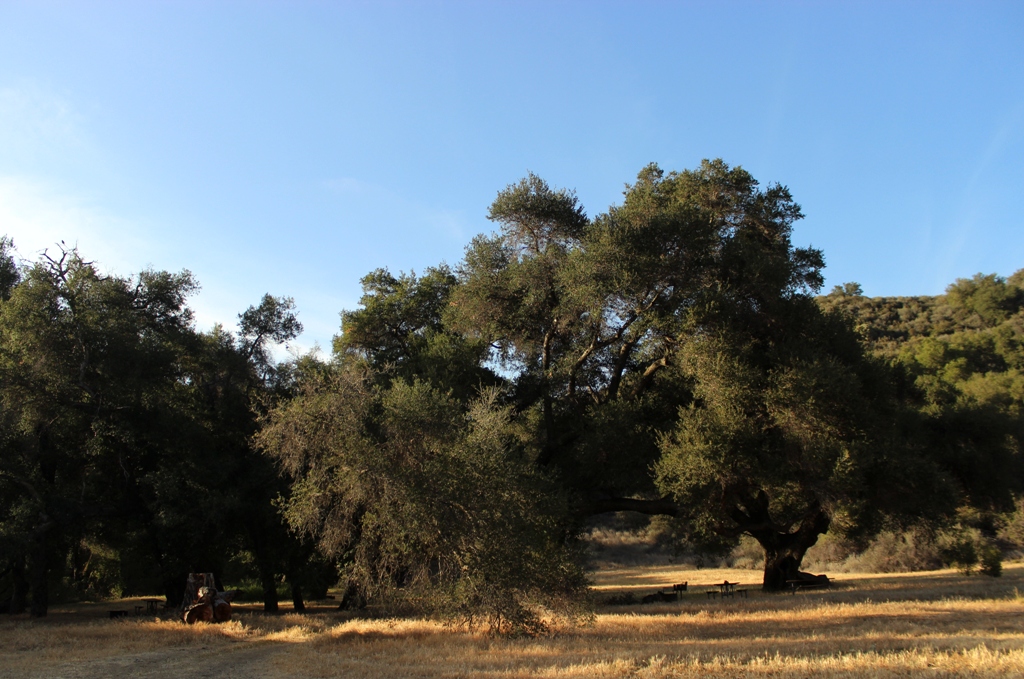
 P-Bar Flat Campground along the upper Santa Ynez River began as a private hunting camp around 1916.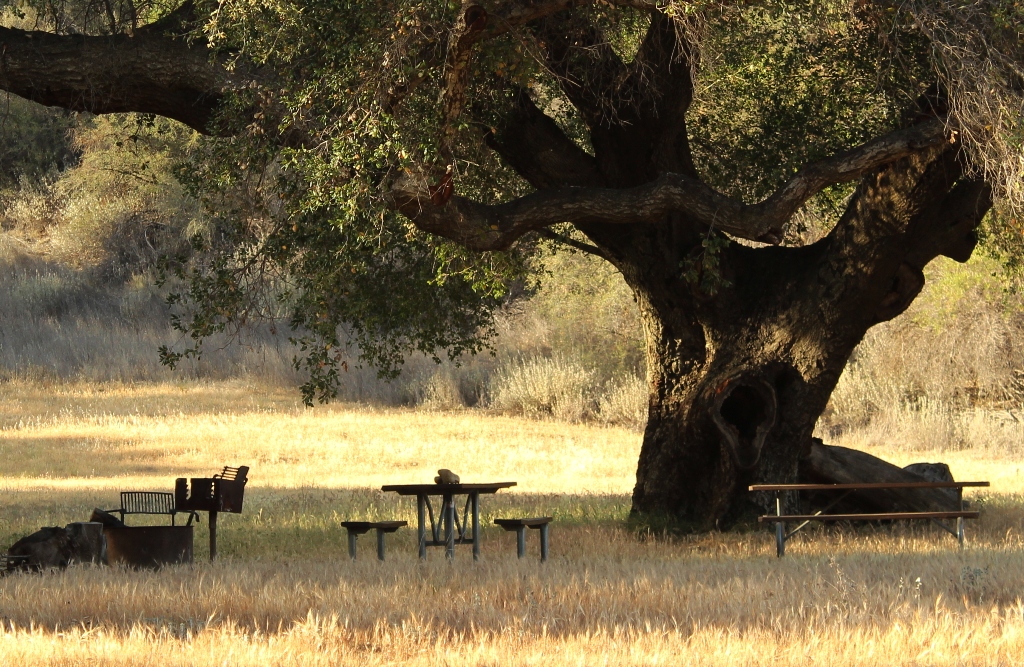


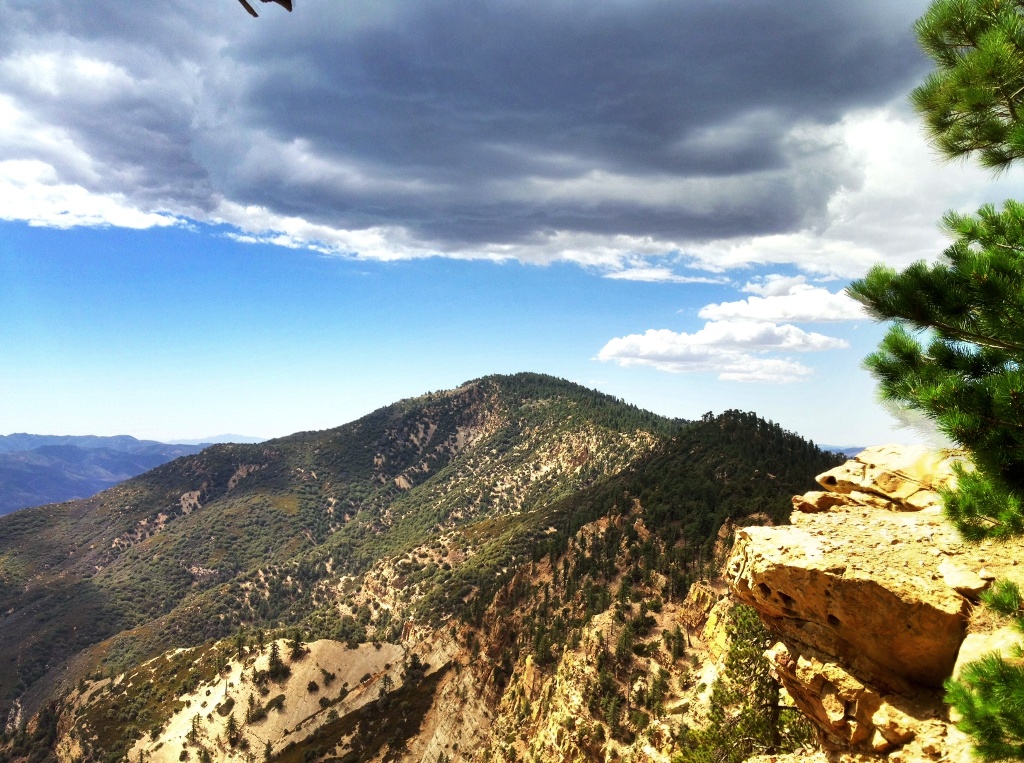




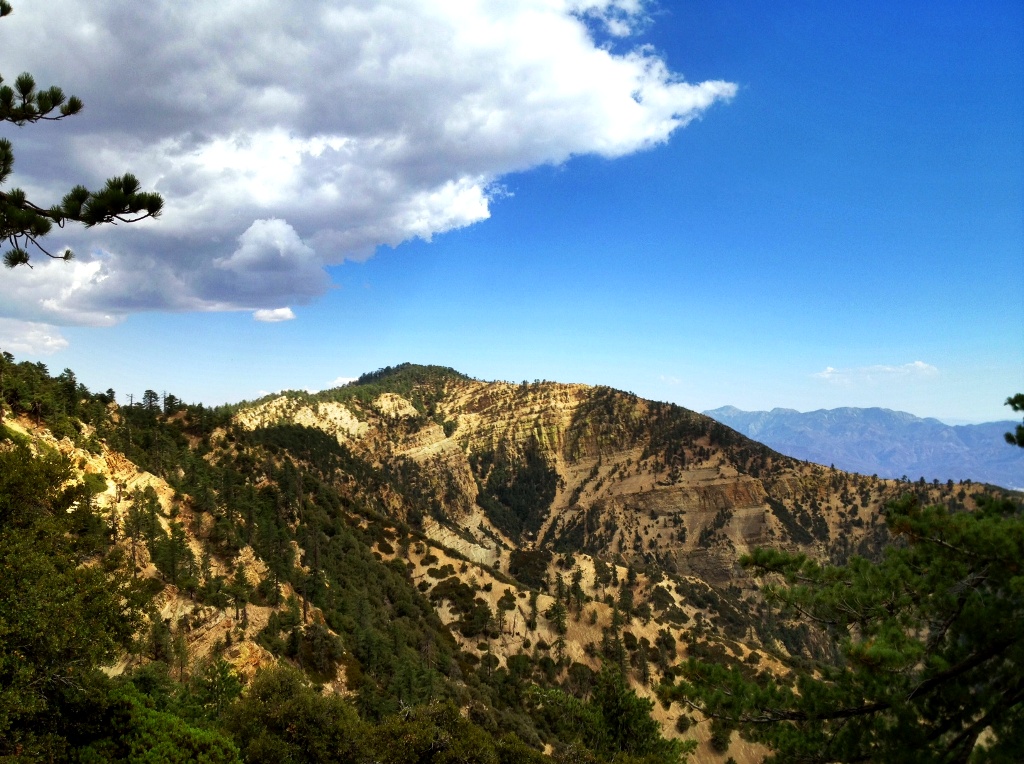




 Haddock Mountain summit (7,431′).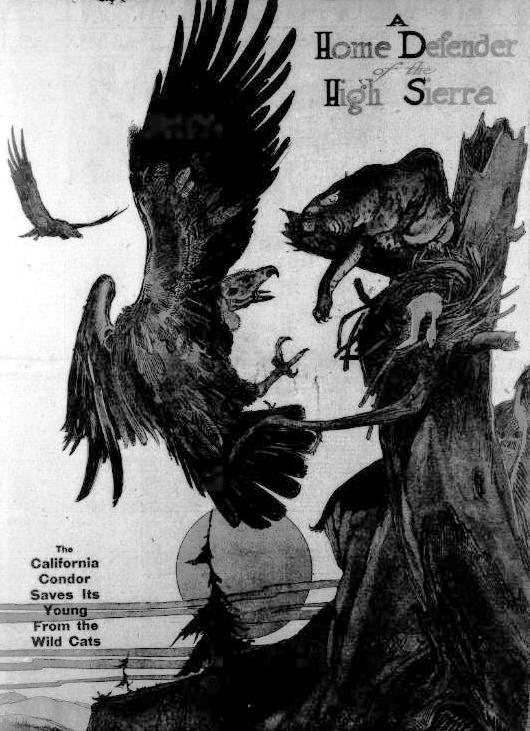



 Murky and mossy, slow-flowing summertime creek.
 Wild rose
 Crawdad
 Dead mountain lion in the mouth of a shallow cave beside the creek.













 Jack Elliott's Santa Barbara Adventure