Roaring River Falls, Kings Canyon National Park

Roaring River Falls, Kings Canyon

“Kings River Canyon calls forth the most enthusiastic encomiums of all who have visited it. The rocks tower in majestic altitude above the bed of the tumultuous stream, their profiles carved by the elements in shapes that suggest the work of a grand sculptor, while waterfalls dash down every intersecting rivulet and over every rocky canyon. For miles through this narrow cavity in the mountains sublime scenes in infinite variety greet the eye of the enraptured observer. Mount King, at an altitude of 13, 316 feet, Mount Woodworth and Mount Brown, of almost equal height, are the sentinels of this mighty fissure.”

San Francisco Call, “The Glories of Kings River Canyon,” March 21, 1897

Posted in California | Tagged , , , , , , , , , | 6 Comments

Rolling with Little Ms. E, Sequoia National Park

Sequoia National Park

You have to be committed to push a stroller along a rocky mountain trail for two miles up and down a small canyon, while wearing flip-flops. Or maybe you just need to be committed.

The trail began as a three-foot-wide pathway made of packed decomposed granite and turned to asphalt for a short distance. As we ventured further into Sequoia National Park’s Giant Forest, however, the trail turned to dirt and quickly narrowed to the width of a footpath. It led through some dense underbrush, which appeared impassable with the stroller. We had apparently reached the terminus of our great adventure just a few yards beyond the paved walkway.

I considered our limited options for a moment before deciding to ditch the stroller. We’d march ahead, and when the time came, I’d carry Little Ms. E on my shoulders for a bit. But immediately after walking through the narrow brushy section the trail opened up. I had her wait while I went to get the stroller and I tossed our water bottle on the ground near her as I turned back.

Sequoiadendron giganteum giant sequoiaSequoiadendron giganteumbrook troutBrook trout

Giant Sequoia TreeWith Little Ms. E back in the saddle we were rolling again. I forced the stroller across off camber sections leaning over steep slopes, pressing it against the hillside and fighting the pull of gravity, and I pushed it up and over and over and down bouldery step-like sections, and rammed it through several narrow brushy spots barely wide enough to pass through. We made good use of the stroller’s five point harness and its rear suspension.

In one part, where the trail passed between two trees, we had to push our way up the bank a few feet through the twigs and needles and around one tree and back down onto the trail. In another part, squeezing between a tree and a granite outcrop, I had to fold the stroller up and carry it through. But that was as rough as it got.

When we stopped for a break, and I eagerly went for the water, I realized that I’d forgotten to pick up the bottle after getting the stroller. And so we went without a drink for the couple of hours we were out. We passed by several clear flowing streams and I regretted not having my pocket-sized water filter.

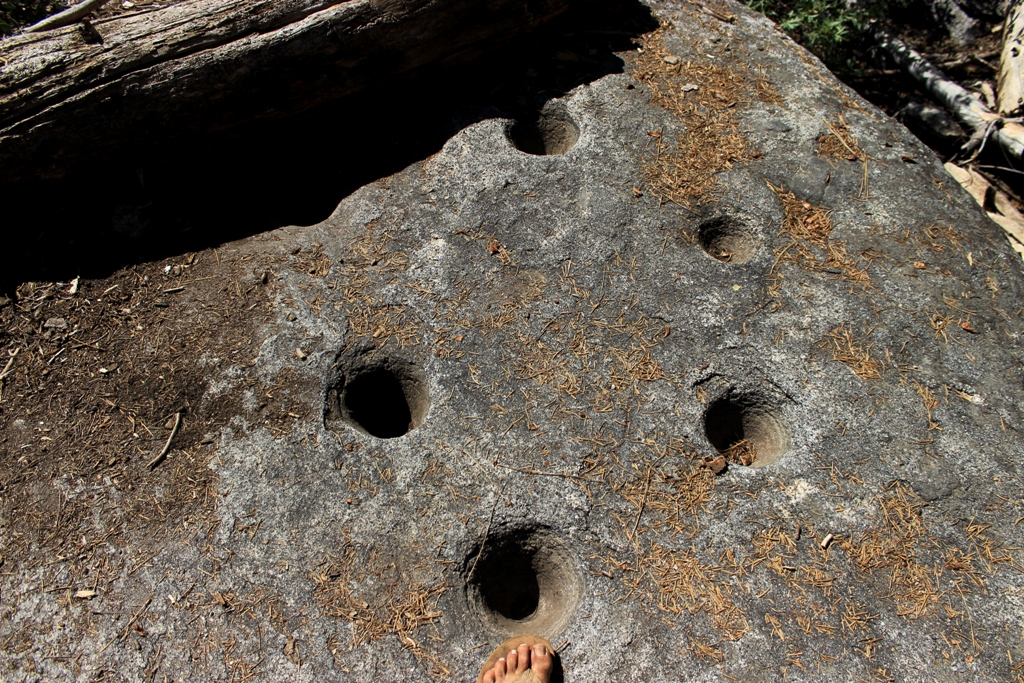
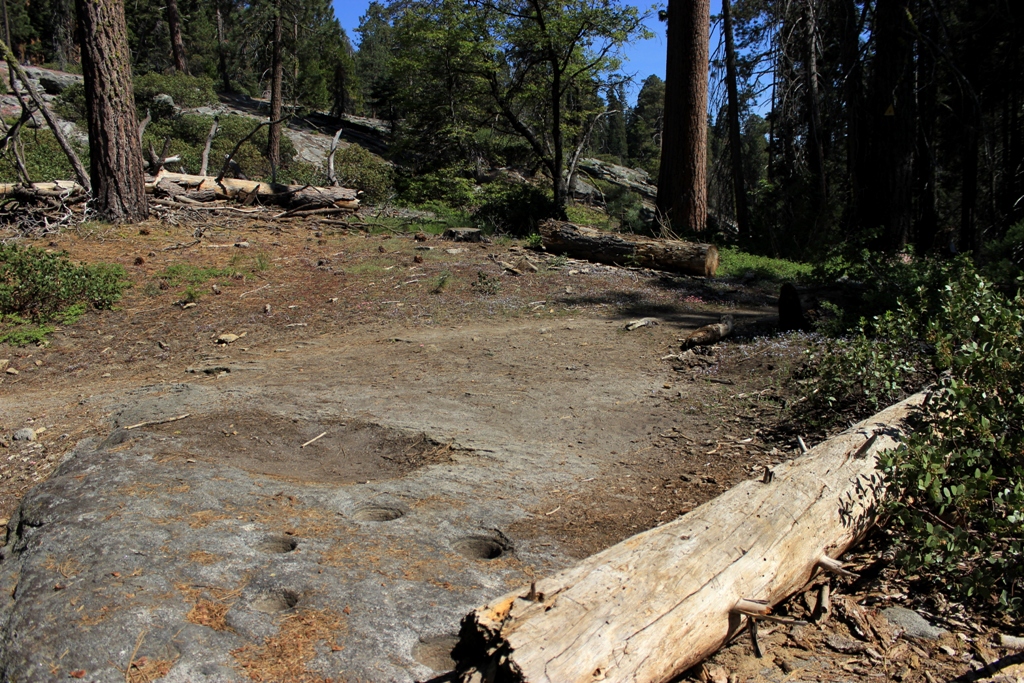
As we crested a slope coming out of the canyon we came upon the collection of bedrock mortars we set out to see. The mortars overlooked a brook trickling clear cold water through a crease in the granite-capped mountainside.

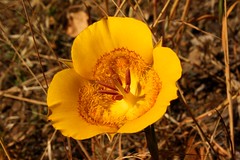
wildflowersbedrock mortarbedrock mortarsAs we explored the land surrounding the mortar site two people came walking down the trail. They sauntered by and we exchanged a few friendly words. The lady had seen me taking photos and when she saw a pine cone a moment later she insisted I take a picture of it. The cone was sitting nearly upright with its tip pointing into the air. The lady went on to explain with great enthusiasm that she could tell the pine cone had rooted into the soil because of the way it was sitting. She thought pine cones were actually seeds themselves like a coconut or something.

On our way back down the trail my daughter spotted a marmot. On our way up the trail she had pointed out a bear walking through the woods behind me. I’m typically an observant person and I put a premium on situational awareness, but I’ve apparently got work to do on this front. Nevertheless, I was happy to see Little Ms. E keeping her surroundings in focus.

Going downhill on our way back was considerably easier and quicker, of course. We seemed somewhat far away on the hike up the quiet canyon to the mortars, having left the throngs of tourists behind, but following the quick walk down the mountain it seemed we had hardly gone anywhere. How ever far it may have been, though, it may as well have been another planet for Little Ms. E, who was seeing things for the first time.

brown bearThere’s a bear over there.

marmotMarmot

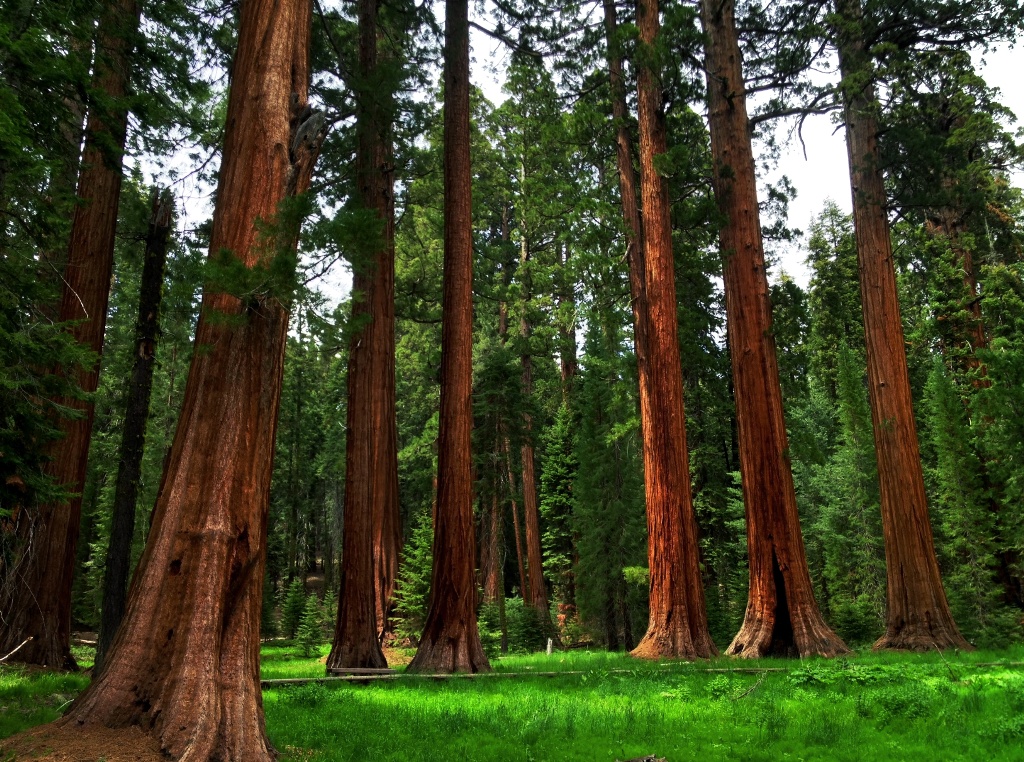
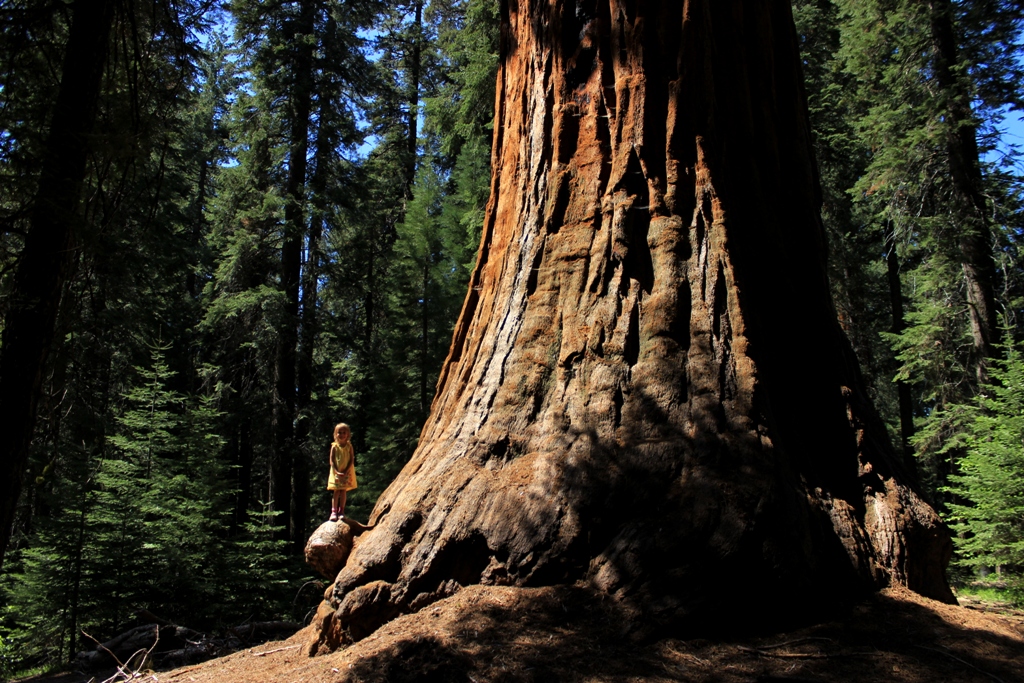
giant Sequoia fire scarsGeneral Sherman giant Sequoia treeThe General Sherman giant Sequoia tree is estimated to be 2300 to 2700 years old and is considered to be the largest tree in the world by volume or the largest living thing on Earth.

General Sherman by the tape:
Height above base: 274.9′
Circumference at ground: 102.6′
Maximum diameter at base: 36.5′
Diameter 60 feet above base: 17.5′
Diameter 180 feet above base: 14
Diameter of largest branch: 6.8′

Posted in Santa Barbara | Tagged , , , , , , , , , , | 4 Comments

El Saucito Ranch House, Carrizo Plain (1878)

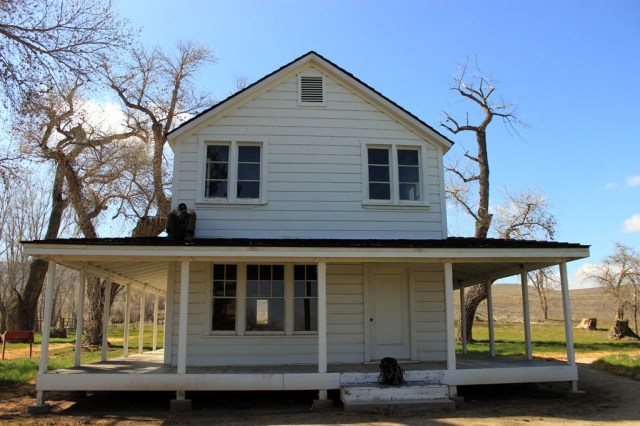
El Saucito RanchThe El Saucito Ranch house, built of redwood by Chester Rude Brumley in 1878, was occupied until the late 1960s and is the oldest still standing farm house on the Carrizo Plain.

“Mr. Brumley has grown grapes, figs, pears, apples and other varieties of fruits and berries, his grapes are very large and very sweet and make large and luscious raisins. The other fruits were of the very best quality and some of the figs brought to San Luis were thought the best ever eaten by those whose fortune it was to get them. Apples and pears bore so heavily as to break down the trees.”

Myron Angel (circa 1880s)

El Saucito ranch lies as a speck on the vast, bleak Carrizo Plain. Standing on a slope far above the old pioneer homestead, the world silent but for the gentle rush of wind over my ears and nary a sign of other people, the ranch sits like a far-flung outpost of civilization amid the emptiness of hundreds of thousands of square acres of sweeping grassland.

I can see the faint line of Soda Lake Road from afar, and the tiny clump of bushes and trees with a tinge of white that is the building housing the Carrizo Plain National Monument Visitors Center. But aside from those tell-tale signs of humanity, it appears as if very little change has come to the surrounding landscape over the last 140 years. It appears as lonely today as it was when the old house was first built.

Peering across the plain down upon the puny dots that are the ranch and its few outbuildings, in what is now the nation’s most populace state with an economy larger than that of most countries, utter desolation is its defining feature, even today. What must it have felt like in the 1870s when Brumley lived there with his wife, Margaret, and their children?

El Saucito Ranch HouseA trap door in the porch just outside the French doors provides access to a root cellar.

The Brumleys first lived in a house made from the dirt of the plain itself, a one room adobe, before building their elegant two-story wooden home. They were reportedly the only permanent residents for nearly 600 square miles. This at a time when miles were far longer than they are today, as the common conveyances were all pulled by horse over rough substandard roads. That’s a long way to travel for provisions and a hellish journey if in need of a doctor.

El Saucito Ranch was a self-contained oasis. Self-reliance was not optional, of course, it was a necessity of pioneer life, so far removed was the Brumley residence from the rest of the world. A powerhouse on the property generated electricity. Any machines that broke down were repaired onsite in the large detached garage presumably using whatever spare parts or material were on hand.

The sort of ingenuity required to run such a remote ranch is hinted at in a storage and sorting tree at the workshop, where spare nuts, bolts, small parts and other odds and ends were kept for future use or reuse. The homemade upright storage receptacle was crafted from old concave metal plow disks attached at intervals horizontally to a metal pole, the disks serving as makeshift holding bins.

The Brumleys raised sheep, cattle and horses and grew a wide variety of produce. There is a well on the property and a windmill that once drew cool water from the underlying aquifer. There is a small open reservoir that lies deep in the ground below the level of the surrounding plain and is surrounded and shaded by willow trees. This is the same willow thicket that purportedly originally attracted Brumely’s attention as a tell-tale sign of water, and which is the natural feature for which the ranch is named. Saucito means little willow in Spanish.

carrizo plains 113

During the time the Brumley’s lived at El Saucito there were still Native Americans roaming the countryside. A display at the ranch relates one such experience recalled by one of the Brumley daughters:

“Life on the lonely plain was a big change from life of San Francisco. Nellie Brumley remembered a morning alone in the house with her mother when a band of 20 Indians arrived, chanting and asking for water. A nervous Margaret ordered Nellie to hide in the house, while she presented the Indians with water and a pail of freshly-baked cookies. The Indians ate all the cookies. . .down to the last crumband departed as abruptly as they had arrived.”

Carrizo Plain Soda LakeEl Saucito ranch is seen here as a few trees and a speck of white about center frame. The white saltpan of Soda Lake is seen to the left and the Temblor Range, created by the San Andreas Fault, is in the distance beneath the clouds.

Related Post:

Ruminations on a Hart-Parr 18-36H Tractor (1930)

Posted in San Luis Obispo County | Tagged , , , , , , , , , | 12 Comments

Hand Caught Trout in the Sierra

Sierra Nevada Mountain Road

“There’s a fine line between fishing and standing on the shore like an idiot.”

Steven Wright

With our long ago planned outing thoroughly drowned in a week’s worth of forecasted Oregonian rain, we decided on an alternative eleventh hour fallback option and hit the super slab toward California’s Sierra Nevada for two weeks of RV camping.

We arrived at our creek side campsite in late afternoon. Situated beneath tall timber with granite outcrops, well separated from other sites and on the bank beside the creek, it was the best spot in the entire campground. There was even a small pool in the creek right below the campsite perfect for the kids to play in.

Though the pool immediately caught my eye as being a prime trout hole, its proximity to a popular campground, right off a paved highway leading to world renown tourist traps, put any hope of hooking fish out of mind. The spot had been heavily fished for decades. Trout that happened to find themselves therein on any particular season had no doubt been routinely bombarded by every lure and bait known to mankind. I was sure that if on the off chance there were fish in the pool they’d ignore anything I threw at ’em.

Shortly before sundown we ventured down to the creek to take a looksee around and I was astonished to see several trout holding in the pool. Not minnows, but fair sized fish. They measured some eight to ten inches or so and sent me scrambling to retrieve my rod and reel. It was a perfect opportunity for my daughter to catch her first fish.

But one clumsy cast confirmed my previous pessimism, as the trout darted away as soon as my line hit the water. My wife giggled at my inept attempt. The world’s most powerful brain, human, defeated by a fish brain the size of the tiniest pebble. I was left standing on the bank feeling like an idiot.
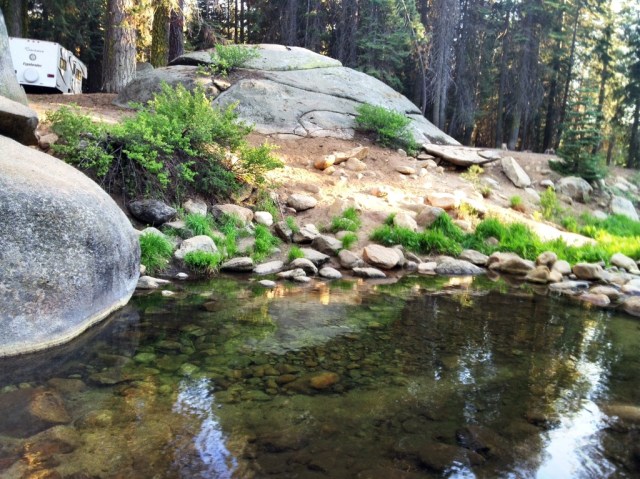
Sierra creekThe next day, late afternoon, I’m considering giving the trout pool another try when I see two rather portly guys down there hobbling around on the cobblestones gracelessly tossing their lines in. I’m instantly irritated.

I mosey down toward the water with my daughter, acting indifferent and pretending not to be interested in their fishing, when I’m thrown into a mental tail spin and my afternoon is thoroughly spoiled. I see one of the guys hoist a stringer from the stream loaded with dangling trout.

Having been pessimistic about my chances of catching a fish, I had put in a halfhearted attempt the previous day and prematurely written off the spot. Just a few sloppy casts with one lure and then a pathetically tied bait rig for my daughter to play with.

Seeing two dudes apparently pulling out trout at will sent me stomping back to camp in a foul mood, angry with myself for not having given the pool a serious try. My daughter asking why two guys were catching all our fish, and further innocent comments about how we’re not good fisherman, didn’t help.

Keeping an eye on the two guys from our camp, I watch them leave and then walk down to the water to see if they did indeed catch all the trout we had seen. It was bad enough that I blew my chance, that these two guys showed up and raided the hole right in front of me. But when I walk up to the edge of the stream I see cigarette butts gleaming white against the darkened wet sand.

The pool had been plundered not by some skilled angler or woodsmen I might be able to respect, but two slobs with no consideration for anybody or anything else. Our pristine little pool below camp was now strewn with cigarette butts and wads of guts from recently cleaned fish.
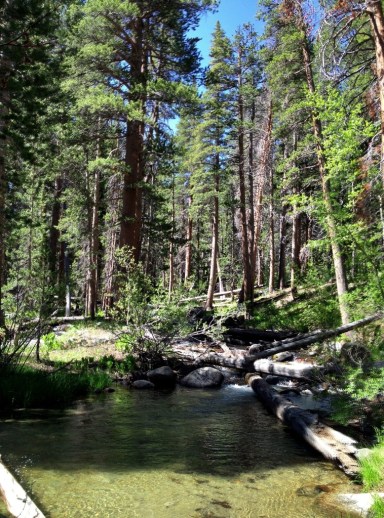
Sierra CreekSulking around camp, I decided to take a walk up the creek to check out the small bridge where the road crosses, thinking there might be a pool below it. On the way up the stream with my daughter, walking sloppily and being preoccupied, I slipped on the rocks and stepped into the chilly water twice, which further aggravated my already irascible mood. With less than an hour of light left I had two cold wet feet, cigarette butts and trout entrails but no fish.

There was no pool beneath the bridge. The water flowed under the two lane overpass and tumbled down over a section of small jagged rocks and into a large puddle, which, while some twenty feet across, measured only about six or eight inches deep at most. The downstream side of the puddle was walled off by another berm of small jagged rocks, which the water flowed through like a sieve.

As we stood at the edge of the shallow, gravelly puddle we had hoped was a deep pool, my eagle-eyed daughter, who over the course of our trip would spot nearly every notable wild animal we saw, shouted excitedly as she spotted a trout swimming by in just several inches of water. I couldn’t believe it. Then, with even greater excitement, I realized the fish was trapped.

The creek under the bridge is cemented over. When trout swim or get washed downstream over the cement chute under the bridge they can’t swim back upstream. The fish can’t escape the shallow puddle by swimming downstream either because of the berm of small jagged rocks. The creek works remarkably well as a natural fish trap.
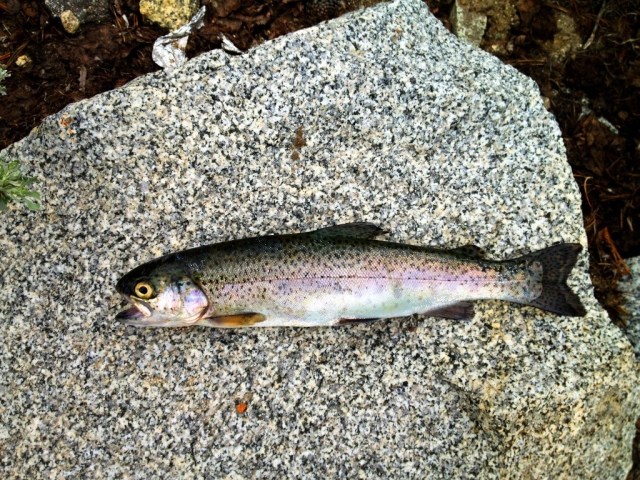
troutAn eleven inch ugly snatched by hand.

In the middle of the puddle there was a small boulder just big enough to stand on. When I chased the trout into the shallows trying to catch it the fish darted under the boulder and hid. I made my way out onto the boulder, and as I knelt down and peered over its edge, I saw several trout tails fluttering back and forth in the gentle current.

With only inches of open, slow-flowing water in the puddle, the single boulder was the only shelter the trout had and it had attracted a hand full of them. Crouching on the boulder, I slowly dipped each hand into the water and slid them into a surprisingly deep cavity under the rock. I could feel several fish slithering around.

Blindly grasping, slowly, gently, I carefully felt out the largest fish, clenched tightly onto it and ripped it from the water triumphantly holding it aloft. What better way to fortify my flagging masculinity? If only I’d had a loin cloth on and been bare chested with a big Grizzly Adams beard!

My daughter erupted into a fit of squeals and screams and cheered me on to catch more. I snapped a thin green branch from a nearby tree, bent it in half into a v-shape and slide one end through the trout’s gill plate and out its mouth for a makeshift stringer, before going back to the boulder for another try. Too young to understand the trout was dead, and not having seen me knock it out on a rock, my daughter promised to dutifully watch our one glorious fish so it didn’t swim away.

It turned out there were six trout under the rock. I managed to grab five, three of which I kept, the other two I let free in the creek below the trap. I had never caught a fish by hand. “Just like a bear,” my daughter noted. What had begun as an extremely disappointing afternoon ended triumphly. It was a surprisingly unexpected chance experience, which far exceeded any excitement we may have had in catching the fish below camp with a plain rod and reel. One never knows when luck is going to swing dramatically in their favor.

foodCamp beside the creek, fresh caught trout roasting on the grill over oak, and on the stove sauteed vegetables sizzling their way toward caramelization and fried potatoes gettin’ crispy.

Related Posts:

Native Trout of Los Padres National Forest

Waterfalls, Trout and Indian Mortars in the Sierra

Native Steelhead of Yore, Santa Ynez River

Posted in Sierra | Tagged , , , , , , , , , , , | 5 Comments

Guadalupe Valley Waterfall, Mexico

Guadalupe Valley Waterfall, MexicoA waterfall located on the outskirts of the Guadalupe Valley in Mexico, a noted wine making region just outside of Ensenada. The falls pour into Agua Caliente Canyon, so named, officially or unofficially I’m not sure, for the natural hot springs just upstream. There is an old rancher by the name of Federico that owns the property through which you pass to reach the waterfall and hot springs and he charges a toll to open his gate. He handcrafts his own fresh cheese that he offers tasters of and sells to passersby.

Posted in Mexico | Tagged , , , , , , , , , , | 2 Comments