
 Map of California coast showing Santa Barbara Channel Islands
In 1835, a ship set sail from San Nicolas Island off the California coast, 78 nautical miles south by southeast of Santa Barbara, and headed for the mainland forcibly removing the island’s last remaining native Nicoleño inhabitants, as organized by the Franciscan padres of the Spanish missions. The captain left behind a single person, a woman who then lived alone on the island for the next 18 years.
In 1853, Captain George Nidever found the woman and brought her to the mainland where she lived with him and his wife for a short time. The Lone Woman of San Nicolas Island, as she became known, was given the name “Juana Maria.” Seven weeks after being brought to the mainland Juana Maria became ill and died. She was buried in the cemetery at Mission Santa Barbara and today a residential street in town is called “Juana Maria.”
 Memorial plaque at Santa Barbara Old Mission.
 San Nicolas Island
Over the last week news outlets, including Ventura County Star and Los Angeles Times, have been reporting on the apparent find of a cave on San Nicolas Island where the Lone Woman once lived. “‘We’re 90% sure this is the Lone Woman’s cave,’ Navy archaeologist Steve Schwartz told several hundred fellow researchers last week at the California Islands Symposium in Ventura,” as reported in the Los Angeles Times.
The following article recounts a version of Juana Maria’s story and was originally published in the Los Angeles Herald on February 21, 1897 under the title, “A Female Robinson Crusoe: A Romance of Truth from Santa Barbara Islands.”

With seething breakers rolling up on their rugged cliffs, a group of small islands dot the Pacific Ocean near the coast of Southern California. They are known as the Santa Barbara Islands. The nearest lies distant some twenty-five nautical miles, while the furthest, called San Nicolas, rears its jagged rocks seventy miles away, being at least thirty miles beyond its nearest neighbor. Some of these are quite rich in seals and sea otters, also contain a wealth of abalone or ormer shells, otherwise called Venus’ ear (Hallotis), a species of shell whose dried meat is extensively exported to China for food, and the shells, which, when polished, are very beautiful, are sent to Europe to be manufactured into pearl trinkets. Beyond a few hunters and abalone fishers, rarely a wanderer drifts to San Nicolas Island, which for most of the year, in solitude and utter loneliness stands a bleak sentinel on the vast stretches of the ocean, with no sound but the roar of the tossing waves as they play in wild abandon on its rocky coast.
But it was not always uninhabited. At the time of the discovery of California, the coast, as well as all the islands, was quite thickly populated. Congregated in numerous villages, the people are described as a superior race, with white skin, light hair and rosy cheeks. In proportion as the early settlers coming from Europe increased, the number of the natives fell away. A few years later Franciscan monks from Spain founded missions in many parts of Southern California, converting and then utilizing the native Indians. Some time after, in order to have them completely in their power, they brought the inhabitants of all the nearer islands in a body to the mainland, and in 1835 the entire population of San Nicolas, hitherto left in peace, because of its distance, was also transported. It was at this time that the event occurred which, conforming to an old English report, will here be retold.
One sunny morning in April, of the 1835, all Santa Barbara crowded to the bay. People of all ages and both sexes walked or rode to the beach that they might enjoy the as yet rare spectacle of a ship sailing out of the harbor. Even the pious monks left their customary employment at the altar or in the garden and mingled with the curious throng at the shore. The center of observation was the ship Peor es Nada, a trim schooner of twenty-five tons, that had been chartered by two Americans for the purpose of hunting sea otter on the coast of Lower California. After a successful cruise, three months later it entered the southerly harbor of San Pedro, disposed of its skins and at once set sail for San Nicolas, in obedience to the commission of the missionaries to convey its inhabitants to their domain. Before the schooner reached the island, the weather, so far favorable, changed and a fierce storm was threatening. After some difficulty a landing was effected, but as the wind rapidly increased, and it was feared the ship might wreck on the jagged cliffs, the embarking of the islanders was hurriedly accomplished, and immediately the vessel prepared to leave the dangerous neighborhood of the island to seek the safety of a sheltering harbor. At the very moment of departure one of the women missed her baby, whom she thought had been carried on board by one of the sailors. Weeping, and with heartbreaking lamentations she begged to be allowed to go on shore again.
But, as the wind was now blowing a gale, the captain, not daring to lose a moment, as the least delay might bring the destruction of all, gave the command to put off, assuring the broken-hearted mother that immediately after the storm, probably the next morning, he would return. When the poor mother realized that her pleading was in vain and the vessel was leaving the island, with a despairing shriek she jumped into the boiling sea. She was seen to battle with the fatal breakers, and then was soon lost to sight. Nothing could possibly be done toward her rescue.
After a tremendous tempestuous voyage, the schooner reached San Pedro. There the San Nicolas Islanders, never to return to their home, were landed and distributed among the missions of Los Angeles and San Gabriel.
The captain was sincere in his intention to return to the island and learn the fate of the woman and her child, but the schooner was needed so urgently for other purposes that humanity was forced to withdraw before business, and as the ill-fated vessel had the misfortune to wreck on the next trip, no possible means of reaching the island presented, since at that time the coast of Southern California could boast nothing larger than the fisherman’s yawl, and no one was found to venture the trip in an open boat.
Indeed, there was very little hope that the woman had reached land, the indications being strongly that she was drowned in the breakers, while the infant, thus abandoned, could not have survived its mother. Therefore, the whole affair was soon forgotten.
Among the monks in the mission of Santa Barbara was a certain Father Gonzales, whom the fate of the unfortunate mother had affected very deeply. Though he spared no pains to obtain certainty relative to it, nevertheless, it was fifteen years before he was able to find a person who would consent to go to San Nicolas Island and search for proof on the spot. A skipper named Thomas Jeffries, who had just had a small schooner built for himself, was assured $200 for the trip. Jeffries searched the entire island, and though signs of human habitation were not lacking, for he found a hut of whalebone, a number of stone utensils, some of which, among them a beautiful cup of serpentine, he took with him, he discovered nothing which could lead to the belief that any one was at the time living there.
On his return San Nicolas Island was again a favorite subject, and not long after, a second expedition sailed for it, though with a different object. Jeffries had related that he had seen, outside of numerous foxes and wild dogs, an almost inconceivable amount of seals and sea otters. His description aroused the intense interest of a number of hunters, and the following spring a small party, under the leadership of Captain George Nidiver, and accompanied by Jeffries, set sail for the island. Arriving they anchored at the southern end. Climbing to the top of the cliffs, they had a magnificent view of the endless stretches of the ocean, horizon to horizon. But neither the grandeur of the water nor the wild beauty of the lonely island produced such an effect as the many rocks literally covered with black seals and the numberless fissures alive with otter. Scarce taking time to erect suitable tents for the camp, the men began the slaughter. For six weeks they remained on the prolific shores, employing the entire time with seal killing and otter trapping. To explore the interior of the island they had neither the time nor the inclination, as a spring bubbling out of an adjacent rock furnished sufficient fresh water, everything else being provided.
At one time, in the last few days of their stay, during a storm, one of the men claimed to have seen, on a distant exposed rock in the interior, a human figure, which appeared to run back and forth and to hail him. When, in response to the man’s shouting, the captain came, the figure had disappeared.
In Santa Barbara, when in the arrival of the party the story quickly spread, the ghost of San Nicolas Island was for a long time a favorite topic among the superstitious.
In July, 1853, another party departed for the island, with Captain Nidiver again at the helm. Among them was a certain Charles Detman, a fisherman, known as Charley Brown, an Irish cook and a number of Indians from the missions. This time the destination was the northern end of the island. Immediately after anchoring Nidiver and Brown determined to take a jaunt along the shore, though only for pleasure. The night being rather warm, and the full moon very bright, they wandered further than they had intended. Suddenly Nidiver stood still, glanced about in all directions, then knelt down to examine something that had attracted his attention. Without a doubt what he saw was a clearly defined imprint of a human foot. “Eureka!” the woman of San Nicolas was still living.
The excitement of the men in making this discovery was intense. Without communicating with the rest of the party they immediately began to search. They called loudly that they were friends, and had come to help her, but although they walked and called for hours they neither saw nor heard anything. The next day they found hanging on a limb of a tree a basket made of rush, containing some bone needles, twine or twisted fish gut, fish hooks of shell and an unfinished dress of bird skins. Brown advised throwing the things around under the tree, to ascertain if they would he picked up, and this was done. Further in the interior they discovered circular enclosures, constructed of dovetailed branches. Nearly clean-hewed posts had been driven in the earth, having cross pieces high above ground, on which were hung dried meats. Likewise were found dried fish and seal fat stored away in crevices near the springs, but nowhere a sign of the owner herself. However, that some one, either the woman herself or the child, now grown up, had lately been on the island was proved beyond a doubt. Searching for many days without further success, and as the articles thrown out of the basket had not been picked up, the footprints also proving to be older than at first supposed, they came to the conclusion that at least no living being existed there anymore, and they returned to the business that had brought them. In a few weeks they had finished and prepared for the return trip. But old Nidiver could not forget the poor, abandoned soul. He proposed to the party that they should once more search every part of the island to find, if possible, at least, her remains. Refusing at first to waste their time on such a fruitless mission, he finally, but with difficulty, persuaded them, and then the entire body scoured the island, “seeking a ghost,” as they said.
After several days Charley Brown found the whale bone hut, in which lay several implements, but the grass around it bore no traces of disturbance. Climbing up a towering promontory, further toward the interior, he discovered fresh footprints, that, however, were soon lost in the soft moss. Going to the edge he saw his companions far behind him. Coming back to examine further, he suddenly became aware of a strange movement at some distance, but could not make out what it was. Gliding closer as silently as possible, he now clearly perceived the head of a woman, that just showed itself over the bushes. Carefully approaching to within a few feet he saw what he had supposed to be bushes was the wall of a roofless hut, built of strong branches intertwined. In the hut was an apparent couch of grass, several pots and baskets, a knife, rudely fashioned out of a barrel hoop, with wooden handle, and a steadily burning fire, with some bones in the ashes.
The woman’s skin was lighter in hue than most Indians, her features were very regular and pleasing, and her brown hair hung in thick braids over her shoulders. Talking incessantly to herself, her eyes shaded with her hands, she was gazing at the foot of the rocks. She had not yet seen the men below, and Brown, fearing to frighten her, if he called, endeavored to attract her attention by placing his hat on his ramrod and raising it up and down. This signal was seen, however, by the men, and Brown then by further signals gave them to understand that they should surround the place and then climb up in that way preventing the woman’s possible flight. Before the men came up, he approached the woman and spoke to her. She started back in fear, seemed anxious to run away, but evidently changed her mind, for she stood still and spoke to Brown in a strange tongue. She appeared to be between 40 and 50 years of age, of sturdy build and erect stature; also her face showed no wrinkles. She was dressed in a sort of cloak made of birdskins that reached to the ankies, the arms being bare. As Brown’s companions neared she greeted them in a simple dignified manner that impressed both the white men and the Indians. She then busied herself to prepare a meal for them only of roasted roots. The Indians in the party spoke a number of dialects, but none could converse with the new found islander nor understand what she said. Made to understand by pantomime that they wished her to accompany them, she was at once ready. Her possessions were packed into the baskets, which the men carried, she taking a burning brand from the fire and following the rest to the shore. Without hesitation she stepped into the boat and then into the schooner.
Brown, wishing to save her dress of birdskin, made her a petticoat of a piece of canvas, gave her a man’s cotton shirt, and a colored neck cloth. During Brown’s dressmaking efforts she observed him closely, and was amused at the way he operated his needle. Then she showed him how she first punched the holes with the bone needle and then drew the thread through them. Realizing, however, that Brown’s method was speedier, she expressed the wish to sew in like manner, whereupon he gave her his needle, instructing her how to thread. Her first efforts were very clumsy. While sewing she told various episodes from her lonely life on the island, as well as she could without the aid of speech. The poor lone woman had from time to time seen vessels sailing by, had hoped and prayed they would come and take her with them, then when she saw them disappear in the far distance she had despaired and thrown herself on the ground screaming in the agony of her abandonment, but in time had become more resigned. On a few occasions men had landed on the island, but in her fear she had always hid away until they were gone, though then she was sorry. If Brown had not surprised her, it would have been the same way, but now she was glad to get back to her tribe that had gone away with the white people. Crossing her hands on her breast and sucking her thumb, with a sad look in her eyes and a pathetic hush movement of her arms, she gave them to understand that she had a baby at that time, but when she swam to the shore after leaping from the vessel she could not find it, seek it where she would. For days she had lain on the ground, weeping and wailing in her hopeless grief. Her food all this time was a few leaves of a wild species of cabbage that grew there. When more composed, she had managed by rubbing a pointed stick along a narrow rut in a flat piece of wood, after many unsuccessful attempts to start a fire, which she was most careful to keep alive. On all her tramps she had always taken a burning brand with her, and had never failed to cover the burning fire in her hut with ashes. She had lived on fish and seal fat, shell-meat and roots. The birds, the skins of which furnished her the material for her dress, she had caught at night in the crevices of rocks. Her principal dwelling place was a roomy cave at the north end of the island, but she also had different places built enclosures, where she spent the night secure from storms and wild beasts. At these places she had provided a supply of dried meat, hung on poles beyond the reach of wild dogs.
During the voyage home a severe storm came up. The woman signified that she wished to calm the inclement weather. Turning her face to windward she mumbled some words, and her joy, when the sky cleared, demonstrated that she ascribed it to the power of her charm. Just as the schooner dropped anchor in Santa Barbara, a wagon drawn by oxen rolled by, a sight that quite frightened the poor woman. On the other hand, a horse and rider were a source of delight to her. She affectionately stroked the horse, and proceeded to satisfy herself that the rider was not grown to the horse. Beckoning to her late shipmates, she described the wonderful spectacle, endeavoring to illustrate it by placing two fingers of her right hand over the thumb of her left, and giving to them a swinging motion. Captain Nidiver’s residence was the center of attraction for the many curious and interested people who wished to see the stranger reclaimed from the dead. Even two speculative showmen proposed to the captain to lease the woman to them in order to exhibit her in San Francisco. But Captain Nidiver was too honorable to wish to profit through the misfortune of his guest, and refused all offers.
A remarkable affection the poor woman manifested for Nidiver’s children. She caressed and played with them for hours. Occasionally visitors gave her small presents, which the instant the givers were gone, she distributed among the children, laughing and supremely happy if they were only pleased.
Through the efforts of the fathers of Santa Barbara numbers of Indians were brought from different missions, with the hope that there might be one among them that could understand her language, but this hope was in vain. The inhabitants of San Nicolas, brought over eighteen years before, had been sent to numerous missions, and not a trace of one could now be found. The poor, helpless woman lonelier than ever, among friends, was sorely disappointed and heartbroken when she realized that none of her tribe were left.
The change of living also affected her health seriously, and in a few months she was so weak that she was unable to walk without assistance. Every day she was carried in a chair in front of the door, where, sitting in the warm sun, she scanned every passerby closely, as if expecting to see a friend. Nothing was spared for her comfort. Even seal fat was obtained and prepared in the ashes as she had done, thinking the accustomed food might do her good. She feebly showed gratitude, but could not eat it. One day she fell unconscious from her chair, and although she revived, it was beyond a doubt that her last hour was approaching. The Madam Nidiver hastily sent for a priest, that her protege might be baptized. In her dying hour, with the dull gray of death mantling her sunken cheek, this first ceremony was sadly performed.
Juan Maria, as she was called, needed not this passport for the kingdom of heaven, for the keen anguish and endless sorrow of desolation this poor, suffering exile endured in her unwilling banishment surely purged her of all sin. Underneath a plain, simple mound in the graveyard at Santa Barbara in eternal rest sleeps the 1st of her race in peace.
—Oliver Paul
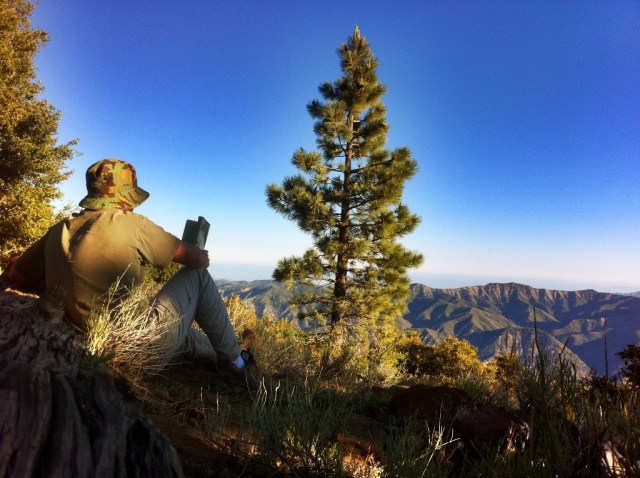


 Pool Rock pictograph
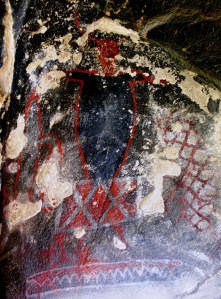 We spent an hour or two exploring the rock, a wind and rain-scoured honeycomb stained yellow and rose by a mineral in the sand. Here groups of the Chumash Indians used to come, in that time of year when water could be found in the canyons. They may have come to gather certain foods in season, or to take part in magic rites whose origin and significance are no longer understood. In a small cave at the base of the rock, the stylized figures of headless reptiles, insects, and strange birdmen are painted on the smoke-blackened walls and ceiling. These and some bear paw impressions gouged in the rock, and a few rock mortars used for grinding seeds, are all that is left of a once-flourishing people.
 Bear paw petroglyph at Pool Rock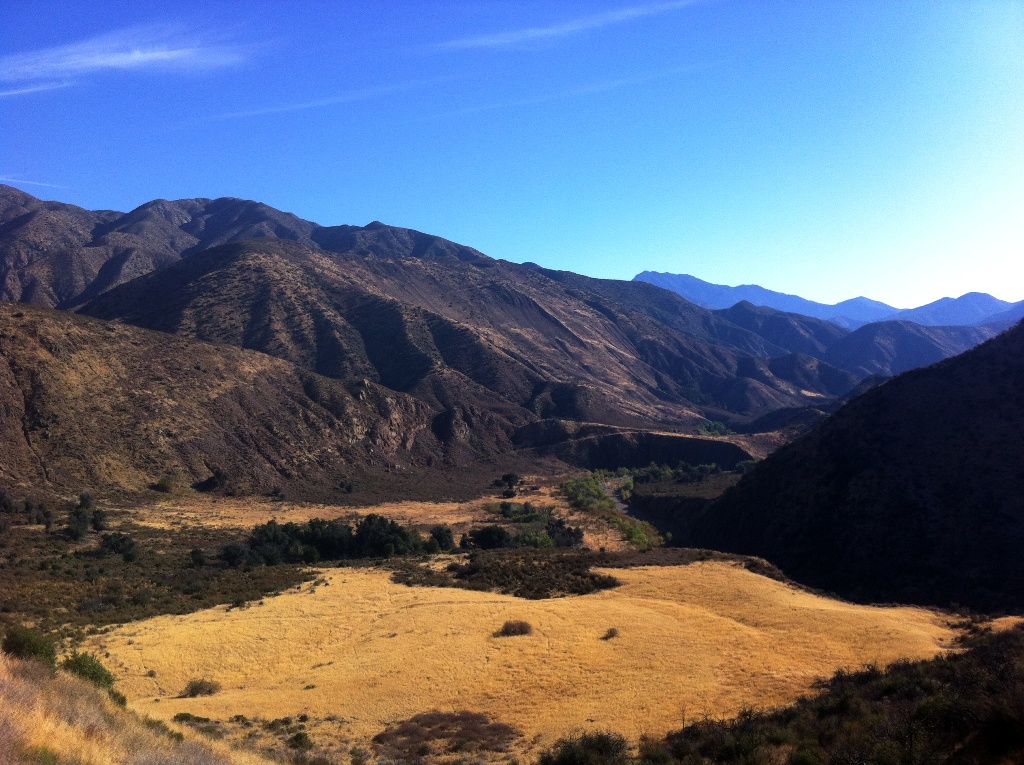



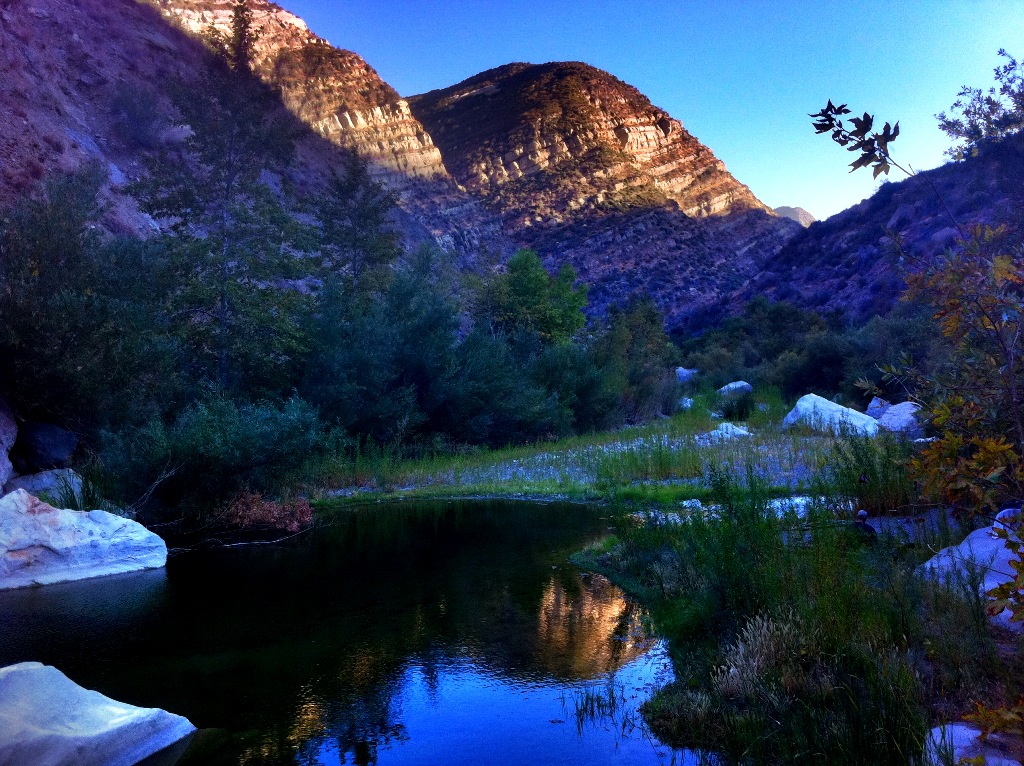

















 Jack Elliott's Santa Barbara Adventure