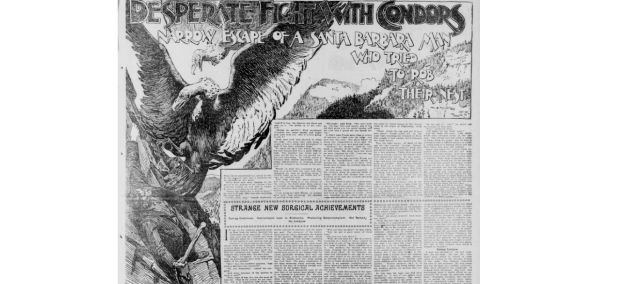
 A front page illustration on San Francisco’s The Call newspaper from April 30, 1899 showing two condors attacking a ledge-bound man wielding a club in defense. (Click to enlarge.)
The illustration above accompanied a harrowing tale of two Santa Barbara men, Frank and Fred, who in stealing an egg from a condor nest in 1899 met with the instinctual fury of North America’s largest flying bird. By today’s standards the story is an indictment of ignorant or careless men of the time and, in general, society at large. It reads like a tale of glorious battle and triumph by brave men facing the wrath of the vicious natural world, while offering no appreciation or concern for the condors involved.
“When Frank and Fred reached Santa Barbara,” the story reads, “the condor’s egg became the sight of the town.” How times have changed! Had they reached town with a condor egg today, never mind the illegality of it, they would have faced the fury and wrath of an outraged citizenry only a little less ferocious than the parent birds themselves.
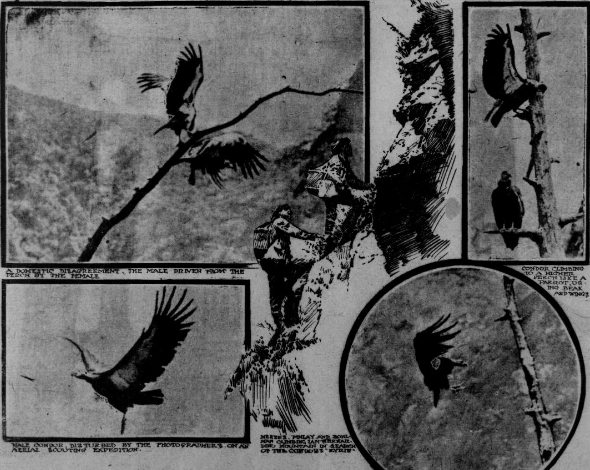
On June 14, 1908, The Call published another story titled, “Cloudland with the California Condor.” The article describes the experience of men climbing “ragged cliffs” and “clinging to the edges of the rocks along an almost perpendicular mountainside” in the San Bernardino Mountains of Southern California while on a quest to find condor nests. The story relates what may have been a motivating factor in Frank and Fred’s desire to risk their lives in 1899 to take home a condor egg.
“The condor’s disappearance seems now to be only a question of years. … Its eggs, eagerly sought after by collectors, are worth from $250 to $350 apiece, a price that sufficiently explains why egg hunters are willing to brave the dangers of almost inaccessible heights in order to reach their nests.”
In 2010 inflation adjusted dollars that amounts to about $5990 to $8390 per egg, respectively.
Readers familiar with the Santa Barbara backcountry may note with interest that the story from 1899 involves one Fred Forbush, a man that has come to hold a noteworthy place in Santa Barbara history relative the common men and women of his time. Today a popular backpacking camp in the Santa Ynez Mountains in the Los Padres National Forest behind Santa Barbara bears his name. The camp has been noted on this blog in a previous post: East Camino Cielo to Mono Camp.
Forbush Flats Camp was established in 1934 at the site of the homestead claim where Fred Forbush built a cabin in 1910. With proper seasonal timing, hikers can still to this day eat of the pears in the orchard Forbush planted some 100 years ago, and thereby connect in some small manner to the man written of in a story that made front page news in San Francisco in 1899.
Desperate Fight with Condors: Narrow Escape of a Santa Barbara Man Who Tried to Rob Their Nest
From Santa Barbara comes the most exciting adventure story of the year. Frank Ruiz and Fred Forbush met in deadly combat with a pair of condors and only vanquished the vicious birds of prey after a long fight.
From the stories told by the men, it appears that both were out hunting for Indian relics in San Royal Canyon a few days ago. The place is about eight miles from Santa Barbara, and is as wild a spot as can be found in the whole state of California. The canyon is narrow, with massive walls of rock hundreds of feet rising heavenward on both sides. These walls are precipitous, and it is only by the greatest care that a foothold can be obtained at any point.
While both men were digging in the gravel at the bottom of the canyon, Fred suddenly looked up and saw a condor flying into a cave high up on the cliff.
“Guess that bird’s got a nest in there,” he said to Frank, who was also watching the giant bird.
“Looks that way,” Frank answered. “And if it has, the chances are there are eggs in it. I’m going up to see, anyhow.”
“Better be careful,” Fred cautioned; “Condors are mean beasts and might pick your eyes out. But if you’re going, so am I.”
With that both men started to climb the cliffs. For arms they took along a couple of heavy sticks and determined to fight if the birds attacked them.
To reach the cave into which the condor had disappeared was a most difficult task. The weather was warm and to climb the 300 feet to the top proved trying and exhausting. At certain points a foothold was almost impossible and a single miscalculation in stepping meant death by falling to the bottom of the canyon.
Nearly an hour was consumed in getting on a level with the cave and then remained the task of crawling along a narrow ledge, so as to get inside and secure the condor’s nest.
This ledge was only about seventeen feet long, but from it to the bottom of the canyon the walls went down almost as straight as the walls of a building. It was a situation that called for nerve and daring.
“I am going in,” said Frank, an instant after both had calculated the chances of getting to the nest.
“All right,” said Fred. “We can’t both go. I’ll stay here and watch, and if the old bird gives you too much trouble call me over and I guess we can knock her out.”
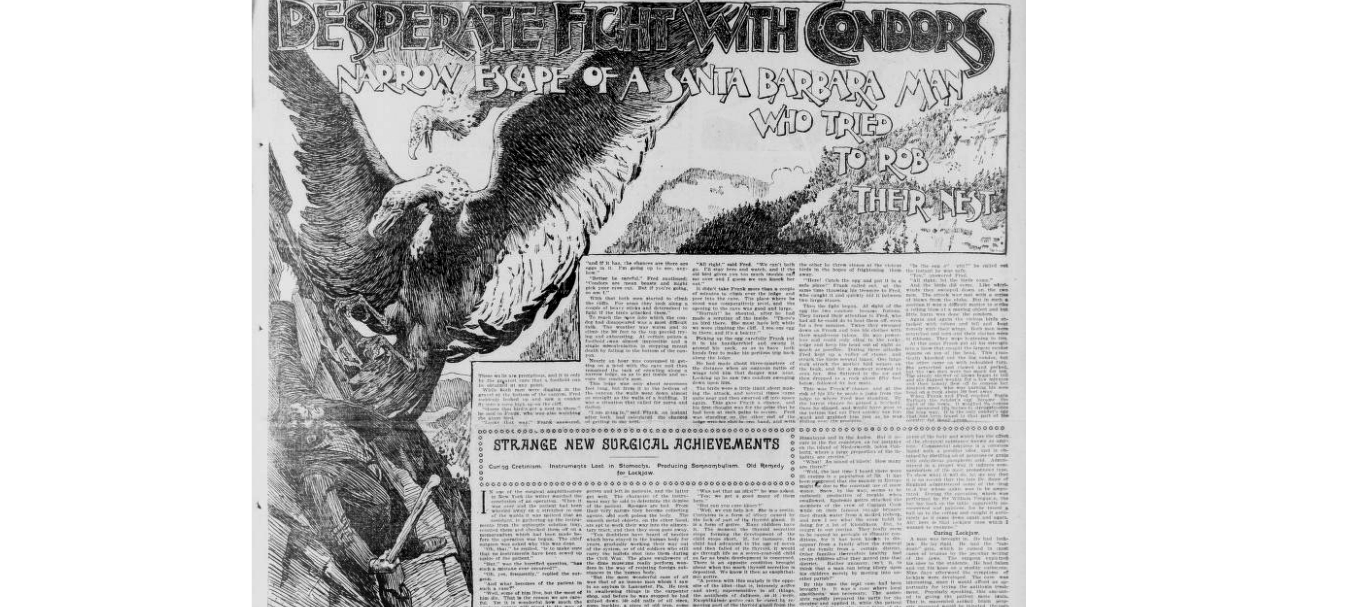
 A montage of photos and hand drawn illustration from the story that ran in The Call on June 4, 1908 showing condors in habitat and two men scaling a rocky cliff searching for their nests.
It didn’t take Frank more than a couple of minutes to climb over the ledge and peer into the cave. Where he stood was comparatively level, and the opening to the cave was good and large.
“Hurrah,” he shouted after he made a scrutiny of the inside. “There’s no bird there. She must have left while we were climbing the cliff. I see one egg in there, and it’s a beauty.”
Picking up the egg carefully Frank put it in his handkerchief and swung it around his neck, so as to have both hands free to make his perilous trip back along the ledge.
He had made about three-quarters of the distance when an ominous rattle of wings told him that danger was near. Looking up he saw two condors sweeping down upon him.
The birds were a little timid about making the attack, and several times came quite near and then swerved off into space again. This gave Frank a chance, and his first thought was for the prize that he had been at such great pains to secure. Fred was standing on the other end of the ledge with his club in hand, and with the other he threw stones at the vicious birds in the hopes of frightening them away.
“Here! Catch the egg and put it in a safe place!” Frank called out, at the same time throwing his treasure to Fred, who caught it and quickly hid it between two large stones.
Then the fight began. At first sight of the egg the two condors became furious. They turned their attention to Fred, who did all he could do to beat them off, even for a few minutes. Twice they swooped down on Frank and tore his clothes with their murderous talons. He was powerless and could only cling to the rocky ledge and keep his head out of sight as much as possible. During these attacks Fred kept up a volley of stones and struck the birds several times. One large rock struck the mother bird square on the beak and for a moment seemed to stun her. She fluttered in the air, and then dropped to a rock about fifty feet below, followed by her mate.
This was Frank’s chance, and at risk to his life he made a jump from the ledge to where Fred was standing. By the barest chance he gained a foothold. Once he slipped and would have gone to the bottom had not Fred quickly ran forward and grabbed him just as he was sliding over the precipice.
“Is the egg alright,” he called out the instant he was safe.
“Yes,” answered Fred.
“Alright let the birds come.”
And the birds did come. Like whirlwinds they swooped down on the two men. The attack was met with a series of blows from the clubs. But in such a position it was a difficult matter to strike a telling blow at a moving object and but little harm was done to the condors.
Again and again the vicious birds attacked with talons and bill and beat fiercely with their wings. Both men were scratched and torn and their clothes were in ribbons. They were beginning to tire.
At this point Frank put all his strength into a blow that caught the largest condor square on top of the head. This practically knocked out the big condor, but the other came on with redoubled fury. She scratched and clawed and pecked, but the two men were too much for her. The steady shower of blows began to tell and she flapped weakly for a few minutes and then lamely flew off to console her disabled mate, who was nursing his sore head on a rock about 100 feet away.
When Frank and Fred reached Santa Barbara the condor’s egg became the sight of the town. It weighed 9 1/2 ounces and measured 11 1/2 inches in circumference the long way. It is the only condor egg that has been found in that part of the country for many years.
Related Post:
Condor in a Cage, Santa Barbara Zoo





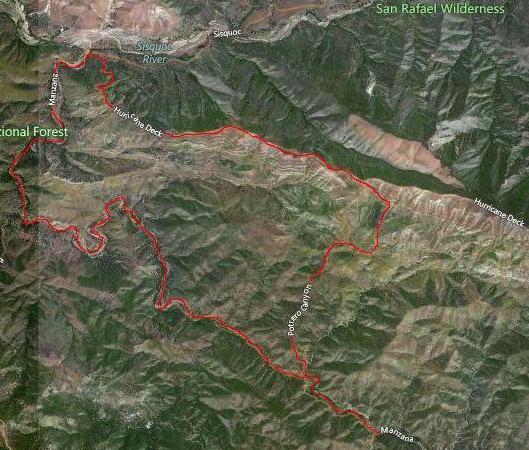 The circuit I hiked noted on Bing imagery.













 Jack Elliott's Santa Barbara Adventure