

Detail showing Abel Mtn. on a 1938 map of Los Padres National Forest.
Backstory
I’ve long had an interest in place, in the particularity of natural settings and the composition of undeveloped scenes, and in the forest placenames chosen by humanity.
Natural places and language are, of course, the preoccupation of this thirteen-year-old weblog.
Oftentimes we have sought to learn from the land’s Indigenous Peoples, and to view these matters through the lens of California Indian culture and history, for sake of clarity and deeper understanding.
I wrote something of it seven years ago in the post, Sitiptip Flat. I quoted professor Dan Flores writing about Native American place naming habits: “It’s landscape associative.”
That’s reasonable, common sense. Name the land simply for what it is, not out of conceit for some person or people.
In pondering place and name I referenced Richard Applegate in Chumash Placenames (1974). I noted the difference in perspective among Native American cultures as compared to mainstream American culture. I wrote:
“As with the Comanche and Kiowa of which Flores writes, sense of place and the importance of the landscape figured prominently in Chumash culture. Whereas in American culture places are often named after people, the Chumash tended to name people after places.”
One motivating impetus behind that post, previously unmentioned, was the finding of a makeshift memorial at so-called Sitiptip Flat.
The people who saw fit to leave their trace had claimed and named the unspoiled meadow on behalf of their dead friend.
I again raised the issue of naming places after people a year ago in the post, The Case For Renaming Los Padres National Forest.
“Enough of that!” I exclaimed in exasperation.
This land-centric perspective is one of the underpinning ideals informing our call on this blog to rename the forest, Condor.
 Detail of U.S. Forest Service map from 1938.
In 1936, Santa Barbara National Forest was renamed Los Padres.
The new name was “a fitting memorial to its first white users,” wrote William S. Brown not long after in 1945. History of Los Padres National Forest, 1898–1945
Was Brown opining personally or relating popular sentiment of the time?
In The Case For Renaming Los Padres I offered shocking examples of the racist social and political atmosphere during 1930s America to provide cultural context.
I do not believe we can separate the naming of Los Padres in 1936 with what all else was happening in the country at the time.
We return now to ponder yet another example.
Main Point
Following the renaming to Los Padres, mount Cerro Noroeste in Kern County showed as Abel Mtn. on the official government map.
Cerro Noroeste is a name that has come to us through history from the earliest Spanish speaking residents of the land.
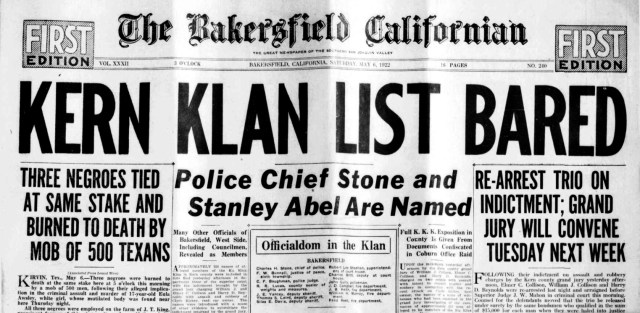
Peter Gray, a blogger, provides us with an eyebrow-raising sketch of Kern County Supervisor, Stanley Abel, after whom the mountain was named.
His write up includes the preceding graphic of a front page newspaper story listing Abel as a member of the Ku Klux Klan.
By 1922, avowed Klan members controlled the Bakersfield mayor’s office, various police departments throughout the county, much of the sheriff’s force of deputies, several judgeships, the city school-district, and the county board of supervisors which included Stanley Abel. Klan members were required to take an oath that superseded any vows of office or citizenship. Police chiefs and sheriff’s deputies literally swore to protect the Klan before enforcing the law. Abel unabashedly wrote that he was proud of “the good work” of the KKK, adding in a front-page newspaper column, “I make no apology for the Klan. It needs none.”
In the 1930s, Kern County Supervisor, Stanley Abel, played a role in having a road constructed to the top of “our” beautiful mountain and consequently the press of the day started referring to the mountain as “Mount Abel.”
Gray notes that as per the United States Board of Geographic Names (BGN) the name Abel was unofficial and that twice the name Cerro Noroeste was reaffirmed by the BGN.
However, one wonders how exactly to interpret that, because after all, the name was used on the Forest Service map of 1938, and thus given the stamp of approval by the federal government.
Surely this aided in popularizing the name and helping it to persist in common use for decades.
As Robert A. Burtness wrote in his local hiking guide from 1962 describing public campsites in the forest, making a casual observation on common practice of the times:
Camp Alto Camp
Spanish for high camp, Campo Alto is located atop Mt. Cerro Noroeste, commonly known as Mt. Abel.
The United States Forest Service still uses the name.
It’s perplexing why the Forest Service prints the name at all, let alone placing it prominently before Cerro Noroeste as if the latter is ancillary.
From June 1, 2023:

Nuance
The need to rename our forest is far less clear and certain when the name itself, Los Padres, is not derogatory and not that of a known Klansman.
Los Padres National Forest was named in 1936. Santa Barbara Bowl was originally built in 1936 as a venue to celebrate Old Spanish Days–Fiesta. San Diego’s baseball team was also named the Padres in 1936.
Los Padres were clearly having their moment of remembrance in California in the 1930s. What could be wrong with that? It all appears so wholesome and communal in a town, a state, with deep Spanish roots.
Whether or not we need to rename the baseball team is beyond the scope of this blog. But, it is indeed an entirely fitting memorial honor for those times that the team was named for a group of white men. Because the game was segregated and black men were not even allowed to play in the major leagues.
So, you see, it’s not so much about the name, per se, but the underlying story about motivations and equality.
Something is wrong with the name Los Padres as it was applied to our national forest and we need to change it.











 Jack Elliott's Santa Barbara Adventure
I suggest we go back to the Santa Barbara National Forest. I know full well much of it is not in the Santa Barbara area. Just saying my thoughts. If you look at the original boundaries it reaches deep towards the City of Santa Barbara.
We might add the portions of the forest now in Ventura County to the overall total for Santa Barbara County, being that originally, until 1872 that is, all of Ventura was part of Santa Barbara. It’s another interesting tidbit about local name changes.
The Scots name for natural features and not people – that’s why there are 3000 plus foot mountains (big in Britain) ‘Beinn Mhor’ i.e. Big Hill!
First things first, get Stubbs out of power so he can’t try and shut down the whole forest again!
Los Padres Forest Watch
July 19, 2023
The Name “Mt. Abel” Glorifies an Avowed Klansman
On the evening of April 22, 1922, a group 200 or so men donned masks and raided the Elduayen family home in Inglewood, CA. The raiders seized Spanish immigrants Fidel Elduayen and his brother Mathias, threatening them with death on suspicion of the men being bootleggers. One of the raiders, a constable in the town, was shot and killed by police during the incident. It was quickly discovered that the raiding party was largely comprised of members of the Ku Klux Klan (KKK). At a time when the Klan was at its most popular while also causing mayhem across the country, the raid made headlines and resulted in a massive investigation into the organization’s dealings in California. …
https://lpfw.org/the-name-mt-abel-glorifies-an-avowed-klansman/
To quote Winston
Churchill: “A nation that forgets its past has no future”. Understanding that learning about your history is not about making any one person or people group feel guilty.
You cannot be guilty of actions that took place before you were born.
I suggest we leave the past as it is and look forward to the future.
Biden-Harris Administration proposes new Chumash Heritage National Marine Sanctuary off California coast
https://www.noaa.gov/news-release/biden-harris-administration-proposes-new-chumash-heritage-national-marine-sanctuary-off-california