Rain Beetle

rain drop caught in spider webA drop of rainwater suspended in a spider web stuck to the underside of a boulder.

Prior to the recent few downpours last month in late February and early this March, it hadn’t rained in a long time. Just a smattering of precipitation had fallen here or there over the many months, but hardly enough to wet the ground in most places and everything was so dry from the ongoing drought that a day or so later, with a little sun and a light breeze, there was hardly a trace of moisture left.

Santa Barbara County-wide rainfall totals

Before February, as per the County’s official measure, it had been over a year since it had rained more than a single inch during the course of a day. I had started thinking it may become the season I remember ever after as the winter it didn’t rain.

Then it finally did rain: 2.47 inches on February 27th, 2.60 inches on the 28th, 1.16 inches on March 1st and 2.00 inches on the 2nd. The precipitation that fell during those several days amounted to almost half the total rainfall of the previous season.

Last season’s rainfall county-wide measured in at 46 percent of normal. With most of the wettest part of this season past the tally stands at just 43 percent of normal. Those recent four days of rain very well may end up being the vast overwhelming majority of all precipitation for the entire year! (As an aside, apart from the lack of rain, this winter in Santa Barbara has also been the warmest in five years according to University of California, Davis.)

Rain Beetle PleocomaA rain beetle (Pleocoma spp.).

“By tying its mating cycle to that of the rain, this beetle can remain underground for long periods of time in case of drought.”

Joan Easton Lentz, A Naturalist’s Guide to the Santa Barbara Region (2013)

Rain beetle larvae live underground for ten or more years before finally emerging as mature adults to mate. Male beetles fly low over the land, often while it’s raining, in search of females. As fancy looking as their finely, evolutionarily tailored body appears, once they emerge from the ground as an adult they never eat, as their mouthparts are not functional and they have no developed digestive system.

A decade of burrowing around as a grub underground eating roots, much to the frustration of fruit tree growers, only to emerge into the open air just long enough to get some and then die. The life of a bug.

I always wish I could get inside bugs and drive or fly them around like a big truck or an aircraft, like they had an air conditioned cab or a cockpit with plush captain’s chairs. By the looks of a rain beetle, I bet I could have some serious fun cruising around in them like Spaceman Spiff.

Related Posts:

Tarantula Hawk, World’s Worst Sting: “blinding, fierce, shockingly electric. A running hair drier has been dropped into your bubble bath.”

Deluge and Drought In Santa Barbara County

Posted in Santa Barbara County | Tagged , , , , , , , , , | 3 Comments

Swordfish Cave, Earliest Chumash Rock Art On California’s Central Coast

“The people venerated the swordfish because they sometimes chased whales ashore and thus the people had a lot of meat.”

Luisa Ygnacio (c. 1835-1922)

“All, whatever there is in the ocean is just like everything that is here on this earth. . .We are the people of this land … The people of the ocean are the swordfish.”

Mary J. Yee (1897-1965), Luisa Ygnacio’s granddaughter and the last speaker of Barbareno Chumash

Swordfish featured prominently in Chumash culture and were accorded the high status of being the marine equivalent to what humans were terrestrially. (Though it should, perhaps, be noted that in general there in fact was no single homogenous Chumash culture, but there existed a wide diversity of beliefs among the historic people commonly known under that name in contemporary times.)

One of the most important Chumash ceremonies involved the Swordfish Dance performed in regalia comprised of a headdress made of a swordfish skull and bill and a cape decorated with pieces of sparkling abalone shell. Sometimes the costume was made of feathers representing the swordfish.

Fernando Librado, a Chumash consultant to ethnographer John P. Harrington, described the performance of the Swordfish Dancer:

“During the dance the performer whirled; his headdress feathers looked like a wheel as he spun around, first in one direction and then another, giving thanks. The feathers on his belt whirled also and looked like a stripe.”

Fernando Librado Kitsepawit (1839-1915), born and raised at Mission San Buenaventura, sits next to Jerd Barker and Pat Forbes. Kitsepawit's parents born Santa Cruz Island and brought to the mission as children. 1912Fernando Librado Kitsepawit (1839-1915)

An excerpt from the notes of David Banks Rogers, the first curator of anthropology at the Santa Barbara Museum of Natural History, describing in 1944 his find of a Chumash skeleton 18 years earlier that was dressed in the ceremonial regalia of a swordfish dancer:

(The site) is on the crest of an exposed headland over-looking the ocean about three miles west of the Goleta Slough … it bore abundant evidence of having been the site, at different periods, of the three successive cultures which have peopled our coast … and the most remarkable find at this site was made on May 28 (1926) … I encountered a skeleton in the embryonic position, resting on the left side … and everything which comprised this find … was encased in … mud. In spite of this fact it was very evident this was no ordinary burial, for a wide cape composed of symmetrically arranged bits of shell (Haliotis) which had each been carefully shaped and pierced for attachment extended from the side and back of the skull, over the shoulder, suggestive of the scale armor of ancient warriors …

Nor was this all of special interest which attached to this burial. A further removal of the mud … showed that the skull was enclosed in another skull, that of a swordfish, the beak of which extended upward from the forehead and as it lay, pointed due west, in the same general direction in which the heads of all the skeletons in this section had pointed …

Several days later, being somewhat dried, a large part of the adhering soil was carefully removed from the head portion, disclosing that it was of even greater interest than its first appearance indicated.

… the outstanding features of this burial were the appurtenances that first wakened in me the deep interest in it, the armor-like cape composed of bits of shell and as of now, cleared of soil, displaying their sparkling iridescent surfaces turned out, and this creation in turn seemingly having been attached to the base of the skull of a swordfish, this skull having been divided longitudinally in the rear and opened so that it clasped each side of the back of the wearer’s head, the beak, some sixteen inches long, having projected obliquely upward and forward from above the forehead as the wearer stood upright. This beak when found was broken from the skull, and was also broken in one other place, not far from the tip…. but all the parts lay in sequence.

A remarkable feature of the swordfish skull was the eye orbit on the right side. The orbit had been greatly enlarged and was inlayed with shaped sections of shell, to form a most striking ellipse-shaped, iridescent ornament of the side of the wearer’s head. The center of this ellipse was a well-worked, plain ellipse of mother-of-pearl set in asphalt. Radiating from this center was a mosaic of other pieces of mother-of-pearl, each shaped much as were those of the cape attached below them…

When I described this amazing attire to Tehachipi George, a Santa Barbara Canalino, third removed, he nodded knowingly and said it was the regular regalia of the ‘Swordfish Dancer’ who did the dance in honor of the swordfish who brought his people whale meat in plenty….

An excerpt from David Banks Rogers’, “Prehistoric Man of the Santa Barbara Coast” (1929), in which he describes his find of the swordfish dancer:

“I had, at intervals, found the beaks of swordfish near the heads of male skeletons. Finally, I had good fortune to find on in place, protruding above and forward from the face of the skeleton; above and below the skull lay a thick sheet of overlapping triangular ornaments, shaped from the iridescent inner layer of abalone shell. Each of these pieces was pierced with one or more small holes , as though for attachment to some fabric or dressed skin. It was the most convincing picture imaginable.

David Banks Rogers ChumashThe body that had lain here had been dressed to symbolize the swordfish, the scaly sides of the head and neck and the formidable sword being very suggestive. I am inclined to believe that this individual had, in life, danced the character of the swordfish, and, in death, had been put away in his ceremonial paraphernalia.

Traditions persist among the surviving remnants of kindred people, that the Canalino held this combative fish in great veneration, because it drove ashore or killed the whales that contributed so largely to the food supply of this people. It is probable that, in our dancer, we have an individual who had done homage to the benefactor of his people.”

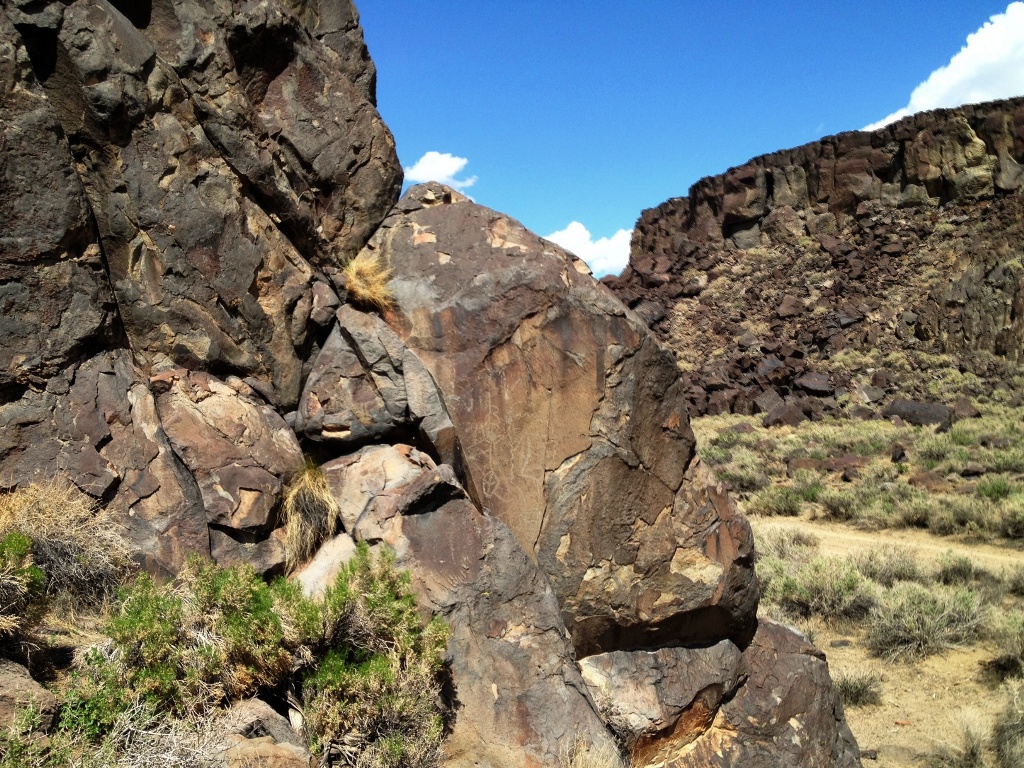
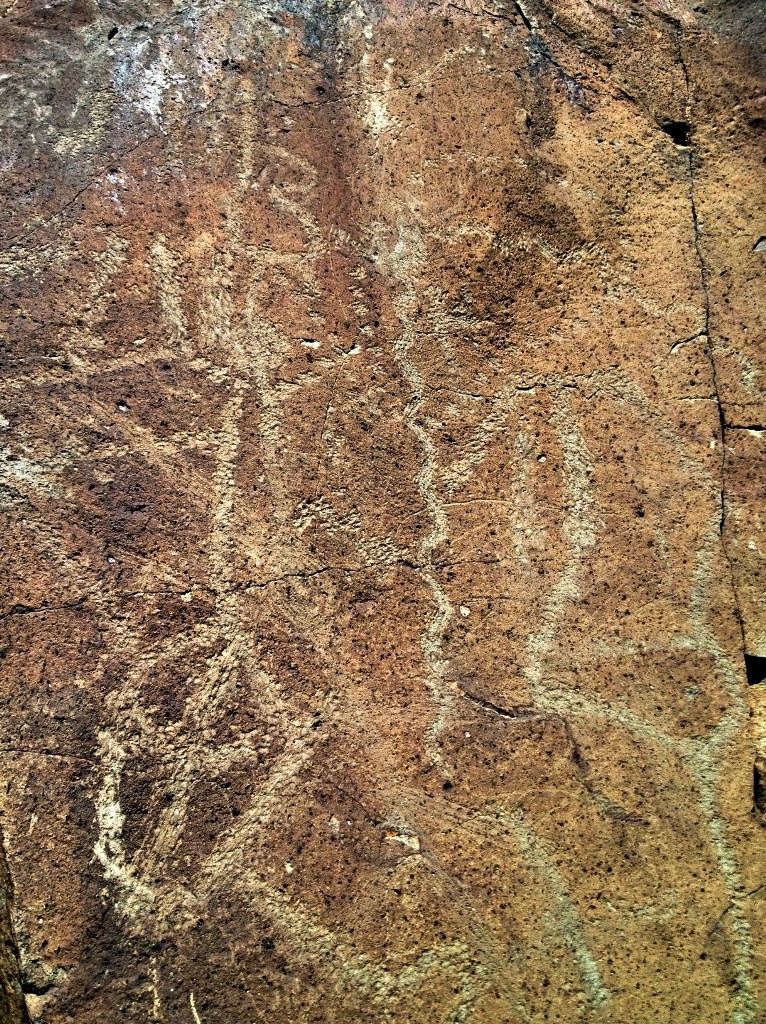
At least three different Chumash rock art sites feature swordfish pictographs with numerous other locations containing more abstract motifs which may be representative of the great billed fish.

Taken together, the dance and art reflect the significant role swordfish played in the maritime culture’s rituals, aside from serving as food and raw materials for the crafting of numerous utilitarian goods such as cups made from vertebra.

Chumash rock art pictograph swordfish caveThe swordfish depicted as negative space.

Swordfish Cave is located in the vicinity of Point Conception in Santa Barbara County, a geographical location held sacred by many Chumash people past and present as the historic site of a shrine to the dead and a point through which the deceased pass on to the afterworld. (However, in the interest in being as accurate and true to the Chumash people as possible, it should perhaps be noted that Point Conception is often erroneously labeled decisively as the so-called “Western Gate” in traditional Chumash lore. While there is a factual basis to this idea surrounding Point Conception, and it stems from genuine Chumash belief among some, the term “Western Gate” is a manufactured label that was popularized in the late twentieth century. The matter is often oversimplified and it’s incorrectly suggested if not stated positively that the point was the only such site as believed by all Chumash people, which, based on the notes of John P. Harrington, was clearly not the case.)

The following text is taken verbatim from a reader board posted at Swordfish Cave:

“Human occupation at Swordfish Cave  began 3,500 years ago, shortly after the cave formed and when the bedrock floor was still exposed. From that time until about 2,700 years ago, the ancestral Chumash periodically used the cave as a campsite while hunting and gathering. Small mammals such as cottontail rabbits and ground squirrels were an important source of food. Early cave occupants created a bedrock mortar in the cave floor for grinding plant foodsthe mortar is currently visible in the cave floor.

Petroglyphs (carvings in the rocks) were created during these occupations between 3,500 and 2,700 years ago, and it is likely that some pictographs (paintings) were also created during that period. Swordfish Cave contains the earliest known rock art along California’s Central Coast.

swordfishThe ancestral Chumash society changed around 2,700 years ago. A religious system in which religious specialists (shamans) were distinguished from political leaders was instituted. Swordfish Cave was not used as a campsite for the next 2,500 years, as it was apparently reserved for ceremonial and religious purposes. Petroglyphs were not created during this period, although it is possible that pictographs were.

Mission la Purisima Conception was established in Lompoc in 1787, dramatically changing the Chumash lifeways. Nearly the entire local Chumash population was under control of the mission, but missionaries were unable to feed the Chumash neophytes year-round. Consequently, they periodically turned to hunting and gathering. Swordfish Cave was used as a campsite for the last time between A.D. 1787 and 1804, when some Chumash people reverted to a lifestyle similar to that between 3,500 and 2,700 years ago. This time, however, cave residents were eating larger animals, including cattle.

The prehistoric artwork at Swordfish Cave is diverse. Petroglyphs include horizontal and vertical incised lines in the cave walls; incised lines are even evident in the bedrock floor. Small drilled holes are also evident, typically in clusters. The larger holes around the mouth of the cave were created naturally, but some of these have been enhanced with paint. Pictographs include painted lines as well as anthropomorphic and zoomorphic figures, including a realistic rendition of a Swordfish. (Text by Clayton G. Lebow.)”

Chumash rock art pictographs swordfish caveSwordfish Cave

Swordfish Cave Chumash rock art pictographChumash swordfish Cave rock artChumash swordfish cave rock art pictographChumash rock art pictographChumash swordfish cave incised marksPetroglyphs and/or incised rock.

Chumash petroglyphswordfish cave Chumash incised marks

Reference:

“The Chumash and the Swordfish,” Davenport, Demorest; Johnson, John R.; Timbrook, Jan, Antiquity 67: 257-72 (1993).

“Point Conception and the Chumash Land of the Dead: Revisions from Harrington’s Notes,” Haley, Brian D.; Wilcoxon, Larry R., Journal of California and Great Basin Anthropology
Vol. 2 1 , No. 2, pp. 21 3-235 (1 999).

Posted in Santa Barbara County | Tagged , , , , , , , , , , | 9 Comments

Point Conception, the Cape Horn of the Pacific

Point Conception Lighthouse mural LompocA mural of Point Conception lighthouse painted on the exterior of a building in Lompoc, California, Santa Barbara County. An accompanying reader board describes the surrounding coastline as “the mariner’s stretch of nightmare coast known as ‘the graveyard of ships.'”

“Point Conception we passed in the night, a cheery light gleaming over the waters from its tar light-house, standing on its outermost peak. Point Conception! That word was enough to recall all our experiences and dreads of gales, swept decks, topmast carried away, and the hardships of a coast service in the winter.”

-Richard Henry Dana, Jr., Two Years Before the Mast (1840)

In 1834, Richard Henry Dana, Jr. dropped out of Harvard University, boarded the brig Pilgrim in Boston harbor and set sail on a two year voyage working as a common seaman. His maritime job brought him to the Pacific coast of California, where he worked in the hide and tallow trade loading the ship with cattle skins. The voyage from Boston around Cape Horn to Santa Barbara took 150 days.

Richard Henry Dana Jr. Santa BarbaraIn 1840, he published a narrative of his experiences under the title, Two Years Before the Mast, and in this story he relates an early view of California including Santa Barbara, which he called at that time “the central port of the coast,” and which the Pilgrim called upon numerous times.

In Two Years Before the Mast, Dana describes his experience during a treacherous nighttime passing of Point Conception. In his full narrative, select excerpts of which follow below, he details the frantic work of his fellow sailors to guide their ship through the tempest in one piece, while wild swells sweep the deck, the sails and rigging are ripped to shreds and the gale force wind threatens to snap the mast in two. Dana describes working on the open deck and being “several times buried in the seas, until the mate ordered us in, from fear of our being washed off.”

“We had a fine breeze to take us through the Canal [Santa Barbara Channel], as they call this bay of forty miles long by ten wide. The breeze died away at night, and we were becalmed all day on Sunday, about half-way between Santa Barbara and Point Conception.

Sunday night we had a light, fair wind, which set us up again; and having a fine sea-breeze on the first part of Monday we had the prospect of passing, without any trouble, Point Conception, the Cape Horn of California, where, the sailors say, it begins to blow the first of January, and blows until the last of December.

Toward the latter part of the afternoon, however, the regular northwest wind, as usual, set in, which brought in our studding-sails, and gave us the chance of beating round the Point, which we were now just abreast of, and which stretched off into the Pacific, high, rocky, and barren, forming the central point of the coast for hundreds of miles north and south. A cap-full of wind will be a bag-full here, . . .”

Richard Henry Dana Santa Barbara“We had been below but a short time, before we had the usual premonitions of a coming gale, —seas washing over the whole forward part of the vessel, and her bows beating against them with a force and sound like the driving of piles.”

“I shall never forget the fineness of the sight. It was a clear, and rather a chilly night; the stars were twinkling with an intense brightness, and as far as the eye could reach there was not a cloud to be seen. The horizon met the sea in a defined line. A painter could not have painted so clear a sky. There was not a speck upon it. Yet it was blowing great guns from the northwest.”

“It was a fine night for a gale; just cool and bracing enough for quick work, without being cold, and as bright as day. It was sport to have a gale in such weather as this. Yet it blew like a hurricane. The wind seemed to come with a spite, an edge to it, which threatened to scrape us off the yards. The force of the wind was greater than I had ever felt it before; . . .”

Richard Henry Dana Two Years Before the Mast Point Conception“The force of the wind had never been greater than at this moment. In going up the rigging, it seemed absolutely to pin us down to the shrouds; and, on the yard, there was no such thing as turning a face to windward.”

“The gale was now at its height, `blowing like scissors and thumb-screws’; the captain was on deck; the ship, which was light, rolling and pitching as though she would shake the long sticks out of her, and the sails were gaping open and splitting in every direction.”

“For three days and three nights the gale continued with unabated fury, and with singular regularity. There were no lulls, and very little variation in its fierceness. … All this time the sea was rolling in immense surges, white with foam, as far as the eye could reach, on every side, for we were now leagues and leagues from shore.”

“During these seventy-two hours we had nothing to do but to turn in and out, four hours on deck, and four below, eat, sleep, and keep watch. …and we had many days’ sailing to get back to the longitude we were in when the storm took us.”

“Day after day Captain Faucon went up to the hill [overlooking Monterey Bay] to look out for us, and at last gave us up, thinking we must have gone down in the gale which we experienced off Point Conception, . . .”

1859 point conceptionIllustrations of Point Conception lighthouse penned in 1859 by Major Hartman Bache, inspector of the 12th Lighthouse District. (c) NOAA

Dana’s dramatic description of the sea and weather surrounding Point Conception is lent greater weight having come from a mariner well experienced in sailing open ocean through some of the world’s most deadly waters, including a frightful trip around Cape Horn during an Antarctic winter, and having to work the icy decks and rigging of a pitching and rolling ship under howling winds in the midst of “driving sleet, and darkness, and wet, and cold.”

Herman Melville, author of Moby Dick (1851), widely considered one of the greatest American novels of all time, advises readers in White Jacket (1850):

“But if you want the best idea of Cape Horn, get my friend Dana’s unmatchable Two Years Before the Mast. But you can read, and so you must have read it. His chapters describing Cape Horn must have been written with an icicle.”

Knowing well the nastiness of Cape Horn, Dana still saw fit to compare Point Conception to it, which surely is some proof of the Central Coast headland’s formidable nature. The treacherous seas off Point Conception result in part from the confluence of cold and warm water oceanic currents. Typically it is a region of unsettled, foggy and blustery weather and rough and turbulent chilly water that has long played havoc on passing vessels.

A short distance up the coast from Point Conception, at Honda (Pedernales) Point, one of the largest peacetime disasters in United States naval history occurred, when on September 8, 1923, a navigational error in foggy or misty weather led seven destroyers aground on the jagged seashore and 23 sailors died.

As the United States Coast Pilot publication of 2012 notes:

Point Conception has been called the Cape Horn of the Pacific because of the heavy NW gales encountered off it during the passage through Santa Barbara Channel. A marked change of climatic and meteorological conditions is experienced off the point, the transition often being remarkably sudden and well defined.

Point Conception Lighthouse 1859 Drawing by Major Hartman Bache, inspectof of the 12th Lighthouse District.Another view of the lighthouse from 1859 when it was located atop the crest of the headlands rather than at its base, as shown below.

Point Conception LighthousePoint Conception lighthouse. (c) John Wiley

Santa Barbara Channel IslandsMap showing Point Conception.

Related Post:

Santa Barbara Seen Through a Sailor’s Eyes (1835)

Posted in Santa Barbara County | Tagged , , , , , , , , , , | 4 Comments

8@20 WNW 286°

California surf 1-24-14A lesser set wave on Friday, January 24, 2014.

As an observer it’s interesting to me, the big(ger) wave event along this stretch of coastline. I surf and I surf, and I surf, through the months or even years, and everything else around me in the surrounding knot of civilization carries on as usual, indifferent and apart from my experience at the beach. Nobody but surfers and saltwater junkies, the usual suspects, cares or shows any interest in the ocean.

Then comes a large swell event and suddenly the beach is abuzz in activity. Spectators crowd the shoreline just to watch the raw power of the Pacific slam against the edge of the continent. They stand ashore gazing upon the breakers mesmerized as when watching a glassy wavecampfire. Harbor Patrol boats and Coastguard Cutters cruise the roiling nearshore waters, helicopters fly up and down the beaches, and emergency first responders tool around in their various rigs, some towing wave runners.

As the swell grows the crowd in the lineup thins. On the day an exceptionally large swell peaks, typically a much small group of guys are out than I’d expect. The next day, as the swell fades, though still big, the crowd grows proportionate to how much the waves shrink until the surf reaches a more normal size, maybe overhead or whatever, and the lineup is once more thick with scores of bobbing heads. At that point the crowds of spectators and the rest have long disappeared, the coastline again quiet for the most part.

Some days later the waves turn puny and only a few people remain. Completing the cycle, the Pacific eventually flattens out like a lake taking on its namesake calm character. Then, there’s nobody around. They’ve all gone just as fast as they came, a mania of fleeting interest.

Yet I remain.

surf sunset

Posted in Santa Barbara County | Tagged , , , , , , , , , | 7 Comments

Salmon Choking the Santa Ynez (1896)

California southern steelhead Santa BarbaraRainbow Trout (Oncorhynchus mykiss) (c) Timothy Knepp – U.S. Fish and Wildlife Service

The following newspaper brief was published in the San Francisco Call on March 11, 1896 and testifies to the way things once were not all that long ago in the wilds of Santa Barbara County. Whereas historic steelhead runs on the Santa Ynez River are estimated to have numbered up to 30,000 fish, today the number is thought to be somewhere around 100. And, of course, fishing for them is strictly forbidden.

While the story is from the late nineteenth century, large steelhead runs like it describes, aside from the exaggerated number, routinely happened at least as late as the 1940s. Many of the fish identified as salmon in the news clip would likely have been upwards of two feet long, based on historic photos and the stories told by those who were there. And then the monster-sized fish vanished from the forest.

“Anecdotal accounts suggest that run sizes declined precipitously during the late 1940s and 1950s, due possibly to both drought and to anthropogenic changes to the river system such as dam construction,” the National Oceanic and Atmospheric Administration reports in a technical memorandum from 2005.

Ponder the thought of seeing a 30-inch steelhead in a tiny tributary of the Santa Ynez River, deep in the Los Padres National Forest. Not just once, a rare freak happening long thought to no longer be possible, but seeing them routinely through the years. It’s something that sounds preposterous, a laughable fantasy, as based on common experience in the forest these days.

A person just does not expect to see very many or very large fish in the creeks and rivers around here anymore. Tell younger generations or even some middle-aged men who’ve never heard these sorts of true fish stories from the past and you’ll blow their minds.

salmon santa ynez riverThe news clip from 1896, aside from noting the steelhead run, relates the common practice back then of spearing the fish as they passed through the shallows. One might imagine the historic population of Chumash Indians taking the large sea-run trout in a similar fashion through the centuries to supplement their diets with fresh and dried or smoked fish.

santa ynez river trout steelheadA report from a Santa Barbara newspaper reprinted in the Los Angeles Herald on March 15, 1909, which tells of yet another method in which steelhead were once taken by means other than a rod and reel.

On occasion I daydream of the small riverside town of Lompoc, near the mouth of the Santa Ynez River, as a renowned fishing destination. A place where anglers and fishermen flock during steelhead season, the motels and inns fill up, and the breakfast joints and cafes hum with fish stories bantered back and forth among old men in flannel and denim, suspenders pulled tight over shoulders, sipping black coffee. The walls of the eateries decorated with old fishing rods and reels, handcrafted lures and flies, taxidermy, and scores of photos documenting the memorable fishing experiences of its out-of-town patrons and locals alike, men, women and children, and the town’s main street dotted with small tackle shops and pickup trucks and SUVs, their rear windows and bumpers polka dotted with various outdoorsy-type stickers.

The town is nothing like that today, and I don’t necessarily wish it was, but I entertain the thought amusingly, because it very well might have been.

Related Post:

santa-ynez-river-steelhead-1942Native Steelhead of Yore on the Santa Ynez River
Posted in Santa Barbara | Tagged , , , , , , , , , , , | Leave a comment