Pool Rock, Condor Bird Bath?

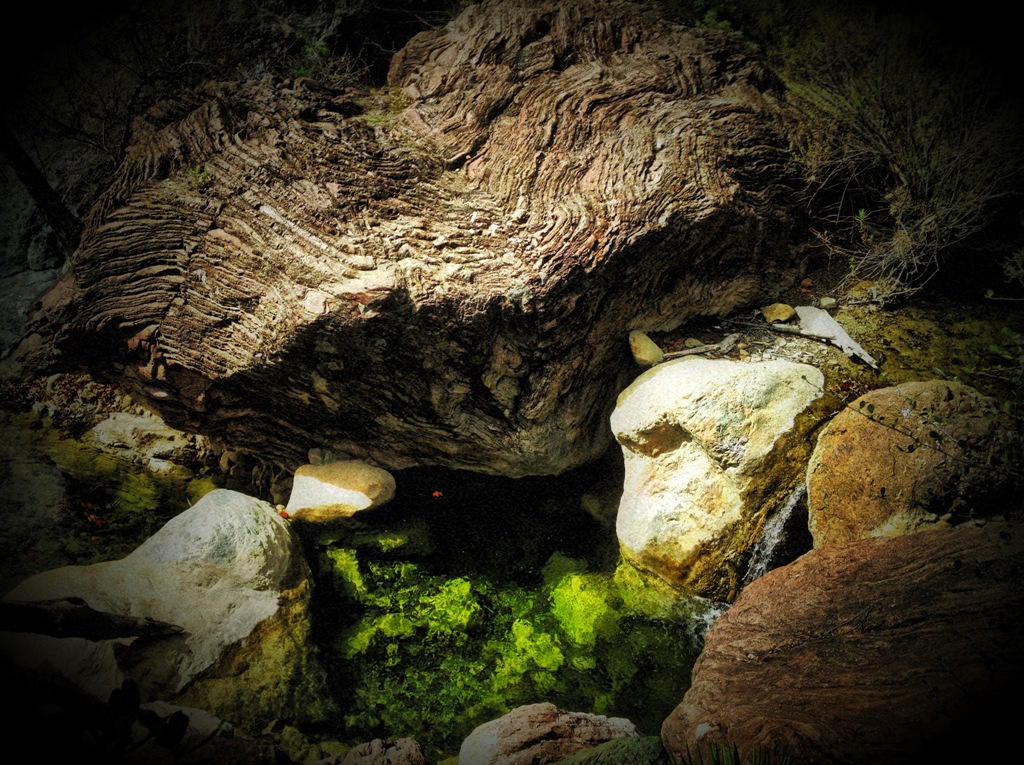
Pool Rock 2.1Pool Rock holding relatively little water for early March.

This pool sits atop an outcrop some 80 feet above the ground. In being similar to other pools that attract(ed) California condors, I suspect that in times past condors made use of it if’n people weren’t around. Not a bad bird bath, eh?

Posted in Santa Barbara County | Tagged , , , , , , , , , | 5 Comments

Fallen Rock Chumash Pictograph Rock Art

In September 2012 I had the privilege of naming a Chumash pictograph site theretofore undocumented by the U.S. Forest Service. In August 2012 I mentioned on this blog that I stumbled across some Chumash rock art  I didn’t know existed. Following that post a friend, or perhaps it’s more accurate to say an acquaintance, contacted me and said there was a chance that the site in question was unknown to the U.S. Forest Service. Not that it was a new, never before seen discovery, but that it was not officially documented and recorded by the U.S.F.S. in their annals of archaeology.

And indeed, he was correct. He later organized an outing with a friend of his that serves as a volunteer for the U.S.F.S. and who documents archaeological sites in the Los Padres National Forest. His friend has, let’s say, a family association with recording the history and prehistory of the L.P.N.F. And so one sunny morning we met in the mountains and I led them to the site for a day of oh-fficial documentation.

It was mentioned while hiking that as the person that reported the pictograph site I was entitled to bestow a name upon it. At first I thought it was said in jest, but through out the day I was asked several times what I wanted to name the site. For whatever reason I was preoccupied with other thoughts and never thought much about a name.

The archaeological site was recorded in detail with photographs, sketches, and descriptions of the pictographs and notes taken on “culturally relevant variables such as vegetation, fauna, soils, geology, landform, slope, aspect and exposure.” It was concluded to be, “A Chumash rock art site without artifacts or other cultural features, which suggests a spiritual significance.”

Later that afternoon, after having returned from the pictographs, the subject of naming it came up again. I mentioned that I wasn’t sure what to call it, but that I would like to choose an appellation that reflected the unique nature of the location. I wanted a name based on the specific character of the pictographs or the geography of the area where they are located.

One of the guys in our four man group, I’ll call him WC, suggested “Fallen Rock.” That was exactly the type of name I wanted. One of the defining features of the site are the rocks that have fallen off of the sandstone cliff where the main panel of paintings are located. These fallen rocks are adorned with numerous pictographs including, “An anthropomorphic figure composed of an aquatic with a dorsal fin and a bulbous head with two short, knobbed antennae.”

And so it is that this particular site came to be officially named Fallen Rock.

name

Fallen RockFallen Rock .1Fallen Rock .12Fallen Rock 2Fallen Rock .2Fallen Rock .3Fallen Rock .4Fallen Rock 3Fallen Rock .5Fallen Rock .51Fallen Rock .5123Fallen Rock .512Fallen Rock 4Fallen Rock 6

Posted in California | Tagged , , , , , , , , , , | 9 Comments

Night on Carrizo Plain, Tule Elk and Caliente Peak

SelbySun kissed sandstone.

“A house was simply a place to sleep. The time that mattered would be spent outdoors.”

-Elmer Kelton, Stand Proud (1984)

We arrive at Selby Campground in the waning darkness before first light. It’s frosty and clear skied, the glow of dawn growing brighter above the skyline of the distant Temblor Range as we sip hot coffee. The campground sits on an abandoned oil pad leveled out of the foothills of the Caliente Range, tucked back in a draw above the Carrizo Plain. It’s bare, minimal but sufficient, and nearly as stark as the plain itself.

“We left a little early,” Stillman says. I’ve been awake since 2:30 a.m. and the black coffee feels as good as it tastes. “It’s nice to be up here at dawn,” I say.

In all the times I’ve been to the Carrizo Plain and watched the sunset I’ve never seen the sunrise. It’s not long before the orangy light of early morning illuminates the nearby hillsides and brings some welcome warmth. A few ravens pass overhead breaking the silence between our idle chitchat with their throaty cackles.

“Well. Shall we get going?”

“Yeah, might as well.”

carrizo carrizo We roam the vast grass land. There are few sounds. Dry grass crushing under foot and brushing against our legs, the occasional melodious songs that bursts forth from unseen birds. Wind rushing past ears. In certain places, between sloping undulations, where the surrounding mountain ranges disappear from sight, I feel like I’m lost in the vast rolling hills of the American Midwest.

Views of the gleaming white saltpan of Soda Lake across the plain, and the barren Temblor Range in the background, inspire thoughts of ancient hominids hunting big game with bow and arrow. It’s a thought that comes to mind every time I visit the Carrizo Plain. The landscape has a primordial feel.

We come upon low-lying shelves of exposed bedrock in a crease of the land that leads out of the foothills. In spots here and there along the dry drainage depressions in the sandstone hold small pools of water. Such natural tanks always catch my eye, like in the forest up on top of Whiteacre Peak, but especially in a dry realm like the Carrizo Plain. Yet, these natural reservoirs are a bit different here on the plain. I quickly notice something else about them. The soft stone is heavily scarred with long scratch marks all around each pool of water. The tell-tale traces of hoofed animals. Deer, elk or pronghorn antelope.

There are cows nearby, but they appear to be fenced out of this particular area and I haven’t seen the usual ubiquitous cow patties littering the area. Looking down the fence line a little bit later, it’s clear by the way the grass is growing on either side of the barbed wire barrier that the cows graze the grassland on the opposite side of the fence from where the natural tanks of water are located.

On a landscape of very little fresh water such seasonally available collections of rainwater would naturally attract thirsty wildlife. I wonder how many ungulates were taken in this particular area in ancient times. This place has an unrecorded history told only by its landscape features to those with keen eyes and a pondering mind.

tule elkTule elk on Carrizo Plain.

carrizo

prairie falconPrairie falcon
carrizo

carrizo Soda LakeOverlooking the Caliente Range foothills at night from Selby Camp lookout, the white saltpan of Soda Lake seen in the distance.

Selby RocksSelby Rocks in the light of a full moon.

On our second day we hiked to the top of Caliente Peak (5106′) in temperatures in the 40s beneath clear skies with light gusts of wind. It was an excellent day of winter hiking. It’s 17 miles round trip on a smooth gated road that runs atop the ridgeline along the spine of the Caliente Range.

The trail meanders through scrub oak and juniper and through some patches of open grassland in places. On clear days it offers superb views of the Cuyama Valley to the south and the Carrizo Plain to the north. It’s the best place to gain a bird’s eye view of the plain and the San Andreas Fault which runs the length of its far side. The old wooden World War II lookout hut, built to house watchman surveying the air for Japanese planes that presumably might have sought to attack the nearby oil fields, is nothing but a pile of lumber these days.

Caliente PeakCaliente PeakCaliente PeakThe line of crinkled hills seen here about center frame, this side of the Temblor Range which are the larger mountains, is Dragon’s Back Ridge. Caliente Peak Caliente PeakCaliente Peak

Caliente PeakThe old lookout hut is but a pile of lumber. A photo of the structure when standing can be seen here.

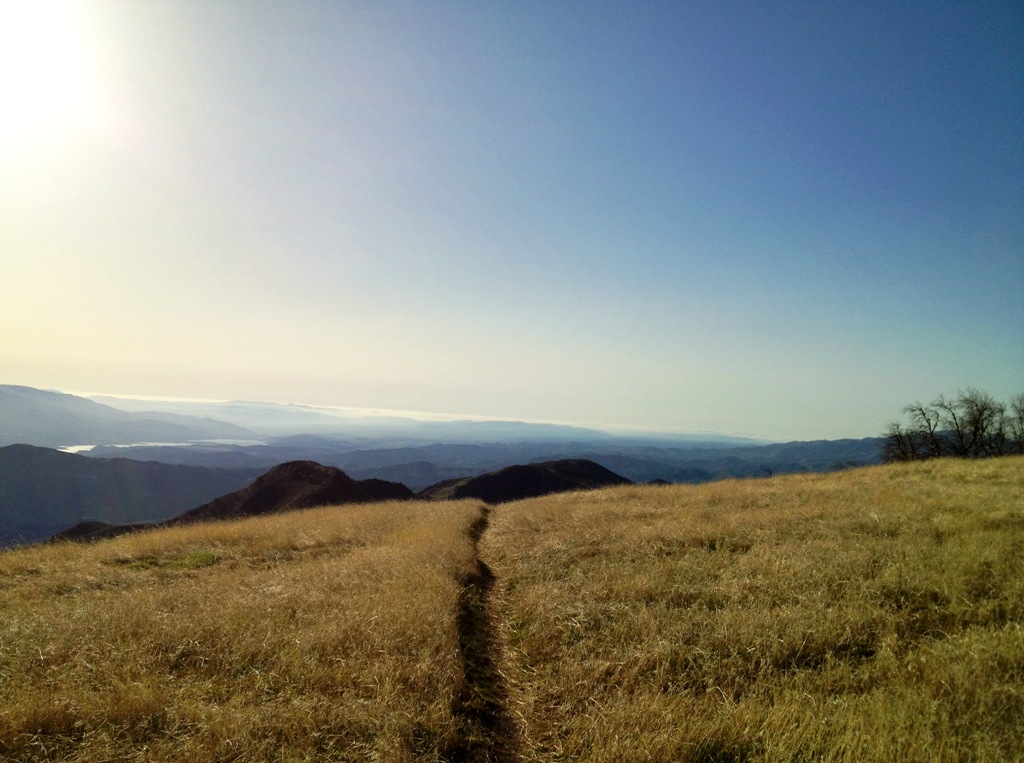
Caliente PeakCaliente Peak Soda Lake in the distance.carrizo plains 340Soda Lake

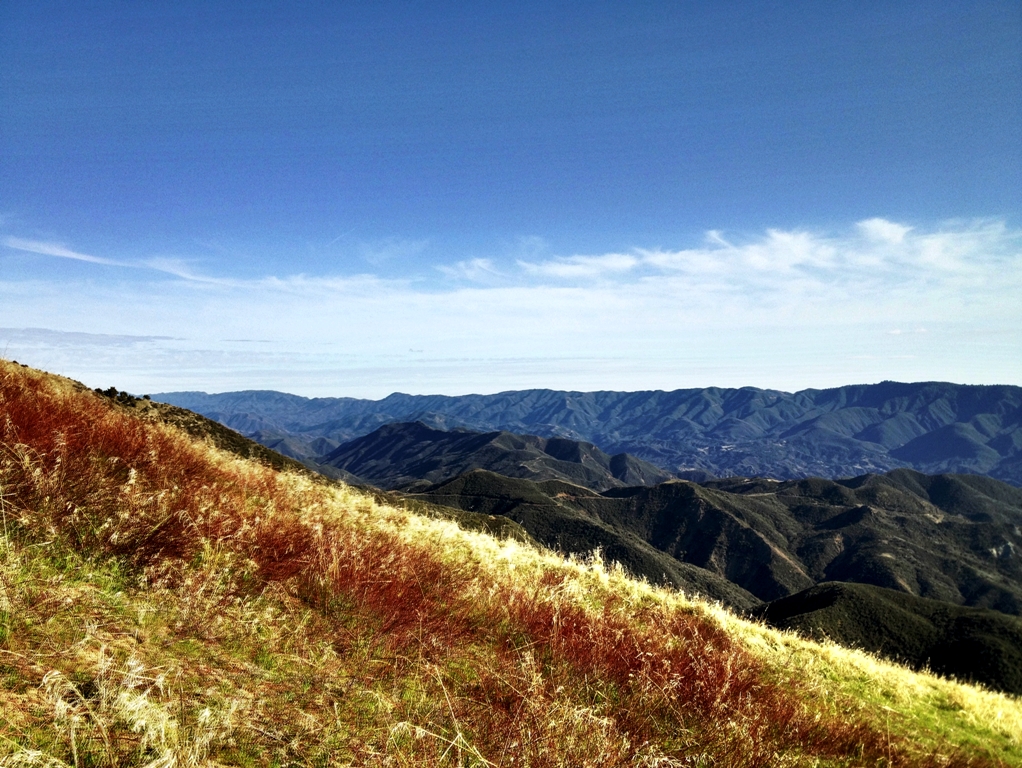
Caliente PeakLooking west from Caliente Peak.

Posted in San Luis Obispo County | Tagged , , , , , , , , , , , , , | 6 Comments

Coyote Gulch Waterfall, Utah

Green RiverA waterfall in Coyote Gulch in Grand StaircaseEscalante National Monument. (c) Clint Elliott

Posted in Utah | Tagged , , , , , , , | 6 Comments

Astray Again on White Mountain II

(. . .continued from Astray Again on White Mountain I)

White Mountain Late afternoon view looking east from White Mountain.

“The general rules of life clearly state that if you’re ready for something, it won’t happen and if you ain’t ready, it sure will happen!”

—Mykel Hawke, Captain, U.S. Army Special Forces

And so it is I come to be wandering a darkened mountain slope searching for the trail without any of my usual basic supplies; no headlamp, no warm clothes and no emergency vacuum-metalized polyethylene blanket. I don’t have my GPS because I feel it is a crutch, a form of cheating. It represents in some sense the very sort of mind numbing creature comfort of civilization which I seek to escape when I walk into the woods.

I’m straining to see in the the faint trace of remaining twilight. It will be pitch black in minutes. I decide to walk on through the brush in the direction I think I need to head, but meet overhead chaparral within yards. I might as well try climbing through a tangle of barbed wire. I cast a long thoughtful look down the ridge, and decide to follow it.

I have no idea where the trail is other than it’s somewhere close by lost in the deepening darkness. I do know with absolute certainty, however, that the ridge leads to the road. If I follow the ridge for a couple of hundred yards it will lead me to the road just a short walk below where I parked. When it gets totally dark, only a crescent moon rising but not until well after 11 pm, and I can no longer see much of anything, I plan to guide myself along the ridgeline by referencing the lights of Santa Barbara far below on the coastal plain.

I settle on the plan and start barging down the sloping ridgeline through knee to waist deep brush, while wondering how thick it will get, and if in darkness I’ll have to resort to brutal, bare-handed bushwhacking. Later in the night, I find deep bloody gouges on my shins testifying to my hurried charge through the brush and the pain numbing adrenaline that was coursing through my body.

White Mountain I bust my way through the wiry chaparral moving farther down the ridge following the line where the shorter fire regrowth meets the wall of older, unburned overhead chaparral. I come to yet another impenetrable wall of brush. My plan is already failing. I retrace my steps as best I can in the dark and try again but end up in the same dead end. Standing there contemplating whether to try climbing over and through the brush, I can see another slight rise in the mountain in the direction I want to go, which means that’s not the way to go. This is bad. And getting worse.
I decide to turn rightward, and head down toward the southern edge of the ridge, toward the sparkling city lights because it’s the path of least resistance. A burst of confidence rushes over me. I feel that the trail in fact runs below me, and that I was too high on top of the ridge, and that I’m not as far down the flank of the mountain as I had previous thought. I had been looking for the 90 degree turn in the trail northward back to the road, but I was still way too high up the mountain. The trail is still far down the ridge. That’s my reckoning and I go with it.

Within twenty yards I break out of boulders and waist deep brush and onto the trail. Despite several wrong decisions, I had worked my way through the muddle based on my memory of the hike in, the rock outcrops passed and the lay of the land which were still discernible in the darkness, and a vague feeling of where the trail should logically run. I hurry on down the ridge trying to remain on what little trail there is and thinking how close I came to being stuck on the mountain. I’m elated. I keep walking quickly, but my good feeling shrivels as I realize just how high up the mountainside I am and how far off the mark I had been. I still have a long ways to go down the ridge before the trail cuts northward toward the road, wherever that may be.

My I made it! feeling turns to Not so fast, jackass, you still very well may not find your way back. And indeed, I lose the trail. Once more I’m barging through the brush up and down and over and back and around trying to find it. It’s too dark to see any path at all and I’m just searching for something, anything that might clue me into to where I need to go. I don’t know if I passed the turn off to the road or if I need to continue down the ridge. It’s the most difficult position I find myself in thus far: Do I continue down or return back up? Eeny, meeny, miney moe. Which way do I go?!

White Mountain

After two unsuccessful pushes farther down slope I run uphill trying to find the last place I felt like there was possibly a trail. I see a tunnel heading into the brush, a black hole, and I charge over and into it. It’s an instant dead end. But as I stand up from my doubled over position and cast a look out of a break in the brush I see the road. And my truck. It’s right there not much more than a stone’s throw away. It’s a huge break. Even if I don’t find the trail now, I’ll rip myself to shreds if need be to get through the chaparral and down to the road.

I run out of the brush tunnel and head up the slope once more tearing through knee to waist deep chaparral. I come to an area of tall, thick brush and spend a few seconds wondering which way to go. I pace back and forth trying to find a passable route before jumping in without regard. I tear through into more open terrain and work my way along the edge of overhead chaparral when I come upon a piece of trash. It’s an old wad of white paper gleaming in the blackness.

Where it not for the piece of paper I likely wouldn’t have seen the trail. It was too dark, the trail an unmarked obscure hole through the overhead brush. I remember seeing the trash when I first came in. I step over the paper and into the brush tunnel, and slide down the gravely ravine through the leaf mulch, and break out onto the asphalt of Gibraltar Road with a nervous chuckle of relief. I raise a clenched fist in the air and pump it back and forth in triumph as I walk up the road.

“On my way home!” I text my wife. “Fell asleep. Woke up, sun was setting. Lost trail in dark for awhile.”

“Great to hear,” she replies.

White Mountain Santa Barbara, the Pacific Ocean and Santa Cruz Island

Posted in Santa Barbara County | Tagged , , , , , , , , , , , | 5 Comments