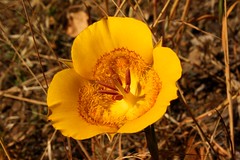
We grew up hearing about Chief Matilija and his group of warriors who tried to fight off the ever-present armies. In the myth, the story goes on to tell of Chief Matilija’s daughter, Amatil, who was very much in love with the handsome warrior, Cocopah. Tragically, he was killed in the final battle. Amatil’s love was so deep and so pure that she laid upon her lover and there she died. What remained of that love was a beautiful flower with pure white petals symbolizing their love and a yellow center to represent the everlasting brilliance of their love. We know this flower as the Matilija Poppy.
— Julie Tumamait-Stenslie, My Chumash Ancestral Legacy
On a bend in the Santa Ynez River, at the confluence with an arroyo, a small meadow lies hidden behind a skirt of oak, sycamore, mule fat, yerba santa and other riparian residents.
Trace specks of clamshell midden and chipped stone lay here or there in patches of rocky soil amidst the grasses.
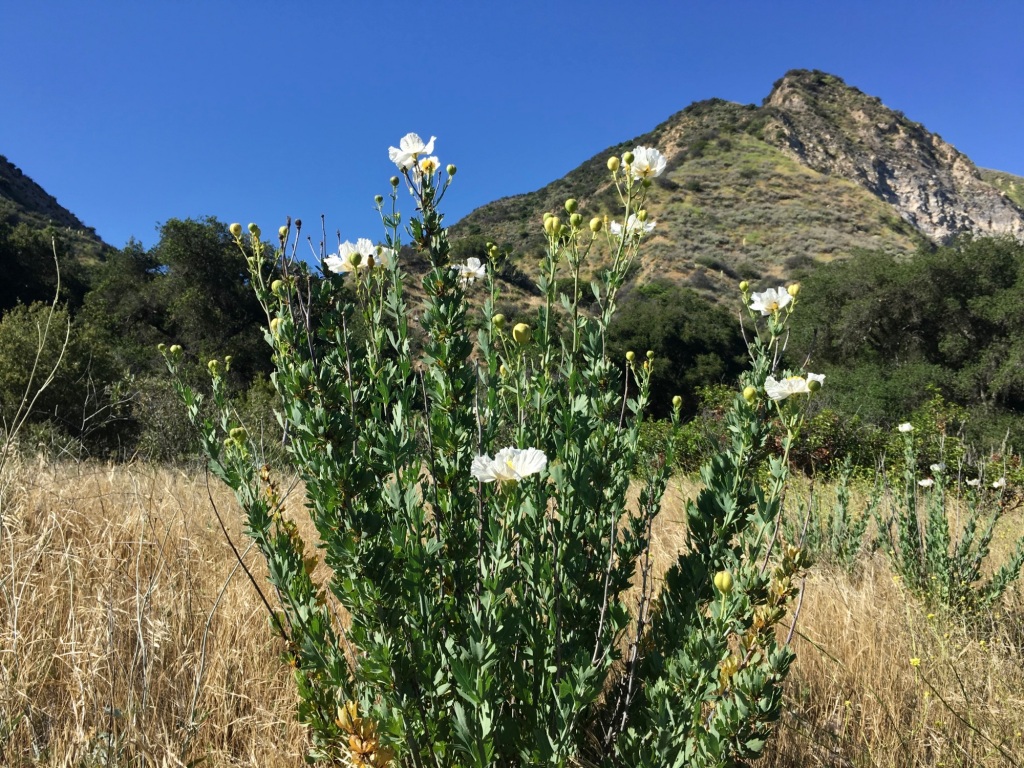
Along the edge of the meadow, where the grassy flat falls away toward the river just below, several clumps of Matilija poppies grow.
“This species is relatively rare in nature but is very commonly grown in gardens,” the California Native Plant Society notes in their book, Wildflowers of California.
A wisp of Santa Cruz Island floats on the horizon in Channel Islands National Park.
The excerpt below details an island sea cave in neighboring Ventura County, not the cave above on the mainland coast in Santa Barbara County.
The description is, nevertheless, fitting in its emotive explication of natural place. And the words may relate the ambience filling any cave found along this stretch of the Pacific seashore.
The authors convey the auditory and visual sensory dynamics inherent in a sea cave, which charge them with an energy and feeling of life most unlike the still quiet of a mountain cave.
The cave itself lies on the boundary between land and ocean. The incessant sound of ocean waves against the rock fills the cave with a rhythmic pounding.
Even though the environment of the cave has changed with the erosion of the sand floor that was present 20 years ago, the space still retains characteristics of a liminal zone where one might focus attention on cult activities.
Natural formations in the cave, such as ledges and rock shelves, may have provided surfaces for setting items used in ceremony or ritual, or for sitting or lying down. … The natural geological formation of the cave interior may be viewed as similar to that of a whale. The large central portion of the space tapers towards the rear (or tail) and widens at the entrance (or mouth).
If one expands the observation of the cave environment to include its visual and auditory scope, it is a kinetic and changing space.
It appears to be ‘alive’ as witnessed in a variety of lighting and moisture conditions which affect the illumination and coloring of the walls.
The varying sounds of the surf, reflecting tidal and weather conditions with waves crashing onto the entrance or just outside on adjacent rocks make for constantly changing sounds inside the cave.
Depending on the surf conditions, the space acts as a natural amphitheater, magnifying the sounds. At various times of the day, the sun reflects light which plays across the walls and ceiling of the cave.
When these factors are combined with the sounds, one could imagine being inside a wave or perhaps the belly of a whale.
One’s auditory experience often includes the sounds of marine mammals on nearby beaches as well as the sounds of shore birds including gulls and cormorants.
— Cave of the Whales: Rock Art On San Nicolas Island Kathleen Conti, William D. Hyder, Antoinette Padgett SantaBarbaraBotanicGarden.org
An extraordinary flush of canyon sunflowers now covers many places likely to hold fire poppies.
The curvaceous winding slopes under thickening oak canopy, cleaned by wildfire three years ago, now bulge with sunflower bushes standing four to six feet tall, shoulder to shoulder, as far as eyes can see through the late afternoon gloom of heavy sea fog.
In Refugio Canyon two canyons over, as made privy to by a commenter on the blog, more than 80 inches of rain have fallen this season.
The season prior rainfall county-wide measured in at over 200%-of-normal and in this water year we’re over 140%-of-normal so far.
The swiftly swelling forest is now closing fast, shrouding the mountain and erasing the Alisal Fire scar, disappearing the favored places to sprout of the fire poppies.
Who knows? They may not grow here for decades.
Last year I found two stands of the poppies far removed from each other, a smattering of plants each, perhaps a score, as many as I’ve ever seen at once anywhere, which is never many.
I don’t believe anybody else saw those particular plants or would know they even existed. I’m just telling it how it is. That’s all.
They won’t let you see the plants.
How can you when they won’t allow a hillwalker to so much as set foot off their narrow little blinkered path?
In the name of access and stewardship you can’t go and so you won’t know.
Although one of the growsites this year remains relatively open with some patches of bare soil or gravelly substrate still showing, not one plant could be found on this day by our indefatigable wanderer of lands of lesser interest.
RULE 4: “Make the enemy live up to its own book of rules.”If the rule is that every letter gets a reply, send 30,000 letters.You can kill them with this because no one can possibly obey all of their own rules.(The besieged entity’s very credibility and reputation is at stake, because if activists catch it lying or not living up to its commitments, they can continue to chip away at the damage.)
It appears the company is not living up to its contractual commitment.
Is the company at liberty to pick and choose who pays and who does not?
Is selective enforcement legal?
Is this official Parks Management policy?
Is the US Forest Service officially aware of Parks Management’s selective enforcement?
We noticed long ago Parks Management had not bothered servicing campgrounds back of Figueroa Mountain during midweek. And Dan McCaslin in Noozhawk noted this a year ago.
We like a little free camping to be enjoyed by savvy locals and the fortunate few lucky others who show up at the right time. We also enjoy stopping in to BBQ at the campsites during hours we know Parks Management will not be there.
But shouldn’t we look at it from all angles?
Would you be frustrated if you happened to speak to a neighboring camper and find they didn’t have to pay, while you doled out nearly fifty bucks?
There are no exceptions to the fee stated on the bulletin board at campground entrances. It doesn’t say midweek is free or payment is only required if reserved online.
If reserved online in advance the base cost midweek starts at $38. Depending on how you decide to pay, you might just camp for free on the very same night other people are paying $48 for a two vehicle one night stay.
If the US Forest Service rule is that there are fees at these campgrounds, and if Parks Management signed onto the service contract as managers, then isn’t the company obligated to follow the rules?
Is not Parks Management responsible for enforcing fee payment just as much as the camping public is expected to be responsible for paying the fees?
If Parks Management is allowed to decide when or if following the rules is necessary, then are recreationists also allowed to decide for themselves at will when and wherever following rules is necessary in the forest?
I combed the beach for over an hour before sitting to rest in the hook of the arroyo mouth.
The narrow, deep drainage chute cuts the shalestone sheets underlying the grassy plain of the coastal terrace and emerges onto the beach in the lee of a big point. Here surfer’s sit.
Some thirty years ago I kindled a fire here at this spot from salted driftwood, always burning with an inordinate reek, and dried my girlfriend’s shoe. She had slipped a foot into the water on accident during our beach walk.
Decades later she mentioned it in conversation as an early measure of a person she was still at that time getting to know. We were teenagers.
At that time no otters could possibly have been seen at this beach; they weren’t legally allowed to exist here, in their historic native range.
On a recent afternoon I sat here on a sunbleached log for a rest. I looked up to the scene before me for the first time, having been consumed with beachcombing all moments prior, chin to chest, eyes hard on the positive rake.
And there floated the sea otter before me. To see an otter in Gaviota waters today is to witness positive change in one’s lifetime.
By the 1930s, it’s said that fewer than 50 otters remained in existence in California waters, only around Big Sur, a remnant population that had survived over 100 years of hard pursuit by fur trappers.
From this small band the otters rebounded to their present population of about 3,000, having been listed under the Endangered Species Act in 1977.
But then from 1987, until the moratorium on removal was granted in 1993, under the No Otter Zone law, otters found in south county waters in Santa Barbara were forcibly relocated north of Point Conception. The anti-otter policy was not officially terminated until 2013.
Return of the otters to the Gaviota Coast has been a long time coming.
I sat watching the otter dive and eat whatever it was collecting from the seafloor.
Sometimes the otter would remain underwater for longer than usual, as if troubled by something particularly hard to get a hold of.
Then finally it’d rocket through the surface of the water with buoyant force enough to lift half its body into the air.
I thought of one of those lobsters you get a hand on once in awhile when freediving coastal shallows, but the bug is wedged deep in a cavity in the reefstone. You hold out as long as possible, trying with gentle force to pull the lobster out of its hole, until, desperate for air, you plunge upward breaking through the surface water in a violent, gasping rush.
Whenever the otter surfaced with its quarry the seagull would swim in close hoping to score some of the pickings.
On and on the game went, the otter and the gull, at otter’s point, along the Gaviota Coast.
“He may be just a tramp, a guy that likes to roam about this great country without any special aim, just to thank the Lord for these beautiful mountains.”
-B. Traven, The Treasure of the Sierra Madre
“. . .here, where there are still the silences and the loneliness of the earth before man, . . .”



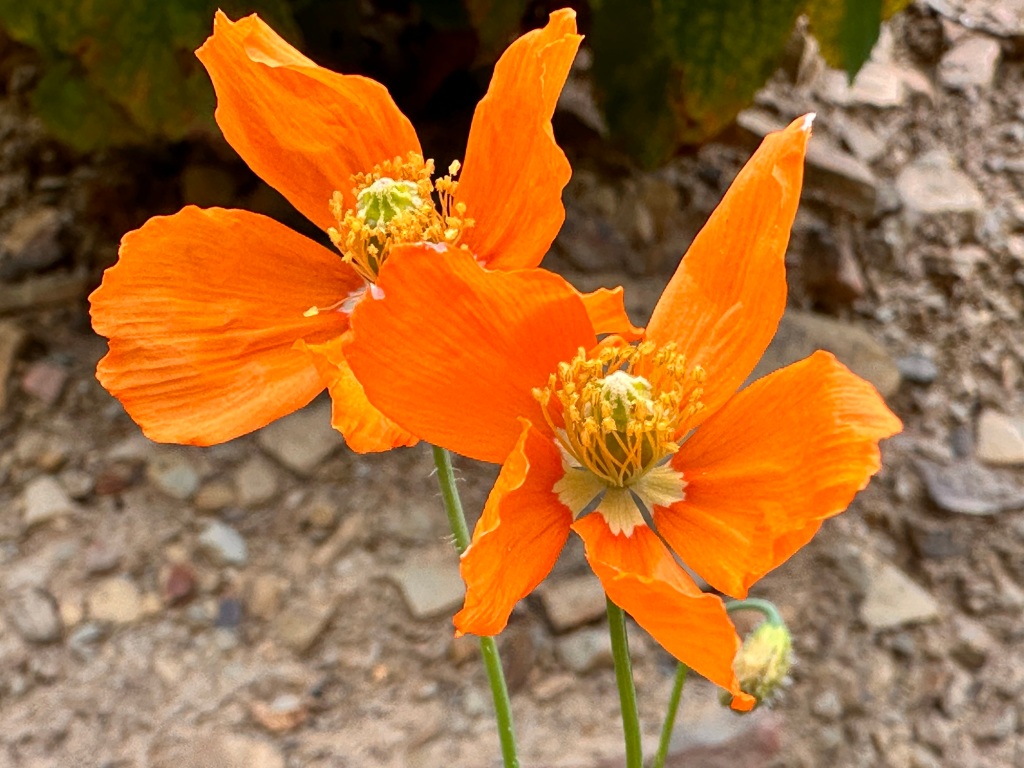
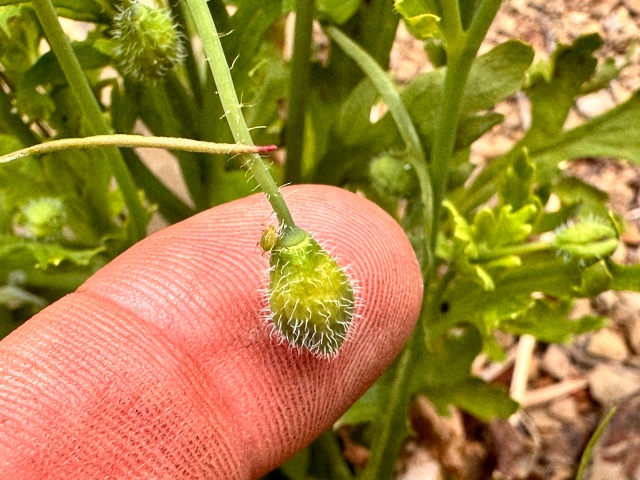
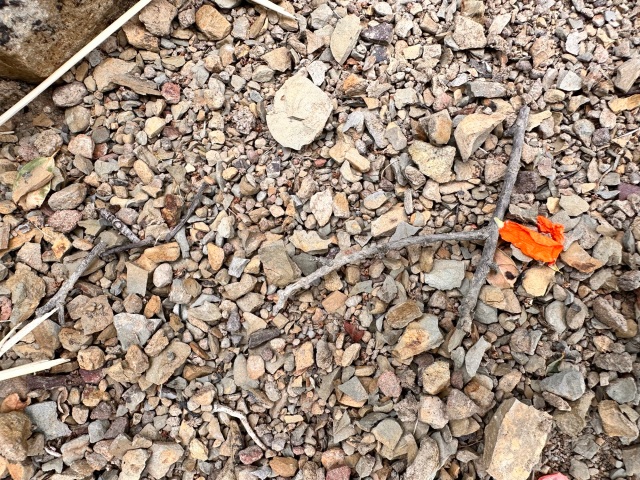 The tender plants grew from this rocky ground.
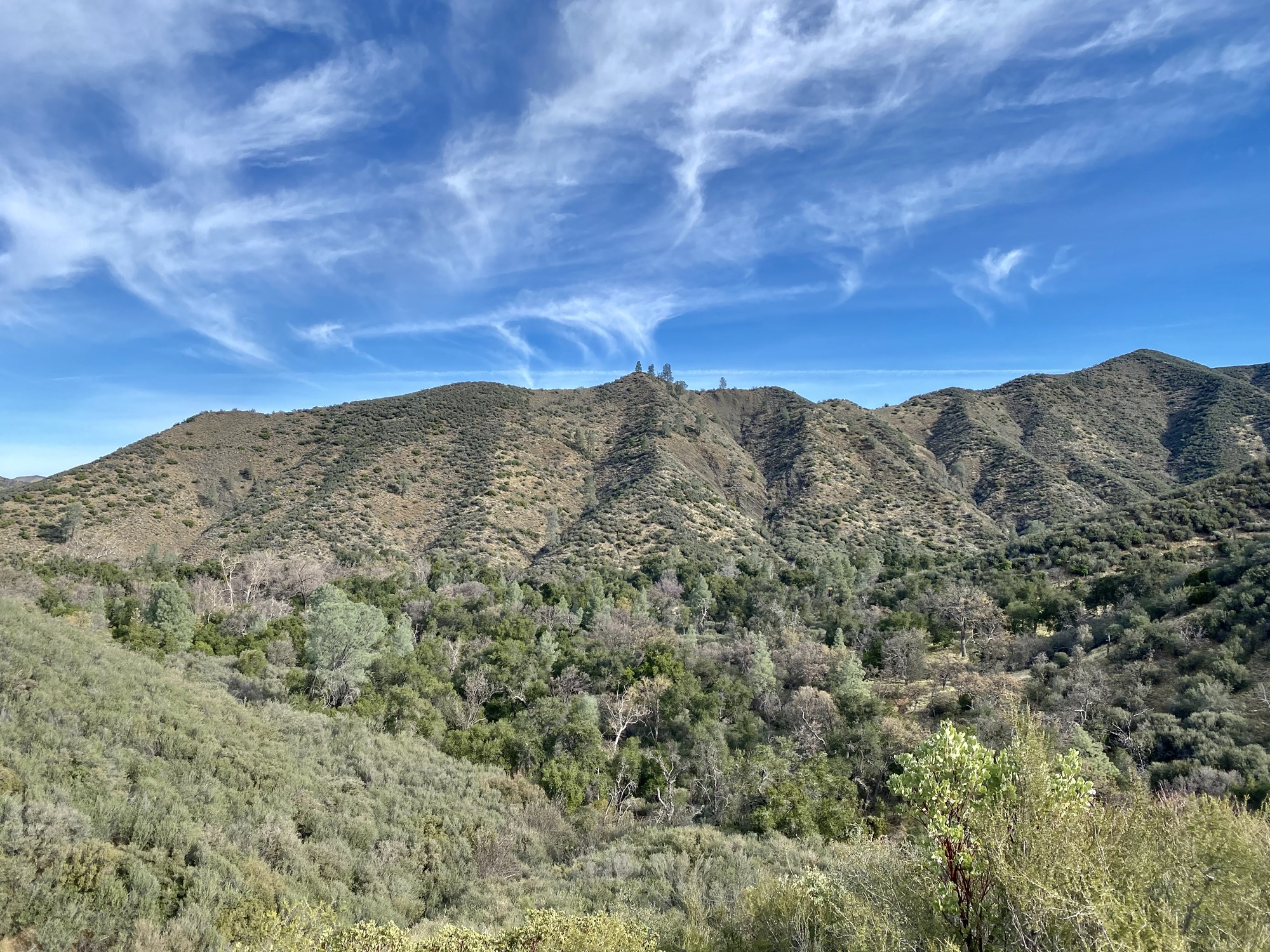 A valley of mixed woods,