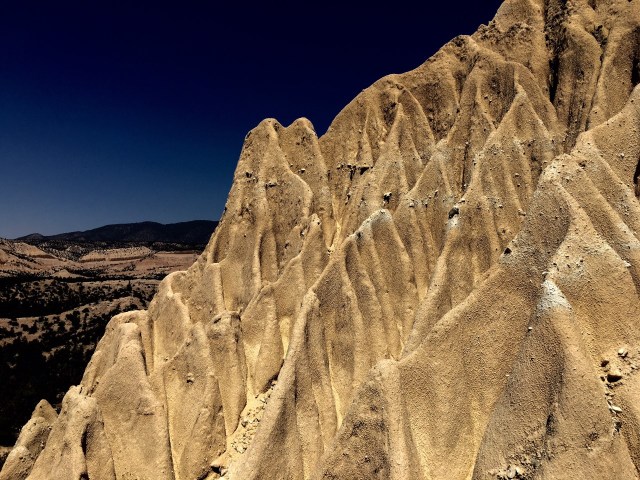
A Great Interval of Silence, Chumash Wilderness

campfire cookingBoilin’ the billy.

“Great intervals of silence are evidently conducive to our well-being. A meditative stillness, suggests Gary Snyder, was invented by waiting hunters. Perhaps this reflected the poised and ruminating hush of mothers of sleeping infants. High levels of sound have been directly linked to degenerative diseases in urban life.”

Paul Shepard, “A Post-Historic Primitivism”

I rolled slowly down into Quatal Canyon toward Cuyama Badlands, the crunch of wheels on a gravely dirt road. Passing Toad Springs Campground, I cast a casual glance over my left shoulder at a grizzled and greasy man hanging thin sheets of raw beefsteak over a wire fence.

We locked eyes for a second as I passed. What a look. What a mug. A good face for an artist to render in woodcut. Scruffy and tanned and weathered and creased and glistening in the late afternoon mottled light of the forest, a character out of a Clint Eastwood spaghetti western.

Jesus, I thought. What the hell is that psychopath up to? He might have been thinking the same of me. His piercing gaze and the hanging flaps of raw red meat, a primal scene. I was trying hard to step back in time, into the primitive realm of the undeveloped world let alone by humanity. “Seldom used,” Craig Carey wrote of where I was headed. Perfect. And this strange man appeared like a sign post in the forest hinting that I was traveling in the right direction, maybe.

I kept rolling deeper into the shadowy woods, farther from all others and the incessant noise of civilization. Onward forth toward the great soul-soothing silence of wildness.

Chumash WildernessTrail along foothills of Mount Pinos.

The trailhead was unmarked, which seems fitting for the southern Los Padres National Forest, where official hiking trails are often signless, overgrown, difficult to find, and not easy to follow if located. “Navigating for the correct trail can be a bit tricky,” Carey wrote.

An article appearing in the Los Angeles Times in 1990 described different portions of this trail as “the unsigned trailhead,” “unsigned Mesa Spring Trail,” “an unsigned trail junction,” and “a (poorly) signed trail junction.” Twenty-six years later it remains much the same, fortunately. I saw the sign for the camp on the ground last I was there a few years ago. I didn’t see it there this go around.

There is enough room for two vehicles to park off the dirt road at the trailhead, maybe three can fit with skill. Without four-wheel drive, and the sort of driving ability and gusto for risk that usually accompany such vehicles, the parking spot here might best be described to the average driver of a car as, “Wait, what? I’m really supposed to park there? You’ve got to be kidding me!” It wouldn’t take much to get stuck.

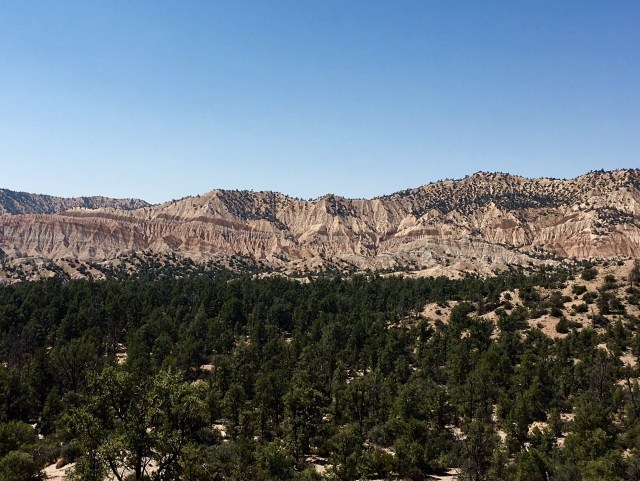
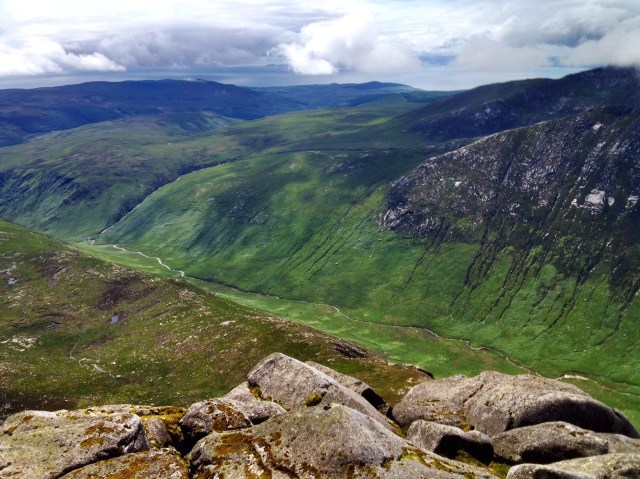
Cuyama Badlands San Emigdio ChumashTrailside view of Cuyama Badlands.

On the way out of town I stopped at the beach and surfed for hours, lured and distracted by a good winter swell. I reached the trailhead late in the afternoon and the sun had nearly set. It was impossible to hike to camp before darkness swallowed the land.

Half an hour after walking away from my vehicle I left the trail. I stepped carefully through breaks in the scrub oak and spotty tangle of brush so as to leave as little trace as possible in the delicate dry habitat.

I found an opening of gravelly soil surrounded by scrub and accented with a single piñon pine. I spread out my bedroll, set alight a small pile of thin branches and twigs, pushed my can of water aside the dancing flame to boil, and laid upon the earth to watch the sunset colors peak and fade to black.

The next morning I scooped up the small pile of powdery ash and scattered it about the area beneath scrub oaks. Scraping up a bit of soil from here and there under the brush, I sprinkled it over the burn site for concealment and then topped it with a dead branch lying nearby. I left only footprints visible as I marched away toward Mesa Spring in the cool morning light.

Cuyama Badlands San Emgdio hikes

I laid in the shade at camp listening to the ebb and and flow of wind through trees.

I wandered through miles of piñon forest, walked San Emigdio potrero, and strolled aimlessly along differing lengths of different trails searching for something I never lost, something nobody had ever left behind, something that most people have no interest in and do not value. What it is I’m not sure. I never found it. The search will continue.

In the mornings and afternoons I sat on a slope along the foothills of Mount Pinos, overlooking the forest of piñon pine backed by Pine Mountain Ridge in the bluey distance.

For three days I watched intently the timeless show rendered in pacific hues of green and blue, tinged orange yellow and red at dawn and dusk, the calming low desolate murmur of wind blown pine needles the soundtrack.

I saw nobody; the sort of body a body like me likes to see when enjoying the medicinal qualities of a great interval of solitude in the woods.

I felt a million miles away from all that is said to matter in the metropolis, alone swaddled in the great therapeutic silence of wildness; salve for the soul. If somebody jarred the feeling I’d be a buyer, maybe even a junkie.

“What is there to do out there?” Somebody may ask from the crowd that constantly demands the throbbing pulse of instant gratification, and the glittering, overt, up-in-your-wide-eyed-face smash of Las Vegas-like stimuli. “Here we are now, entertain us,” Kurt Cobain said.

Nothing. Nothing at all. There’s nothing to do.

That’s the point.

Chumash Wilderness San Emigdio

San Emigdio hike

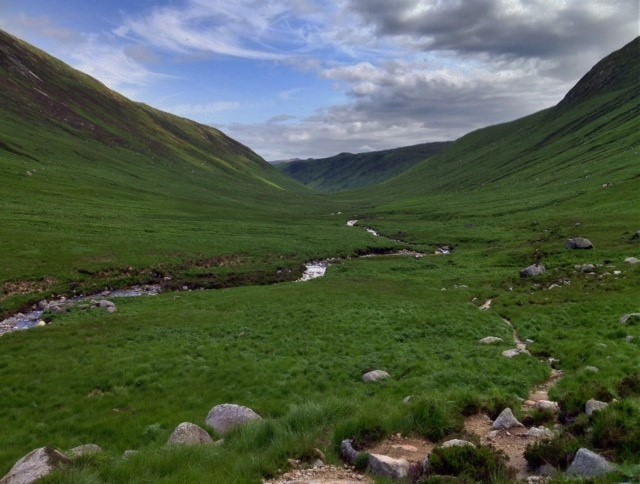
San Emigdio MesaA green-tinged San Emigdio Mesa in February.

Chumash Wilerness campMesa Spring Camp

Chumash Wilderness San Emigdio Los PadresSunset colors from camp.

Posted in Ventura County | Tagged , , , , , , , , , , | 13 Comments

A Wander In Hawaii Turns Up Ancient Rock Shelters

imageThe dry wash described below lets out into this small cove on the lee side of the point.

“Where you off to?” she asked.

“I saw a big crack in the Earth just down the road that looks like it needs to be explored,” I said.

imageLooking over the dry wash from above. Shortly beyond the last visible trees the canyon narrows into a gorge.

We had just returned from a six hour road trip and I desperately needed to get out. This dog needed to be released from the kennel and unleashed for a run.

One might question how a six hour drive could possibly be called a road trip. It’s a fair question. I have a good reason.

Spend five hours locked in the van with two four year olds and a seven year old with nothing to do, with but an hour break for lunch, and you’d call it a trip, too.

I drink little and infrequently, and rarely ever order a cocktail let alone in early afternoon and never with lunch, but this day I ordered one. “Oh wait,” I said as the waitress started to walk away. “I need some liquor.”

Suffice to say our day hadn’t gone according to plan due to approaching tropical storm, Darby. We essentially drove for six hours to eat lunch. We never made it to Volcanoes National Park. Damn right I was ordering a drink!

Fortunately the Mai Tai had hit like a mule kick and took me out of commission. Yeah, I know, I’m a real lightweight. Leveled by a single drink. My only defense is to say that it was stiffer than the British upper lip in WWII.

The drink helped to relax and soothe my frayed nerves, but also resulted in the Mrs. taking over driving duty. This in turn gave me the opportunity to gaze out the window, that had then resulted in my having spied that aforementioned big crack in the ground.

imageThe ragged and rugged scene while hiking up the canyon.

That crack was really a chasm that had been carved deep into the lava rock by heavy rains that fall high up on the slope of Kohala (5,505′). Passing over a short bridge at speed, I had caught a glimpse of this small red-walled canyon filled with the green canopy of kiawe trees (Hawaiian mesquite). It winds its way up the slope of surrounding desert-like dry rolling grassland and narrows to a gorge. It looked too appetizing to be left alone. “No way,” I muttered to myself. “Wow.” I was compelled to go.

I stepped cautiously in my flip-flops down into the wickedly spiny forest of kiawe filling the canyon and had walked about forty yards up the dry creek bed from the beach when I saw it.

imageThe ruins were hard to capture clearly in a photo, but look carefully and the circular shape of a stacked stone design should be visible.

There on a bench beside the wash, above flood level, was a large circular-shaped group of boulders. It resembled an old stacked stone wall enclosing an open space within where a patch of grass grew and it stood about three to four feet tall.

There was no question in my mind when I saw it that it was something of archaelogical significance, though it should be noted that I am not a trained expert and nor do I have confirmation by an expert. But what else could it be?

Many if not most of the boulders were too heavy for one man to lift and would require at least two or more people to move and arrange. It was not the sort of creation I would imagine modern people to have built for it clearly required a great deal of strenuous work and many hours. It was not some beach hut thrown together by modern locals at their favorite spot to hang out at.

imageLooking at same ruin from another angle.

imageA closer view of the stacked stones.

imageLooking out the mouth of the dry wash to the ocean.

The site seemed well-suited for a camp. It was tucked back in the narrow canyon away from the immediate seashore and was sheltered from wind by forty to fifty foot sheer cliffs on either side. The mouth of the dry wash drained into the sea on the lee side of a small point and was protected from the prevailing winds. The location allowed for quick and easy access to the ocean for fishing or whatnot.

In the preceding days I had been freediving in the area nearby popping scallops from the rocks. My brother-in-law, a native Pacific Islander born on Hawaii, had introduced me to his friend who had shown me a photo of a thirty-five pound ulua he had recently shot nearby while spear fishing. They had told me of a man having disappeared last year while spear fishing not too far away, presumably due to a shark attack (link to story here). They told me about another guy who, four days later, survived a tiger shark attack while spear fishing in the same area (link to story here). I had also been told that in winter humpback whales pass by this place hardly more than a stone’s throw from the beach. Not that anybody needs one line anecdotes to appreciate that these coastal waters of Hawaii were (are) exceptionally rich, but this area probably wouldn’t have been a poor choice to camp in prehistoric times.

imageTwelve hours later the formerly dry wash was raging, the eerie thud and crack of boulders being swept to sea, which is just visible here through the trees frame left.

The wash, while relatively small, was one of the more significant drainages in the area; a fact that was confirmed early the next morning when, after a night of heavy rain on the mountain, the formerly dry creek bed was a torrent of runoff that pushed a fluvial discharge of muddy water far out into the sea for several hundred yards.

No other such plumes of runoff could be seen along the coast anywhere in the immediate area. It was remarkable enough that it even caught the eye of my four year old son who pointed it out. Two days later the wash was empty again but, standing on the edge of the canyon high above, I could see a few pools of water dotting the otherwise dry creek bed. The silt had settled and the pools were clear; plenty of water to slake the thirst of the ancient ones who may have lived there.

imageOne of the other ruins, which appears far more distinct when standing before it than it looks in this photo, but the circular shape should be evident.

After spotting that first circular stand of boulders I began scanning the area more closely than I had previously, and out of the jumbles of lava rocks I began to notice several ruins of other lesser structures of similar form. I had overlooked them previously, but now they began to standout.

The ruins were grouped in the same area and all constructed from large and heavy boulders that would require group effort to move and arrange. It was plainly evident that a considerable investment of time and energy went into putting them together; not something I’d imagine modern people to have any interest in troubling themselves with.

Who else would bother with such hard work for so long as it took, but prehistoric people seeking to secure shelter and comfort from the elements along a coast naturally rich in sustenance?

Of course, supposing the ruins were indeed constructed long ago, they could be something other than the remains of prehistoric camp shelters. What might the purpose have been?

imageA cave about thirty-five feet above the dry wash on the cliff adjacent the ruins.

Posted in Hawaii | Tagged , , , , , , , , , , | 7 Comments

‘Akaka Falls, Hawaii & Cliff Climbing Goby

image‘Akaka Falls on Kolekole Stream on the Big Island of Hawaii plunges 442 feet.

‘Akaka Falls may be one of the most remarkable waterfalls in the world. Not because of its impressive height nor natural splendor, but because of a tiny fish measuring no longer than five inches that lives in the creek, and which accomplishes an extraordinary journey as part of its life cycle.

The Hawaiian freshwater goby or Lentipes concolor was a traditional food source of the ancient islanders. It was raised in the waters of flooded taro fields in an early system of aquaponics, wherein the fish and plants were farmed in a symbiotic relationship.

Today the ‘o’opu ‘alamo’o, as it is known in the Hawaiian language, is noted for its incredible ability to scale the 442 foot sheer cliff over which ‘Akaka Falls pours to reach its natal habitat and spawning grounds.

imageA male Lentipes concolor. The fish is endemic to Hawaii.

The following description is taken from an interpretive sign near the waterfall:

“The name ‘o’opu ‘alamo’o comes from the Hilo area and refers to the lizard-like (mo’o) shape of the head.

The scientific name for the ‘o’opu ‘alamo’o is Lentipes concolor. This name recognizes the ability of the male to change colors during courtship and periods of aggression.

For the ‘o’opu ‘alamo’o, a native goby living in Kolekole Stream, life is full of challenges. Imagine having to swim 2.5 miles upstream from the ocean and then climbing 442 feet straight up against the flow of the waterfall!

An ‘o’opu begins as an egg laid in the upper reaches of the stream, often between rocks in the streambed. Once the egg hatches, the embryo drifts downstream with the current to the open ocean. Here the larvae remain for up to six months. When the ‘o’opu receives the freshwater signals from the stream, it’s time to begin the swim back upstream.

The ‘o’opu uses its suction disc and pectoral fins to climb up the water-slickened surfaces along the rocky sides of the waterfall. As an adult, the ‘o’opu measures about five inches. It stays upstream amongst the rocks and lays its eggs to start the next generation of ‘o’opu.”

image

Kirill Vinnikov, a PhD student working in the Department of Biology at the University of Hawaii whom researches amphidromous gobies, provides an explanation that helps clarify the graphic above which is posted near ‘Akaka Falls:

“All species of gobies have a unique morphological feature: their adults have a peculiar fusion of pelvic fins to form a disc with a strong sucking power. Amphidromous gobies use their sucking disc to move upstream; the disc allows them to attach to stones and climb on vertical rock surfaces, and finally, to reach their home habitats even when they are located at high elevations above waterfalls.”

Posted in Hawaii | Tagged , , , , , , , , , , | 4 Comments

Bear Trail Don’t Burn

bear prints tracks santa barbara los padres santa ynez mountains hikesTwo bear footprints worn through dried leaves to the soil beneath in an area burned by the Sherpa Fire along the Gaviota Coast. This print pattern, more distinct in some places than others, continues for some distance along the unburned trail seen in the next photo.

Bears around these parts tend to have a remarkable habit of stepping in the exact same places when walking some sections of their own trails. I’ve seen it all over the forest.

A bear trail will often resemble a human trail. Typically it’s a foot-wide or so single-track path pressed into the leaf mulch of the forest floor.

However, unlike human trails a bear trail through leaf mulch is sometimes also dotted with individual paw impressions that mark the particular places that the bear steps each and every time it walks the path.

These are not distinct paw prints with toe and pad impressions as often seen in mud or silty dirt and which are left by a single footstep, but rather they are roundish holes pressed into the leaves from each foot having been repeatedly placed in the exact same spot.

In areas of heavy oak leaf mulch under forest canopy these paw impressions can become potholes up to six inches deep or more and sometimes push through the leaves entirely to bare soil. To follow in the bear’s footsteps is like taking the sort of measured and precise steps needed when walking on stepping stones.

bear trails santa barbara santa ynez mountains los padresBear trail don’t burn. A burned out understory in an oak grove with brown crispy dry leaves marking the course of a bear trail. The trail continued on to a three-way intersection. The same boulder in the upper right corner beside the oak tree shown here can be seen from the other side in the photo below.

While wandering the woods I came upon a puzzling sight. A trail of dried leaves and grasses led an incredible distance across land blackened by wildfire.

Multiple sections of paw impressions in the leaves, as mentioned above, revealed that a bear had left this trail that did not burn. The golden-brown path wound through a charred oak grove for some fifty yards or more between two creek crossings.

In a few places the unburned trail disappeared into large white patches of powdery ash where large oak trees had fallen and burned away, then it reappeared on the other side as a trail of unburned leaves and grasses surrounded by blackened, baked and crusty soil.

The trail could be seen from across the burned out forest from many yards away. In one location this remarkable trail of brown leaves formed an even more notable feature: a triangular intersection at a point where a path branched off on another route.

The trail had been used after the fire. There were fresh paw prints through ashy sections, which was a good sign to see, because not far away the body of a scorched bear lay dead in an arroyo with it’s head missing; the skull apparently taken for a trophy by some eager scavenger in desperate need of a curio for his shelf.

The forest is open and easy to walk through after the wildfire, but the bear continues along its same trail walking the line that oddly didn’t burn.

bear trail los padres forest santa ynez mountainsA three-way intersection on the bear trail. The trail as seen here leads into the distance through center frame, and disappears there around the oak tree and boulder mentioned in the previous photo. The trail continues in the photo here around the two thin sycamores on the right in the foreground and on out of frame toward the lower right corner. Another branch of the trail leads out of the lower left corner. The untrampled triangular space created by the intersection of the trails had burned, but the trails making the triangle largely did not.

Posted in Gaviota | Tagged , , , , , , , , , , | 16 Comments

Matías Reyes, Santa Barbara Mission (1887)

Don Diego Guiterrez Santa Barbara Mission 1887.

“Old Matías Reyes lived in Mission Cañon. He used to bring wood to town and sell it.”

—Santa Barbara: Tierra Adorada, A Community History (1930)

In her book, “Canyon Voices: The Nature of Rattlesnake Canyon (2006),” Santa Barbara resident Karen Telleen-Lawton writes of local historian, Jim Blakley:

“Blakley uncovers a sheath of fragile, yellowed paper wrapped in heavy parchment. One document dated 1875 shows the transfer of title of much of the land in Rattlesnake Canyon to Matías Reyes. Reyes’ wife Griselda, an American Indian from a tribe near Riverside, California, signed the title with an “X.” The Reyes homestead encompassed the lower part of the canyon, including some relatively flat areas above the immediate flood channel that could provide building sites.”

Telleen-Lawton also writes of Frank Van Schaick who had lived in Santa Barbara since 1936. He was a teacher of natural history, among many other subjects, wrote the column “Nature Walks” for the Santa Barbara News-Press, and co-authored a couple of books with Dick Smith, after whom the Dick Smith Wilderness was named. Van Schaick had built with his own hands a home in Rattlesnake Canyon made of redwood and sandstone. Rattlesnake Creek is a tributary of Mission Creek. Regarding his home Telleen-Lawton continues:

“Van Schaick shifts focus and strides purposefully to the front door. He gestures to the sandstone slab doorsill, noting it came from the original adobe dwelling on the 19th century Spanish land grant of which this was a part. The Spaniard’s name, he says, was Matías Reyes.”

A seldom used and unkempt backcountry campsite located a short walk from the Santa Ynez River, beside a sunny patch of grass on the north slope of the Santa Ynez Mountains, takes its name from Mr. Reyes: Matías Potrero Camp. Reyes had staked a claim and built a cabin there, according to Blakley.

I imagine during Reyes’ time walking down to fish the river for three foot-long steelhead. (Native Steelhead of Yore, Santa Ynez RiverSteelhead Fishing, Santa Ynez River [1948])

Bald eagles and osprey would have been working the stream for fish and perhaps an increasingly rare grizzly bear or wandering wolf, both heading toward extinction. When in 1887 Jacinto Damien Reyes (no relation to Matías) arrived in Ventura County not too far away he said the forest “was infested with wolves, coyotes and grizzly bears.” (Gladiator Games of Bulls and Bears: Recollections of Jacinto Damien Reyes [1880])

Today the fish eagles still fly and we’re left with coyotes, but only a meager steelhead population of about one to two percent of its former size. “One of the penalties of an ecological education is that one lives alone in a world of wounds,” wrote Aldo Leopold. “Nostalgia for the good old days when everything was abundant is almost universal among conservationists.” Sorry for the sorrowful digression, but we can’t rightly dream of what the world can be if we don’t keep in mind what it once was.

Aside from the natural splendor surrounding Matías Potrero Camp, an old weathered handcrafted sign placed in an oak tree by Boy Scouts is perhaps the most notable human-made feature of the campsite nowadays, where the old rotten picnic bench has finally collapsed and a small stone fire circle lies rarely used.

Matias Potrero Los Padres National Forest hikes camping Matías Potrero

(Author’s note: Several sources identify the man in the historic photo featured here as being Matías Reyes. Among those sources are two mentioned here: The book, “Santa Barbara: Tierra Adorada, A Community History”, as well as historian Jim Blakley. However, it should be noted that the man is said to be Don Diego Guiterrez by somebody associated with the Black Gold Cooperative Library System and University of California.)

Posted in Santa Barbara | Tagged , , , , , , , , , | 4 Comments