“Fortunately, the task of preparing this volume has been carried on by those who have had the feeling that a piece of work must be done, but who also have had a purpose to make it reveal beauty and exude the historical atmosphere of the region with which it is concerned.”

—Santa Barbara: A Guide to the Channel City and Its Environs (1941)

Posted in Reference | 7 Comments

Mono Narrows Camp

mono jungle 1Mono Jungle under early morning fog.

I walked so much I wore down my feet
Do you know how weird that feels?

Shel Silverstein, “Foot Repair”

A dense marine layer clings to the Santa Ynez Mountains as I putter up the road straining to see in the gloomy predawn darkness. I’m Freddy piloting the Mystery Machine through some fog-filled Scooby Doo mountain scene. I’m surprised to emerge into clear skies midway up the mountain, but when driving along the crest of the range a bit later, I see a thick river of fog flowing up the Santa Ynez Valley thousands of feet below. A finger of it is poking up into Mono Creek, where I’m heading. Some 45 minutes later, while standing at the unmarked trailhead, I watch a chilly blast of condensation flowing farther up the canyon. So much for escaping the coastal fog bank and getting some backcountry sun.

mono creek Mono Creek

At six-thirty a.m. I’m stomping down the trail rhythmically pounding poles into the earth like some bipedal insect with spindly elongated arms. With over eighteen miles to cover for the day I’m eager to put distance behind me. Storming up the weedy trail, a machine on autopilot, I’m daydreaming about what the day may bring rather than focusing on the trail or its surroundings.

Yet, what begins as a fair trail through chaparral and riparian and oak woodland soon peters out and fades from sight. My rapid pace slams to an abrupt halt. Mere minutes from the trailhead and I’m standing around wondering where the footpath went I was so easily following just seconds before.

Mono Creek TrailTrail through the trees along the creek.

mono creek hikeCutting a bench along the creek.

The lowermost section of the Mono-Alamar Trail is a fair sampling of classic southern Los Padres less traveled tread. Even when the trail is there, it’s still sorta not. I’m on it, but am I really? Yes, I am, definitely. Wait, am I? Well I was. I’m searching for it then realize I’m on it. I think I’m on it just before having to search for it. Walking it one second and wandering after it the next.

It’s early morning and I’m a bit dazed and spacey. I’ve been ripped from the carefree abstract realm of a daydream by a sudden concerning present reality: where’s the trail? I’m somewhat startled. It’s more thinking than I care to muster at the moment. I didn’t expect to start this game so soon.

I was hoping to quickly cover some distance rather than slowly fight my way through the brush. I don’t feel like dealing with the chore of route findingdo I go right? left? straight? back? into the creek? along the bank? A few incorrect choices strung together and I’ll be way off course wasting time and energy.

A bad feeling ripples through me.

Mono Creek ogilvyA mostly dry section of Mono Creek.

mono creek ogilvy ranchThe Ogilvy Ranch property,which was once the site of the Chumash Indian village “Sigvaya.”

Mono CreekLooking down the winding green belt of Mono Creek. The marine layer being sucked over the backside of the Santa Ynez Mountains in the distance.

I wander through sparse undergrowth beneath a canopy of oak, crunching through deep leaf mulch, scanning the landscape for signs of the trail, but resolved to push farther up canyon without it if necessary. Coming to Mono Creek I spend a minute searching for a way across without getting wet. It’s no more than several inches deep but I’m hesitant to get my feet wet so soon. I finally relent for sake of time and walk through. It’s a bad decision. Hiking with wet feet has never troubled me, but today will be different.

Despite weaving on and off the inconspicuous trail for miles on end I’m able to maintain a decent pace. Several times, when seemingly having lost the trail, I have the good fortune of looking up to see a faded length of ribbon flagging the route (Hat tip BC). My luck spotting these markers in key places is uncanny. I’m amazed. I’ll be marching along and suddenly feel a need to stop to reassess my route, and when I glance around, there’s a flag or the tell tale signs of the trail leading through the brush.

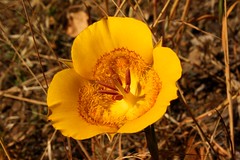
CalochortusMarisposa lily (Calochortus)

mono creek

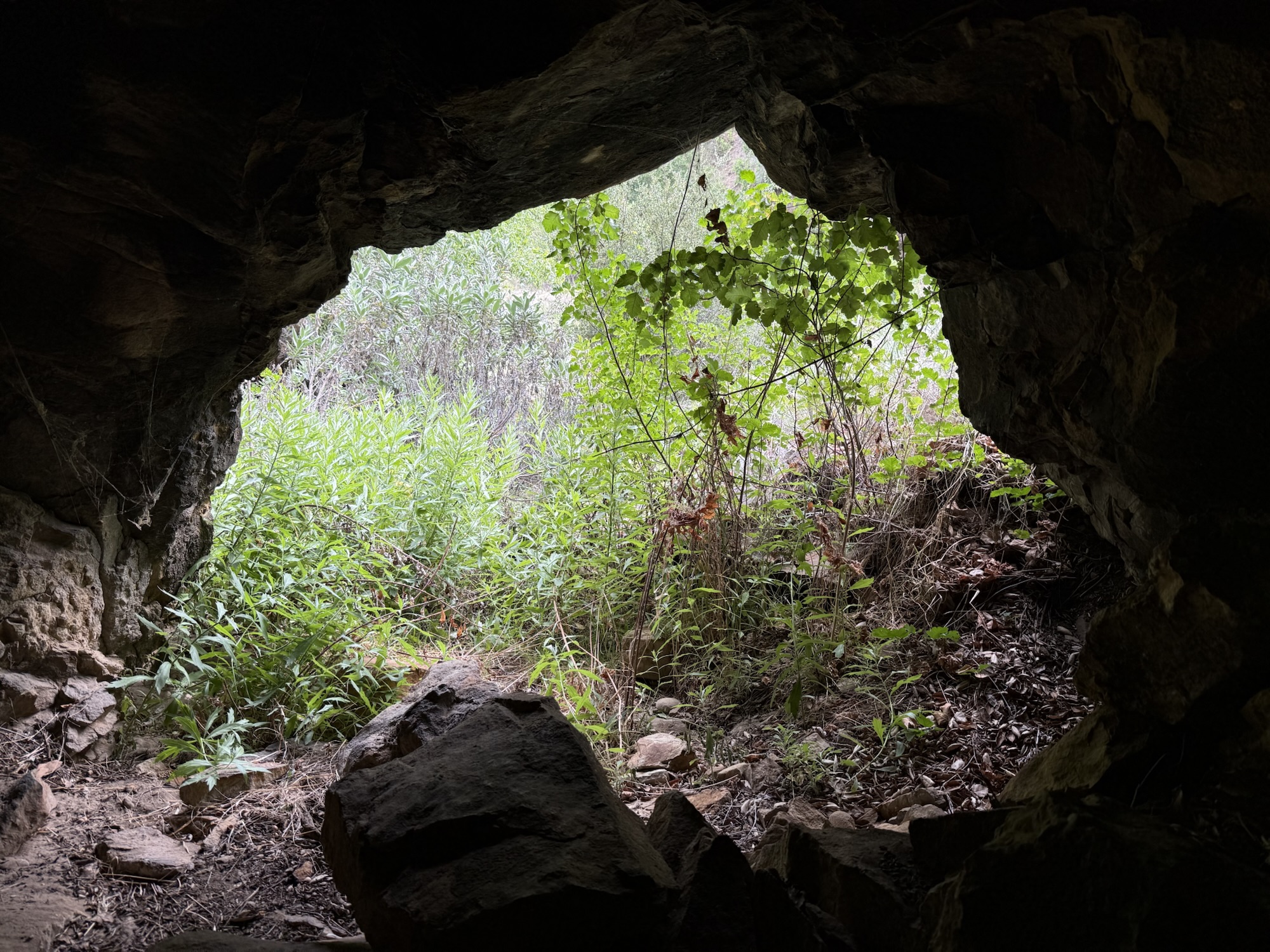
survival shelterA streamside cave several feet off the ground made into a prime survival shelter. Somebody put in a small stacked stone fire pit at one end and partially closed off the cave using long planks of cottonwood bark.

mono creek pool 1Somewhere around the seventh mile, about two miles before reaching Mono Narrows Camp, a building discomfort in my feet intensifies into a deep tissued tenderness. Stomping up the canyon across shifting sections of uneven soils and over cobblestones and gravel and through brush and down and up crumbling streamside slopes—hiking without a trail, that ishas left my wet feet battered and sore.

I sit for a brief rest and consider turning around and heading back, how easy it would be, but I continue on determined to make it up into the narrows.

The discomfort had been ignorable, but it’s grown into an increasingly irritating pain. It’s now frequently determining my foot placement and slowing me down as I try to lessen the impact of each footfall. Every step sends a weird sensation pulsing through my feet that feels as though the bottoms are peeling off like the delaminated sole of a cheap well-worn shoe. I stubbornly press on. I have to at least reach the campsite.

Mono Creek Narrows CampMono Narrows Camp center frame under the oak tree.

I sit at Mono Narrows Camp debating whether or not to continue up to the narrows itself. I hate the thought of not proceeding, but the nine mile hike has exacted a surprisingly severe toll on my feet. Boulder hopping farther up the rugged creek would inflict more harm and make my return trip slower and more painful.

I don’t have enough time to have a good look around the narrows and make it back to the trailhead before sunset. I’d only get a passing glance. It’s not worth it. I don’t want to be limping around with shredded feet, possibly fumbling my way down canyon through the dark by headlamp, fighting my way through the bushes and searching for a substandard trail, which took effort enough to find in broad daylight.

I capitulate, though, and leave my pack at camp and take off up the creek. I feel compelled to at least make an effort. I scamper up the drainage for a short distance before slowing my pace and eventually stopping. I can’t trust my aching feet to carry me through the narrows and back to the trailhead by sunset. I’m done. I stand looking longingly up the canyon. Then, begrudgingly, turn back.

Mono Creek Narrows Camp (2)Mono Narrows Camp

Mono Creek Narrows Camp (3)Another view of the camp.

Despite my weakened condition I manage a fairly normal pace back down the canyon and reach the trailhead well before sunset, some twelve hours after having left. With ample light remaining in the day I regret having turned around before the narrows.

Later, back at home, after finally pulling off a wet boot, the sock peels from the bottom of my foot like the rind of an orange. I’m shocked to see how white and puffy my wrinkled foot looks, as if it’s been dipped in bleach.

Several large irregularly shaped blisters look more like patches of flesh that have separated from the underlying tissue than liquid filled bubbles. The blisters look and feel totally bizarre to the touch. Not only did it feel like delamination when hiking it looks like it too.

Wrinkles in the sole of my foot have turned to deep aching creases and I wonder if the skin has in fact split to expose thin slits of raw flesh. The next day I’m awkwardly hobbling around the house on fat swollen feet that barely fit into my flip-flops. Good thing I turned back early.

Mono Creek Looking downstream past Mono Narrows Camp on the right.

mono creek Looking up stream from camp.

mono narrows 12Looking into Mono Narrows.

Posted in Santa Barbara County | Tagged , , , , , , , , , | 6 Comments

Indian Creek Waterfalls and Narrows

Gibraltar ReservoirSanta Barbara backcountry

“My companion and I, for I sometimes have a companion, take pleasure in fancying ourselves knights of a new, or rather an old, order, —not Equestrians or Chevaliers, not Ritters or Riders, but Walkers, a still more ancient and honorable class, I trust. … No wealth can buy the requisite leisure, freedom, and independence which are the capital in this profession.”

—Henry David Thoreau, Walking

Stillman and I spent two days hiking the better part of Indian Creek. We enjoyed two days of the classic Santa Barbara frontcountry/backcountry seasonal atmospheric dichotomy, whereby the coastal Santa Ynez Mountains serve as a dam baring the inflow of maritime fog into the hinterlands. While the immediate coast was smothered in the confines of a cool, heavy marine layer, we escaped to the backcountry wilderness which was basking in the sunny warmth of spring under an expansive blue dome.

As per usual we set off afoot around dawn, eagerly looking forward to the next 36 hours of woodland walking, each of us “self-contained,” as Steinbeck once wrote, “a kind of casual turtle carrying his house on his back.”

After a strenuous push up the narrowing canyon, boulder hopping, sloshing through waist deep pools, scrambling up and down stony slopes, scooting across ledges, and trudging along at a humble but steady pace, we finally arrived in the latter half of the afternoon.

Stillman single-handedly turned the long abandoned site, buried in a deep layer of leaf mulch, into a functional camp, stoked up a fire and then prepared the classic western meal: beans, bread and steak. Filet Mignon grilled over an oak wood fire, sourdough slathered in butter and baked beans. Good stuff, Maynard, I’m tellin’ ya.

Topping it off with a hot cup of coffee or two, we sat into the night some time watchin’ the flutter of the fire, listenin’ to the chirp and croak of crickets and frogs, the trickling stream, and havin’ a damn fine night. By around eight next morn, we were packed up and stepping back into the cool water of Indian Creek on our way back.

Prickly Phlox Leptodactylon californicumPrickly phlox (Leptodactylon californicum) was abloom.

Indian Creek Meadow CampThe view up Indian Canyon as seen from Meadow Camp.

Indian Creek CampIndian Canyon Camp lies under the oaks in a grassy field above the creek. From there the trail ends and it’s into the creek upstream any which way you want.

While lower Mono Creek was dry, Indian Creek was flowing all its way down canyon. It was interesting to note the sedimentary change in lower Indian Creek falls and the creek itself in general. When I was last there in June of 2010, three years after the Zaca Fire, the second largest wildfire on record in California and which incinerated the area, the upper pool was filled with gravel and sand.

The following rainy season brought an abundance of precipitation, well above normal, which must have finally flushed the pool clean of sediment, sending it downstream to eventually further fill in the increasingly shallow Gibraltar Reservoir. In the bright afternoon sun the pool is colored with that ever inviting characteristic emerald hue, though its intensity is not fully reflected in these most recent photos.

The creek itself has also largely been flushed clear. Whereas in 2010 many stretches resembled something like a gravel garden path that made for easy walking through the water, nowadays the creek is noticeably rockier, the thick layer of gravel gone.

Indians Creek WatefallsStillman

Indian Creek waterfallsThe upper pool of the lower falls, as seen in June 2010.

Indian Creek waterfallsSame pool as seen in April 2013. Note the absence of sediment, the difference in water volume over the falls in this drier year, as well as the tall green tree behind Stillman, which in the photo from 2010 is no more than a small sprout barely visible in the shadows.

Indian Creek waterfalls

Indian Creek hikingIndian CreekIndian Creek hikeIndian Creek cragsIndian Creek hikesIndian Creek Stillman taking a gander at a narrow spot in the canyon.

Indian Creek Perfect 10The Perfect 10

Indian Creek narrowsLooking downstream through the narrows of Indian Creek.

Indian Creek Narrows viewLooking upstream at the narrows.

Indian CreekThe ubiquitous fire scorched skeletons of chaparral.

Indian Creek

Related Post:

Indian Creek Waterfalls

Posted in Santa Barbara County | Tagged , , , , , , , , , , | 6 Comments

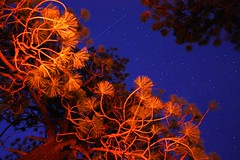
Orange Fire, Blue Twilight Along Sisquoc River

“You know to be silent in the wilderness. It is that which matters, to learn to live with silence.”

Louis L’Amour, The Californios (1974)

Lying in the dirt beside the campfire, a long hard day’s hike from the nearest road, a steaming cup of coffee in hand, watching the warm glow of sunset fade to the cool colors of night and reflecting on the day’s happenings. The falling temperature drawing a floral and earthen mélange of fragrance from the surrounding wilderness, chaparral at dusk, herbal and sweet smelt briefly between swirling plumes of wood smoke biting at the nostrils. The staccato pop and crackle of the building blaze exploding sporadically like miniature gunfire from the sandstone encircled pit, embers shoot winding into the endarkened void overhead, the aqueous din of the nearby Wild and Scenic Sisquoc River constant. It is the smallest elements, frequently overlooked, often ignored and mostly taken for granted as ordinary and boring, when attention is focused on the minutes of the moment, which can weigh heavy on the balance of life. If allowed.

Posted in Santa Barbara County | Tagged , , , , , , , , , , | 3 Comments

Oil and Animals in the Santa Barbara Channel

oil seep Carpinteria, California

Crude oil actively bubbling out of the ground at the beach in Carpinteria, California in Santa Barbara County. Three offshore oil derricks are visible as dots in the distance.

“The surface of the sea, which was perfectly smooth and tranquil, was covered with a thick, slimy substance . . . the light breeze, which came principally from the shore, brought with it a strong smell of tar, or some such resinous substance. The next morning the sea had the appearance of dissolved tar floating on its surface, which covered the sea in all directions within the limits of our view.”

George Vancouver, Captain Cook’s navigator, describing naturally occurring oil seeps in the Santa Barbara Channel (1792)

“Literature reviews of marine hydrocarbon seepage usually conclude that the area along the northern Santa Barbara Channel is one of the most prolific hydrocarbon seepage areas in the world.”

Journal of Geophysical Research, “The world’s most spectacular marine hydrocarbon seeps (Coal Oil Point, Santa Barbara Channel, California)” (1999)

“The waters of the Santa Barbara Channel form one of the most biologically productive ecosystems found on earth.”

Santa Barbara Channelkeeper

“The Santa Barbara Channel contains some of the most biologically diverse waters on the planet. Within these waters is the Channel Islands National Marine Sanctuary, which is host to the densest seasonal population of blue whales in the world.”

—United States Coast Guard

oil tar carpinteria beach

The Pacific waters of the Santa Barbara Channel hold several remarkable distinctions among all the world’s oceans. They are home to an abundance and variety of marine life rivaled by few other stretches of ocean on the planet, while also containing some of the largest natural oil and gas seeps in the world.

Fractured seafloor off Coal Oil Point in Santa Barbara County oozes about 4200 gallons of oil into the ocean every day or what amounts to the spill equivalent of one Exxon Valdez every five to seven years. The surface of the sea resembles a roiling boil of fizzing bubbles above some of the submarine vents and the iridescent sheen of crude oil covers vast swaths of the sea’s surface at times.

Scientists at University of California, Santa Barbara estimate that the natural seeps emit twice the amount of air pollution as “all the on-road vehicle traffic in the the county.” Due to this natural phenomenon, Santa Barbara County has thus far found it impossible to meet Environmental Protection Agency clean air standards. Over half of the tar that washes up on Los Angeles County beaches some eighty miles to the south originates from Santa Barbara County seeps. Studies suggest that at least 80 million to 800 million gallons of oil has been spread across the seafloor and buried in the sediment surrounding the seeps and outlying areas.

The seepage historically, however, has been far greater. In 2010, UCSB scientists announced the discovery of extinct 40,000 year old asphalt volcanoes 10 miles off the Santa Barbara coast. “They’re larger than a football-field-long and as tall as a six-story building,” geoscientist David Valentine said. “They’re massive features, and are made completely out of asphalt,” he said.

oil seep carpinteria beachGas bubbling through natural seep oil on the beach in Santa Barbara County.

Oil is a biological product and is therefore biodegradable. Millions of years ago, the Channel was shrouded in a verdant tangle of plant life rather than immersed beneath a briny expanse of water. While earthly forces slowly turned once living plant matter into oil certain microorganisms evolved to make use of it. These single-celled organisms grew into voracious oil eaters. Today they thrive on the seepage greatly reducing the amount of it in local waters.

In 2008, Valentine and fellow researchers discovered that these microbes devour far more of the compounds in oil than previously known. “They ate around 1,000 of the 1,500 compounds we could trace, and presumably are eating many more,” he said. Much of what is left of the oil afterward eventually falls to the seafloor. A subsequent study analyzing seafloor sediment provided a glimpse at just how significant an impact the microbes have. “It’s dramatic how much the oil loses in this life cycle,” Christopher Reddy said, a marine chemist and colleague of Valentine. “It’s almost like someone who has lost 400 pounds,” he said.

Another study published in the Journal of Geophysical Research notes that not only is there active life around the seep sites, but there are actually more organisms than areas where no seepage occurs:

“There is a well-developed community of bottom-dwelling marine organisms in the sediments associated with the seeps at Coal Oil Point. Comparison of the benthic fauna at an 0il seep with the fauna in an area free of seepage showed that there are higher densities of individual organisms near the seep.”

humpback whale breachHumpback whales pass through the Santa Barbara Channel between May and August. (c) NOAA

giant kelp forest Channel IslandsForest of giant kelp in the Channel Islands National Marine Sanctuary. (c)Claire Fackler, NOAA

Meanwhile, as voluminous amounts of oil drain into the ocean marine life thrives. A combination of natural features and phenomena like ocean currents, wind patterns and submarine canyons create a region of exceptional habitat. A wealth of marine life flourishes from plankton to blue whales, which return to the Santa Barbara Channel seasonally in greater numbers than anywhere else on earth.

No less than 27 species of whales, dolphins or porpoises have been spotted and a handful of different types of seals and sea lions breed on the Channel Islands and mainland shore. The islands are home to over 150 endemic species and have been called the “North American Galapagos.” Thereon eleven species of seabirds occupy important nesting sites including bald eagles. A cornucopia of other smaller wildlife inhabits the region, too, many of which despite their relatively puny size are no less spectacular.

“If in any country a forest was destroyed I do not believe nearly so many species of animals would perish as would here from the destruction of the kelp.” –Charles Darwin 1834

Darwin, writing of the Galapagos, captures in one sentence the essential role kelp plays in the marine environment. An extraordinary sight in and of themselves, kelp forests provide critical habitat and food for well over 800 creatures in the Pacific waters of California from tiny organisms to large game fish and mammals. Kelp forests hold one of the greatest concentrations of biodiversity in all the world’s oceans and support one quarter of native marine life in local waters.

These forests of giant brown algae grow around the islands, along the mainland coast and, despite the abundance of oil, near Coal Oil Point. “In the shallow seep areas,” a UCSB study notes, “the bottom consists mostly of shale outcrops with rubble and sand and supports extensive beds of kelp.” Giant kelp is one of the fastest growing organisms in the world and can grow three feet in a single day. One of the more noted animals found among the kelp are southern sea otters.

Historically Coal Oil Point, one of the oiliest areas of sea in existence, was prime otter territory prior to their removal and relocation under the “no-otter zone” implemented in 1987 (a government policy officially abandoned in 2012). In 2008, a raft of about 30 otters appeared at the point in a seasonal push to expand their range, says Michael Harris, an environmental scientist with the California Department of Fish and Wildlife. They did not, however, return in following years, although one continued to be observed.

“If otters are allowed to,” Harris says, “they will eventually reoccupy and live in that area where there is natural seep.” Otters rely entirely on their thick fur for insulation because they have no blubber and a small tar blob caught in it can be lethal. Yet, Harris deals with just a handful of southern sea otters washing ashore annually which may be the result of natural seep oil. Presumably there would be more oiled otters if they returned to Coal Oil Point, yet return they will, Harris says.

The same environment that sustains such wondrous amounts of marine life also works wonders to reduce and dissipate massive amounts of crude oil therein. Various functions work to degrade and break it down thus lessening its impact on wildlife. Some of the oil evaporates when it surfaces or photo-degrades in sunlight, while the expansive Pacific itself disperses what remains and microscopic organisms feed upon it. Despite the abundant natural hydrocarbon seeps, the Santa Barbara Channel supports prolific marine ecosystems of immeasurable value that are home to iconic wildlife like few other places on earth. The region is a national natural treasure. Sometimes, oil and animals do mix.

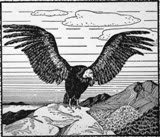
bald eagle

southern sea otterSouthern sea otter and nursing pup.

garibaldi sea urchinsThe California state fish, garibaldi, surrounded by sea urchins in the Channel Islands National Marine Sanctuary. (c)Claire Fackler, NOAA

spiny lobsterA spiny lobster and sea urchins in the Channel Islands National Marine Sanctuary. (c)Claire Fackler, NOAA

Santa Barbara Channel Map

Reference:

University of California, Santa Barbara Hydrocarbon Seep Project Website

Journal of Geophysical Research, “The world’s most spectacular marine hydrocarbon seeps (Coal Oil Point, Santa Barbara Channel, California)” (1999) (PDF)

University of California, Santa Barbara Geology Department Website

National Park Service, Channel Islands Website

Exclusive interview of Mike Harris, Environmental Scientist, California Department of Fish and Wildlife

Related Posts:

Oil Seeps at Carpinteria, California

Sulfur Mountain Oil Seeps, Ventura County

Great White Shark at Rincon

Spearfishing, 48 Pound White Seabass

Freediving For Spiny Lobster

19 Inch Halibut

27 Inch Halibut

Posted in Santa Barbara County | Tagged , , , , , , , , , , | 12 Comments

Earth Day

“Earth and sky, woods and fields, lakes and rivers, the mountain and the sea, are excellent schoolmasters, and teach some of us more than we can ever learn from books.”

―John Lubbock

Senator Gaylord Nelson (D-WI) is widely credited as the father of Earth Day. As the story goes, after visiting Santa Barbara and viewing firsthand the catastrophic consequences of the oil spill of 1969 in the Santa Barbara Channel, he was inspired to found a special day of environmental education and awareness. This would later become known as “Earth Day.”

Today, Earth Day 2013, we have all sorts of people around the nation and the world celebrating by holding huge gatherings that in their planning, carrying out and attendance require the consumption of massive amounts of resources and result in the emission of immeasurable amounts of pollution.

And in so doing the activities of Earth Day promote the type of disconnect from the natural world and heedless consumption that is the very sort of thing the concept of the environmental day of education was designed to lessen. If one really wants to celebrate and learn of Earth, then why not go for a long hike into the wilderness alone? Leave the metropolitan bubble of artificial reality behind. Part company with its hurried masses and material culture. Escape the urban cage and enter the natural realm.

I have found that there are few better ways to reconnect with the natural world than time alone spent immersed in it, with but the bare basic necessities to sustain you. It is a healthy activity for mind and body that requires few material items and leaves a relatively miniscule environmental footprint. It affords time for reflection and the pondering of nature and one’s place within it to an extent that is impossible to achieve within the man-made bounds of a city. It simplifies life and in that simplification reveals its essence in a way that reaffirms one’s bond to the mother of all mothers. Take a hike!

Posted in Santa Barbara County | Tagged , , , , , , , , | 2 Comments